Alberta field guide
Alberta trees, natural region by natural region
Alberta has six natural regions, and each has its own short list of trees. Start with where you are, then check the needles, leaves and cones.
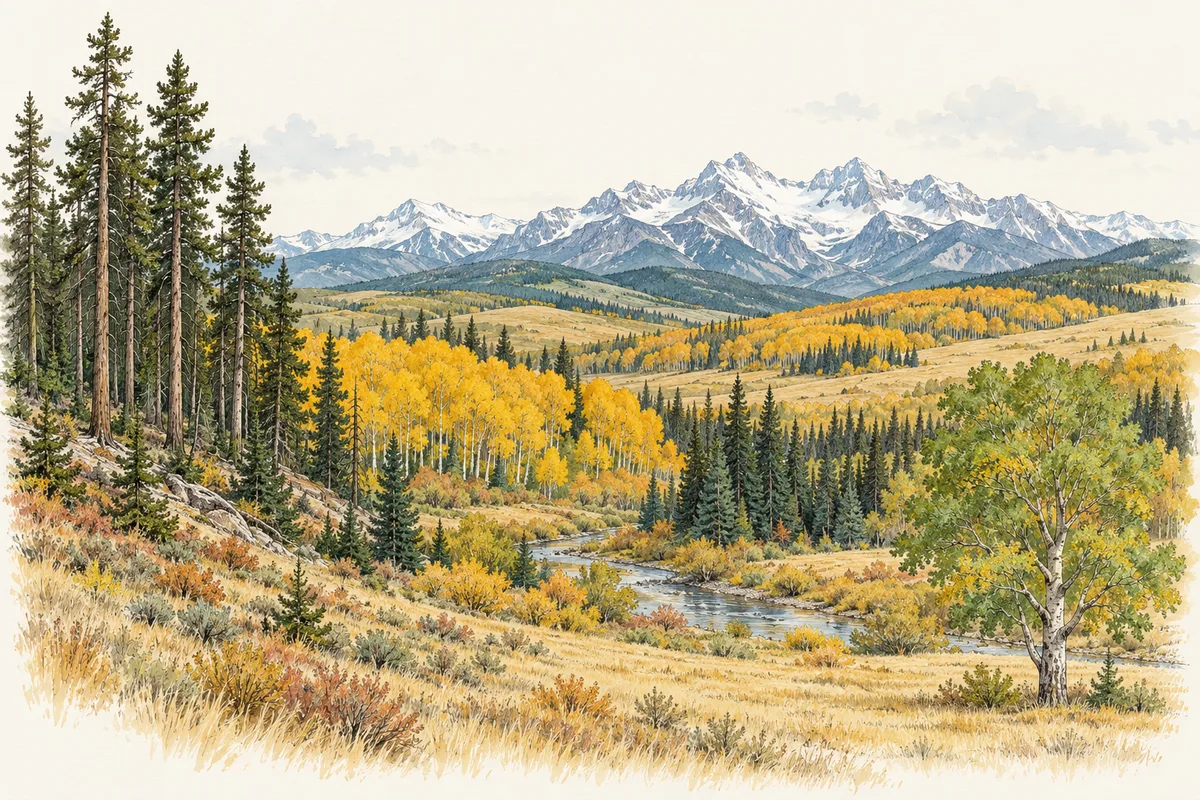
In short
Alberta trees follow the province's six natural regions. Trembling aspen, balsam poplar, white and black spruce and jack pine dominate the Boreal Forest; lodgepole pine, Alberta's official tree, rules the Foothills; Engelmann spruce, subalpine fir, Douglas-fir and limber pine grow in the Rockies; aspen groves mark the Parkland; and cottonwoods line Grassland rivers. Tamarack fills the boreal bogs.
- The Boreal Forest Natural Region covers 58% of Alberta; aspen and balsam poplar are its commonest broadleaf trees, white spruce, black spruce and jack pine its main conifers.
- Lodgepole pine has been Alberta's official tree since 1984: two twisted needles per bundle, 3 to 7 cm long.
- Whitebark pine and limber pine, both with needles in fives, are Alberta's two endangered tree species.
Alberta runs from prairie in the southeast to boreal forest in the north and the Rocky Mountains in the west, and its trees change with the land. The Government of Alberta divides the province into six natural regions, and this guide follows them, with the trees most worth learning in each and one clue for each tree. Measurements are from Natural Resources Canada's (NRCan) tree factsheets unless another source is named.
Alberta's six natural regions and their trees
Alberta Parks' booklet Natural Regions and Subregions of Alberta (2015), based on the Natural Regions Committee's 2006 classification, recognizes six natural regions divided into 21 subregions. Shares of the province are from the booklet.
| Natural region | Share of Alberta | Trees the booklet names |
|---|---|---|
| Boreal Forest | 58% | Aspen and balsam poplar; white spruce, black spruce and jack pine; black spruce and larch in treed fens and bogs |
| Grassland | 14.4% | Plains and narrow-leaf cottonwood, balsam poplar and aspen along rivers |
| Foothills | 10% | Aspen, lodgepole pine, white spruce, balsam poplar; lodgepole pine at higher elevations |
| Parkland | 9% | Aspen groves and closed aspen–balsam poplar stands among grassland |
| Rocky Mountain | 7.4% | Lodgepole pine, aspen, white spruce, Douglas-fir, limber pine (Montane); Engelmann spruce, subalpine fir, whitebark pine, subalpine larch (Subalpine) |
| Canadian Shield | 1.5% | Open jack pine, aspen and birch stands |
The booklet calls the Boreal Forest Alberta's largest natural region and the Canadian Shield its smallest. Decide first whether your tree has needles or broad leaves. If it has needles, check whether they come in bundles (pine), in soft tufts (larch) or one at a time (spruce, fir, Douglas-fir).
Boreal Forest and Canadian Shield
The Boreal Forest covers 58% of Alberta, and the booklet names aspen and balsam poplar as its most common deciduous trees and white spruce, black spruce and jack pine as its main conifers.
- Trembling aspen (Populus tremuloides): nearly round leaves 3 to 7 cm on a flattened stalk usually longer than the blade, and smooth, pale green to nearly white bark. It grows throughout Canada's forested areas. The poplar guide compares it with its relatives.
- Balsam poplar (Populus balsamifera): leaves 7 to 12 cm with a long, drawn-out tip, silvery green beneath and often stained with brownish resin, and very resinous, fragrant buds up to 25 mm. A tree of river valleys and moist, low ground.
- White spruce (Picea glauca): stiff needles 15 to 22 mm on hairless twigs, and slender cones 3 to 6 cm with smooth, rounded scale edges.
- Black spruce (Picea mariana): shorter needles, 8 to 15 mm, on hairy twigs, and small, nearly round cones; the booklet places it in treed fens and bogs with larch.
- Jack pine (Pinus banksiana): two stiff needles 2 to 4 cm, spread apart, and curved cones that usually stay closed for 10 to 20 years until fire opens them. NRCan calls it the most widely distributed pine in Canada.
- Tamarack (Larix laricina): soft needles in tufts of 15 to 60 that turn yellow and drop each autumn, on cold, wet sites such as sphagnum bogs and muskeg. See the tamarack profile.
- White birch (Betula papyrifera): creamy white bark peeling in sheets.
In the Canadian Shield corner of northeastern Alberta, granite and hundreds of small lakes leave room only for open jack pine, aspen and birch stands where the soil is deep enough.
Foothills and Rocky Mountains
The Foothills carry mixed forests of aspen, lodgepole pine, white spruce and balsam poplar at lower elevations, and lodgepole pine forests higher up.
- Lodgepole pine (Pinus contorta), Alberta's tree: two stiff, usually twisted needles 3 to 7 cm per bundle, and cones 3 to 6 cm with a curved prickle on each scale, often held closed by resin for 10 to 20 years. Canadian Heritage's Alberta page gives 1984 as the year it was adopted. Our pine guide covers bundle counts.
The Rocky Mountain region has three subregions. In the Montane, the lowest and warmest, lodgepole pine, aspen and white spruce mix, and the booklet adds Douglas-fir from the Athabasca valley south and open limber pine stands on ridgetops.
- Douglas-fir (Pseudotsuga menziesii): flat needles that smell strongly when crushed, and hanging cones under 8 cm whose three-pronged bracts stick out beyond the scales (NRCan's Rocky Mountain Douglas-fir factsheet).
- Limber pine (Pinus flexilis): needles in bundles of five, 3 to 7 cm, and cones 7 to 15 cm that open and drop their seed, according to the COSEWIC report (2014). NRCan says its young branches are so tough and flexible they gave the tree its name.
In the Subalpine, open stands of Engelmann spruce and subalpine fir dominate the higher slopes, with dense lodgepole pine lower down:
- Engelmann spruce (Picea engelmannii): bluish-green needles 15 to 25 mm, aromatic when crushed, and cones 3 to 7 cm with thin, flexible, loose scales that are often split at the tip. It often forms part of the alpine tree line.
- Subalpine fir (Abies lasiocarpa): needles 25 to 40 mm curving upward, upright barrel-shaped cones 4 to 10 cm that break up on the branch, and a narrow, spire-topped crown.
- Whitebark pine (Pinus albicaulis): five stout needles 4 to 9 cm clustered toward the twig ends, and cones 5 to 8 cm that barely open; at the tree line it may grow as a sprawling shrub. COSEWIC separates it from limber pine by its shorter, purple cones.
The Alpine subregion above the tree line has no forest; the booklet notes stunted subalpine fir and Engelmann spruce at its edge, and subalpine larch along the tree line in the south. The Government of Alberta names whitebark and limber pine as the province's two endangered tree species, threatened by white pine blister rust, mountain pine beetle, fire suppression and climate change.
Parkland and Grassland
The Parkland is Alberta's most densely populated natural region, a mosaic of aspen groves and grassland between the prairie and the boreal forest. In the south, islands of aspen grow in moist hollows and on north-facing slopes; to the north, closed aspen and balsam poplar stands are common. Learn aspen and balsam poplar first, then the planted trees around farms and towns.
- Manitoba maple (Acer negundo), also called box-elder: the maple with compound leaves of 3 to 9 leaflets, opposite on the twig, and keys in drooping clusters. NRCan lists lakeshores, stream banks and seasonally flooded sites as its habitat. The boxelder page has the details.
The Grassland, 14.4% of Alberta, is the warmest and driest region and is mostly treeless. Trees follow the rivers: the booklet describes plains cottonwood forests, narrow-leaf cottonwood stands, and balsam poplar and aspen along rivers and streams.
The trees you meet in Alberta towns
City trees differ from forest trees. The City of Edmonton publishes its tree inventory as open data: the Trees dataset, updated 19 October 2026 and read on 21 October, lists 482,603 city-maintained trees in parks, boulevards and buffers. Counted by species:
| Rank | Edmonton city tree | Trees | Share |
|---|---|---|---|
| 1 | American elm | 94,375 | 19.6% |
| 2 | Green ash | 92,298 | 19.1% |
| 3 | Colorado spruce | 42,718 | 8.9% |
| 4 | White spruce | 25,525 | 5.3% |
| 5 | Bur oak | 17,971 | 3.7% |
| 6 | Crabapple | 16,283 | 3.4% |
Native forest trees appear lower down: trembling aspen (12,268) and lodgepole pine (11,628), next to Scots pine (11,965), a planted European pine. Manitoba maple counts 5,638 trees. For the national ranking of forest trees, see the most common trees in Canada; the Canada hub lists every provincial tree.
Using a photo app on Alberta trees
Tree Identifier names a tree from one photo of a needle bundle, a cone, a leaf or the bark, with a follow-up chat for questions such as "lodgepole or jack pine?". It shows no confidence score and no list of look-alikes, so check the answer against the clues above, especially for the two five-needle pines and the two-needle pines, which differ mostly in their cones. In the mountains you will need a data connection for an answer, since the app sends the photo to a cloud AI model. Its Tree Map keeps each located find, useful for returning to a stand of tamarack or alpine larch when it turns gold.
What a photo can't settle
- Natural regions blend into one another, and Alberta's towns and shelterbelts are full of planted trees from elsewhere, so location narrows the list but never settles a name.
- Planted city and shelterbelt trees such as Colorado spruce and Scots pine are not native, so a spruce or pine in town may match nothing in the regional lists here.
- Whitebark and limber pine are hard to tell apart without cones, and stunted trees near the tree line rarely match the textbook sizes.
Questions people ask
What is Alberta's provincial tree?
The lodgepole pine (Pinus contorta), adopted in 1984. Canadian Heritage notes it was used for the railway ties linking Alberta to eastern Canada. Look for two stiff, usually twisted needles per bundle, 3 to 7 cm long, and cones that can stay closed on the tree for 10 to 20 years.
What trees are native to Alberta?
The main native trees are trembling aspen, balsam poplar, white spruce, black spruce, jack pine, lodgepole pine, tamarack, white birch, subalpine fir, Engelmann spruce, Douglas-fir, limber pine, whitebark pine and subalpine larch, with cottonwoods along prairie rivers. Which ones you meet depends on the natural region.
What evergreen trees grow in Alberta?
Spruces (white, black and Engelmann), pines (lodgepole, jack, limber and whitebark), subalpine fir and Douglas-fir. Tamarack and subalpine larch look evergreen in summer but are larches: their needles turn yellow and drop in autumn.
Are any Alberta trees endangered?
Yes. The Government of Alberta names whitebark pine and limber pine as the province's two endangered tree species. It lists white pine blister rust, mountain pine beetle, fire suppression and climate change as threats, and notes the trees only start bearing cones at about 40 (limber) and 50 (whitebark) years.
What are the most common trees in Edmonton?
In the City of Edmonton's open tree inventory, read on 21 October 2026, American elm (94,375 trees) and green ash (92,298) lead, each about a fifth of the 482,603 city trees, followed by Colorado spruce, white spruce and bur oak.
Sources
- Natural Regions and Subregions of Alberta: A Framework for Alberta's Parks (2015) — Alberta Parks, Government of Alberta
- Alberta: provincial symbols — Canadian Heritage, Government of Canada
- Trees, insects and diseases of Canada's forests: tree factsheets — Natural Resources Canada, Canadian Forest Service
- COSEWIC Assessment and Status Report on the Limber Pine Pinus flexilis in Canada (2014) — Government of Canada, Species at Risk Public Registry
- Whitebark and limber pine recovery — Government of Alberta (alberta.ca)
- Trees — City of Edmonton Open Data
Keep reading
- Canada field guideTree identification in Canada, region by region
- Canada by the numbersThe most common trees in Canada, ranked by forest area
- Tree profileTamarack (Larix laricina): how to identify it
- Tree profilePoplars, cottonwoods and aspens (Populus): how to identify them
- Tree profileBoxelder (Acer negundo): how to identify it