Canada by the numbers
The most common trees in Canada, ranked by forest area
Spruce covers half of Canada's forest land. Here are the ten tree groups that cover the rest, the twenty species behind them, and what grows on city streets instead.
In short
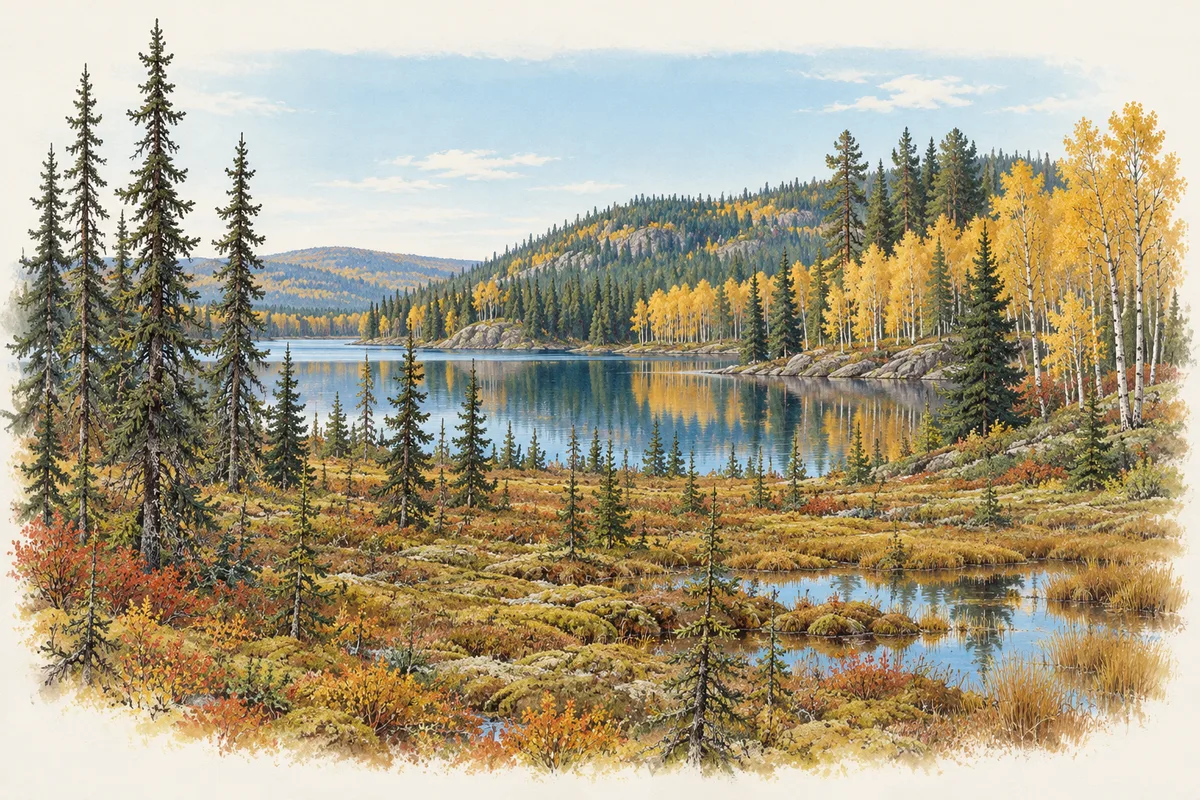
The most common trees in Canada are spruces: in the National Forest Inventory (remeasured 2007–2017, version 3.1, October 2025), forest land classed as spruce covers 51.4% of the total and hold 43.9% of tree volume. Pine (11.2% of area), poplar (10.7%) and fir (6.6%) follow, then birch, larch, maple, hemlock, Douglas-fir and cedar. Black and white spruce, jack pine and trembling aspen are the species behind most of it.
- Ranked by forest area, the top four groups are spruce, pine, poplar and fir; ranked by volume, poplar moves ahead of pine.
- Seven of the ten groups are conifers, and the State of Canada's Forests 2025 classes 70.2% of forest land as coniferous.
- City streets are a different list: in Toronto's street-tree inventory, Norway maple and honey locust lead.
Which trees are most common in Canada depends on what you count: forest area, wood volume or the trees on your street. This page uses Canada's National Forest Inventory (NFI), the national statistics compiled by Natural Resources Canada (NRCan) with the provinces and territories, and states the measure for every number. The ID clues come from NRCan's tree factsheets.
The top 10 most common trees in Canada
The ranking below is by area of forest land, from the NFI's Table 14.0, which combines plots remeasured from 2007 to 2017 with projections (version 3.1, October 2025). The inventoried forest land totals 369,019 thousand hectares, about 369 million ha. The volume column is from Table 16.0 in the same release, which totals 51,074 million m³. Shares are our arithmetic from those totals.
| Rank | Species group | Share of forest area | Share of tree volume | How to recognize it | Our page |
|---|---|---|---|---|---|
| 1 | Spruce | 51.4% | 43.9% | Single, four-sided, sharp needles on small woody pegs | Spruce vs fir |
| 2 | Pine | 11.2% | 11.8% | Needles in bundles of 2 or 5 | Pine |
| 3 | Poplar | 10.7% | 13.6% | Leaves on long, often flattened stalks that flutter | Poplar |
| 4 | Fir | 6.6% | 8.4% | Flat needles and upright cones that fall apart on the tree | Spruce vs fir |
| 5 | Birch | 3.7% | 3.3% | Bark that peels in papery sheets or curls | Birch |
| 6 | Larch | 2.6% | 1.5% | Soft needle tufts that turn yellow and drop in autumn | Tamarack |
| 7 | Maple | 2.6% | 3.0% | Opposite, lobed leaves | Maple |
| 8 | Hemlock | 1.7% | 6.2% | Short flat needles in two rows, white-lined below; cones under 2 cm | — |
| 9 | Douglas-fir | 1.6% | 3.8% | Cones with three-pronged bracts | — |
| 10 | Cedar and other conifers | 1.1% | 3.1% | Flat sprays of scale leaves | Cedar |
The two measures disagree in useful ways. Poplar has a larger share of volume than of area because aspen stands grow fast and dense. Hemlock and Douglas-fir hold far more volume than area because much of it sits in very old, very large trees: 73% of hemlock volume is in stands over 200 years old, by the same table. Larch does the opposite, covering more ground than its wood volume suggests, since tamarack often grows small on wet, poor sites.
The NFI does not inventory the Arctic ecozones, or the Taiga Plains and Hudson Plains ecozones in Nunavut. The area table classes hectares of forest land by species group; it is not a count of individual trees. A further 4,415 thousand ha is listed as unspecified conifers and 16,862 thousand ha as unclassified.
The species behind each group, with one clue each
Each NFI group covers several species. These are the two that matter most in each, so the top 10 groups become a list of 20 trees. Ranges and measurements are from NRCan's factsheets.
- Black spruce (Picea mariana): short, dull greyish-green needles 8 to 15 mm on hairy twigs; NRCan maps it as transcontinental. White spruce (P. glauca): needles 15 to 22 mm on hairless twigs, throughout Canada except the Pacific coast.
- Jack pine (Pinus banksiana): two stiff needles 2 to 4 cm, spread apart, and curved cones that stay closed for 10 to 20 years; NRCan calls it the most widely distributed pine in Canada. Lodgepole pine (P. contorta): two twisted needles 3 to 7 cm and cones with a curved prickle on each scale.
- Trembling aspen (Populus tremuloides): nearly round leaves 3 to 7 cm on a flattened stalk, found throughout the forested areas of Canada. Balsam poplar (P. balsamifera): leaves 7 to 12 cm with a long tip and resin-stained, silvery undersides; very sticky, fragrant buds.
- Balsam fir (Abies balsamea): flat needles 15 to 25 mm with resin blisters on young bark. Subalpine fir (A. lasiocarpa): needles 25 to 40 mm curving upward and a narrow, spire-topped crown.
- White birch (Betula papyrifera): creamy white bark peeling in sheets, across Canada. Yellow birch (B. alleghaniensis): yellowish to bronze bark in thin curling shreds.
- Tamarack (Larix laricina): tufts of 15 to 60 soft needles on spur shoots, across Canada. Western larch (L. occidentalis): 15 to 30 needles per tuft and cones 3 to 5 cm with bracts poking out; southeastern BC into Alberta.
- Sugar maple (Acer saccharum): five-lobed leaves with rounded notches. Red maple (A. rubrum): three main lobes with V-shaped notches and fine teeth. The red maple vs sugar maple page sets them side by side.
- Eastern hemlock (Tsuga canadensis): flat needles 10 to 20 mm in two ranks, white-lined below, and cones 12 to 20 mm. Western hemlock (T. heterophylla) is its coastal BC counterpart.
- Douglas-fir (Pseudotsuga menziesii): flat needles 2 to 3 cm with a slight apple smell when crushed and three-pronged bracts sticking out of the cone. NRCan lists a coastal form and a Rocky Mountain form.
- Western redcedar (Thuja plicata): shiny yellowish-green scale leaves 1 to 2 mm in drooping sprays and shredding reddish-brown bark. Eastern white-cedar (T. occidentalis): stiff, fan-shaped flat sprays and cones 7 to 12 mm.
If a branch is out of reach, a photo of a cone, a needle spray or the bark is enough for Tree Identifier to suggest a name with key traits. It gives one name with no confidence score and no list of look-alikes, so check it against the clue above.
Coniferous, broadleaf, and what the boreal forest is made of
NRCan's State of Canada's Forests: Annual Report 2025 gives 368,672,267 ha of forest land for 2024 and classes it by forest type: 70.2% coniferous, 13.6% mixedwood, 11.4% broadleaf and 4.9% temporarily non-treed, mostly after fire or harvest. The same report notes that in the boreal forest, the largest forest region in Canada, spruce and poplar make up 79% of total tree volume.
That is why a walk almost anywhere from Newfoundland to the Yukon turns up the same few trees: a spruce, a fir or pine on dry ground, trembling aspen and white birch where fire or harvest opened the canopy, and tamarack in the wet spots. The broadleaf groups that dominate southern Ontario and Quebec, maple and the hardwoods, cover only a few percent of Canada's forest land overall.
The trees you meet in towns and gardens
Forest statistics leave out the trees most Canadians see every day. City inventories cover those. The City of Toronto publishes every city-owned street tree in its Street Tree Data on its open data portal, refreshed on 4 June 2026. We counted its 688,335 records by species, cultivars included:
| Rank | Toronto street tree | Records | Share |
|---|---|---|---|
| 1 | Norway maple (Acer platanoides) | 99,736 | 14.5% |
| 2 | Honey locust (Gleditsia triacanthos) | 59,904 | 8.7% |
| 3 | Little-leaf linden (Tilia cordata) | 27,342 | 4.0% |
| 4 | Colorado blue spruce (Picea pungens) | 24,086 | 3.5% |
| 5 | Red oak (Quercus rubra) | 23,707 | 3.4% |
| 6 | Kentucky coffeetree (Gymnocladus dioicus) | 21,482 | 3.1% |
| 7 | Silver maple (Acer saccharinum) | 20,833 | 3.0% |
Three of the top four are not native to Canada. Norway maple, from Europe, looks like a sugar maple; snap a leaf stalk and it bleeds milky white sap, a test Virginia Tech Dendrology gives. Honey locust has compound leaves of small leaflets with rounded tips, some leaves divided twice; NRCan notes that the cultivars used in landscaping are thornless, while wild trees carry sharp, branched thorns on the trunk. Little-leaf linden is a European linden; the linden page covers the genus.
Other cities differ. The City of Edmonton's open Trees inventory of 482,603 city trees, read on 21 October 2026, is led by elm (98,301) and ash (96,274) rather than maple, and the Canada hub lists the native trees to learn region by region, with every provincial tree.
How to use this list in the field
South of the border the ranking changes: red maple and loblolly pine lead the most common trees in the US.
Start from the odds. In most of Canada, a conifer is likely a spruce, a pine or a fir, and a broadleaf tree in the forest is likely an aspen, a balsam poplar or a white birch. Then check the one feature that separates the candidates:
- Needles single or bundled? Bundles of two or five mean pine. Single needles mean spruce, fir, hemlock or Douglas-fir: roll one between your fingers, since a four-sided spruce needle turns and a flat fir needle does not.
- Needles in soft tufts that fall in autumn? Larch, usually tamarack.
- Opposite leaves? In a Canadian forest that usually means maple.
- Leaf stalk flattened sideways? Trembling aspen.
On a city street, reverse the order of suspicion: a planted maple, linden or locust is more likely than any forest tree. Tree Identifier's Tree Map keeps each located find, which helps when you want to check a tree again in another season.
What a photo can't settle
- The National Forest Inventory ranks species groups, not single species, and classes hectares of forest land rather than counting trunks, so a share of area is not a share of individual trees.
- The Arctic ecozones and the Taiga Plains and Hudson Plains ecozones in Nunavut are not inventoried, so the shares here describe the inventoried forest, not every tree in Canada.
- Street and park trees in towns are outside the forest inventory, and a photo app can name a planted cultivar only to species, not to cultivar.
Questions people ask
What is the most common tree in Canada?
Spruce, as a group. The National Forest Inventory classes 51.4% of Canada's forest land as spruce and puts 43.9% of all tree volume in spruce. Black spruce and white spruce, both mapped by NRCan across almost all of Canada, are the two species that make up most of it.
What are the top 10 most common trees in Canada?
By forest area in the National Forest Inventory: spruce, pine, poplar, fir, birch, larch, maple, hemlock, Douglas-fir, and cedar with other conifers. The inventory ranks species groups, so each entry stands for several species, such as black and white spruce or trembling aspen and balsam poplar.
Is Canada's forest mostly coniferous?
Yes. The State of Canada's Forests 2025 classes 70.2% of forest land as coniferous, 13.6% as mixedwood and 11.4% as broadleaf, with 4.9% temporarily without trees after fire or harvest. Seven of the ten most common tree groups are conifers.
What is the most common tree in Canadian cities?
It depends on the city, and forest statistics don't cover it. In Toronto's open street-tree inventory, refreshed in June 2026, Norway maple is the most common street tree at about 14.5% of 688,335 records, followed by honey locust at about 8.7%.
How many trees are there in Canada's forests by volume?
The National Forest Inventory table for 2007–2017 (version 3.1, October 2025) totals 51,074 million cubic metres of tree volume in the inventoried area. Spruce holds 22,430 million, poplar 6,938 million and pine 6,051 million.
Sources
- Table 14.0. Area (1000 ha) of forest land by species group and age class in Canada (remeasured 2007–2017, version 3.1, October 2025) — Canada's National Forest Inventory, Natural Resources Canada
- Table 16.0. Total tree volume (million m3) by species group and age class in Canada (remeasured 2007–2017, version 3.1, October 2025) — Canada's National Forest Inventory, Natural Resources Canada
- The State of Canada's Forests: Annual Report 2025 — Natural Resources Canada
- Trees, insects and diseases of Canada's forests: tree factsheets — Natural Resources Canada, Canadian Forest Service
- Street Tree Data (refreshed 4 June 2026) — City of Toronto Open Data
- Trees — City of Edmonton Open Data
- Norway maple fact sheet — Virginia Tech Dendrology
Keep reading
- Canada field guideTree identification in Canada, region by region
- Tree comparisonSpruce vs fir: how to tell them apart
- Tree profilePoplars, cottonwoods and aspens (Populus): how to identify them
- Tree profileTamarack (Larix laricina): how to identify it
- Tree profileBirches (Betula): how to identify a birch tree