Tree profile
Linden tree (Tilia): basswood, lime and littleleaf linden
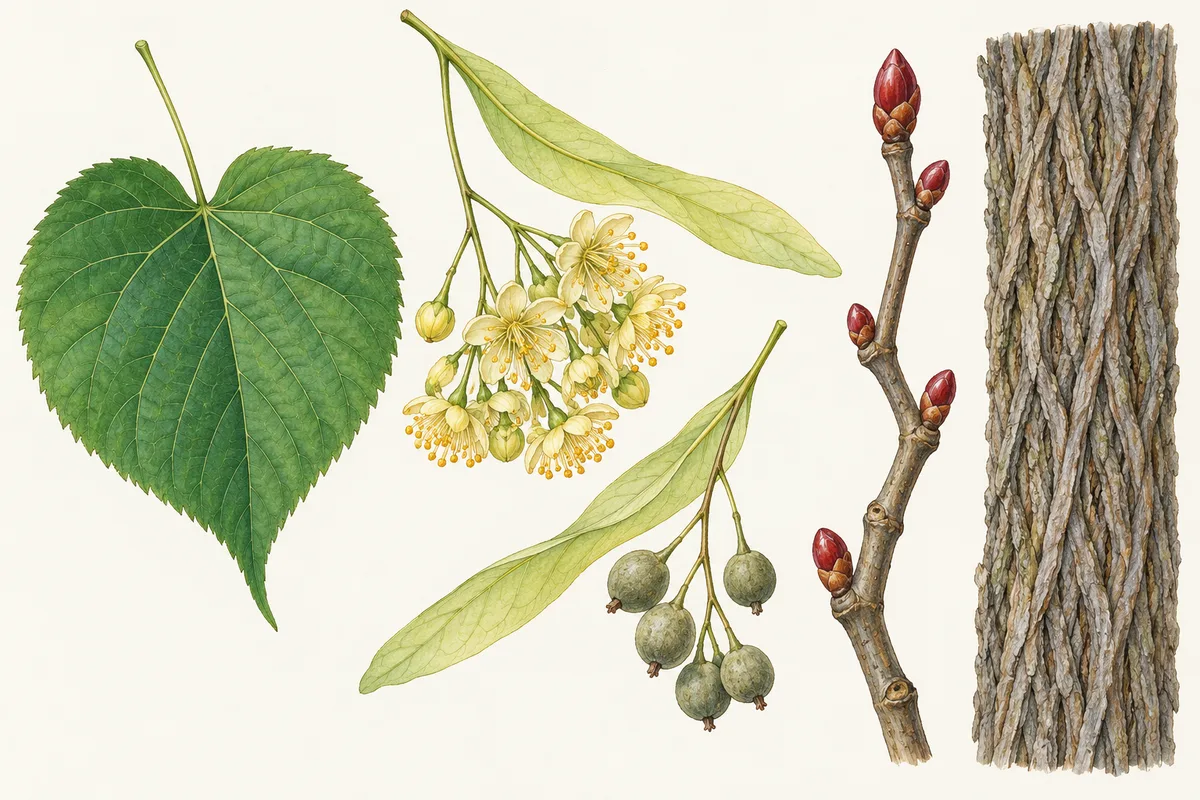
One genus, three names. A strap-shaped leafy bract carrying the flowers and nutlets, and a heart-shaped leaf with a lopsided base, mark every linden; the hairs under the leaf tell you which one.
In short
A lime tree in Britain is a linden, genus Tilia, not a citrus; in North America the native linden is called basswood. To identify a linden tree, look for alternate, toothed, heart-shaped leaves with a lopsided base, then for a long, strap-like leafy bract with the flowers or pea-sized nutlets hanging from its middle. Turn a leaf over: rusty tufts in the vein angles point to littleleaf linden, a silvery-white underside to silver linden.
- The leafy bract is the giveaway: no other common tree hangs its flowers and fruit from a strap-shaped leaf.
- Basswood, linden and lime are the same genus: basswood for the North American species, linden or lime for the European and Asian ones.
- Check the hairs under the leaf: rusty tufts (littleleaf), creamy-white tufts (common lime), hairy all over (large-leaved lime), silvery felt (silver linden).
Field marks at a glance
- Scientific name
- Tilia spp. (T. americana, T. cordata, T. platyphyllos, T. × europaea, T. tomentosa)
- Family
- Malvaceae (mallow family)
- Type
- Broadleaf, deciduous
- Leaves
- Alternate, simple, toothed, heart-shaped with a lopsided base. American basswood 4 to 8 inches long; littleleaf linden 1.5 to 3 inches; large-leaved lime 6 to 12 cm (2.5 to 5 in).
- Bract
- A long, strap-shaped, leaf-like bract on every flower cluster; the stalk of flowers, then nutlets, hangs from its middle, and the bract acts as a wing when the fruit falls.
- Flowers
- Pale yellow to creamy, strongly scented, in hanging clusters in early to mid-summer (June in most of the basswood's range); heavily visited by bees.
- Fruit
- Round nutlets about 1/5 to 1/4 inch, covered in gray-brown hairs, hanging in small clusters under the bract and ripening in fall.
- Under the leaf
- Littleleaf linden: rusty to light brown tufts in the vein angles. Common lime: creamy-buff to white tufts. Large-leaved lime: hairy all over. Silver linden: silvery-white felt. American basswood: mostly hairless.
- Twigs and buds
- Zigzag twigs, green in summer and red in winter, with no true end bud. Buds plump, red and lopsided, with only 2 or 3 visible scales.
- Bark
- Smooth and gray-green when young; later gray to gray-brown with long, shallow furrows and flat-topped ridges. Sprouts and burls often crowd the base.
- Size
- American basswood 75 to 130 ft (23 to 40 m) in forests, 60 to 80 ft in landscapes; littleleaf linden up to about 60 ft; silver linden 50 to 70 ft.
- Names
- North America: basswood, American linden. Britain: lime (small-leaved, large-leaved, common lime). Garden trade: littleleaf linden, silver linden.
Linden, basswood and lime are three names for one genus, Tilia. North Americans call the native species basswood or American linden; the British call their native species limes, which is why a "lime tree" on a London street is a linden and not a citrus. Gardeners and city foresters on both sides of the Atlantic plant the European species as littleleaf, silver and common linden. Two features identify the whole genus; the hairs under the leaf separate the species.
How to recognize any linden: the bract and the leaf
1. The leafy bract. In early summer each flower cluster hangs from the middle of a long, strap-shaped, leaf-like bract. The flowers become round nutlets, and the bract stays attached, acting as a wing when the cluster drops in fall. The Virginia Tech Dendrology American basswood fact sheet describes a round nutlet about 1/4 inch across, covered in gray-brown hair, hanging in a cluster topped by a curving, leafy bract. No other common North American or British tree carries its fruit this way, so a bract on the ground under a tree with heart-shaped leaves is close to proof.
2. The heart-shaped, lopsided leaf. Linden leaves are alternate, toothed and heart-shaped, and one side of the base sits lower than the other where it meets the stalk. Virginia Tech gives 5 to 6 inches for American basswood; the Morton Arboretum gives 4 to 8 inches with coarse teeth.
3. The underside of the leaf. Turn a leaf over and look where the side veins leave the midrib. The hairs there, or their absence, are the best quick key to the species (table below).
In winter, look at the twigs. Basswood twigs are zigzag, green in summer and red in winter, with no true end bud; each side bud is plump and bulges out on one side. The Woodland Trust describes small-leaved lime buds as smooth, shiny and red, with only two or three scales.
Tree Identifier can name a linden from a photo of a leaf, a flower cluster with its bract, or the bark. The app shows no confidence score and no list of look-alikes, so check the bract and the leaf base yourself before you accept the name.
Which linden: the five you are most likely to meet
| Linden | Leaf length | Under the leaf | Other marks | Where |
|---|---|---|---|---|
| American basswood (T. americana) | 4–8 in | Mostly hairless, paler green | Largest leaves; often several trunks from old stump sprouts | Native, eastern North America |
| Littleleaf linden, small-leaved lime (T. cordata) | 1.5–3 in (3–8 cm) | Rusty to light brown tufts in vein angles | Flower clusters spread in several directions | Native to Britain and Europe; street tree in the US and Canada |
| Large-leaved lime (T. platyphyllos) | 2.5–5 in (6–12 cm) | Hairy all over, soft | Hairy leaf stalks; no suckers at the base | Native to Britain and Europe; rarest of the UK natives |
| Common lime (T. × europaea) | 2.5–4 in (6–10 cm) | Creamy-buff to white tufts | Large burrs and shoots crowding the trunk base | Hybrid of the two above; parks and avenues |
| Silver linden (T. tomentosa) | 2–5 in | Silvery-white felt | Leaves flash white in wind; road-salt tolerant | Southeastern Europe and Asia; planted |
Leaf sizes and hairs come from Virginia Tech's littleleaf linden fact sheet, the Morton Arboretum's American basswood and silver linden pages, and the Woodland Trust's profiles of small-leaved lime, large-leaved lime and common lime. Morton adds that white basswood, a southern variety of American basswood, has dense hairs under the leaf that make it look white, so a hairy underside alone does not prove a European species.
American basswood, the native linden
American basswood grows wild from southwestern New Brunswick and New England west through Quebec and Ontario, and south to northeastern Oklahoma, northern Arkansas, Tennessee and western North Carolina, according to the USDA Forest Service's Silvics of North America. It reaches 75 to 130 feet (23 to 40 m) in forests and is shade tolerant, growing best on moist, rich sites.
- Bloom: usually June, lasting about two weeks; the flowers produce abundant nectar, "choice honey" is made from it, and in parts of its range basswood is known as the bee-tree.
- Sprouts: basswood sprouts prolifically from stumps, so old trees often stand in clumps of two or more trunks.
- Bark: smooth and gray-green when young, later gray-brown with long, shallow furrows and flat-topped ridges, and very fibrous. Virginia Tech notes the name comes from "bass cloth" made from that fiber.
- Wood: soft and light, valued for hand carving.
The European limes in Britain and in American streets
Britain has two native lindens. The Woodland Trust describes small-leaved lime as a large tree over 20 m (65 ft), now rare in woods and an indicator of ancient woodland in some English regions, with leaves 3 to 8 cm long and reddish-brown tufts underneath. Large-leaved lime is the rarest of the UK's native limes, found locally in southwest England on lime-rich soils; its soft, furry leaves droop in hot weather. Common lime is their hybrid, rare in the wild but common in parks and towns, and easy to spot by the burrs and leafy shoots crowding the base of the trunk.
In the United States and Canada, littleleaf linden is the European lime you are most likely to see, planted along streets for its dense, rounded crown. Virginia Tech describes it reaching about 60 feet, with numerous burls and sprouts around the base. Silver linden is also planted; the Morton Arboretum lists it as tolerant of road salt and moderate drought, with leaves dark green above and silvery-white beneath.
Aphids, honeydew and bees under lindens
If your car is sticky after parking under a linden, aphids are the reason. The Woodland Trust notes that common limes are "often host to heavy aphid populations which drip sticky honeydew" onto anything below. The honeydew is not wasted: aphids feed hoverflies, ladybirds and birds, and bees drink the honeydew from lime leaves. The Morton Arboretum lists aphids and Japanese beetles among the pests of American basswood and silver linden, while noting that silver linden is less susceptible than other lindens to Japanese beetles.
The flowers draw bees by the thousand in early summer. Morton describes them as favorites of honey bees and other pollinators, and the Forest Service says bees and flies are the main daytime visitors to basswood flowers, moths the main night visitors.
Lindens and their look-alikes
A heart-shaped leaf puts several trees in play. Our guide to trees with heart-shaped leaves compares them side by side; these are the quick tests against a linden:
- Eastern redbud: smooth-edged hearts, no teeth. See the redbud page.
- Catalpa: much larger leaves in pairs or threes, and long pods. See the catalpa page.
- Mulberry: toothed hearts mixed with mitten and three-lobed leaves on one tree. See the mulberry page.
- Elm: lopsided base, but oval, doubly toothed leaves and papery wafer seeds in spring.
If you want to find a particular linden again when it blooms next June, Tree Identifier's Tree Map keeps every identification you save with its location. Littleleaf linden (Tilia cordata) is one of the species in the app's Collection, the 138-species catalog that fills in as you identify. For British limes alongside the other common trees of UK streets and woods, see tree identification in the UK.
Look-alikes and how to tell them apart
Eastern redbud (Cercis canadensis)
Redbud's heart-shaped leaves have smooth, untoothed edges and an even base, and a small swelling sits on the leaf stalk just below the blade. It flowers pink before the leaves and carries flat pods, never a leafy bract.
Catalpa (Catalpa speciosa and C. bignonioides)
Catalpa leaves are larger, 6 to 12 inches, smooth-edged, and sit in pairs or whorls of three at each node, not one at a time. Long, bean-like pods hang in fall and winter.
Mulberry (Morus rubra and M. alba)
Mulberry leaves are toothed and often heart-shaped too, but one tree usually mixes unlobed, mitten-shaped and three-lobed leaves. The fruit is a blackberry-like cluster, not a nutlet under a bract.
Elm (Ulmus americana and relatives)
Elm leaves are lopsided at the base like a linden's, but they are oval rather than heart-shaped and doubly toothed. The fruit is a flat, papery wafer that falls in spring.
What a photo can't settle
- Planted lindens include hybrids and many cultivars, and common lime is itself a hybrid of small- and large-leaved lime; a photo of one leaf may not settle which species or cultivar a street tree is.
- The hair tufts under the leaf are tiny and often invisible in a photo; use a hand lens or photograph the underside close up in good light.
- Leaves on sprouts around the base of a linden are often much larger than crown leaves, so measure leaves from the crown before comparing sizes.
Questions people ask
Is a lime tree the same as a linden?
In Britain, yes. The British lime tree is a linden, genus Tilia, and has nothing to do with the citrus that grows limes. Small-leaved lime is the same species Americans buy as littleleaf linden. A lime tree in a Florida or California yard, with glossy evergreen leaves and green fruit, is a citrus.
Is basswood the same as linden?
Yes. Basswood is the usual name for the native North American lindens, chiefly Tilia americana, also sold as American linden. The Morton Arboretum notes that European and Asian species are usually called linden and native US species basswood. All share the leafy bract and lopsided heart-shaped leaves.
Why is the ground sticky under a linden tree?
Aphids. Lindens often carry heavy aphid populations, and the Woodland Trust notes that common lime drips sticky honeydew onto anything beneath it, cars included. Bees also collect the honeydew. A black film on leaves below is often sooty mold growing on it.
When do linden trees bloom?
In early to mid-summer, after the leaves are out. The USDA Forest Service gives June for American basswood, starting in late May or early July depending on latitude, with bloom lasting about two weeks. Silver linden blooms in early summer too, in hanging clusters of 7 to 10 flowers, says the Morton Arboretum.
How do I tell littleleaf linden from American basswood?
Measure the leaves: littleleaf linden's are 1.5 to 3 inches long, American basswood's 4 to 8 inches. Then turn one over: littleleaf linden has light brown tufts in the vein angles, while basswood's underside is mostly hairless and lighter green.
Sources
- Small-leaved lime (Tilia cordata) — Woodland Trust
- Large-leaved lime (Tilia platyphyllos) — Woodland Trust
- Common lime (Tilia x europaea) — Woodland Trust
- American basswood fact sheet — Virginia Tech Dendrology
- Littleleaf linden fact sheet — Virginia Tech Dendrology
- American Basswood (Tilia americana), Silvics of North America — USDA Forest Service
- American basswood (Tilia americana) — The Morton Arboretum
- Silver linden (Tilia tomentosa) — The Morton Arboretum
Keep reading
- Clue guideTrees with heart-shaped leaves, and how to tell them apart
- Tree profileCatalpa tree: how to recognize northern and southern catalpa
- Tree profileMulberry (Morus): how to identify it
- Tree profileElms (Ulmus): how to identify an elm tree
- Field guideTree identification in the UK: British trees by leaf, bark and picture