Tree profile
Redbud tree (Cercis canadensis): how to identify it
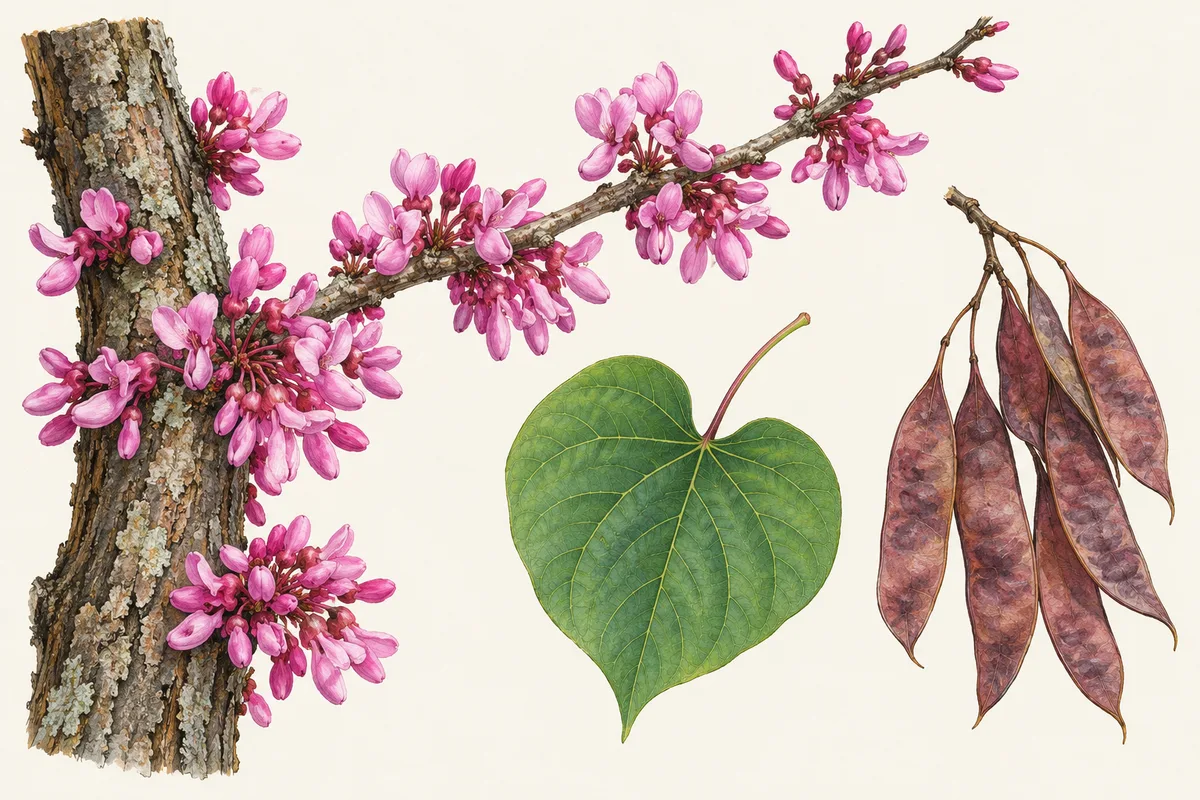
Pink-purple pea flowers straight out of the bark before any leaf opens, smooth heart-shaped leaves, and flat brown pods that hang on all winter. Here is how to check each one.
In short
A redbud tree is a small tree, usually 20 to 30 feet tall, that covers its bare twigs, branches and even its trunk with pink to purple pea-like flowers from March to May, before the leaves. Its leaves are heart-shaped, 3 to 6 inches long, with smooth edges and a swollen joint at the top of the stalk. Flat brown pods, 2 to 4 inches long, hang on through winter.
- Flowers on the trunk and old branches, before the leaves, are the redbud's signature: few other North American trees bloom straight out of the bark.
- A heart-shaped leaf with a smooth edge and a swollen knob where the stalk meets the blade means redbud; a toothed, lopsided heart means linden.
- Texas redbud has thick, glossy leaves with a rounded tip; western redbud is a shrubby tree of the Southwest with small, round or notched leaves.
Field marks at a glance
- Scientific name
- Cercis canadensis
- Family
- Fabaceae (legume or pea family)
- Type
- Broadleaf, deciduous
- Leaves
- Alternate, simple, heart-shaped, 3 to 6 inches (8 to 15 cm) long and about as wide, smooth-edged, with a pointed tip and seven veins fanning from the base. A small swelling sits on the stalk just below the blade.
- Flowers
- Pink to reddish purple, rarely white, pea-shaped, under 1 inch, in clusters of two to eight on twigs, branches and the trunk. March to May, before the leaves.
- Pods
- Flat, reddish-brown legumes, 2 to 4 inches (5 to 10 cm) long and about 1/2 inch wide, with 4 to 10 hard seeds. Many stay on the tree through winter.
- Bark and twigs
- Bark dark brown to black, smooth when young, later in narrow plates and scales, sometimes showing orange inner bark. Twigs slender, dark reddish brown and zigzag.
- Form and size
- Small, often multi-trunked tree with a rounded crown, 20 to 30 feet (6 to 9 m) tall and 25 to 35 feet wide; the trunk usually divides close to the ground.
- Native range
- Eastern and central United States: New Jersey and southern Pennsylvania to southern Michigan, southeastern Nebraska, central Texas and central Florida; a separate population in west Texas and Mexico.
- Fall color
- Gold to yellow; pods turn from green to brown in late summer and fall.
- Lifespan
- Short-lived: NC State Extension gives typically under 75 years, and the USDA Forest Service notes heart rot in old trees.
The redbud is the small tree that turns roadsides and woodland edges pink in early spring, weeks before the forest leafs out. Eastern redbud (Cercis canadensis), a member of the pea family, is the species across most of the United States; Texas redbud and western redbud take over in the Southwest. Three checks name it in any season: flowers on bare wood, a smooth heart-shaped leaf, and a flat pod.
Never eat a berry, nut, seed or pod on the strength of a web page or an app; check with a local expert.
How to identify a redbud tree: flowers, leaves, then pods
1. Flowers on bare wood, in early spring. From March to May, small pea-shaped flowers, pink to reddish purple and rarely white, open in clusters of two to eight along twigs, branches and the trunk itself, according to the USDA Forest Service's Silvics of North America. Botanists call flowering straight from old wood cauliflory, and NC State Extension uses the term for redbud. The leaves appear about two to three weeks after flowering begins, and the flowers drop as they open. A tree in full bloom with no leaves, and flowers sprouting from the trunk, is almost certainly a redbud.
2. A smooth heart. The NC State Plant Toolbox describes alternate, heart-shaped leaves 3 to 6 inches (8 to 15 cm) long and about as wide, hairless, with smooth (entire) edges, a pointed tip and seven veins spreading from the base. Look at the top of the leaf stalk: a small swollen knob sits just below the blade. Run a finger round the edge; any teeth rule redbud out.
3. Flat pods. After flowering, the tree sets flat, reddish-brown pods 2 to 4 inches (5 to 10 cm) long and about 1/2 inch wide, each holding 4 to 10 hard, bean-like seeds. The Forest Service notes that they stay on the tree until after leaf fall and that some last through winter, which makes them the best winter clue.
In winter, add the twigs and bark: slender, zigzag, dark reddish-brown twigs, and dark brown to black bark that is smooth when young and later breaks into narrow plates and scales, sometimes showing orange inner bark (NC State).
Eastern redbud is in the app's Collection. A photo of a leaf with its stalk, or of a flowering branch, is enough for Tree Identifier to suggest a name; the app shows no look-alike list, so run the three checks above before you settle.
Redbud through the year
- Early spring (March to May): the pink-purple bloom on bare wood; the main reason people notice the tree. Bees and butterflies visit the flowers, and NC State lists twelve butterfly and moth species whose caterpillars feed on redbud, among them Henry's elfin.
- Late spring and summer: heart-shaped leaves, lustrous dark green, open after the bloom. A redbud tree in summer is easy to pass by; look for the green pods hanging among the leaves.
- Fall: leaves turn gold to yellow (NC State) and pods brown.
- Winter: bare zigzag twigs and dangling dry pods.
Size and growth: NC State gives 20 to 30 feet (6 to 9 m) tall and 25 to 35 feet wide, a medium growth rate, and a lifespan typically under 75 years; the trunk usually divides close to the ground. The Forest Service describes it as a regular but uncommon understory tree that grows best on moist, well-drained sites, is frequent on limestone outcrops and alkaline soils, and does not tolerate severe competition or shade.
Eastern, Texas and western redbud
Eastern redbud (Cercis canadensis var. canadensis) grows wild from New Jersey and southern Pennsylvania northwest to southern Michigan, southwest to southeastern Nebraska, south to central Texas and east to central Florida (USDA Forest Service). NC State's range runs north to Ontario. It is the redbud of the East, the Midwest and the South.
Texas redbud (var. texensis) is found in southern Oklahoma, Trans-Pecos Texas and southeastern New Mexico, according to the Forest Service. NC State describes its leaves as thick and glossy, heart- to kidney-shaped, and lacking the pointed tip of the eastern form. A third form, Mexican redbud (mexicana), has dark green, leathery leaves 2 to 6 inches long with wavy edges (NC State).
Western redbud (Cercis occidentalis) is a separate species. Utah State University's western redbud page describes a shrub to small tree up to about 20 feet, often with several trunks, native to California, Arizona, Nevada and southern Utah. Its leaves are 1 to 4 inches across, heart-shaped to nearly round, with rounded or notched tips, somewhat leathery, and its pink to deep purple-red flowers open from February to April. Pods are 1 to 3 inches long.
The redbud and Oklahoma. The redbud is Oklahoma's state tree. The Oklahoma Historical Society records that Senate Joint Resolution Five gave it emblem status on March 30, 1937, and that it became the official state tree by statute on June 24, 1971.
Redbud varieties and cultivars
Nurseries sell many redbud cultivars, and several do not look like a wild redbud at all. These come from NC State's list:
| Cultivar | What you see |
|---|---|
| 'Forest Pansy' | Purple leaves all summer; the usual answer to "redbud with purple leaves" |
| The Rising Sun ('JN2') | About 12 feet tall; leaves in apricot, yellow, gold and green on the same tree |
| 'Ruby Falls' | Weeping habit with red to burgundy heart-shaped leaves |
| 'Lavender Twist' | Weeping form |
| Golden Falls | Weeping form with golden yellow leaves |
| 'Ace of Hearts' | Dwarf, 10 to 12 feet |
| 'Alba', 'White Pom Poms' | White flowers |
A redbud with yellow leaves in midsummer may simply be a gold-leaved cultivar; on a green-leaved tree, yellowing in summer is more often a sign of stress, which is outside what a leaf page can diagnose. NC State notes that 'Forest Pansy' is susceptible to verticillium wilt.
Redbud vs other spring-flowering trees
Redbud season overlaps with several other trees people photograph in bloom:
- Redbud vs dogwood. They often bloom side by side in eastern woods. Flowering dogwood shows four large white or pink bracts around a button of tiny flowers, at the twig tips; redbud shows many small pea flowers along the wood. Dogwood leaves are opposite with curving veins; redbud leaves are alternate hearts. See dogwood tree identification.
- Redbud vs cherry blossom. Ornamental cherries have five-petaled flowers on stalks, in clusters at the twig ends, and toothed leaves; redbud has pea flowers on the wood and smooth leaves.
- Redbud vs crape myrtle. Crape myrtle blooms in summer, not early spring, with crinkled flowers in large clusters at the branch tips.
For more pink- and purple-flowered trees, see trees with pink flowers. In summer, when the leaf is the only clue, the heart-shaped leaves guide separates redbud from linden, katsura, catalpa and princess tree. If you have the pods and wonder about the long, thin ones under another tree, that is a catalpa; the guide to trees with long seed pods sets redbud's short, flat pods against catalpa and locust.
Redbud abroad: the Judas tree
In Britain and southern Europe, the tree with pink flowers on bare branches is usually the Judas tree (Cercis siliquastrum), the redbud's Mediterranean cousin. The RHS describes a bushy small tree 8 to 12 m (26 to 40 ft) tall with broadly heart-shaped leaves up to 10 cm wide, rosy-pink pea flowers on older wood and flattened purplish pods up to 12 cm long, native to southern Europe and western Asia. The Oklahoma Historical Society notes that when the state chose its tree, an argument that the eastern redbud and the Judas tree were "one and the same" was answered by showing that the two are related but different species.
If you want to come back to a particular redbud in bloom next spring, Tree Identifier's Tree Map pins each located identification so you can find the tree again.
Look-alikes and how to tell them apart
American linden or basswood (Tilia americana)
Linden leaves are heart-shaped too, but coarsely toothed, lopsided at the base and up to 10 inches long, and the flowers hang in June from a long, leaf-like bract. Redbud leaves are smooth-edged, even at the base and smaller; the flowers come before the leaves.
Catalpa (Catalpa speciosa and C. bignonioides)
Catalpa leaves are much larger, 6 to 12 inches, and grow in pairs or whorls of three, not one per node. The flowers are white bells in late spring, after the leaves, and the pods are thin cigars up to 22 inches long, not flat 3-inch pea pods.
Katsura (Cercidiphyllum japonicum)
Katsura leaves are heart-shaped but small, 2 to 4 inches, with scalloped edges, and they sit in pairs on short side shoots. Fallen katsura leaves smell of burnt sugar in fall. The tree has no showy flowers and no pods.
Judas tree (Cercis siliquastrum)
The European cousin, planted in Britain and Europe: same flowers on bare wood, but a bigger tree, 25 to 40 feet (8 to 12 m), with broadly heart-shaped leaves up to 4 inches (10 cm) wide and flattened purplish pods up to about 5 inches (12 cm). It is native to southern Europe and western Asia.
What a photo can't settle
- Out of bloom, a young redbud and a young linden or katsura can look alike in a photo of one leaf: check the edge (smooth on redbud) and the swollen knob at the top of the leaf stalk.
- Cultivars blur the picture: purple-leaved 'Forest Pansy', gold-leaved The Rising Sun and weeping forms do not look like a wild redbud in summer, and a single photo may not name the cultivar.
- Where eastern and Texas redbud meet in Oklahoma and Texas, intermediate leaves are common, so the variety of a given tree may not be settled by its leaves alone.
Questions people ask
What does a redbud tree look like?
A small tree, 20 to 30 feet tall and often wider than tall, usually with several trunks dividing near the ground. In spring its bare branches and trunk are covered in pink-purple pea flowers; in summer it carries smooth, heart-shaped leaves 3 to 6 inches long; in winter flat brown pods hang from the twigs.
What is the difference between eastern and western redbud?
Eastern redbud is a tree of the eastern and central states with pointed, heart-shaped leaves 3 to 6 inches long. Western redbud (Cercis occidentalis), native to California, Arizona, Nevada and southern Utah, is a shrub or small tree up to about 20 feet with smaller leaves, 1 to 4 inches, that are round or notched at the tip.
How big does a redbud tree get?
NC State Extension gives 20 to 30 feet (6 to 9 m) tall and 25 to 35 feet wide, with a medium growth rate. Dwarf cultivars stay smaller: 'Ace of Hearts' reaches 10 to 12 feet and The Rising Sun about 12 feet.
Is the redbud the state tree of Oklahoma?
Yes. The Oklahoma Historical Society records that Senate Joint Resolution Five gave the redbud emblem status on March 30, 1937, and that it became the official state tree by statute on June 24, 1971.
Do redbud trees tolerate black walnut?
NC State Extension lists eastern redbud as resistant to black walnut, deer and clay soil, and sensitive to herbicides and lawn chemicals. That makes it one of the few small flowering trees often planted near walnuts.
Sources
- Cercis canadensis (eastern redbud) — North Carolina Extension Gardener Plant Toolbox, NC State University
- Eastern Redbud (Cercis canadensis), Silvics of North America — USDA Forest Service
- Redbud — The Encyclopedia of Oklahoma History and Culture, Oklahoma Historical Society
- California or Western Redbud — Utah State University Forestry Extension
- Cercis siliquastrum (Judas tree) — Royal Horticultural Society
- Tilia americana (American basswood) — North Carolina Extension Gardener Plant Toolbox, NC State University
- Catalpa speciosa (northern catalpa) — North Carolina Extension Gardener Plant Toolbox, NC State University
- Cercidiphyllum japonicum (katsura tree) — North Carolina Extension Gardener Plant Toolbox, NC State University
Keep reading
- Clue guideTrees with heart-shaped leaves, and how to tell them apart
- Tree profileCatalpa tree: how to recognize northern and southern catalpa
- Tree profileDogwood tree identification: flowering dogwood and its look-alikes
- Clue guideWhich tree has white flowers? Start with the month
- Field guideHow to identify trees by their leaves