Clue guide
Which trees have purple leaves? Tell the cultivars apart
A tree that is purple all summer is almost always a named cultivar of a green species. The leaf shape, bark and flowers tell you which one.
In short
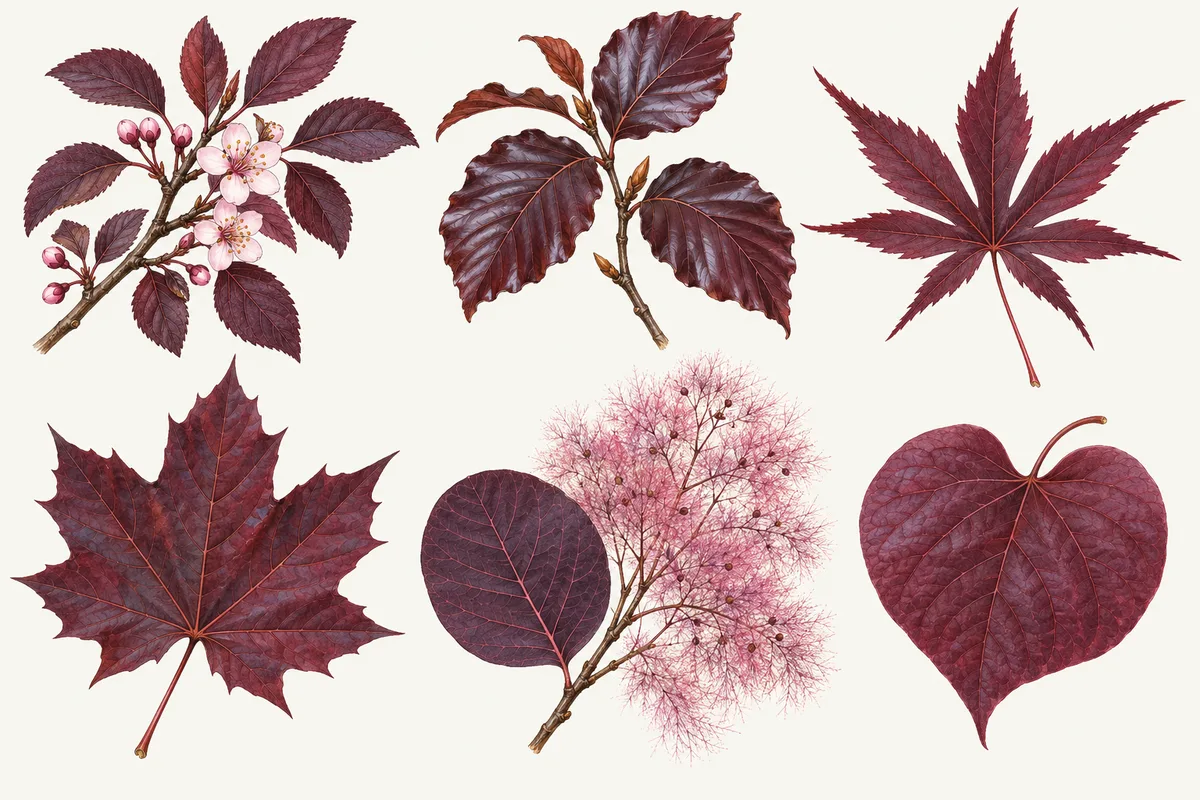
Trees with purple leaves all season are almost always cultivars: purple-leaf plum ('Thundercloud', small toothed leaves, pale pink spring flowers), copper beech (smooth gray bark, wavy-edged oval leaves), 'Crimson King' Norway maple (hand-shaped leaves, milky sap), 'Forest Pansy' redbud (heart-shaped leaves), red-leaved Japanese maples and 'Canada Red' chokecherry, which opens green and turns purple by early summer.
- Purple foliage all summer means a cultivar of a green species: check the leaf shape and bark to find the species, then the cultivar is usually obvious.
- Purple leaves still contain chlorophyll; anthocyanin pigment simply outweighs the green, the Wisconsin DNR explains.
- Crimson King is a Norway maple, a species listed invasive by Connecticut and the Morton Arboretum.
A tree with purple leaves from spring to fall is almost never a wild species. It is a cultivar, a named selection of a normally green tree, propagated for its color. That makes identification a two-step job: find the species from the leaf shape, bark and flowers, as you would for any tree, then match the cultivar. Never eat a berry, nut, seed or fruit on the strength of a web page or an app; check with a local expert. Several trees below bear small plums, cherries or crabapples.
Purple-leaved trees at a glance
| Tree | Leaf | Bark | Flowers and fruit | The feature that settles it | Our page |
|---|---|---|---|---|---|
| Purple-leaf plum (Prunus cerasifera 'Atropurpurea', 'Thundercloud') | 1.5–3 in, oval, finely toothed, alternate | Red-brown to dark gray, horizontal lenticels | Pale pink to white, April, as leaves open; few small plums | Small toothed leaves on a 15–30 ft tree | Cherry |
| Copper beech (Fagus sylvatica Atropurpurea Group) | 2–4 in, oval, wavy smooth edge, 7–9 vein pairs | Smooth, dark gray, like elephant hide | Inconspicuous; spiny husks with triangular nuts | Smooth gray trunk on a big tree | Beech |
| 'Crimson King' Norway maple (Acer platanoides) | About 7 in across, 5 pointed lobes, opposite | Gray-brown, shallow furrows | Small yellow flowers in spring; wide-winged samaras | Milky sap from a snapped leaf stalk | Maple |
| 'Forest Pansy' redbud (Cercis canadensis) | Heart-shaped, 3–5 in, smooth edge | Dark, with orange inner bark showing | Pink to purple, on bare branches; flat pods | Heart-shaped leaf | Redbud |
| Red-leaved Japanese maple (Acer palmatum 'Bloodgood', 'Atropurpureum') | 2–5 in, 5–9 deep lobes, opposite | Smooth, gray | Tiny red-purple flowers; paired samaras | Deeply cut, hand-shaped leaves on a small tree | Maple |
| 'Canada Red' or 'Schubert' chokecherry (Prunus virginiana) | 1.5–5 in, oval, toothed, long tip | Thin, smooth | White flowers; red fruit turning black | Green in spring, purple by June | — |
| Purple-leaved crabapples (Malus, e.g. 'Cardinal') | Simple, purple-red to purple-green by cultivar | Varies by cultivar | Magenta-pink flowers; small red apples | Tiny apples in late summer and fall | Fruit trees |
| Smoke tree (Cotinus coggygria 'Royal Purple'), shrub or small tree | 1.5–3.5 in, rounded, smooth edge | Smooth gray, rougher with age | Hazy pink plumes in midsummer | Crushed leaf smells like radish | — |
| Purple-leaf sand cherry (Prunus × cistena), shrub | 1–2 in, oval, toothed | Gray-brown | Pinkish white, after the leaves; purple-black fruit | A shrub under 10 ft | — |
Leaf, bark and flower details come from the NC State Extension Gardener Plant Toolbox, except chokecherry color (Oregon State University) and crabapple cultivars (The Morton Arboretum).
Why some leaves stay purple
Purple leaves are not missing their green pigment. The Wisconsin Department of Natural Resources explains that the color comes from anthocyanin, a pigment that occurs naturally in plant cells, and that cells look purple when they hold more anthocyanin than chlorophyll. The chloroplasts still work, so the tree photosynthesizes, but anthocyanin absorbs some of the light the tree could use. The Wisconsin DNR describes it as acting like a natural sunscreen and notes that many purple cultivars prefer full sun. Most trees make anthocyanin only in late summer and fall, which is why green trees turn red in autumn; the trees with red leaves in fall guide covers that seasonal red.
Small trees with purple leaves
Purple-leaf plum is the small purple tree with toothed oval leaves. The NC State profile describes the species as a short-lived tree of 15 to 30 feet with oval, finely toothed leaves 1.5 to 3 inches long. Its cultivars have deep reddish purple foliage, and the leaves keep that color until they drop in fall. Flowers open in April as the leaves emerge, white on the species and pale pink or lavender on the cultivars. NC State lists 'Thundercloud' with coppery purple foliage and pale pink to white flowers, and 'Newport' and 'Krauter's Vesuvius' with dark purple leaves. Most years these trees bear few or no plums.
'Forest Pansy' redbud is an eastern redbud with purple leaves, as NC State's cultivar list notes. The heart-shaped leaf, 3 to 5 inches wide with a smooth edge and a swelling on the stalk just below the blade, separates it from every other tree here. In early spring, pink to purple flowers cover bare branches before any leaf appears. The redbud page covers the species.
Red-leaved Japanese maples are small trees, 15 to 25 feet, with 5 to 9 deep lobes per leaf, set in opposite pairs. The NC State profile lists 'Bloodgood', whose deep burgundy spring and summer leaves turn bright crimson in fall, 'Atropurpureum' with dark purple foliage, and 'Crimson Queen', a dwarf with lacy, finely cut purple leaves that turn scarlet. Japanese maple is in Tree Identifier's Collection.
'Canada Red' chokecherry, also sold as 'Schubert', is a purple selection of chokecherry, a shrub or small tree native to North America. Oregon State University describes leaves that open green and turn dark purple, with about 90% of the foliage purple by June, on a tree 20 to 25 feet tall; new growth and root suckers stay green for a while. Oregon State reports that 'Canada Red' is apparently a sport of 'Schubert', and that sources disagree on whether they differ. NC State describes the species' white flowers and red fruit that ripens black.
Purple-leaved crabapples carry small apples. The Morton Arboretum lists cultivars such as 'Cardinal', with dark purple-red foliage, magenta-pink flowers and deep red fruit, and Showtime, with purple-green foliage and pinkish red flowers.
Large trees with purple leaves
Copper beech, also called purple beech, is the big one. The RHS describes deep purple leaves that turn reddish copper in autumn on a tree that reaches about 30 m (about 100 feet) over time. Its smooth, dark gray bark, which NC State compares to elephant hide, and oval leaves with wavy, smooth edges confirm a beech. NC State's European beech profile lists 'Riversii' as the common purple selection, 'Dawyck Purple' and 'Purple Fountain' as narrow upright forms, and notes that 'Purpurea' leaves open purple and become greener. The beech page compares European and American beech.
'Crimson King' Norway maple has hand-shaped leaves about 7 inches across with 5 sharply pointed lobes, set in opposite pairs. Snap a leaf stalk: Norway maple oozes milky sap, a test no other tree here passes. The NC State profile lists 'Crimson King' with red leaves and 'Crimson Sentry' as compact, narrow and upright with deep maroon-purple foliage, on a species of 40 to 50 feet. Norway maple is listed as invasive by several bodies: NC State calls it invasive in several northeastern states, the Morton Arboretum lists it as invasive on its grounds, and the Connecticut Invasive Plant List (October 2025) includes it with a prohibition date of October 2030, noting that some of its cultivars have not been evaluated separately. The maple page covers the green Norway maple.
Purple shrubs that look like small trees
- Smoke tree is a shrub or small tree of 10 to 15 feet. The NC State profile notes that 'Royal Purple' has deep purple, almost black foliage through the growing season, and that the rounded, smooth-edged leaves smell like a radish when crushed. In midsummer it carries 6- to 8-inch plumes of hazy pink flower stalks, the smoke of its name.
- Purple-leaf sand cherry is a shrub of 7 to 10 feet. NC State's profile describes it as a hybrid of purple-leaf plum and the native sand cherry, with reddish purple leaves 1 to 2 inches long that hold their color all season and pinkish white flowers after the leaves open.
Red leaves all year: the same cultivars
Searches for trees with red leaves all year, or with reddish purple or burgundy leaves, lead to the same short list. The color is a matter of degree: NC State describes 'Crimson King' as red-leaved and 'Crimson Sentry' as maroon-purple, purple-leaf plum foliage as purple, reddish purple, red or coppery red depending on the cultivar, and 'Bloodgood' Japanese maple as deep burgundy. A tree that is red in spring and summer and then turns a brighter red in fall, like 'Bloodgood', is still one of these cultivars, not a fall-color tree.
Purple-leaved trees by region
- Northeast, Midwest and Great Lakes: 'Crimson King' Norway maple on older streets, copper beech on estates and in parks, purple-leaf plum and crabapples in yards.
- Northern Plains, Minnesota and the Canadian Prairies (Alberta, Saskatchewan, Manitoba): 'Canada Red' chokecherry, a purple selection of the native chokecherry, and purple-leaved crabapples.
- Southeast and Texas: 'Forest Pansy' redbud, Japanese maples and purple-leaf plum. NC State notes that 'Crimson King' is not well suited to the South.
- West Coast: purple-leaf plum, which NC State says has naturalized in parts of the far West, and Japanese maples.
- UK and Ireland: a large purple tree is usually a copper beech, which the RHS describes as reaching about 30 m; smaller purple trees in gardens are usually purple-leaf plums or Japanese maples.
Using a photo to name a purple tree
Photograph a single leaf against the sky or a plain background, then the trunk. Tree Identifier names a tree from one photo, and the leaf shape is usually enough to get the species: a heart for redbud, a hand for maple, an oval with a wavy edge for beech, a small toothed oval for plum. The app gives one name without a confidence score and does not name cultivars, so check the bark and flowers in the table above. Ask the follow-up chat how a purple-leaf plum differs from a sand cherry, or save the tree on the Tree Map to check its flowers next spring.
What a photo can't settle
- Many purple cultivars of the same species look alike: 'Thundercloud', 'Newport' and 'Krauter's Vesuvius' plums, or the dozens of red Japanese maples. A photo can name the species but rarely the cultivar.
- Some cultivars, such as copper beech 'Purpurea', open purple and turn greener during the season, NC State notes, so the same tree can look different in May and August.
- Never eat a berry, nut, seed or fruit on the strength of a web page or an app; several of these trees bear small fruit.
Questions people ask
What tree has purple leaves all year?
No deciduous tree keeps leaves all year, but several cultivars stay purple from spring until the leaves drop: purple-leaf plum, which NC State says keeps its color until fall, copper beech, 'Crimson King' Norway maple, 'Forest Pansy' redbud and Japanese maples such as 'Bloodgood'. The searches for trees with red leaves all year point to the same cultivars.
What tree has purple leaves and pink flowers?
Purple-leaf plum, in early spring: NC State describes its cultivars with pale pink or lavender flowers as the leaves emerge. 'Forest Pansy' redbud also blooms pink to purple, but on bare branches before the leaves. Smoke tree carries hazy pink plumes in midsummer.
What tree has purple leaves in spring that turn green?
Several. NC State notes that copper beech 'Purpurea' leaves open purple and become greener, and that the Carolina Sweetheart redbud's leaves emerge purple, gain white, green and pink, and turn green in summer. 'Canada Red' chokecherry does the opposite: green in spring, purple by June, according to Oregon State.
Do trees with purple leaves have chlorophyll?
Yes. The Wisconsin DNR explains that purple-leaved trees still have functioning chloroplasts: the purple shows because anthocyanin outweighs chlorophyll in the cells. Anthocyanin absorbs some of the light the tree could use, which is why many purple cultivars do best in full sun.
What is the big tree with purple leaves?
Usually a copper beech, which the RHS says reaches about 30 m (about 100 feet) over time, or a 'Crimson King' Norway maple, 40 to 50 feet according to NC State. Beech has smooth gray bark and oval leaves; the maple has hand-shaped leaves in pairs and furrowed bark.
Sources
- How Do Trees With Purple Leaves Photosynthesize? — Wisconsin Department of Natural Resources, Forestry News
- Prunus cerasifera (purple leaf plum) — North Carolina Extension Gardener Plant Toolbox, NC State University
- Fagus sylvatica Atropurpurea Group (copper beech) — Royal Horticultural Society
- Acer platanoides (Norway maple) — North Carolina Extension Gardener Plant Toolbox, NC State University
- Connecticut Invasive Plant List (October 2025) — Connecticut Invasive Plants Council
- Acer palmatum (Japanese maple) — North Carolina Extension Gardener Plant Toolbox, NC State University
- Cotinus coggygria (smoketree) — North Carolina Extension Gardener Plant Toolbox, NC State University
- Prunus virginiana 'Canada Red' — Landscape Plants, Oregon State University