Clue guide
Which trees have red leaves in fall? Sort them by leaf shape
Red is the color, but the leaf shape names the tree. Check the lobes, the edge and where the leaves sit on the twig, then match your region.
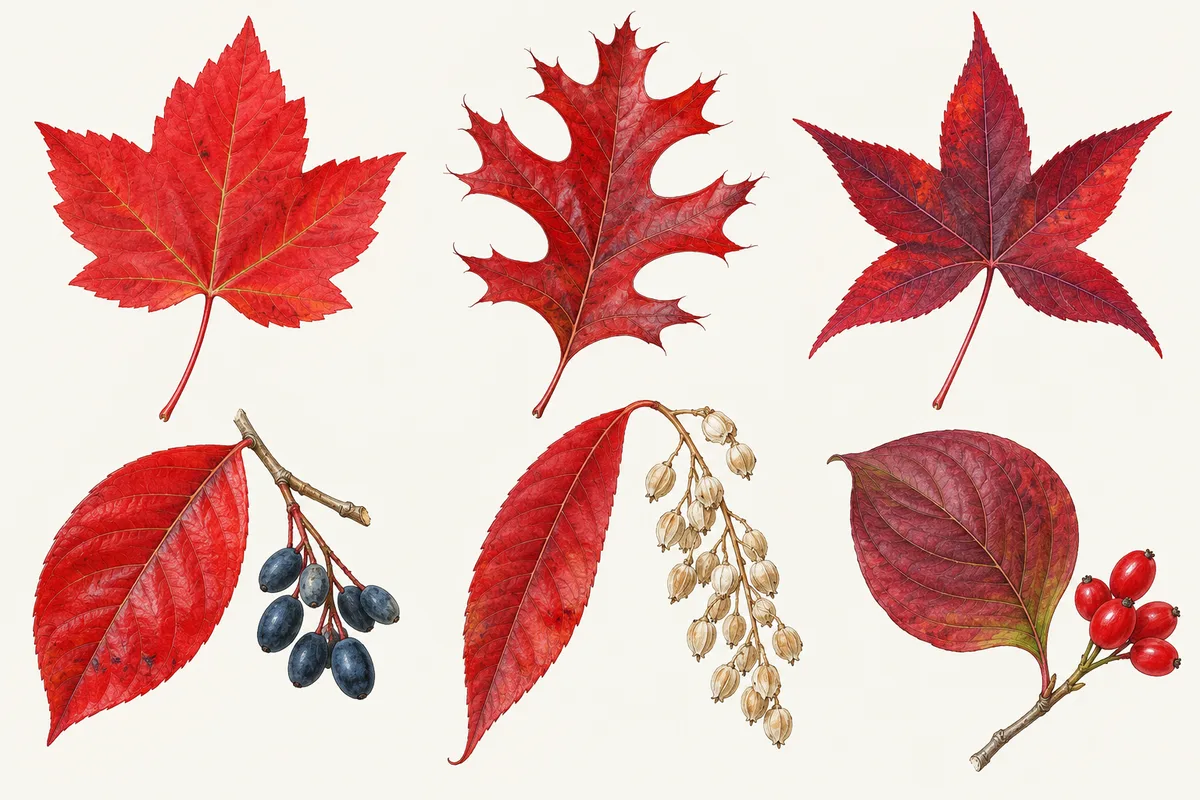
In short
Trees with red leaves in fall are most often red maple (3 lobes, toothed edge), scarlet or northern red oak (bristle-tipped lobes), black gum (glossy oval leaves, scarlet early), sourwood (crimson, with strings of silver seed capsules), sweetgum (star-shaped leaves) or flowering dogwood (opposite leaves, red berries). Planted Japanese maples, Callery pears and burning bush, a shrub, add to the list.
- Leaf shape settles a red tree faster than the shade of red: lobed like a hand, lobed with bristles, star-shaped, or plain and oval.
- Red comes from anthocyanin pigments that many trees make in late summer and fall; yellow pigments were in the leaf all season.
- Callery pear and burning bush are often the reddest plants on a street, and both are listed invasive in Connecticut and other states.
Red fall leaves narrow a tree down to a dozen or so candidates, and the leaf shape does the rest. Pick up a red leaf that is still attached to a low branch, note whether it is lobed, star-shaped or plain, check whether the leaves sit in pairs or alternate along the twig, and then read the section that matches. Several of these trees carry berries, nuts or pods in fall: never eat a berry, nut, seed or pod on the strength of a web page or an app; check with a local expert.
Trees with red fall leaves at a glance
| Tree | Leaf shape | Fall color | The feature that settles it | Our page |
|---|---|---|---|---|
| Red maple (Acer rubrum) | 3–5 lobes, toothed, opposite | Red, orange, yellow | V-shaped notches and a toothed edge; red buds | Red vs sugar maple |
| Scarlet oak (Quercus coccinea) | 7 deep, bristle-tipped lobes, C-shaped sinuses | Scarlet, late in the season | Acorn half covered by a deep cap, often with rings on the nut | Oak |
| Northern red oak (Q. rubra) | 7–11 shallow, bristle-tipped lobes | Brownish red to scarlet | Flat-topped bark ridges; acorn with a flat, beret-like cap | Red oak vs white oak |
| Pin oak (Q. palustris) | 5 bristle-tipped lobes, cut nearly to the midrib | Dark red to russet; young trees hold dead leaves into winter | Small round acorns, 1/4–1/2 in, with a thin shallow cap | Oak |
| Black gum (Nyssa sylvatica) | Oval, glossy, mostly smooth-edged | Scarlet, also yellow, orange or purple | Blocky, nearly black bark on old trees | — |
| Sourwood (Oxydendrum arboreum) | Oval, finely toothed, peach-like | Crimson, sometimes yellow and purple | Silver-gray seed capsules hanging in strings | — |
| Sweetgum (Liquidambar styraciflua) | Star-shaped, 5–7 pointed lobes | Yellow, orange, purple and red mixed | Spiky gumballs under the tree | Spiky balls |
| Flowering dogwood (Cornus florida) | Oval, opposite, veins curving to the tip | Red to reddish purple | Clusters of glossy red berries at the same time | Dogwood |
| Sassafras (Sassafras albidum) | Three shapes on one tree: oval, mitten, three-lobed | Red, orange, yellow | Aromatic leaves and red-brown, corky-ridged bark | — |
| Japanese maple (Acer palmatum) | 5–9 deep, finger-like lobes | Red, purple, bronze or yellow, by cultivar | A small, often multistemmed tree in a yard | Maple |
| Staghorn sumac (Rhus typhina), shrub or small tree | Compound, 11–31 toothed leaflets | Yellow, orange, red | Velvety twigs and upright red fruit clusters | — |
| Callery pear (Pyrus calleryana), invasive | Oval to heart-shaped, glossy, wavy-toothed | Reddish purple to bronze red | Street trees that bloomed white in early spring | Bradford pear |
| Burning bush (Euonymus alatus), shrub, invasive | Small, opposite, finely toothed | Bright red | Corky wings along the stems | — |
Leaf, bark and fruit details come from the NC State Extension Gardener Plant Toolbox; fall colors from NC State and from Iowa State Extension's Trees and Shrubs with Great Fall Color. Each species can show more than one color, and the timing shifts with latitude and weather.
Why some leaves turn red
Green chlorophyll hides two other kinds of pigment for most of the year. Iowa State Extension explains that yellow and orange carotenoids are present in the leaf throughout the growing season and show once chlorophyll breaks down in fall, while red and purple anthocyanins are produced in the leaf in late summer and early fall. Harvard Forest describes this as active synthesis of anthocyanin just before the leaves drop, and reports that about 70% of the shrubs and trees at Harvard Forest make anthocyanins as their leaves age. A tree that makes plenty of anthocyanin turns red or purple; one that makes little turns yellow, which is why the trees with yellow leaves in fall are a separate list.
Lobed leaves with teeth: red maple and Japanese maple
Red maple grows across eastern North America. NC State gives its native range as Newfoundland to Florida, west to Minnesota, Oklahoma and Texas, and its fall color as brilliant red, orange and yellow. The leaf has 3 main lobes, sometimes 5, with an irregularly toothed edge and V-shaped notches between the lobes; the leaves sit opposite each other on the twig. Sugar maple, its common neighbor, often turns orange instead and has smooth edges with U-shaped notches: the red maple vs sugar maple page compares them mark by mark.
Japanese maple is the red tree of small yards. NC State describes leaves 2 to 5 inches long with 5 to 9 lobes, most cut deeply, turning yellow, bronze, purple or red in fall depending on the cultivar. The tree stays small, 15 to 25 feet. Several cultivars are red or purple all summer; those are covered with other trees with purple leaves.
Lobed leaves with bristle tips: the red oaks
Every oak in the red oak group has a tiny bristle at the tip of each lobe. Feel for it, then use the sinuses and the acorn to name the species.
- Scarlet oak. The NC State profile describes leaves 3 to 7 inches long with deep, C-shaped sinuses and 7 bristle-tipped lobes, and fall color that is scarlet, showy and late. The acorn, 1/2 to 1 inch, is about half covered by a deep cap and often shows concentric rings. It grows in dry upland forests of the East and Midwest.
- Northern red oak. Leaves about 7 inches long, cut less than halfway to the midrib into 7 to 11 lobes, turning brownish red to scarlet, according to NC State. Some leaves hang on through winter. The red oak vs white oak page covers its acorns and bark.
- Pin oak. Five bristle-tipped lobes with U-shaped sinuses that cut almost to the midrib, dark red to russet fall color, and small round acorns 1/4 to 1/2 inch across, per NC State. Young pin oaks keep their dead leaves into winter. It is native to the Northeast and Midwest, and NC State notes that it adapts to drier and urban conditions, so it is often planted.
White oak, which has rounded lobes with no bristles, turns a wine red too, Iowa State notes, so a rounded-lobed red oak leaf is a white oak, not a red oak.
Star-shaped leaves: sweetgum
A leaf shaped like a five- to seven-pointed star is sweetgum. NC State describes leaves 4 to 8 inches across with toothed, deeply separated lobes, fragrant when bruised, and fall color that at its best mixes yellows, oranges, purples and reds, often on the same tree. Under the tree you will find the spiky, 1- to 3-inch gumballs; the trees with spiky balls guide covers them. Twigs may carry corky wings after the second year. Sweetgum grows from the Southeast north to New England and is planted as far as California.
Plain, oval leaves: black gum, sourwood, dogwood and sassafras
When the red leaf has no lobes at all, check the leaf arrangement and the fruit.
Black gum (black tupelo) is the oval-leaved tree that turns scarlet. The NC State profile notes that it is grown as an ornamental for that scarlet fall color and that leaves turn yellow, orange, red or purple; they are 3 to 6 inches long, glossy dark green in summer, alternate and mostly smooth-edged. Old bark is nearly black and breaks into square blocks. Native from southern Ontario to Florida and Texas, it tolerates wet ground and swamp margins.
Sourwood carries its red leaves next to its seed capsules. According to NC State, the glossy, finely toothed leaves (3 to 6 inches, like a peach leaf) turn crimson red, sometimes yellow and purple, and the 1/3- to 1/2-inch capsules ripen silver-gray in September and October, hanging in long, finger-like strings that stay into winter. It is a tree of the Southeast and Appalachians, Pennsylvania to northern Florida, west to Ohio and Louisiana, and grows 20 to 30 feet.
Flowering dogwood is the one with opposite leaves. NC State gives leaves 2.5 to 6 inches with veins that curve toward the tip and fall color of red to reddish purple, alongside clusters of glossy red berries from August to October. The dogwood page covers the spring flowers.
Sassafras has three leaf shapes on one tree, oval, mitten-shaped and three-lobed, which no other tree on this list shares. NC State describes fall color in reds, oranges and yellows, aromatic leaves and red-brown bark with corky ridges.
Shrubs and invasive trees that turn red
Some of the reddest plants in fall are not native trees, and two are invasive.
- Staghorn sumac is a shrub or small tree, 8 to 25 feet, with large compound leaves of 11 to 31 toothed leaflets and twigs covered in velvety reddish-brown hairs, like a stag's antlers in velvet. Iowa State lists its fall color as yellow, orange and red. It spreads by suckers into thickets on roadsides and woodland edges.
- Callery pear, planted as Bradford pear and other cultivars, turns reddish purple to bronze red, NC State notes. Its glossy leaves have rounded, wavy teeth. NC State calls it invasive in North Carolina and other southeastern states, and the Connecticut Invasive Plant List (October 2025) lists it as invasive with a prohibition date of October 2027. The Bradford pear page covers how to recognize it.
- Burning bush is a shrub up to 15 to 20 feet tall, named for its bright red fall leaves. The stems carry corky wings. NC State lists it as invasive in North Carolina, Iowa State warns that it can become weedy and invasive in woodlands, and Connecticut lists it as invasive with a prohibition date of October 2028.
Red fall trees by region
- Northeast and Great Lakes: red maple dominates; scarlet oak, northern red oak and black gum add red, and sugar maple adds orange. Pin oak and Callery pear are often planted in towns.
- Southeast and the Appalachians: sourwood, black gum, sweetgum, flowering dogwood and scarlet oak. Callery pear lines highways and old fields.
- Midwest: pin oak, northern red oak, sassafras, sumac thickets on roadsides, and planted red maples and sweetgums. White oaks turn wine red.
- Texas and the Southwest: red maple, black gum and sweetgum reach Texas in their native ranges, according to NC State; farther west, red fall color comes mostly from planted trees.
- West Coast: few native trees turn red. Sweetgum and Japanese maple are widely planted in towns, and Callery pear grows as a street tree.
Red autumn leaves in the UK
In Britain, many of the reddest autumn trees are planted North American or Asian species; a few native trees and shrubs add red of their own.
- Red oak (Quercus rubra), from eastern North America, is planted in parks and estates. The RHS describes leaves up to 22 cm long turning red or red-brown in autumn. Look for bristle-tipped lobes, which native oaks do not have.
- Sweet gum (Liquidambar styraciflua), native to the eastern USA, is grown in British gardens and parks. The RHS describes glossy, maple-like leaves with 5 to 7 lobes turning orange, crimson and purple in autumn. Its leaves alternate along the twig, whereas maple leaves sit in pairs.
- Wild cherry (Prunus avium) is native, and the Woodland Trust says its leaves fade to orange and red in autumn. The shiny, reddish-brown bark with horizontal bands confirms it.
- Spindle (Euonymus europaeus), a native small tree up to about 5 m, turns a rich orange-red, according to the Woodland Trust, with pink fruits and orange seeds at the same time.
- Japanese maples are planted in gardens and arboretums across Britain; their deeply cut, paired leaves turn red, purple, bronze or yellow depending on the cultivar.
Two native trees often mistaken for red ones are not. Field maple, Britain's only native maple, turns a rich golden yellow: the Woodland Trust says its leaves fade to gold before falling. Rowan is known for its scarlet berries in autumn rather than red leaves. For other British species, see tree identification in the UK.
Using a photo to name a red tree
Fall color makes a tree easy to spot and hard to name, because many species share the same red. Photograph one leaf that is still on the branch, flat and in good light, with a bit of the twig showing whether the leaves are paired or alternate. Tree Identifier names a tree from one photo; red maple, Japanese maple, sweetgum, black gum, sassafras and flowering dogwood are among the species in its Collection. The app gives one name without a confidence score, so check the result against the table above, and use the follow-up chat to ask how that tree differs from the look-alike you had in mind. Pinning the tree on the Tree Map lets you come back in spring to see its flowers.
What a photo can't settle
- Fall color varies within one species and even within one tree: Harvard Forest notes that red maple color can vary within a single leaf, so color alone never names a tree.
- Japanese maples, crabapples and Callery pears are grown as many cultivars; a photo can name the species but rarely the cultivar.
- A fallen red leaf may have blown in from a neighbor's tree; photograph a leaf still attached to the branch when you can.
Questions people ask
What tree has the brightest red leaves in fall?
Among native trees, NC State Extension singles out black gum for its scarlet fall color, scarlet oak for vibrant scarlet foliage that comes late, and sourwood for consistently excellent crimson color. Red maple is the red tree found across most of the East. Color varies from tree to tree, so a dull red maple is still a red maple.
What maple trees have red leaves in fall?
Red maple is the native one: Iowa State Extension lists its fall color as orange and red, and NC State as brilliant red, orange and yellow. Sugar maple turns yellow, orange and sometimes red. Planted Japanese maples turn red, purple, bronze or yellow depending on the cultivar. Norway maple turns yellow, not red.
Which oak trees have red leaves in fall?
Scarlet oak is the reddest. Northern red oak turns brownish red to scarlet, pin oak dark red to russet, and white oak a wine red, according to NC State and Iowa State Extension. All red-group oaks have bristle tips on their lobes, which is the quickest way to know you are looking at one.
What small tree has red leaves in fall?
Flowering dogwood (15 to 25 feet), sourwood (20 to 30 feet), Japanese maple (15 to 25 feet) and staghorn sumac (8 to 25 feet, often a shrub) are the usual small ones, with heights from NC State Extension. Burning bush also turns bright red but is a shrub, and it is listed invasive in Connecticut and North Carolina.
Why do some trees turn red and others yellow?
Yellow and orange come from carotenoids, which were in the leaf all season and show once the green chlorophyll breaks down. Red and purple come from anthocyanins, which many trees make fresh in late summer and fall, according to Iowa State Extension. Trees that make little anthocyanin, such as ginkgo and birches, turn yellow.
Sources
- Trees and Shrubs with Great Fall Color — Iowa State University Extension and Outreach, Yard and Garden
- The Process of Leaf Color Change — Harvard Forest, Harvard University
- Quercus coccinea (scarlet oak) — North Carolina Extension Gardener Plant Toolbox, NC State University
- Oxydendrum arboreum (sourwood) — North Carolina Extension Gardener Plant Toolbox, NC State University
- Nyssa sylvatica (black gum) — North Carolina Extension Gardener Plant Toolbox, NC State University
- Connecticut Invasive Plant List (October 2025) — Connecticut Invasive Plants Council
- Quercus rubra (red oak) — Royal Horticultural Society
- Field maple (Acer campestre) — Woodland Trust
Keep reading
- Tree comparisonRed maple vs sugar maple: how to tell them apart
- Tree comparisonRed oak vs white oak trees: how to tell the living trees apart
- Clue guideWhich trees have yellow leaves in fall? Sort them by leaf shape
- Clue guideWhich tree has spiky balls? Six candidates and how to tell them
- Invasive tree profileBradford pear and Callery pear (Pyrus calleryana): how to identify them