Tree profile
Dogwood tree identification: flowering dogwood and its look-alikes
Four notched white bracts in spring, opposite leaves with veins that curve toward the tip, blocky alligator bark and glossy red fruit in fall. Here is the order to check them in.
In short
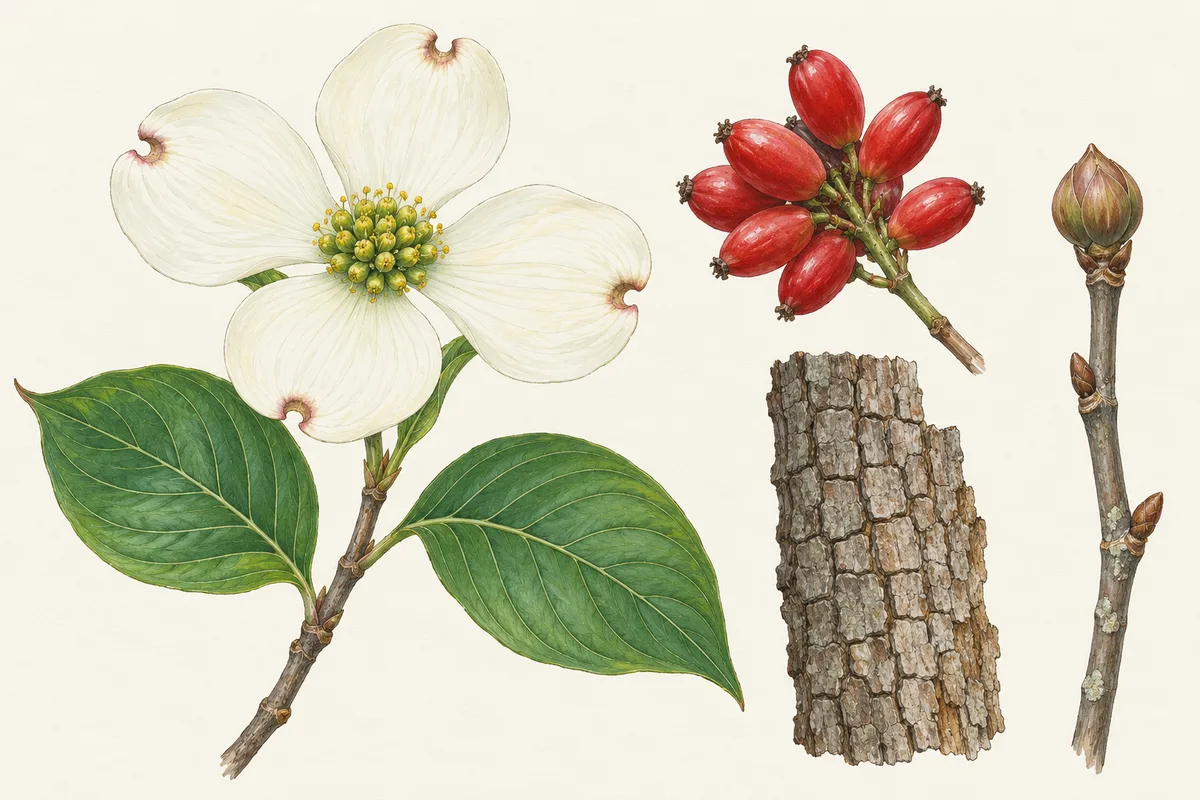
Dogwood tree identification starts with the leaves: opposite, smooth-edged, 3 to 6 inches long, with veins that curve toward the tip. On flowering dogwood (Cornus florida), the spring "flower" is four white or pink bracts, each notched at the end, around a button of tiny green flowers. Confirm with bark broken into small squares like alligator hide and clusters of glossy red fruit in fall.
- Opposite leaves with curving veins put a tree in the dogwood family; tear a leaf slowly and fine threads often hold the halves together.
- Notched bract tips and bloom before the leaves mean flowering dogwood; pointed bracts about a month later, among the leaves, mean kousa dogwood.
- In winter, look for round, flat-topped flower buds at the twig tips: no other common eastern tree carries them.
Field marks at a glance
- Scientific name
- Cornus florida
- Family
- Cornaceae (dogwood family)
- Type
- Broadleaf, deciduous
- Leaves
- Opposite, simple, oval to ovate, 2 1/2 to 6 inches (6 to 15 cm) long, smooth to wavy edges, with 6 or 7 pairs of veins that curve from the base toward the tip. Dull green above, whitish beneath.
- Bracts and flowers
- Four petal-like white (sometimes pink) bracts, about 2 inches long, notched at the tips, around a cluster of small green true flowers. March to May, before or as the leaves open.
- Fruit
- Glossy bright red oval drupes about 1/2 inch long, in clusters of 3 or 4, from August to October; eaten by birds.
- Bark
- Dark gray to brown or black, breaking into small square to rectangular blocks that resemble alligator hide.
- Winter buds
- Flower buds at the twig tips round, flattened and biscuit-shaped, gray-green, wrapped in two silky scales; leaf buds much smaller and slimmer.
- Form and size
- Small understory tree, 15 to 25 feet (4.5 to 7.5 m) tall and 15 to 30 feet wide, with horizontal branching; rarely over 40 feet.
- Native range
- Eastern North America, from southeastern Canada through the eastern United States to eastern Mexico.
- Fall color
- Red to reddish purple leaves, often with red fruit still on the twigs.
Most people asking how to identify a dogwood tree mean flowering dogwood (Cornus florida), the small native tree that lights up eastern woodland edges with white bracts in April. Its closest look-alike is the planted kousa dogwood from East Asia, and the West has its own Pacific dogwood. The leaf identifies the whole family; the bracts, fruit and bark name the species.
Never eat a berry, nut, seed or pod on the strength of a web page or an app; check with a local expert.
How to identify a dogwood: leaf, bracts, bark, fruit
1. The leaf. Dogwood leaves are opposite: two at each node, facing each other. On flowering dogwood they are oval, 2 1/2 to 6 inches (6 to 15 cm) long, with smooth to wavy edges, and the NC State Plant Toolbox notes that the 6 or 7 pairs of veins curve from the base toward the tip, following the edge rather than running straight to it.
The thread test. Hold a leaf at both ends, tear it slowly across the middle and pull the halves apart. In dogwoods, fine elastic threads often keep the two halves joined. The Woodland Trust describes this for the European common dogwood as "a stringy latex-type substance which can be seen if the leaves are pulled apart", next to the "characteristic curving veins". It works on any member of the genus and needs no flowers or fruit.
2. The bracts (spring). What looks like a big white flower is four petal-like bracts, each about 2 inches long and notched at the tip, around a small button of green true flowers (NC State). They open from March to May, before or with the leaves. Pink forms such as 'Rubra' exist; the notch is what matters.
3. The bark. On a mature tree the bark breaks into small, square to rectangular blocks, dark gray to brown or black. The USDA's flowering dogwood fact sheet says the deeply ridged and broken bark "resembles alligator hide".
4. The fruit (late summer and fall). Glossy, bright red, oval drupes about 1/2 inch long, in clusters of three or four, from August to October (NC State). The USDA lists squirrels, bobwhite, cedar waxwing, cardinal, mockingbird, robin, wild turkey and woodpeckers among the animals that eat them. Dogwood is one of the common answers on our trees with red berries page.
Flowering dogwood is in the app's Collection. If the bracts are out of reach on a slope or over a fence, one photo of a branch with leaves is enough for Tree Identifier to suggest a name; check the opposite leaves and the bract notch before you rely on it.
Dogwood in winter: the button buds
Winter is when flowering dogwoods are easiest to spot. Next year's flower buds sit at the ends of the twigs: round, flattened, gray-green and shaped like a tiny biscuit, in NC State's description, covered by two large silky scales that become two of the white bracts in spring. The leaf buds along the twig are much smaller and slimmer, so the fat round buds at the tips stand out.
Add the branching. NC State describes horizontal branching, with opposite twigs that are green to purple when young. Round buds at the tips of opposite twigs, over blocky bark, are a reliable winter ID. The winter tree identification guide explains how to read buds and leaf scars on other trees.
Flowering dogwood vs kousa dogwood
Kousa dogwood (Cornus kousa), from China, Japan and Korea, is planted in yards and on streets across the eastern United States, often next to native dogwoods. The NC State kousa profile gives the differences:
| Feature | Flowering dogwood | Kousa dogwood |
|---|---|---|
| Bract tips | Notched | Pointed |
| Bloom | March to May, before or with the leaves | About a month later, among green leaves |
| Fruit | Small oval red drupes, 1/2 inch, in clusters of 3–4 | Single pink-red ball, 1–1 1/2 inches, raspberry-like |
| Bark | Small dark blocks (alligator hide) | Smooth when young, then peeling in tan and brown patches |
| Leaf | 2 1/2–6 inches, dull green | 2 1/2–4 inches, shiny dark green |
| Size | 15–25 feet | 20–30 feet |
NC State notes that kousa resists the anthracnose and blights that affect native dogwoods. Dogwood anthracnose is a fungal disease of flowering dogwood; in North Carolina NC State says it occurs only above about 1,800 feet, while spot anthracnose, a milder leaf and bract spotting, is more common.
Other dogwoods you might meet
Pacific dogwood (Cornus nuttallii) is the dogwood of the West Coast. It is British Columbia's floral emblem, adopted in 1956; the Government of Canada's symbols page describes a tree 6 to 18 m (20 to 60 ft) tall that flowers profusely in April and May with large white blossoms, and is noticeable in fall for its red berry clusters.
Cornelian cherry (Cornus mas) is a European and western Asian dogwood planted for its very early bloom. The NC State profile describes small yellow flowers in clusters from late March to early April, before the leaves, olive-shaped red fruit 1/2 to 1 inch long in midsummer, and flaky, peeling bark on mature trees, 15 to 25 feet tall.
Shrub dogwoods. Several dogwoods are multi-stemmed shrubs rather than trees. Red-osier dogwood (Cornus sericea) forms thickets up to 15 feet, with bright red twigs, white pith, dull white fruit and the family's curving leaf veins, according to Virginia Tech Dendrology, which lists gray, Tatarian, roughleaf and silky dogwoods as the species it is confused with. In Britain the common dogwood (Cornus sanguinea) has crimson winter twigs, creamy white flowers with an unpleasant smell and small black berries (Woodland Trust). All of them pass the tear test.
Dogwood state symbols and bloom season
The Virginia General Assembly lists the flowering dogwood as both the state tree and the state flower, and NC State Extension notes that it is the state flower of North Carolina. In British Columbia, the emblem is the Pacific dogwood.
Flowering dogwood blooms at the same time as eastern redbud, and the two are often photographed together: dogwood shows four white bracts at the twig tips, redbud shows small pink-purple pea flowers along the bare branches and trunk. For other spring bloomers with colored flowers, see trees with pink flowers. A pink-bracted dogwood is usually still a flowering dogwood: NC State lists 'Rubra' with pink flowers and 'Cherokee Chief' with red ones, and the notched bract tip and opposite leaves give them away.
If you want to come back to a particular tree for its fall fruit or its next spring bloom, Tree Identifier's Tree Map pins each located identification so you can find it again.
Look-alikes and how to tell them apart
Kousa dogwood (Cornus kousa)
Kousa's bracts are pointed, not notched, and open about a month after flowering dogwood, when the tree is already in leaf. Its fruit is a pink-red ball 1 to 1 1/2 inches across that looks like a raspberry, and older bark peels in tan and brown patches.
Pacific dogwood (Cornus nuttallii)
The West Coast dogwood: a taller tree, 20 to 60 feet (6 to 18 m), native from British Columbia to California, with large white blossoms in April and May. Where you are settles most cases, since flowering dogwood is native only in the East.
Cornelian cherry (Cornus mas)
A planted European dogwood that blooms in late March and early April with small yellow flowers in clusters on bare twigs, no white bracts. Its fruit is an oblong, olive-shaped red drupe 1/2 to 1 inch long, ripe in midsummer.
Red-osier dogwood (Cornus sericea)
A shrub, not a tree: many stems forming thickets up to 15 feet, with bright red twigs in winter, white pith and flat clusters of small dull white flowers that become white fruit. Flowering dogwood has a single short trunk, red fruit and showy bracts.
Eastern redbud (Cercis canadensis)
Redbud blooms at the same time in the same woods, but its flowers are small pink-purple pea flowers along the branches and trunk, and its leaves are alternate and heart-shaped, with veins fanning from the base rather than curving toward the tip.
What a photo can't settle
- Out of flower, a young dogwood can be mistaken for other opposite-leaved trees in a photo of one leaf: check the curving veins and, if you can, the tear test.
- Nurseries sell many cultivars of both flowering and kousa dogwood, with pink, red or variegated forms, so color and leaf pattern alone do not name the tree; use the bract tip, bloom time and fruit.
- Dogwood anthracnose and leaf spots can deform leaves and bracts; a damaged tree may not show the features described here, and a photo app cannot diagnose the disease with certainty.
Questions people ask
How do I identify a dogwood tree?
Check the leaves first: opposite pairs, smooth edges and veins that curve toward the tip. Then the season's clue: four notched white bracts in spring, glossy red fruit in fall, blocky alligator bark and round, flat-topped flower buds at the twig tips in winter.
How do you tell a kousa dogwood from a flowering dogwood?
By the bract tips and the timing. Flowering dogwood's bracts are notched and open before or with the leaves; kousa's are pointed and open about a month later among green leaves. In fall, kousa carries large raspberry-like pink-red fruit, flowering dogwood small oval red drupes in clusters.
What does dogwood bark look like?
On a mature flowering dogwood the bark breaks into small square to rectangular blocks, dark gray to brown or black. The USDA compares it to alligator hide. Kousa dogwood bark is different: it peels in patches, leaving a mottled tan and brown trunk.
Is the dogwood the state tree of Virginia?
Yes. The [Virginia General Assembly](https://publications.virginiageneralassembly.gov/display_publication/329) lists the flowering dogwood as both the state tree and the state flower. NC State Extension notes that it is also the state flower of North Carolina. British Columbia's floral emblem is a different species, the Pacific dogwood.
What is wrong with my dogwood's leaves?
A leaf page cannot diagnose that. For context, NC State Extension notes that spot anthracnose is common on flowering dogwood, while the more serious dogwood anthracnose occurs in North Carolina only above about 1,800 feet. A local extension office can look at samples.
Sources
- Cornus florida (flowering dogwood) — North Carolina Extension Gardener Plant Toolbox, NC State University
- Flowering Dogwood (Cornus florida) Plant Fact Sheet — USDA NRCS Plant Materials Program
- Cornus kousa (kousa dogwood) — North Carolina Extension Gardener Plant Toolbox, NC State University
- Cornus mas (cornelian cherry dogwood) — North Carolina Extension Gardener Plant Toolbox, NC State University
- Dogwood (Cornus sanguinea) — Woodland Trust
- Redosier dogwood fact sheet — Virginia Tech Dendrology
- British Columbia: provincial symbols — Canadian Heritage, Government of Canada
- Virginia State Outline (state symbols) — Virginia General Assembly