Clue guide
Which tree has pink flowers? Spring and summer are two different lists
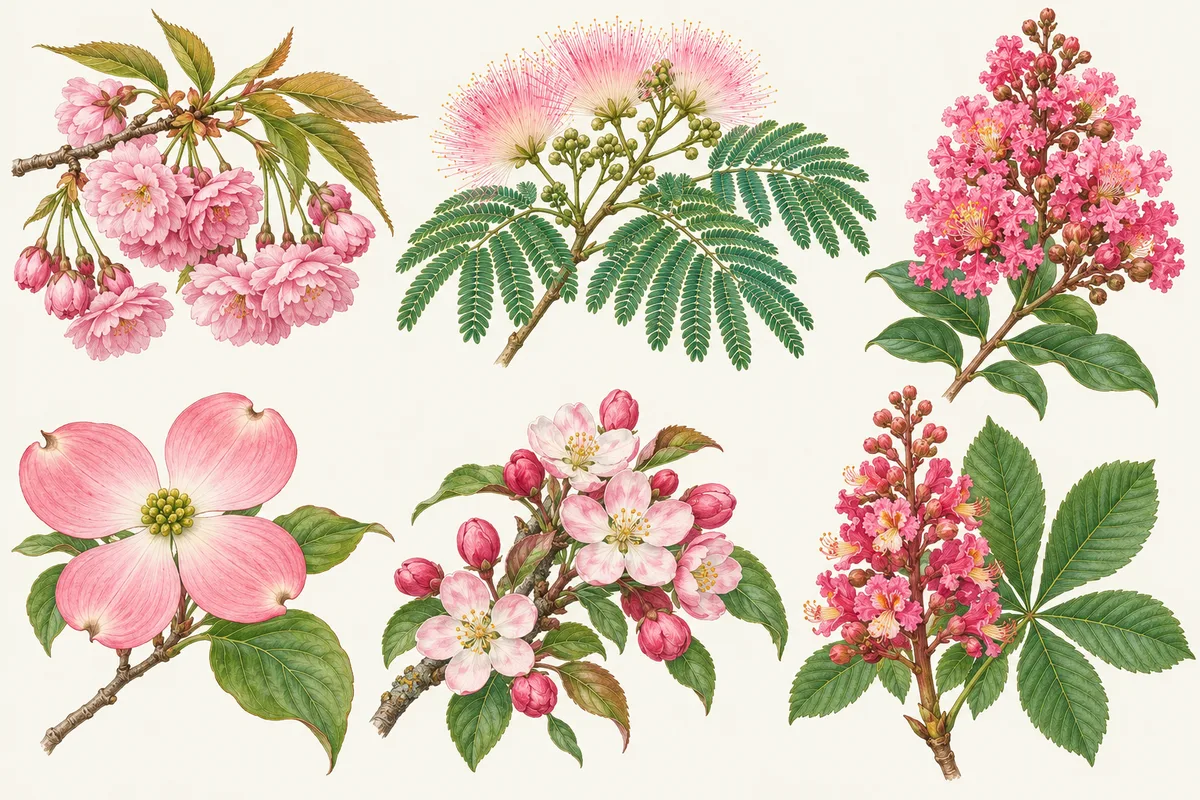
Pink-flowering trees in spring are mostly cherries, crabapples, redbuds and magnolias. In summer, the list shrinks to mimosa and crape myrtle. Start with the month.
In short
A tree with pink flowers in spring is most often a flowering cherry (double pink blossoms before the leaves), a crabapple (red buds opening pink, usually in May), an eastern redbud (tiny pea flowers on bare twigs) or a pink dogwood. In summer it is almost always a mimosa (fluffy pink pom-poms over fern-like leaves) or a crape myrtle (crinkled petals, peeling bark).
- Fluffy pink pom-pom flowers over fern-like leaves in summer mean mimosa, the silk tree, which UF/IFAS rates invasive throughout Florida.
- In spring, check whether the leaves are out: cherries, peach, redbud, pink dogwood and saucer magnolia bloom on bare twigs; crabapples and red horse chestnut bloom among leaves.
- Pink flowers in fall on a tree with a thick, green, spiny trunk, in the frost-free parts of Florida, point to silk floss tree.
A tree with pink flowers sorts into two short lists, and the month decides which one you need. Spring brings cherries, peaches, crabapples, redbuds, dogwoods and magnolias; summer leaves mainly mimosa and crape myrtle. In Florida, the trumpet trees and the silk floss tree add winter and fall bloom. Never eat a berry, nut, seed or pod on the strength of a web page or an app; check with a local expert. Some of these trees have nuts or seeds that NC State lists as poisonous.
Pink-flowering trees at a glance
| Tree | When | The one feature that settles it | Page |
|---|---|---|---|
| Flowering cherry, e.g. Kwanzan (Prunus 'Kanzan') | Spring, before leaves | Double, deep pink, 20–30 petals; horizontal bark lenticels | Cherry |
| Peach (Prunus persica) | Spring, before leaves | Single 5-petaled pink flowers, one or two per bud | Fruit trees |
| Eastern redbud (Cercis canadensis) | March–May, before leaves | Tiny pea flowers on bare twigs; heart-shaped leaves later | Redbud |
| Pink flowering dogwood (Cornus florida 'Rubra') | Spring, before leaves | Four pink bracts around a green button | Dogwood |
| Saucer magnolia (Magnolia × soulangeana) | Mid-spring, before leaves | Big cups, white inside; fuzzy buds | Magnolia |
| Crabapples (Malus) | Spring, usually May | Red buds opening pink or white; tiny apples later | This page |
| Red horse chestnut (Aesculus × carnea) | Mid-spring, with leaves | Upright 8-in spikes; hand-shaped leaves | This page |
| Mimosa, silk tree (Albizia julibrissin) | May–July | Pom-pom flowers; fern-like leaves | This page |
| Crape myrtle (Lagerstroemia indica) | July–September | Crinkled petals; peeling bark | This page |
| Pink trumpet tree (Handroanthus heptaphyllus) | Spring (Florida) | Pink trumpets on a bare tree; 5 leaflets | This page |
| Silk floss tree (Ceiba speciosa) | Fall, usually October | Green, spiny trunk | Trees with thorns |
Bloom times come from NC State Extension's Plant Toolbox, the Morton Arboretum (Illinois) and UF/IFAS (Florida).
Spring, on bare branches: cherries, peach, redbud, dogwood, magnolia
Flowering cherries are the classic pink spring tree. NC State's Kwanzan profile describes deep pink double flowers with 20 to 30 petals, 2.5 inches across, in hanging clusters of 3 to 5, opening before the leaves. Other Japanese flowering cherries bloom in late March to April in pale pink to deep pink, single or double, depending on the cultivar. Before you call it a cherry, check the bark for horizontal lines of lenticels, the short breathing pores that NC State calls conspicuous on Kwanzan. The cherry page tells Kwanzan from Yoshino.
Peach looks like a cherry in bloom but carries its flowers singly or in pairs, not in clusters. NC State's peach profile gives pink, five-petaled, fragrant flowers 1 to 1.5 inches across that open before the leaves, and narrow, long-pointed leaves that tend to curl inward along the midrib. NC State lists the seeds inside the pits as the poisonous part. The fruit tree guide compares peach with apple, pear, plum and cherry.
Eastern redbud is a cloud of small pink to purple flowers on bare, zigzag twigs. NC State's redbud profile notes the flowers come before the leaves, from March to May. Two later clues answer common searches: heart-shaped leaves 3 to 5 inches long and wide with 7 veins fanning from the base, and flat, bean-like pods 2 to 4 inches long, about 9 seeds each, that can hang on into winter. That makes redbud the usual answer to "pink flowers and bean pods" and "pink flowers and heart-shaped leaves".
Pink flowering dogwood is flowering dogwood in a pink form. NC State's dogwood profile lists the cultivar 'Rubra' with pink flowers. As on the white tree, the pink "petals" are four bracts around a small cluster of green true flowers, and the leaves that follow are opposite.
Saucer magnolia shows the biggest pink flowers of spring. Beyond the cup shape and the white inner face, look at the twigs before bloom: NC State's profile describes large, silky-hairy flower buds that sit at the twig tips a year ahead. Later in the season the tree carries cone-like fruits about 2 inches long from which red-orange seeds emerge.
Spring, among the leaves: crabapples and red horse chestnut
Crabapples usually bloom a little later, in May in the Midwest, according to the Morton Arboretum. Flower buds are often red and open to pink or white, and the color changes from tight bud to "balloon" to full bloom, so one tree can look two-toned. Flowers may be single, semi-double or double. In late summer the tree carries small apples a quarter inch to 2 inches across; by the Arboretum's definition, a Malus with fruit over 2 inches is an apple, not a crabapple.
Red horse chestnut is a large tree with upright flower spikes instead of loose clusters. NC State's profile describes 8-inch panicles of pink or red cone-shaped flowers with yellow throats in mid-spring, among dark green leaves divided like a hand into 5 to 7 parts, 4 to 8 inches long, with a red midrib. Later it carries prickly husks holding 2 or 3 glossy brown nuts, which NC State lists as poisonous. The nuts are covered with other spiky fruits in trees with spiky balls.
Summer: mimosa and crape myrtle
Mimosa (silk tree) is the answer to "pink flowers and fern-like leaves". NC State's mimosa profile describes fragrant flowers from May to July that look like pink powder puffs, each a cluster of 15 to 25 silky threads about 1.5 inches long. The leaves are 10 to 20 inches long, divided twice into tiny leaflets about 3/8 inch long, and fold downward at night and in rain. Flat brown pods 4 to 8 inches long follow and can hang on through winter. Introduced in 1745 from Asia, it is listed as invasive by the NC Invasive Plant Council, and the UF/IFAS assessment rates it invasive in north, central and south Florida.
Crape myrtle blooms from July to September in panicles at the tips of the current year's shoots. To confirm it without the flowers, look at the stems and seed heads: NC State's crape myrtle profile describes young stems that are almost square, with small wings, and round, six-parted brown capsules about half an inch wide that stay on through winter. In fall the small leaves turn yellow, orange or red. Purple-flowered cultivars are covered in trees with purple flowers.
Florida: pink trumpet tree and silk floss tree
Pink trumpet tree blooms in spring on bare branches in the frost-free parts of Florida. UF/IFAS's fact sheet describes a tree 40 to 50 feet tall covered in clusters of pink to rose-purple trumpet flowers about 2 inches wide, standing out against light gray bark, with leaves divided like a hand into five leaflets about 2.5 inches long. It grows in USDA zones 9B to 11, and UF/IFAS does not consider it a problem species.
Silk floss tree is the one that blooms in fall. UF/IFAS's fact sheet describes large pink and white, five-petaled flowers that resemble a narrow-petaled hibiscus, produced in fall and winter (usually October) when the tree is nearly bare, on a thick trunk that stays green and is covered with sharp spines. The fruits are pear-shaped capsules about 8 inches long, filled with silky white floss. It grows in zones 10A to 11.
How to tell them apart in the field
- Spring or summer? Summer narrows it to mimosa or crape myrtle; fall in Florida suggests silk floss tree.
- Leaves out or not? Bare branches: cherry, peach, redbud, dogwood, saucer magnolia, pink trumpet tree. Among leaves: crabapple, red horse chestnut.
- One flower, close up. Double with many petals: Kwanzan-type cherry. Pea-shaped and tiny: redbud. Four bracts: dogwood. Big cup: saucer magnolia. Pom-pom of threads: mimosa. Crinkled petals: crape myrtle.
- Bark and twigs. Horizontal lenticel lines: cherry or peach. Smooth and peeling: crape myrtle. Green with spines: silk floss tree.
A photo while it is in bloom
Pink bloom is short, often a week or two, so take a photo that shows a flower cluster and a few leaves or bare twigs. Tree Identifier names a tree from one photo; eastern redbud, flowering dogwood, Japanese flowering cherry, mimosa and crape myrtle are in its Collection. It shows no confidence score, so check its answer against the bloom month and the leaf clues above. The follow-up chat under each result helps with questions such as whether a pink tree is a crabapple or a cherry, and the Tree Map can pin the tree so you can come back for its fruit.
What a photo can't settle
- Many pink trees are cultivars of species that also come in white or red (crabapples, cherries, crape myrtle, dogwood); a photo can name the species but rarely the cultivar.
- Bloom months shift by several weeks from Florida to the Midwest and with each spring's weather.
- No page or app can say whether a fruit, nut or seed from these trees is safe; treat the name as a starting point.
Questions people ask
What tree has pink flowers and fern-like leaves?
Mimosa, also called silk tree. Its pink flowers look like fluffy powder puffs of silky threads and open from May to July, above feathery, twice-divided leaves 10 to 20 inches long that fold down at night and in rain. Flat pods 4 to 8 inches long follow. NC State and UF/IFAS both list it as invasive.
What tree has pink flowers in early spring before the leaves?
A flowering cherry, a peach, an eastern redbud, a pink flowering dogwood or a saucer magnolia. Cherries and peach have five-petaled or double flowers; redbud's are tiny and pea-shaped on bare twigs; dogwood shows four pink bracts; saucer magnolia's flowers are big cups, white inside.
What tree has pink flowers in summer?
In most of the South and East, crape myrtle (July to September, crinkled petals in long clusters, smooth peeling bark) or mimosa (May to July, pom-pom flowers, fern-like leaves). Chaste tree and desert willow also come in pink forms; see our purple-flowers guide for them.
What tree has pink flowers and thorns on the trunk?
Silk floss tree, planted in the warmest parts of Florida (USDA zones 10A to 11). UF/IFAS describes an unusually thick, green trunk covered with sharp spines and large pink and white five-petaled flowers, usually in October, when the tree is nearly bare. Pear-shaped capsules full of silky white floss follow.
What tree has pink flowers and heart-shaped leaves?
Eastern redbud. Its pink to purple pea flowers open before the leaves, from March to May; the leaves that follow are heart-shaped, 3 to 5 inches long and wide, with smooth edges. Flat pods 2 to 4 inches long then hang on, often into winter.
Sources
- Prunus 'Kanzan' (Kwanzan cherry, Japanese flowering cherry) — North Carolina Extension Gardener Plant Toolbox, NC State University
- Crabapple — The Morton Arboretum
- Cercis canadensis (eastern redbud) — North Carolina Extension Gardener Plant Toolbox, NC State University
- Albizia julibrissin (mimosa, silk tree) — North Carolina Extension Gardener Plant Toolbox, NC State University
- Albizia julibrissin, UF/IFAS Assessment of Non-Native Plants in Florida's Natural Areas — UF/IFAS Center for Aquatic and Invasive Plants
- Aesculus × carnea (red horse chestnut) — North Carolina Extension Gardener Plant Toolbox, NC State University
- Handroanthus heptaphyllus: Pink Trumpet Tree (ENH-773/ST615) — UF/IFAS Extension, University of Florida
- Ceiba speciosa: Silk-Floss Tree (ENH321/ST162) — UF/IFAS Extension, University of Florida
Keep reading
- Tree profileCherry trees (Prunus): how to identify them
- Field guideFruit tree identification by leaf, bark and blossom
- Clue guideWhich tree has purple flowers? Check the month, then the leaves
- Clue guideWhich tree has white flowers? Start with the month
- Clue guideWhich tree has spiky balls? Six candidates and how to tell them