Clue guide
Which tree has purple flowers? Check the month, then the leaves
Purple-flowering trees split cleanly by season and region. Note when it blooms and where you are, then look at the flower shape and the leaves.
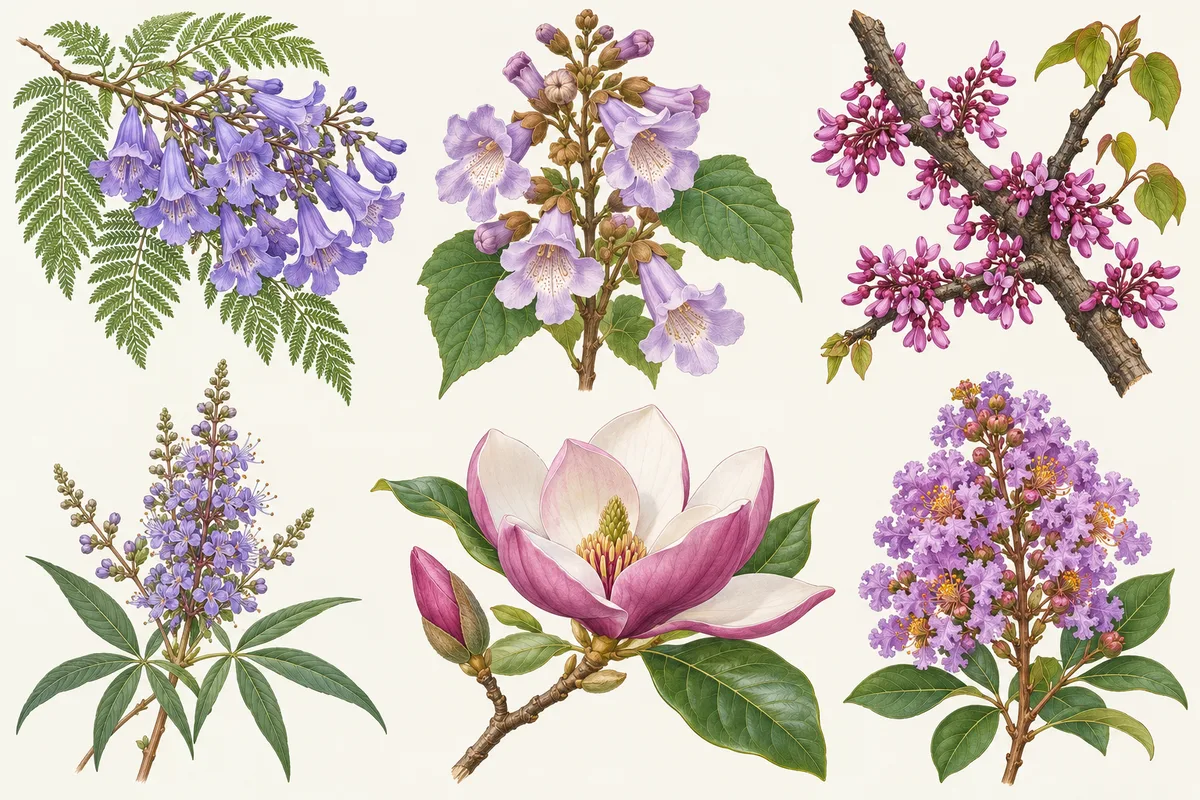
In short
A tree with purple flowers in early spring, before its leaves, is usually an eastern redbud (small pea-shaped flowers, even on the trunk), a saucer magnolia or a royal paulownia (upright 14-inch clusters). In summer it is a crape myrtle or a chaste tree. In Florida and California, a lavender-blue tree with fern-like leaves is a jacaranda; in Texas, a grape-scented evergreen is Texas mountain laurel.
- Purple pea-shaped flowers sprouting straight from the trunk and old branches before the leaves are the redbud's signature.
- A tall, fast-growing tree with foxglove-like lavender flowers and leaves 5 to 12 inches wide is royal paulownia, an invasive species in North Carolina.
- Lavender-blue flowers over fern-like leaves in Florida, Texas or California mean jacaranda; purple flowers over leaves with two rounded lobes in south Florida mean orchid tree.
A tree with purple flowers narrows down fast once you know two things: when it is blooming and where you are. Spring and summer bloomers are almost completely different trees, and Florida, Texas and California each add their own. Never eat a berry, nut, seed or pod on the strength of a web page or an app; check with a local expert. Several trees below carry pods or seeds that are reported toxic.
Purple-flowering trees at a glance
| Tree | When | The one feature that settles it | Page |
|---|---|---|---|
| Eastern redbud (Cercis canadensis) | March–May, before leaves | Half-inch pea flowers on twigs, branches and trunk | Redbud |
| Saucer magnolia (Magnolia × soulangeana) | Mid-spring, before leaves | Cups 5–10 in across, pink-purple outside, white inside | Magnolia |
| Royal paulownia (Paulownia tomentosa) | Spring | Upright clusters to 14 in; velvety leaves 5–12 in | This page |
| Common lilac (Syringa vulgaris) | Spring | Very fragrant cone-shaped clusters; shrub-sized | This page |
| Texas mountain laurel (Sophora secundiflora) | Spring | Evergreen; grape-drink smell; red seeds | This page |
| Jacaranda (Jacaranda mimosifolia) | April–August, mostly May | Lavender-blue trumpets over fern-like leaves | This page |
| Orchid tree (Bauhinia variegata) | January–April | Orchid-shaped flowers; two-lobed leaves | This page |
| Crape myrtle (Lagerstroemia indica) | July–September | Crinkled petals; smooth, peeling bark | This page |
| Chaste tree (Vitex agnus-castus) | Summer | Slender spikes; finger-like leaflets smelling of menthol | This page |
| Desert willow (Chilopsis linearis) | Summer, after rain | Catalpa-like trumpets; leaves 4–12 in long, 1/2 in wide | This page |
Months come from NC State Extension's Plant Toolbox, UF/IFAS and Texas A&M Forest Service. Expect later dates in the North.
Spring, before the leaves: redbud, saucer magnolia, paulownia, lilac
Eastern redbud is the purple haze along woodland edges in March and April. The NC State profile describes pea-shaped flowers only about half an inch wide, roughly 7 to a cluster, pink to red to purple, that open before the leaves and grow on new stems as well as older branches, often straight out of the trunk. That habit answers "tree with purple flowers on the trunk" and "on the bark". The heart-shaped leaves, 3 to 5 inches across, arrive after the bloom. NC State gives the native range as New Mexico north to Nebraska, east to Michigan and Ontario, and south to Florida. The redbud page covers it in full.
Saucer magnolia is the one with flowers the size of a teacup. NC State's saucer magnolia profile gives cup-shaped flowers 4.7 to 10 inches across, with tepals pink-purple on the outside and white inside, on bare branches in mid-spring. It is a hybrid, 15 to 33 feet tall, with smooth gray bark, and NC State warns that late frosts can kill its early flowers. Other magnolias are on the magnolia page.
Royal paulownia (princess tree, empress tree) blooms a little later on a much bigger, coarser tree. The NC State profile describes upright clusters up to 14 inches long of funnel-shaped flowers 1.5 to 2 inches long, pale violet to pink with dark spots and yellow stripes, vanilla-scented and resembling foxglove. Its leaves are opposite, heart-shaped and 5 to 12 inches long, velvety on both sides, so the tree is easy to mistake for a catalpa once the flowers drop. NC State notes it is listed as an invasive species by the NC Invasive Plant Council, the North Carolina Forest Service and the USDA National Invasive Species Information Center; it seeds freely along roadsides and resprouts from the roots when cut.
Common lilac is usually a large shrub, 8 to 16 feet tall according to NC State's lilac profile, but old ones are trained into small trees. Look for cone-shaped clusters up to 8 inches long of highly fragrant, four-lobed tubular flowers and opposite, heart-shaped leaves.
Summer bloomers: crape myrtle, chaste tree, desert willow
If the tree is in full purple bloom in July, rule out everything above.
Crape myrtle is the summer default across the South. According to the NC State profile, it flowers from July to September in panicles 6 to 18 inches long; each flower is 1 to 1.5 inches wide, usually with six crinkled petals that look like crepe paper. Cultivars come in white, pink, red and purple. Confirm with the bark: thin, smooth, pale brown to gray, and peeling. The small leaves (1 to 2.75 inches) are mostly opposite, sometimes in threes.
Chaste tree (vitex, lilac chastetree) has narrow spikes rather than round clusters. NC State describes fragrant lavender, pink or white flowers in loose panicles up to 12 inches long that bloom all summer, and compound leaves with 5 to 9 lance-shaped leaflets spreading like fingers, grayish beneath, with a menthol smell when bruised. Small purple fruits about 3 to 4 millimeters follow. NC State notes it reseeds freely and has the potential to become invasive, especially in the South.
Desert willow is not a willow; its leaves just look like one. Texas A&M Forest Service's Trees of Texas describes linear leaves 4 to 12 inches long and only half an inch wide, tubular lavender or white flowers 1 to 1.5 inches long in summer or after a rainstorm, and slender pods 7 to 12 inches long like a catalpa's. It grows wild in West Texas on dry, gravelly soils and dry stream channels.
Texas and the Southwest
Texas mountain laurel, also called mescalbean, is the purple tree of Texas in early spring. Texas A&M Forest Service's entry describes a dense cluster of purple, pea-like flowers that opens with the new leaves and smells like grape-flavored drink, on an evergreen shrub or small tree to 20 feet with glossy compound leaves of 5 to 9 leaflets. It grows on limestone soils in Central, South and West Texas. Its hard brown pods, 2 to 5 inches long, hold 3 to 8 red seeds. Texas A&M Forest Service states the seeds are highly poisonous to humans, and NC State's Plant Toolbox lists the seeds as the poisonous part.
Mexican redbud grows in the canyons of extreme southwest Texas and is planted for hot, dry sites. Texas A&M Forest Service's Mexican redbud entry gives purple to pink pea flowers before the leaves and small, glossy, heart-shaped leaves 1 to 2.5 inches across with a wavy edge; the Texas redbud has larger leaves without the wavy edge. Desert willow, chaste tree and crape myrtle, above, complete the Texas summer list.
Florida and California: jacaranda and orchid tree
Jacaranda is the purple street tree of frost-light climates. UF/IFAS's fact sheet describes lavender-blue, trumpet-shaped flowers on 12- to 18-inch panicles that can appear any time from April to August, most often in May, sometimes before the new leaves. The leaves are fern-like and twice divided, 9 to 18 inches long with leaflets only a quarter inch long, and the fruit is a round, flat, woody disk about 3 inches across. It grows in USDA zones 9B to 11, and NC State's jacaranda profile lists it as cultivated in Florida, Texas and California, where fallen flowers carpet the ground under it. UF/IFAS does not consider jacaranda a problem species in Florida.
Orchid tree is the other purple tree of south and central Florida. The UF/IFAS Plant Directory describes large, fragrant, orchid-like flowers, pale magenta to indigo and occasionally white, with dark red and yellow on the upper petal, above rounded leaves split into two lobes, then flat pods up to a foot long. UF/IFAS's fact sheet gives flowers 3 to 5 inches wide from January to April. The Plant Directory lists it as a Category 1 invasive species on the Florida Invasive Species Council list, and the UF/IFAS assessment rates it invasive and not recommended in south Florida, a caution species in central Florida and not a problem in north Florida.
Purple flowers and green fruit
The pods and capsules that follow the flowers settle many cases in early summer. Royal paulownia sets woody, oval capsules 1 to 1.5 inches long that are sticky and green at first and turn brown in fall, splitting to release thousands of tiny winged seeds (NC State). Redbud hangs flat pods 2 to 4 inches long, green turning brown, with about 9 seeds each. Desert willow hangs pods 7 to 12 inches long and very slender. Jacaranda makes round, flat disks, and chaste tree small, dry purple fruits. Texas mountain laurel's pods are hard and brown, with red seeds.
How to tell them apart in the field
- Look at the leaves, or their absence. None yet: redbud, saucer magnolia, often jacaranda. Fern-like: jacaranda. Two-lobed: orchid tree. Huge and velvety: paulownia. Finger-like leaflets: chaste tree. Long and narrow: desert willow. Evergreen and glossy: Texas mountain laurel.
- Look at one flower. Pea-shaped: redbud or Texas mountain laurel. Big cup: saucer magnolia. Foxglove-like trumpet: paulownia, jacaranda or desert willow. Crinkled petals: crape myrtle.
- Smell it. Grape drink: Texas mountain laurel. Vanilla: paulownia. Strong perfume on a shrub-sized plant: lilac.
- Check the bark. Smooth and peeling in patches: crape myrtle.
If the flowers lean pink rather than purple, go to trees with pink flowers; for white bloomers, see trees with white flowers.
A photo while it is in bloom
Purple bloom lasts a couple of weeks at most, so photograph it now, with a few leaves in the frame. Tree Identifier names a tree from one photo of the flowers, the leaves or the whole tree; eastern redbud, royal paulownia, jacaranda and crape myrtle are in its Collection. Tree Identifier shows no confidence score, so check the answer against the leaf and flower clues above, and use the follow-up chat for questions such as how a paulownia differs from a catalpa. Its Toxicology notes are AI-written; for anything about seeds or pods, ask a local expert.
What a photo can't settle
- Flower color varies with cultivar, soil and light: crape myrtle, chaste tree and desert willow are sold in white, pink and purple forms, so color alone never names the species.
- Bloom windows shift by weeks between Florida and the Great Lakes and from year to year; the months here are typical windows from the sources.
- A photo can name a crape myrtle or a lilac, but not the cultivar.
Questions people ask
What tree has purple flowers in early spring?
Most often an eastern redbud, whose small pink-to-purple pea-shaped flowers open from March to May before the leaves. Saucer magnolia opens big cup-shaped flowers, pink-purple outside and white inside, on bare branches in mid-spring. Royal paulownia follows with upright clusters of lavender, foxglove-like flowers.
What tree has purple flowers in Texas?
In spring, Texas mountain laurel (dense purple clusters that smell like grape drink, evergreen leaves) and Mexican redbud in far southwest Texas. In summer, desert willow in West Texas and the planted chaste tree and crape myrtle. Texas A&M Forest Service describes all of these in its Trees of Texas guide.
What tree has purple flowers in Florida?
A jacaranda (lavender-blue trumpets over fern-like leaves, mostly in May) or an orchid tree (3- to 5-inch orchid-shaped flowers from January to April, leaves with two rounded lobes). UF/IFAS lists orchid tree as a Category 1 invasive species on the Florida Invasive Species Council list.
What tree has purple flowers and green fruit?
Royal paulownia: after its lavender flowers, it sets oval capsules 1 to 1.5 inches long that are sticky and green before turning brown in fall. Redbud and desert willow carry green pods instead, short and flat on redbud, long and slender on desert willow.
Is a jacaranda the same as a purple paulownia?
No. Both have trumpet-shaped purple flowers, but jacaranda has fern-like, twice-divided leaves and grows outdoors only in frost-light climates (USDA zones 9B to 11, per UF/IFAS). Royal paulownia has huge, velvety, heart-shaped leaves and grows wild along eastern roadsides, from zone 5 south.
Sources
- Cercis canadensis (eastern redbud) — North Carolina Extension Gardener Plant Toolbox, NC State University
- Paulownia tomentosa (princess tree, royal paulownia) — North Carolina Extension Gardener Plant Toolbox, NC State University
- Lagerstroemia indica (crape myrtle) — North Carolina Extension Gardener Plant Toolbox, NC State University
- Vitex agnus-castus (chaste tree) — North Carolina Extension Gardener Plant Toolbox, NC State University
- Desert-willow (Chilopsis linearis), Trees of Texas — Texas A&M Forest Service
- Mescalbean, Texas mountain-laurel (Sophora secundiflora), Trees of Texas — Texas A&M Forest Service
- Jacaranda mimosifolia: Jacaranda (ENH-488/ST317) — UF/IFAS Extension, University of Florida
- Bauhinia variegata, Orchid tree — UF/IFAS Center for Aquatic and Invasive Plants, Plant Directory