Tree profile
Magnolia tree identification: southern magnolia and its relatives
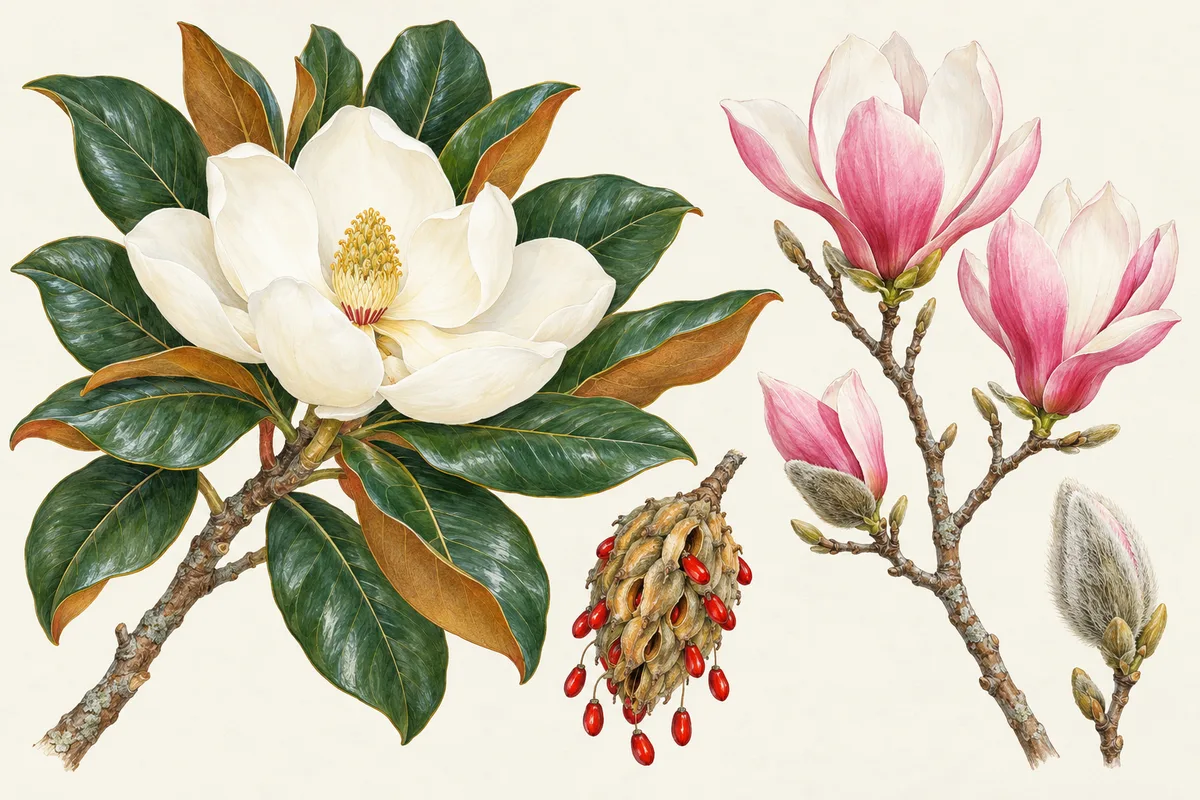
Big cup-shaped flowers, fuzzy flower buds, leaves with smooth edges and a cone-like fruit that splits to show red seeds on threads. Here is how to tell the common magnolias apart.
In short
Magnolia tree identification starts with the fruit and buds: every magnolia carries a cone-like fruit that splits in fall to hang bright red seeds on threads, and fuzzy flower buds. Leathery evergreen leaves 5 to 10 inches long with rusty-brown hairs underneath mean southern magnolia. Pink-and-white flowers on bare branches in late winter mean saucer magnolia; white star-shaped flowers with 12 to 18 narrow tepals mean star magnolia.
- Evergreen and rusty underneath: southern magnolia. Evergreen or half-evergreen and chalky white underneath: sweetbay.
- Bloom on bare wood in late winter means one of the Asian magnolias planted in yards: saucer (pink outside, white inside) or star (white, many narrow tepals).
- Leaves 2 to 3 feet long mean bigleaf or umbrella magnolia; the base of the leaf separates them.
Field marks at a glance
- Scientific name
- Magnolia grandiflora
- Family
- Magnoliaceae (magnolia family)
- Type
- Broadleaf, evergreen
- Leaves
- Evergreen, alternate, simple, leathery, 5 to 10 inches (13 to 25 cm) long, smooth-edged; glossy dark green above, rusty-brown and fuzzy beneath.
- Flowers
- Single, cup-shaped, creamy white, 8 to 12 inches (20 to 30 cm) across, with 6 to 12 petals; strongly fragrant. May into June, a few through summer.
- Fruit
- Cone-like cluster 3 to 5 inches long, rusty-hairy, green turning reddish; in September and October it splits to release rose-red seeds on slender red threads.
- Buds
- Large flower buds wrapped in scales covered with fine hairs.
- Bark
- Brown to gray and smooth when young, later breaking into close plates or scales.
- Form and size
- Large tree, typically 60 to 80 feet (18 to 24 m) tall and 30 to 50 feet wide in NC State's attributes.
- Native range
- Coastal plain of the southeastern United States, from Maryland south to Florida and west to Texas, in bottomlands and moist woods.
- Hardiness
- USDA hardiness zones 6a to 10b (NC State Extension); planted well outside its native range.
Magnolias are among the easiest trees to recognize in flower and among the most confusing out of it, because the name covers native evergreens of the Deep South, deciduous forest trees of the Appalachians and Asian hybrids planted in front yards. Southern magnolia (Magnolia grandiflora) is the one most people picture. The fruit and the buds tie them all together; the leaf and the bloom time name the species.
Never eat a berry, nut, seed or pod on the strength of a web page or an app; check with a local expert.
How to identify a magnolia tree: fruit, buds, then leaves
1. The fruit. Every magnolia sets a cone-like fruit, an aggregate of many small follicles. On southern magnolia the NC State Plant Toolbox describes a rusty-hairy cluster 3 to 5 inches long that turns from green to reddish and, in September and October, releases rose-red seeds on slender red threads; the empty brown cone hangs on into early winter. If you find red seeds dangling from a knobbly cone under a tree, you are under a magnolia.
2. The buds. Magnolia flower buds are big and furry. Southern magnolia's bud scales are covered with fine hairs; saucer magnolia's silky-hairy flower buds form a year before they open (NC State), so they are already visible all winter at the twig tips.
3. The leaf. Magnolia leaves are alternate, simple and smooth-edged, never toothed or lobed. Southern magnolia's are the giveaway: evergreen, leathery, 5 to 10 inches (13 to 25 cm) long, glossy dark green above and rusty-brown and fuzzy beneath. Turn one over: the brown felt underneath is the quickest single check.
4. The flower. Southern magnolia blooms from May into June, with a few flowers through summer: solitary, cup-shaped, creamy white, 8 to 12 inches (20 to 30 cm) across and strongly fragrant (NC State). For other spring and summer bloomers, see trees with white flowers.
Southern magnolia is in the app's Collection. A photo of a leaf turned to show its underside, or of a fruit cone, is enough for Tree Identifier to suggest a name; for a yard magnolia in bloom, the follow-up chat can tell you how saucer and star magnolia differ.
Southern magnolia at a glance
NC State gives a mature height of 60 to 80 feet (18 to 24 m) and a native range on the coastal plain from Maryland south to Florida and west to Texas, in bottomlands and moist woods. The bark is brown to gray and smooth when young, later breaking into close plates or scales. NC State lists hardiness zones 6a to 10b and names the cultivar 'Bracken's Brown Beauty' as winter hardy to zone 6.
State symbols. Mississippi's Blue Book, published by the Secretary of State, records that 23,278 schoolchildren voted in November 1900 and gave the magnolia 12,745 votes for state flower, a choice made official by the 1952 Legislature, and that on April 1, 1938, the Legislature designated the magnolia as the state tree.
The magnolias that bloom on bare branches
In late winter and early spring, the magnolias that cover bare branches in pink or white are Asian species and hybrids planted in yards and parks.
Saucer magnolia (Magnolia × soulangeana) is a hybrid of M. denudata and M. liliiflora. The NC State profile describes cup-shaped flowers 4 3/4 to 10 inches across with nine petal-like tepals, white inside and pinkish purple outside, opening from late winter to mid-spring before the leaves. The tree is 15 to 33 feet tall, often multi-trunked, with smooth gray bark, and its leaves are 3 to 6 inches long, wider toward the tip and fuzzy beneath. It is the usual answer to "magnolia with pink flowers"; see also trees with pink flowers.
Star magnolia (Magnolia stellata) from Japan is smaller and earlier. According to the NC State profile, its white, fragrant, star-shaped flowers are 3 to 4 inches wide with 12 to 18 narrow, strap-shaped tepals, opening in late winter to early spring before the leaves. It grows 15 to 20 feet tall, and its terminal flower buds are tan, fuzzy and about 1/2 inch long.
| Feature | Saucer magnolia | Star magnolia |
|---|---|---|
| Flower color | Pink-purple outside, white inside | White |
| Tepals | About 9, broad, cup-shaped | 12 to 18, narrow, strap-shaped |
| Flower size | 4 3/4 to 10 inches | 3 to 4 inches |
| Tree size | 15 to 33 feet | 15 to 20 feet |
Native deciduous magnolias
Away from yards, the eastern forests hold several native magnolias that drop their leaves in fall.
Sweetbay (Magnolia virginiana) grows on the coastal plain from New York south to Florida and Texas. The NC State profile describes shiny leaves 3 to 5 inches long, dark green above and chalky silvery-white beneath, evergreen to half-evergreen in the South and deciduous in colder areas. Its creamy white, fragrant flowers are only 2 to 3 inches across; each opens in the afternoon, closes at night and lasts two or three days, from mid-spring until frost. The fruit is a cone-like cluster up to 2 inches long with bright red seeds.
Cucumber tree (Magnolia acuminata) is a forest tree 60 to 80 feet tall. The NC State profile describes oval leaves 6 to 10 inches long with pointed tips, greenish-yellow tulip-like flowers 2 to 4 inches long from April to June that are often hidden by the leaves, and a 2- to 3-inch fruit that is "green, warty, cucumber-shaped" before it reddens. Its range runs from southern Ontario and New York to Florida, west to Louisiana, Oklahoma and Missouri. The bark is furrowed and dark gray-brown.
Bigleaf magnolia (Magnolia macrophylla) has leaves up to about 3 feet long and 1 foot wide, silvery-white and hairy beneath, with a heart-shaped base, and creamy flowers 8 to 14 inches across with a purple blotch at the base of the inner tepals (NC State). Umbrella magnolia (Magnolia tripetala) has leaves up to 24 inches long that cluster at the ends of the stems like the spokes of an umbrella, with a wedge-shaped base, and flowers with an unpleasant odor (NC State). The leaf base is the quickest way to tell the two apart.
Tulip tree: the magnolia that isn't
The tulip tree, also sold as tulip poplar or yellow-poplar (Liriodendron tulipifera), belongs to the magnolia family but has a leaf no magnolia shares. The NC State profile describes four main lobes and a broad, flat, cut-off tip, 3 to 8 inches across. Its tulip-shaped flowers, 1 to 3 inches long, are greenish yellow with an orange band at the base of each petal and open high in the crown in May and early June. The fruit is a brown cone of overlapping winged seeds, and the buds are flattened like a duck's bill. It is a far bigger tree, 80 to 120 feet, with gray bark in a diamond pattern of ridges and pale furrows. Tulip tree is also in the app's Collection.
For more on cones, pods and other fruit as clues, see identifying trees by seeds and nuts. Magnolias often bloom at the same time as flowering dogwood in southern yards; dogwood's four notched bracts and opposite leaves keep the two apart.
Look-alikes and how to tell them apart
Sweetbay magnolia (Magnolia virginiana)
Sweetbay leaves are smaller, 3 to 5 inches, thinner, and chalky silvery-white underneath, not rusty. Its flowers are only 2 to 3 inches across, and the tree is usually 10 to 35 feet tall, evergreen in the South and deciduous farther north.
Tulip tree or tulip poplar (Liriodendron tulipifera)
Same family, very different leaf: four lobes and a flat, cut-off tip, deciduous. Flowers are greenish yellow with an orange band, 1 to 3 inches, high in the crown, and the fruit is an upright cone of winged seeds, not red seeds.
Cucumber tree (Magnolia acuminata)
A deciduous native magnolia with thin, pointed leaves 6 to 10 inches long and small greenish-yellow flowers often hidden by the leaves. Its fruit is a green, warty cone 2 to 3 inches long shaped like a small cucumber.
Bigleaf magnolia (Magnolia macrophylla)
Deciduous, with the largest simple leaves of any native tree here: up to about 3 feet long and 1 foot wide, silvery underneath, with a heart-shaped base. Southern magnolia leaves never exceed about 10 inches and stay on in winter.
What a photo can't settle
- Many magnolias in yards are hybrids or cultivars (saucer magnolia is itself a hybrid), and a photo can name the group without naming the exact cultivar.
- Sweetbay keeps its leaves in the South and drops them in the North, so leaf habit alone can mislead: check the chalky white underside.
- Out of flower, a young southern magnolia can be confused with other glossy evergreens in a single leaf photo: look for the rusty hairs under the leaf and the fuzzy buds.
Questions people ask
How do I identify a magnolia tree?
Look for a cone-like fruit that splits to show bright red seeds hanging on threads, and for large, fuzzy flower buds at the twig tips. Then check the leaves: leathery, evergreen and rusty underneath means southern magnolia; deciduous with flowers on bare branches in late winter means saucer or star magnolia.
What do magnolia seed pods look like?
They look like a small, knobbly cone. On southern magnolia it is 3 to 5 inches long and rusty-hairy, turning from green to reddish; in September and October it splits open and rose-red seeds hang out on slender red threads. Afterwards the empty brown cone stays on the tree until early winter.
What does magnolia bark look like?
Southern magnolia bark is brown to gray and smooth on young trees, later breaking into close plates or scales. Saucer magnolia has smooth gray bark, which is why people sometimes ask about a magnolia with pale or white bark. Cucumber tree bark is furrowed and dark gray-brown.
Is the magnolia the state tree of Mississippi?
Yes, and its state flower too. Mississippi's Blue Book records that schoolchildren chose the magnolia as state flower in a 1900 vote, made official by the 1952 Legislature, and that the Legislature designated the magnolia as state tree on April 1, 1938.
Is a tulip tree a magnolia?
It belongs to the same family, Magnoliaceae, but not to the genus Magnolia. You can tell it at once by its four-lobed leaf with a flat, cut-off tip and its upright cone of winged seeds, where magnolias have smooth-edged leaves and red seeds.
Sources
- Magnolia grandiflora (southern magnolia) — North Carolina Extension Gardener Plant Toolbox, NC State University
- Magnolia x soulangeana (saucer magnolia) — North Carolina Extension Gardener Plant Toolbox, NC State University
- Magnolia stellata (star magnolia) — North Carolina Extension Gardener Plant Toolbox, NC State University
- Magnolia virginiana (sweetbay magnolia) — North Carolina Extension Gardener Plant Toolbox, NC State University
- Magnolia acuminata (cucumber tree) — North Carolina Extension Gardener Plant Toolbox, NC State University
- Magnolia macrophylla (bigleaf magnolia) — North Carolina Extension Gardener Plant Toolbox, NC State University
- Liriodendron tulipifera (tulip poplar) — North Carolina Extension Gardener Plant Toolbox, NC State University
- Mississippi Official and Statistical Register 2016–2020 (Blue Book), General Information — Mississippi Secretary of State
Keep reading
- Clue guideWhich tree has white flowers? Start with the month
- Field guideHow to identify trees by their leaves
- Field guideTree seed identification: from acorn, pod or samara to the tree
- Tree profileDogwood tree identification: flowering dogwood and its look-alikes
- Tree profileRedbud tree (Cercis canadensis): how to identify it