Clue guide
Which tree has thorns? Look at where they grow
Thorns in clusters on the trunk, in pairs at each leaf, singly on the twigs, or all over the bark each point to different trees. Note the position, then the leaves and fruit.
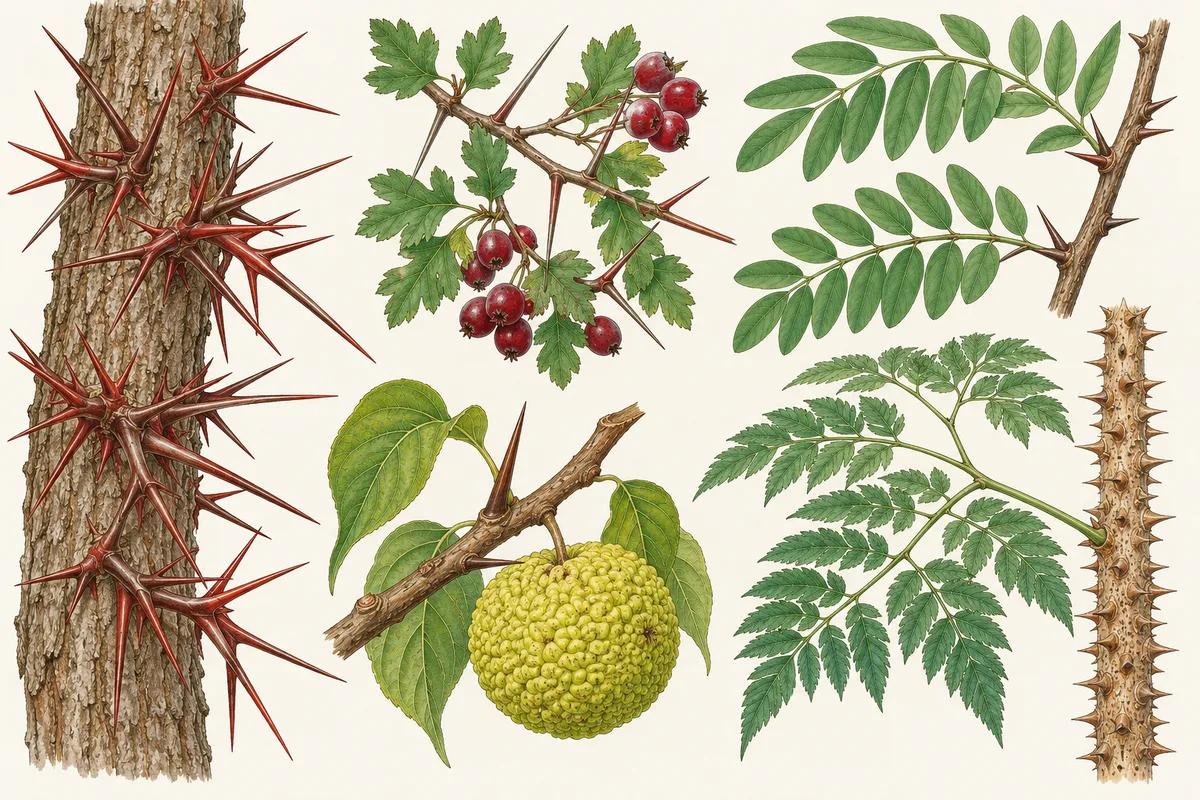
In short
A tree with thorns on its trunk is most often a honey locust, with branched thorns up to 3 inches long in clusters. Small paired spines at each leaf mean black locust; long single thorns on the twigs mean a hawthorn, Osage orange or wild Callery pear. Prickles all over the bark point to devil's walking stick or Hercules' club; in Texas, think mesquite and huisache.
- Branched thorns in clusters on the trunk are the honey locust's signature; thornless honey locusts are planted cultivars.
- Botanists separate thorns (modified stems), spines (modified leaves or stipules) and prickles (outgrowths of the bark or skin); the position on the twig tells them apart.
- Thorny trees with fruit: hawthorn (small red haws), Osage orange (green balls 4 to 5 inches), Russian olive (silvery fruit turning red), trifoliate orange (small sour yellow oranges).
A tree with thorns is one of the easiest clues to work from, because where the thorns grow narrows the list fast: on the trunk, in pairs at each leaf, singly on twigs, or all over the bark. Never eat a berry, nut, seed or pod on the strength of a web page or an app; check with a local expert. And handle thorny branches with heavy gloves: thorns of several trees below are long and stiff enough to cause puncture wounds, and NC State Extension notes that wild Callery pear thorns can injure livestock and even puncture tractor tires. For any wound, ask a medical professional.
Thorny trees at a glance
| Tree | Where the thorns are | Fruit | The one feature that settles it | Page |
|---|---|---|---|---|
| Honey locust (Gleditsia triacanthos) | Trunk, branches, twigs; often branched, in clusters | Twisted pods 10–18 in | Branched thorns on the trunk | Locust |
| Black locust (Robinia pseudoacacia) | Paired spines at each leaf, 1/4–1/2 in | Flat pods 3–5 in | Spines in pairs, not on the trunk | Locust |
| Hawthorns (Crataegus) | Long, straight thorns on twigs | Red or yellow haws | Small toothed leaves; flat white flower clusters | Hawthorn |
| Osage orange (Maclura pomifera) | Stout straight thorns on twigs | Green balls 4–5 in | Milky sap; huge wrinkled fruit | This page |
| Devil's walking stick (Aralia spinosa) | Prickles all over the trunk and leaf stalks | Tiny black fruit | Leaves 3–4 ft long | This page |
| Hercules' club (Zanthoxylum clava-herculis) | Knobby prickles up to 2 in on the bark | Small brown capsules | "Crocodile-teeth" knobs | This page |
| Wild Callery pear (Pyrus calleryana) | Thorns up to 4 in on branches | Small hard pears | White, bad-smelling spring bloom | Bradford pear |
| Russian olive (Elaeagnus angustifolia) | Occasional thorns on branches | Silvery, then red | Silver-scaled leaves | This page |
| Wild plums (Prunus americana and others) | Thorn-like side branchlets | Red-purple plums | White flowers before leaves; thickets | This page |
| Trifoliate orange (Citrus trifoliata) | Numerous long green thorns | Small sour yellow oranges | Green twigs; 3 leaflets | This page |
| Honey mesquite (Prosopis glandulosa) | Stout thorns up to 2 in | Pods 4–9 in | Texas; feathery leaves | This page |
| Huisache (Acacia farnesiana) | Paired thorns up to 2 in at each leaf | Pods 1–2 in | Fragrant orange-gold puff-balls | This page |
| Silk floss tree (Ceiba speciosa) | Sharp spines on a thick green trunk | Pear-shaped pods with floss | Green trunk | This page |
Thorns, spines and prickles
Botanists use three words for the sharp points on trees, and the position of the point on the twig shows which one you have. According to NC State University's plant defense exercise, a thorn is a modified stem, borne immediately above a leaf (or where a leaf would be), so it can branch like a shoot; a spine is a modified leaf or stipule, borne in the leaf's position below the bud; and a prickle is a modified hair, scattered over the stem with no particular relation to the leaves. NC State lists hawthorns and honey locust as thorny, black locust as spiny, and devil's walking stick and Hercules' club as prickly. In everyday speech all three are "thorns", and this page uses the word that way in its headings.
Thorns on the trunk: honey locust and silk floss tree
Honey locust is the tree people mean when they say "thorns growing out of the trunk". Texas A&M Forest Service's Trees of Texas entry describes strong, sharp, brown thorns, straight or branched, on the trunk, branches and twigs, which form on one-year-old wood and stay for many years. NC State's honey locust profile gives stout thorns up to 3 inches long with one or three branches. The leaves are feather-like, 5 to 10 inches long with 15 to 30 leaflets, and the dark brown pods are 10 to 18 inches long, flat and often twisted. Thornless forms are widely planted along streets, so a smooth honey locust in a parking lot is no surprise. The locust page compares honey and black locust in detail.
Silk floss tree is the trunk-thorned tree of the frost-free South. UF/IFAS's fact sheet describes an unusually thick trunk that stays green even on older trees and is covered with sharp spines, as are the young, green branches. In fall, usually October, it flowers pink and white on nearly bare branches, then hangs 8-inch pods full of silky floss. It grows in USDA zones 10A to 11.
Thorns or spines on the branches and twigs
Black locust has the smallest weapons here: Texas A&M Forest Service's black locust entry describes a pair of sharp, strong spines a quarter to half an inch long at the base of each leaf. Leaves are 10 to 14 inches long with 11 to 19 oval leaflets, and the bark is thick, deeply furrowed and light brown. In spring it hangs fragrant white flowers.
Hawthorns are a large group; Texas A&M Forest Service counts 30 or so species, and its hawthorn entry describes small trees, usually to 20 feet, most with long, straight thorns on the twigs, simple toothed leaves 2 to 3 inches long, dense flat clusters of white flowers in spring and round red or yellow fruit a quarter inch to 1 inch across. See the hawthorn page.
Osage orange (bois d'arc, hedge apple) is the answer to "tree with thorns and green balls". Its Trees of Texas entry describes crooked, interwoven, thorny branches, twigs armed with stout straight thorns that bleed sticky, milky sap when broken, glossy leaves 3 to 5 inches long, and a wrinkled green fruit 4 to 5 inches across. It was planted widely for hedgerows before barbed wire.
Wild Callery pear is the thorny form of the Bradford pear. NC State Extension's Callery pear publication explains that the planted cultivars are thornless but their wild offspring have large thorns, up to 4 inches long, on branches and stems, and form dense thickets with an irregular, multi-trunked shape. White flowers that smell bad in early spring confirm it; the Bradford pear page covers its spread and state sale bans.
Russian olive is easiest to name by its color. NC State's Russian olive profile describes a thorny large shrub or small tree up to 30 feet, with narrow leaves 1.5 to 4 inches long covered in silvery scales, young branches that are silvery and occasionally thorny, fragrant silvery-white to yellow flowers from April to June, and half-inch, olive-like fruit that is silver in late summer and turns red in fall. It is listed as invasive by the NC Invasive Plant Council.
Wild plums form thorny thickets. NC State's American plum profile describes thorn-like side branches, twigs that sometimes carry thorny side branchlets, white flowers from March to April before the leaves, and round red-purple plums about an inch across in July and August.
Trifoliate orange is a hardy citrus, first grown as a rootstock for grafted citrus trees. NC State's trifoliate orange profile describes bright green twigs with numerous long, sharp green thorns, leaves of three leaflets on a winged stalk, white flowers in mid-spring and dull lemon-yellow fruit like a small, very sour orange. It is listed as invasive in North Carolina by the NC Invasive Plant Council.
Thorns all over it: devil's walking stick and Hercules' club
Both of these are often called prickly ash and Hercules' club, which makes the names confusing; the leaves sort them out.
Devil's walking stick is often a single stem up to 30 feet tall with a flat-topped crown. Texas A&M Forest Service's entry describes light gray bark armed over the entire surface with stout, sharp prickles, and enormous twice-divided leaves 3 to 4 feet long with prickles along the leaf stalk. In midsummer each plant raises a panicle of small white flowers about a foot across, followed by tiny black fruit.
Hercules' club carries prickles of a different shape. The Forest Service's Hercules'-club entry describes light gray bark covered with knobby, cone-shaped prickles "shaped somewhat like crocodile teeth", up to 2 inches across and 1 inch tall, and once-divided leaves 5 to 8 inches long with 7 to 17 toothed leaflets and sharp prickles along the stalk. Chewing the twigs or inner bark numbs the mouth, which gave it the name toothache tree.
Texas and the Southwest: mesquite, huisache and retama
In Texas, most thorny trees have feathery, finely divided leaves. Honey mesquite, one of the most common trees in the state, has twigs and branches armed with stout, straight thorns up to 2 inches long, leaves with two long, narrow-leafleted branches, and pods 4 to 9 inches long, according to the Forest Service's mesquite entry. Huisache has a pair of straight thorns up to 2 inches at the base of each leaf and fragrant orange-gold puff-ball flowers in spring (entry). Retama has green twigs and thorns up to 1 inch. Their flowers are compared in trees with yellow flowers.
In Britain: hawthorn and blackthorn
In British hedgerows the two thorny trees are hawthorn and blackthorn. The Woodland Trust describes blackthorn as spiny and densely branched, with twigs that form straight side shoots which turn into thorns, snow-white flowers in early spring and purple fruits called sloes. The differences are laid out in hawthorn vs blackthorn.
A photo of the thorns and a leaf
Thorns alone rarely name a tree, but a photo that shows the thorns, a leaf and any fruit together usually does. Tree Identifier names a tree from one photo; honey locust and black locust are in its Collection, and it also names trees outside it, such as Osage orange. It shows no confidence score, so check the result against where the thorns sit, and use the follow-up chat to ask how a thorn differs from a spine on that tree. In winter, when the leaves are gone, the winter tree identification guide helps with twigs and buds.
What a photo can't settle
- Thornless cultivars exist for honey locust and Osage orange, and young or shaded trees can have few thorns, so no thorns does not rule them out.
- North America has many hawthorn species and hybrids; a photo names the genus easily but rarely the species.
- No page or app can say whether a fruit from a thorny tree is safe; several here are reported toxic or very sour.
Questions people ask
What tree has big thorns on the trunk?
Honey locust. Texas A&M Forest Service describes strong, sharp brown thorns, straight or branched, on the trunk, branches and twigs, and NC State gives them up to 3 inches long with one or three branches. Look for clusters on the trunk, feather-like leaves and long, twisted pods 10 to 18 inches long.
What tree has thorns all over it?
Devil's walking stick, whose light gray bark is armed over its entire surface with stout, sharp prickles, or Hercules' club, whose trunk carries knobby, cone-shaped prickles up to 2 inches across. Devil's walking stick has huge twice-divided leaves 3 to 4 feet long; Hercules' club has once-divided leaves 5 to 8 inches long.
What tree has thorns and red berries?
Usually a hawthorn: long, straight thorns on the twigs, small toothed or lobed leaves, and red (sometimes yellow) fruit a quarter inch to 1 inch across. Russian olive also carries thorns and small olive-shaped fruit that is silver in late summer and turns red in fall. Never eat either on the strength of a web page.
What is the difference between a thorn and a spine?
A thorn is a modified stem and grows just above a leaf, where a side shoot would be; it can branch. A spine is a modified leaf or stipule and grows below the bud, often in pairs. NC State gives hawthorns and honey locust as thorny trees and black locust as a spiny one.
Do Bradford pears have thorns?
Planted Bradford and other Callery pear cultivars are thornless. Their wild offspring, spread by birds, carry thorns that NC State Extension says can reach 4 inches and puncture tractor tires, and stump sprouts from a cut tree can grow thorny too.
Sources
- Plant defense structures: prickles, spines and thorns — NC State University Herbarium, Extension Gardener exercises
- Honeylocust (Gleditsia triacanthos), Trees of Texas — Texas A&M Forest Service
- Black locust (Robinia pseudoacacia), Trees of Texas — Texas A&M Forest Service
- Osage-orange (Maclura pomifera), Trees of Texas — Texas A&M Forest Service
- Devil's-walkingstick (Aralia spinosa), Trees of Texas — Texas A&M Forest Service
- Hercules'-club (Zanthoxylum clava-herculis), Trees of Texas — Texas A&M Forest Service
- Callery Pear: Bradford Pear, Other Varieties, and Their Invasive Offspring — NC State Extension
- Elaeagnus angustifolia (Russian olive) — North Carolina Extension Gardener Plant Toolbox, NC State University
Keep reading
- Tree profileLocust trees: how to identify black locust and honey locust
- Tree profileHawthorn (Crataegus): how to identify it
- Invasive tree profileBradford pear and Callery pear (Pyrus calleryana): how to identify them
- Clue guideWhich tree has red berries? Sort it by leaf and season
- Winter field guideWinter tree identification, from buds to bark