Tree comparison
Hawthorn vs blackthorn: how to tell the two hedgerow thorns apart
Both are thorny, white-flowered hedge trees of the rose family. Blossom on bare twigs in March means blackthorn; blossom among green leaves in May means hawthorn. Here are the other five checks.
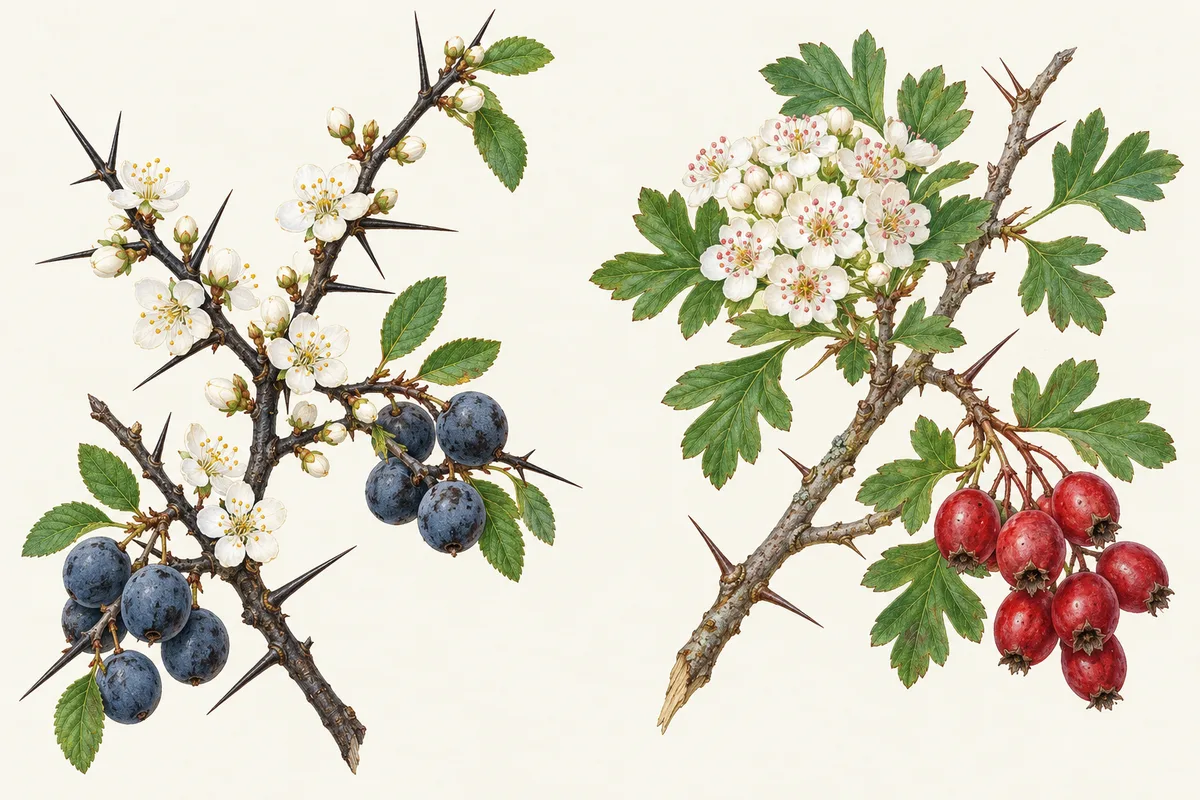
In short
Hawthorn vs blackthorn comes down to timing and fruit. Blackthorn flowers in March and April on bare, dark twigs, before its leaves; hawthorn flowers in May, after its leaves, in flat-topped clusters. In autumn blackthorn carries blue-black sloes about 1 cm across, and hawthorn deep red haws. In winter, blackthorn's buds sit along its spines, while hawthorn's spines grow beside the buds.
- White blossom on leafless black twigs in March or April is blackthorn; blossom among leaves in May is hawthorn, the May tree.
- Blackthorn fruits are blue-black sloes; hawthorn fruits are deep red haws.
- Whitethorn is another name for hawthorn, so the pair is sometimes called whitethorn and blackthorn.
Field marks at a glance
- Scientific name
- Crataegus monogyna and Prunus spinosa
- Family
- Rosaceae (rose family)
- Type
- Broadleaf, deciduous
- Flowering time
- Blackthorn: March and April, before the leaves. Hawthorn: May, after the leaves are out.
- Flowers
- Blackthorn: white, star-shaped, on short stalks, singly or in pairs. Hawthorn: white or occasionally pink, five petals, highly scented, in flat-topped clusters.
- Fruit
- Blackthorn: sloes, blue-black, about 1 cm across. Hawthorn: haws, deep red, one seed each.
- Leaves
- Blackthorn: small, oval, slightly wrinkled and toothed, pointed at the tip. Hawthorn: about 6 cm, deeply lobed, the lobes cut at least halfway to the midrib.
- Thorns and buds
- Blackthorn: side shoots become thorns, with buds along the spines. Hawthorn: spines grow from the same point as a bud.
- Twigs
- Blackthorn: black-purple, black and spiny in winter. Hawthorn: slim and brown, covered in thorns.
- Bark
- Blackthorn: smooth and dark brown. Hawthorn: brown-grey, knotted and fissured.
- Size
- Blackthorn: around 4 m (the Woodland Trust also gives up to 7 m). Hawthorn: up to 15 m when left uncut.
Hawthorn and blackthorn grow side by side in British and Irish hedgerows, both thorny, both white in spring, both members of the rose family. Never eat a berry, nut, seed or pod on the strength of a web page or an app; check with a local expert. The two are easy to separate once you know which clue belongs to which season.
The quick test in each season
| Season | Blackthorn (Prunus spinosa) | Hawthorn (Crataegus monogyna) |
|---|---|---|
| March–April | White, star-shaped flowers on bare, dark twigs | Green leaves opening, often among the first in the hedge |
| May | Leaves out, flowers over | Flat-topped clusters of white, scented blossom among the leaves |
| Summer | Small, oval, toothed leaves | Deeply lobed leaves about 6 cm long |
| Autumn | Blue-black sloes about 1 cm across | Deep red haws, one seed each |
| Winter | Black-purple twigs; buds along the spines | Slim brown twigs; spines beside the buds |
All of it comes from the Woodland Trust's profiles of blackthorn and hawthorn, which name each other as look-alikes.
Blossom: before the leaves or after
This is the test most people need, because both hedges turn white in spring.
Blackthorn flowers first, on bare wood. The Woodland Trust gives March and April, with the flowers appearing before the leaves. They are white and star-shaped, on short stalks, singly or in pairs, so a flowering blackthorn hedge looks like a white haze over black twigs, with no green at all.
Hawthorn flowers in May, after the leaves. Its leaves are often among the first to appear in spring, so by the time it blooms the hedge is green. The flowers are white or occasionally pink, with five petals, highly scented, and grouped in flat-topped clusters. May is where its name May tree comes from.
So: white with no leaves in March or early April is blackthorn; white among leaves in May is hawthorn. The one complication is Midland hawthorn (Crataegus laevigata), which the Woodland Trust says flowers from mid-April, one to two weeks before common hawthorn, but still after its leaves. Our hawthorn page covers how to tell the two hawthorns apart.
If you have only a blurry memory of a hedge in flower, Tree Identifier can suggest a name from a photo of one flowering twig. It gives no confidence score and no list of alternatives, so check for leaves in the picture: their presence or absence is the clue the photo has to show.
Fruit: sloes and haws
In autumn the hedges carry fruit of different colours.
- Sloes are blackthorn's fruit: blue-black, about 1 cm across. The Woodland Trust notes they are eaten by birds in autumn and that sloes are an ancestor of cultivated plums.
- Haws are hawthorn's fruit: deep red, following the flat-topped flower clusters, with a single seed in each. A haw with two seeds belongs to Midland hawthorn.
Sloes are best known as the fruit steeped in gin to make sloe gin, which the Woodland Trust calls a favourite wintry tipple. This page does not cover picking or preparing them. For other red fruits of British hedges, from rowan to holly, see our guide to identifying British trees.
Thorns, twigs and bark in winter
With no leaves, flowers or fruit, go to the twig.
Where the bud sits. The Woodland Trust's winter test: hawthorn's spines emerge from the same point as its buds, while blackthorn has its buds on the spines themselves. On blackthorn, straight side shoots grow out and harden into thorns, and buds line them. On hawthorn, a spine and a bud sit side by side at the same spot on the twig.
Twig colour. Blackthorn twigs are black-purple, black and spiny in winter. Hawthorn twigs are slim and brown.
Bud arrangement. The Woodland Trust's How to Identify Trees guide groups hawthorn with the trees whose buds alternate along the twig, and blackthorn with the spiral group alongside the oaks.
Bark. Blackthorn bark is smooth and dark brown. Hawthorn bark is brown-grey, knotted and fissured, especially on old trees left to grow out of the hedge. Our winter tree identification guide covers reading buds and twigs on other trees.
Handle both with gloves. The Woodland Trust warns that blackthorn thorns can break off in the skin and cause infection or inflammation, sometimes days later.
Leaves, size and the name whitethorn
Leaves. Hawthorn leaves are about 6 cm long and deeply lobed, the lobes cut at least halfway to the midrib, turning yellow before they fall. Blackthorn leaves are small, oval, slightly wrinkled and toothed, pointed at the tip and tapered at the base, with no lobes. A lobed leaf on a thorny hedge shrub is hawthorn.
Size. Left uncut, hawthorn becomes a tree of up to 15 m. Blackthorn stays smaller: the Woodland Trust gives around 4 m in its quick facts and up to 7 m elsewhere on the same page. Blackthorn grows naturally in scrub, copses and woodland and is widely used as a hedging plant; it does best in full sun.
Whitethorn and blackthorn. Whitethorn is one of hawthorn's old names, listed by the Woodland Trust with May tree, quickthorn and one-seed hawthorn, so the pair is sometimes described as whitethorn and blackthorn. In winter the contrast is in the twigs: hawthorn's are brown, blackthorn's black-purple.
Both are native to Britain and appear on the Woodland Trust's list of native trees; our page on UK native trees gives one clue for each of the 45.
Cherry plum: the third white hedge in spring
Cherry plum (Prunus cerasifera) flowers white in early spring too and is often mistaken for blackthorn. The Woodland Trust gives three differences: cherry plum is usually thornless, it flowers as its leaves emerge rather than before them, and its twigs are hairless. Garden and ornamental cherries can also flower on bare wood; our cherry page covers them.
Look-alikes and how to tell them apart
Cherry plum (Prunus cerasifera)
Also flowers white in early spring, but it is usually thornless, flowers as its leaves emerge and has hairless twigs. The Woodland Trust gives thorns, flowering time and hairiness as the main differences from blackthorn.
Midland hawthorn (Crataegus laevigata)
A hawthorn, not a blackthorn: shallow-lobed, glossy leaves, flowers with two stigmas from mid-April, and two seeds in each haw instead of one.
What a photo can't settle
- Cut hedges often never flower or fruit at hedge height, which removes the two easiest clues; the twig and spine test still works.
- Common and Midland hawthorn hybridise, so some hedge hawthorns have in-between leaves and one or two seeds per haw.
- Whether a sloe or a haw is safe to eat is never settled by a photo, an app or this page.
Questions people ask
Which flowers first, hawthorn or blackthorn?
Blackthorn, by about two months. The Woodland Trust gives March and April for blackthorn, with the flowers opening before the leaves, and May for hawthorn, after its leaves. Midland hawthorn, the less common native hawthorn, starts in mid-April.
Is whitethorn the same as hawthorn?
Yes. The Woodland Trust lists whitethorn among hawthorn's other names, with May tree, quickthorn and one-seed hawthorn. Blackthorn's other common name is sloe, after its fruit.
Are sloes from hawthorn or blackthorn?
Blackthorn. Sloes are blackthorn's blue-black fruits, about 1 cm across. Hawthorn's fruits are deep red haws. Never eat a berry, nut, seed or pod on the strength of a web page or an app; check with a local expert.
How do you tell hawthorn from blackthorn in winter?
Look at a spine. On blackthorn, buds sit along the spines themselves; on hawthorn, each spine grows from the same point as a bud. Blackthorn twigs are also darker, black-purple, where hawthorn's are slim and brown.
Which thorn is worse, hawthorn or blackthorn?
The Woodland Trust warns that blackthorn thorns can break off in the skin and cause infection or inflammation, with symptoms sometimes appearing days later. Wear gloves when cutting either hedge, and see a doctor about a wound that becomes red or swollen.
Sources
- Blackthorn (Prunus spinosa) — Woodland Trust
- Hawthorn (Crataegus monogyna) — Woodland Trust
- Midland Hawthorn (Crataegus laevigata) — Woodland Trust
- How to Identify Trees: A Simple Guide — Woodland Trust
Keep reading
- Tree profileHawthorn (Crataegus): how to identify it
- Field guideNative trees of the UK: the full list with one clue for each
- Field guideTree identification in the UK: British trees by leaf, bark and picture
- Winter field guideWinter tree identification, from buds to bark
- Tree profileCherry trees (Prunus): how to identify them