Field guide
Native trees of the UK: the full list with one clue for each
The Woodland Trust lists 45 British native trees, from alder to yew, including just three native conifers. Here is every one with a clue to recognise it, and the familiar trees that are not native at all.
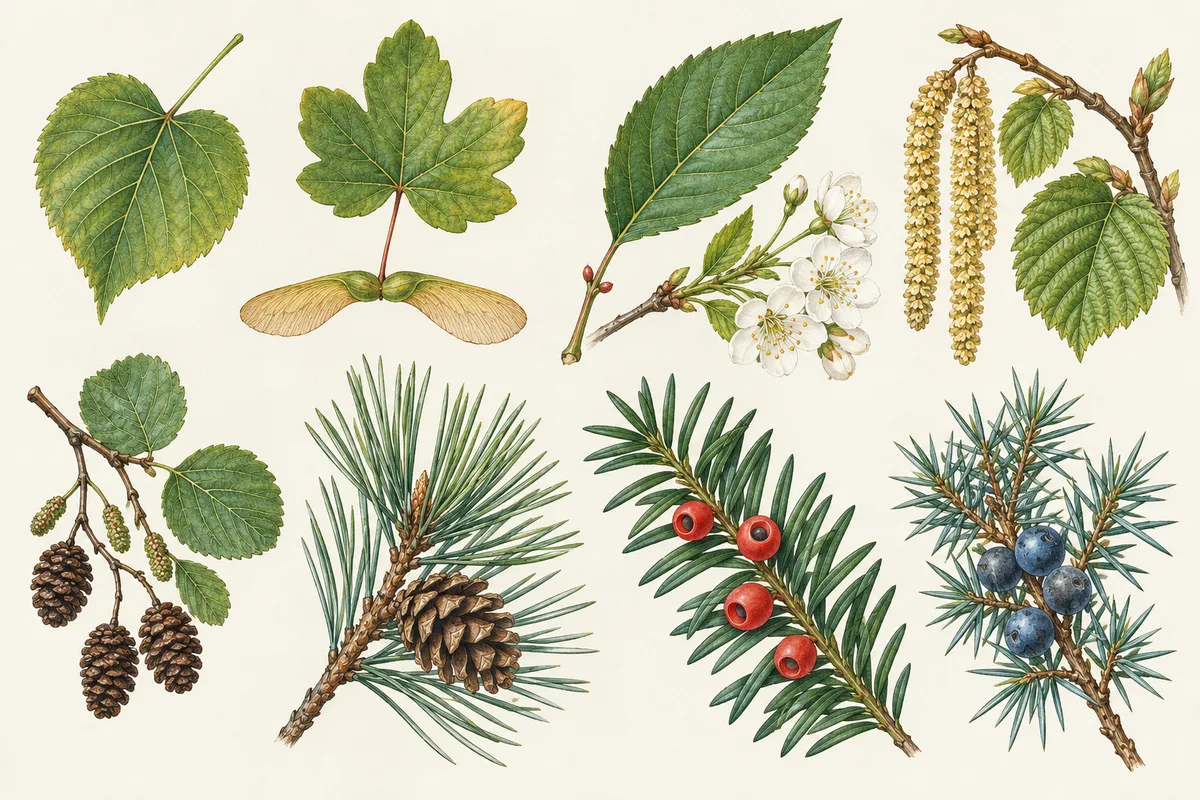
In short
Native trees in the UK are those that colonised the land after the last Ice Age, before Britain was cut off from mainland Europe. The Woodland Trust's list of British native trees has 45 entries, among them English and sessile oak, ash, silver birch, rowan, hazel and hawthorn, and just three native conifers: Scots pine, yew and juniper. Sycamore, horse chestnut and sweet chestnut are not native.
- The Woodland Trust lists 45 British native trees (read 21 October 2026); two entries, common lime and Huntingdon elm, are hybrids.
- Scots pine, yew and juniper are the only native conifers; Scots pine is the only native pine.
- Beech is native, but the Woodland Trust says only in south-east England and south-east Wales; elsewhere in Britain it was planted.
Britain's native trees are the ones that got here on their own. The Woodland Trust's list has 45 of them, but it includes shrubs, two hybrids and some of the rarest trees in Europe, so it helps to know how to read it. Never eat a berry, nut, seed or pod on the strength of a web page or an app; check with a local expert.
What "native" means for British trees
The Woodland Trust's British native trees page defines them by history: native UK trees colonised the land when the glaciers melted after the last Ice Age and before the UK was disconnected from mainland Europe. As the ice retreated, over 10,000 years ago, species recolonised the frozen land from the warmer south. Trees that arrived later came with people, however long ago that was and however wild they look now.
Two consequences matter when you identify trees:
- Native is not the same as common. Sitka spruce and sycamore are both non-native and both among the commonest trees in British woods; our page on the most common trees in the UK has the inventory figures. Arran whitebeam is native and grows on one island.
- Native can be regional. A tree can be native in one part of Britain and planted in another. Beech is the classic case, below.
The list was read on 21 October 2026; the page carries no publication date, so check it again if you need the current version.
The 45 native trees on the Woodland Trust list
The clues come from the Woodland Trust's own descriptions and its A-Z profiles. Links go to our pages where we have one.
Broadleaves with simple leaves
| Tree | One clue | Our page |
|---|---|---|
| Alder | Grows by water; leaf tip rounded or notched, never pointed; small woody cones stay on all winter | Alder |
| Alder buckthorn | Leaves alternate along a smooth, thornless twig | |
| Aspen | Very rounded leaves that tremble in the slightest breeze | Poplar |
| Beech, common | Oval leaves with a wavy edge; smooth grey bark; long, sharply pointed buds | Beech |
| Birch, downy | Fuzzy leaf stalks, shoots and twigs | Birch |
| Birch, silver | Silver-white bark, black and rugged at the base | Birch |
| Blackthorn | Spiny black twigs; white blossom on bare branches in March and April | Hawthorn vs blackthorn |
| Box, common | Small evergreen shrub or tree; Box Hill in Surrey is named after it | |
| Buckthorn, purging | Opposite leaves with 3–5 pairs of curved veins meeting at the tip | |
| Cherry, bird | Almond-scented white blossom in spring | Cherry |
| Cherry, wild | Reddish-brown bark with horizontal lines; red fruits | Cherry |
| Crab apple | Small, hard apples | |
| Dogwood | Buds in opposite pairs; a shrub that bursts into colour in the colder months | |
| Elm, English | Lopsided leaf base; now rare after Dutch elm disease | Elm |
| Elm, field | Lopsided leaf base; grows back easily after Dutch elm disease | Elm |
| Elm, Huntingdon | A hybrid cultivar with some resistance to Dutch elm disease | Elm |
| Elm, wych | Large leaves, 7–16 cm, rough on top, with a lopsided base | Elm |
| Hawthorn | Spiny twigs; deeply lobed leaves; white blossom in May; red haws | Hawthorn |
| Hawthorn, Midland | Shallow-lobed glossy leaves; two seeds in each haw | Hawthorn |
| Hazel | Many stems from the base; "lambs' tail" catkins from February | Hazel |
| Holly | Prickly, glossy evergreen leaves; red berries on female trees only | |
| Hornbeam | Like beech but with finely toothed, pleated leaves | Beech vs hornbeam |
| Lime, common | Hybrid of small- and large-leaved lime; heart-shaped leaves | Lime (linden) |
| Lime, large-leaved | Heart-shaped leaves hairy all over the underside | Lime (linden) |
| Lime, small-leaved | Heart-shaped leaves 3–8 cm, with reddish-brown tufts in the vein joints underneath | Lime (linden) |
| Maple, field | Small lobed leaves; orange or red in autumn; paired winged seeds | Maple |
| Oak, English | Lobed leaves on very short stalks; acorns on long stalks | English oak vs sessile oak |
| Oak, sessile | Leaves on clear stalks; acorns sitting directly on the twig | English oak vs sessile oak |
| Pear, Plymouth | Rare; blossom with an unpleasant smell | |
| Poplar, black | Shiny, heart-shaped leaves with long tips; only about 7,000 wild trees remain | Poplar |
| Spindle | Pink and orange fruits in autumn | |
| Whitebeam | Thick oval leaves, white and felted underneath | |
| Whitebeam, Arran | Found only on the Isle of Arran; a hybrid of rowan and rock whitebeam | |
| Whitebeam, rock | Clings to rocky woods and limestone cliffs | |
| Willow, bay | Very glossy, dark green, finely toothed leaves; mostly in Scotland and northern England | Willow |
| Willow, goat | Male catkins like a cat's paws (pussy willow) | Willow |
| Willow, grey | Soft, silvery look; fuzzy catkins in damp woodland | Willow |
| Wild service tree | Leaves with 3–4 unequal, maple-like lobes; an ancient-woodland indicator |
Broadleaves with compound leaves
| Tree | One clue | Our page |
|---|---|---|
| Ash | Pinnate leaves; black buds in opposite pairs | Ash |
| Elder | Pinnate leaves and clusters of berries; usually a shrub or small tree | |
| Guelder rose | Three-lobed leaves; translucent red berries in bunches | |
| Rowan | Pinnate leaves with toothed leaflets; orange-red berries from August | Rowan |
Native conifers
| Tree | One clue | Our page |
|---|---|---|
| Juniper | Usually a shrub; needles in whorls of three; blue berry-like cones | Conifer identification |
| Pine, Scots | Blue-green needles in pairs; orange upper trunk | Pine |
| Yew | Flat, dark needles; a red fleshy cup around each seed | Yew |
That is 45. Two entries are hybrids rather than species: common lime, which the Trust calls a hybrid between small-leaved and large-leaved lime, and Huntingdon elm, a cultivar. The Trust says Scots pine is one of only three native conifers and the only native pine.
Native trees by where you meet them
The table is alphabetical; in the field it is easier to start from the place.
- Hedgerows: hawthorn, the hedgerow staple; blackthorn, widely used for hedging; and hazel, which the Woodland Trust also lists in scrub and hedges. Hawthorn and blackthorn are the two thorny hedge trees people confuse most; hawthorn vs blackthorn separates them by flowering time, fruit and twig.
- Riversides and wet ground: alder, which the Woodland Trust calls a swamp-dweller whose wood does not rot when waterlogged; bay willow on riverbanks and in wet woodland; grey willow in damp woods.
- Lowland woods: English and sessile oak, ash, beech (in the south-east), hornbeam and wild service tree, an ancient-woodland indicator. Hazel grows in the understorey of lowland oak, ash and birch woods.
- Uplands and the north: Scots pine in the Caledonian pinewoods of the Highlands, downy birch, which grows further north than any other broadleaf in the world, and bay willow, mostly in Scotland and northern England. The rowan grows higher up Scottish hillsides than any other tree.
- Chalk and limestone: box, named in Box Hill on the Surrey chalk, and rock whitebeam in limestone cliffs.
Our guide to identifying British trees groups the commonest of these by leaf type and winter bud. When a tree is out of reach, Tree Identifier can suggest a name from a photo of a leaf, the bark or a fruit; it shows no list of alternatives, so check the clue in the table before you settle.
Commonly mistaken for native
Several of the most familiar trees in Britain are on no native list.
Sycamore. The Woodland Trust's sycamore profile lists it as non-native, thought to have been brought by the Romans, though other reports suggest it arrived in the Tudor era, around the 1500s. The earliest records of it growing wild date from the mid-1800s. Today it covers more woodland in Great Britain than beech does. Its leaf veins are hairy on the underside. See sycamore.
Horse chestnut. The tree of conkers is native to the Balkan Peninsula. The Woodland Trust says it was introduced to the UK in the late 16th century, first brought from Turkey. Its palmate leaves have 5–7 pointed, toothed leaflets spreading from one stalk.
Sweet chestnut. Native to southern Europe, western Asia and North Africa. It was long thought to be a Roman introduction, but the Woodland Trust notes that science does not definitively back this up and that it may have arrived much more recently. Look for widely spaced teeth around the leaf edge. Horse chestnut vs sweet chestnut separates the two chestnuts.
Beech in the north. Beech is on the native list, but the Woodland Trust's common beech profile says it is only considered truly native to south-east England and south-east Wales. A beech wood in Scotland or northern England was planted, however old it is.
Other planted trees. Sitka spruce, the commonest tree in British woods by area, comes from the west coast of North America, and the London plane of city streets is on no native list either; see London plane. Rowan, by contrast, often looks like a garden tree but is a true native.
Native lookalikes worth a second check
A few native pairs are separated by one detail:
- Small-leaved vs large-leaved lime. Turn the leaf over. The Woodland Trust describes small-leaved lime leaves as hairless underneath except for reddish to brown tufts where the veins join; large-leaved lime is hairy all over the underside. Common lime, the hybrid, sits between.
- Alder buckthorn vs purging buckthorn. Alder buckthorn's leaves alternate along the twig; purging buckthorn's are opposite, with curved veins that meet at the leaf tip.
- Hawthorn vs Midland hawthorn. Split a haw: one seed in common hawthorn, two in Midland hawthorn.
- Silver vs downy birch. Feel the young shoots: downy birch is fuzzy, silver birch is not.
For the conifers, our conifer identification guide goes needle by needle, and the yew page covers the native conifer most often found in churchyards.
What a photo can't settle
- Native status is a fact about history, not something you can see in a leaf: a photo can name a tree but not say whether that individual was planted.
- Silver and downy birch, English and sessile oak, and the elms hybridise, so some trees sit between two entries on the list.
- Rare natives such as Arran whitebeam and Plymouth pear grow in very few places; a whitebeam or pear in a park is almost certainly a planted one.
Questions people ask
How many native trees are there in the UK?
The Woodland Trust's list of British native trees has 45 entries (read 21 October 2026). Lists differ because some count shrubs such as box and spindle, rare whitebeams found in one place, and hybrids such as common lime; the Trust includes all three kinds.
Is sycamore native to the UK?
No. The Woodland Trust lists sycamore as non-native, thought to have been brought by the Romans, though other reports put its arrival in the Tudor era. It has been recorded growing wild since the mid-1800s and is now one of Britain's commonest woodland trees.
Is beech a native tree?
Yes, but only in part of Britain. The Woodland Trust says common beech is only considered truly native to south-east England and south-east Wales. Beech woods in Scotland, northern England and elsewhere were planted.
What are the native conifers in the UK?
Three: Scots pine, yew and juniper. Scots pine has blue-green needles in pairs and an orange upper trunk; yew has flat, dark needles and red cups around its seeds; juniper is usually a shrub, with needles in whorls of three and blue berry-like cones.
Which native trees are best for wildlife?
The Woodland Trust says English oak supports more life than any other native tree in the UK, and that 326 species of wildlife are found only on oak. It also singles out goat willow, food for the caterpillars of the purple emperor butterfly, and hazel, whose nuts feed hazel dormice.
Sources
- British native trees — Woodland Trust
- Sycamore (Acer pseudoplatanus) — Woodland Trust
- Horse Chestnut (Aesculus hippocastanum) — Woodland Trust
- Sweet Chestnut (Castanea sativa) — Woodland Trust
- Common Beech (Fagus sylvatica) — Woodland Trust
- Small-leaved Lime (Tilia cordata) — Woodland Trust
Keep reading
- Field guideTree identification in the UK: British trees by leaf, bark and picture
- Field guideThe most common trees in the UK: the top 10 and how to recognise them
- Tree profileHazel (Corylus avellana): how to identify it
- Tree comparisonHawthorn vs blackthorn: how to tell the two hedgerow thorns apart
- Tree profileRowan tree (mountain ash): how to identify it