Tree profile
Yew (Taxus): how to identify it
Flat, dark needles in two rows, green on the underside, a red fleshy cup around each seed and no woody cone anywhere. Here is the order to check them in, and how to tell the yews of North America and Britain apart.
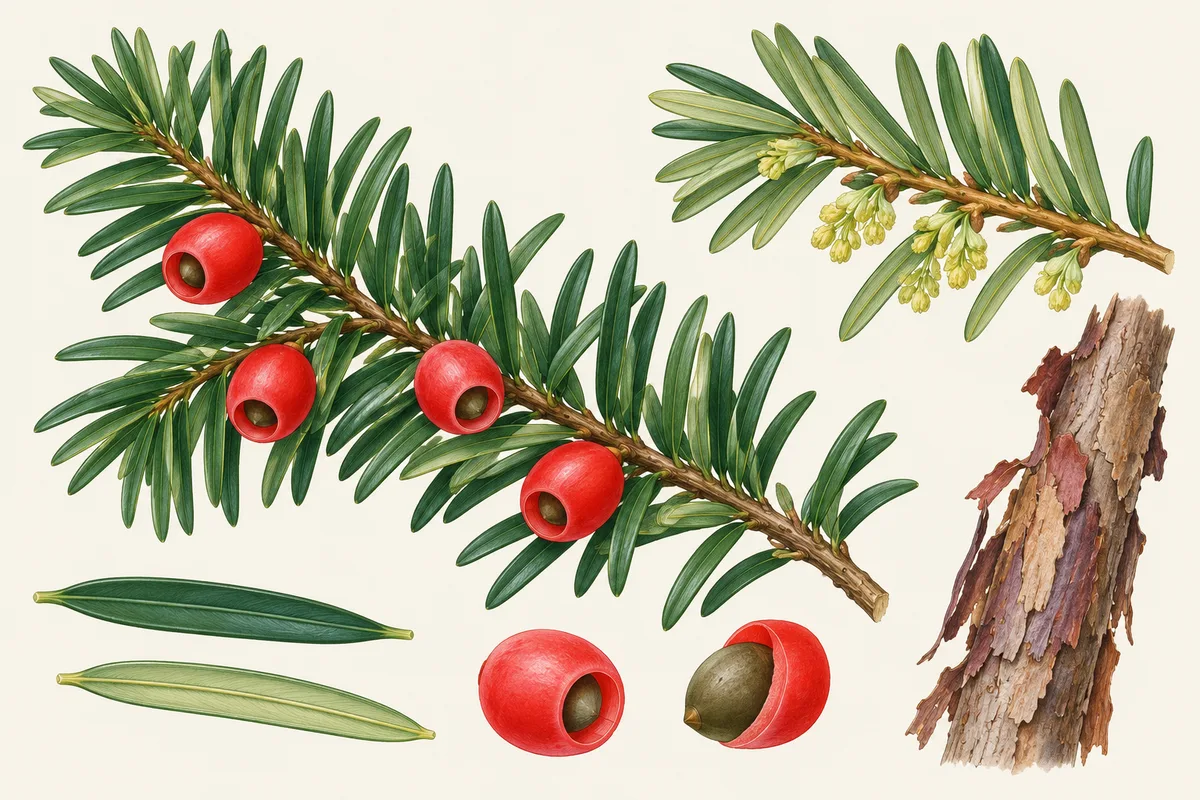
In short
Yew tree identification starts with the needles: flat, pointed, about 1/2 to 1 1/2 inches long, in two rows along green twigs, glossy dark green above and green or yellowish green beneath with no white bands. Female yews carry a single seed in a red, fleshy, open cup (an aril) in fall; yews never bear woody cones. The bark is thin, reddish brown and scaly or peeling.
- Turn a sprig over: hemlock and fir needles show white bands beneath, yew needles do not.
- Red cups instead of cones settle it, but only female yews carry them, so a male plant has to be named from its needles and bark.
- The Woodland Trust and NC State Extension both report yew bark, needles and seeds as poisonous.
Field marks at a glance
- Scientific name
- Taxus baccata, T. brevifolia, T. canadensis, T. cuspidata, T. × media
- Family
- Taxaceae (yew family)
- Type
- Conifer, evergreen
- Needles
- Single, flat, pointed, 0.4 to 1.6 inches (1 to 4 cm) long on English yew; arranged in two rows along the twig; glossy dark green above, green to yellowish green beneath, with no white bands.
- Fruit
- No woody cone. Female plants bear one seed partly enclosed in a red, fleshy, open cup (an aril), in fall. Male plants carry no red fruit at all.
- Bark
- Thin, reddish brown, scaly or peeling; purple tones on English yew, purplish and papery on Pacific yew.
- Flowers
- Male and female flowers on separate plants, in March and April in Britain: small pale globes of pollen on males, tiny bud-like scales on females.
- Form and size
- English yew 30 to 60 ft tall in North American landscapes, to about 65 ft (20 m) in Britain; often a clipped hedge or shrub. Canada yew is a sprawling shrub about 6 ft (2 m) tall.
- Range
- English yew: Europe, western Asia and North Africa, widely planted. Pacific yew: southeast Alaska to central California. Canada yew: eastern Canada and the northeastern US. Japanese yew: Japan, Korea, China and Russia.
- Toxicity
- Bark, needles and seeds are reported poisonous to people and animals by the Woodland Trust and NC State Extension. Never eat any part.
Yews (Taxus) are the dark, dense evergreens of churchyards in Britain and of foundation plantings and clipped hedges across North America. They are conifers without cones: a female yew carries each seed in a red, fleshy cup. Check three things in this order: the needles, the underside of the needles, then the fruit and bark. Never eat a berry, nut, seed or pod on the strength of a web page or an app; check with a local expert.
In the UK, most searches for "yew tree" turn up pubs, schools and farms named after the tree. This page is about the tree.
What to check first: flat needles, plain underside, red cup
1. Flat needles in two rows. Pull a sprig. Yew needles are single, flat and pointed, and on English yew they are 0.4 to 1.6 inches long, according to the NC State Extension profile of English yew. The Woodland Trust describes them as straight and small with a pointed tip, growing in two rows along each twig.
2. The underside. Turn the sprig over. This is the test that separates yew from hemlock and fir. The Woodland Trust describes yew needles as dark green above and green-grey below, with a raised central vein underneath; NC State calls the underside yellowish green. Neither describes any white band, and that is the point: hemlocks and firs both show white or silvery lines beneath their needles (see the conifer identification guide).
3. The red cup. From late summer into fall, female yews carry a single seed partly enclosed in a red, fleshy, open cup called an aril. The cup is open at the top, so you can see the dark seed inside. A yew never has a woody cone, on the branch or on the ground.
4. The bark. Yew bark is thin, scaly and reddish brown (NC State); the Woodland Trust adds purple tones and peeling strips.
Male yews carry no red cups. The Woodland Trust notes that yew is dioecious: male and female flowers grow on separate trees, visible in March and April, the males as small pale globes, the females as tiny bud-like scales. If a yew hedge never fruits, it may simply be male.
Tree Identifier can name a yew from one photo of a sprig, and English yew (Taxus baccata) is one of the species in the app's Collection. The app shows no confidence score and no list of look-alikes, so check the needle underside yourself before you accept a yew over a hemlock.
Yew is reported toxic: what the sources say
The Woodland Trust says the seed inside the red aril is poisonous to humans, and so are the bark and leaves; it describes the red fleshy part itself as not toxic and the tree as extremely poisonous to livestock. NC State Extension lists the bark, leaves, seeds and stems as toxic parts, rates English yew as a high-severity poison and reports it highly poisonous to humans, children, dogs, cats and horses. Its page for the hybrid Taxus × media gives the same rating.
That is why this page gives no tips on handling or tasting any part of a yew. If a child or a pet has chewed one, call a poison control center or a veterinarian, and take a sprig with you. Tree Identifier's Toxicology notes are AI-written and are not a safety verdict.
The yews of North America and Britain
| Yew | Where | Form | Needle underside | Notes |
|---|---|---|---|---|
| English yew (T. baccata) | Europe, western Asia, North Africa; planted in North America | Tree 30–60 ft (NC State), to about 65 ft (20 m) in Britain | Yellowish or grey-green | The yew of British churchyards and hedges |
| Irish yew (T. baccata 'Fastigiata') | Planted, from one Irish tree | Narrow upright column | Very dark green | All female |
| Pacific yew (T. brevifolia) | Southeast Alaska to central California | Understory tree, rarely over 49 ft (15 m) | Dark green | Purplish, papery bark |
| Canada yew (T. canadensis) | Eastern Canada and the northeastern US | Sprawling shrub about 6 ft (2 m), no trunk | Pale green | Also called ground-hemlock |
| Japanese yew (T. cuspidata) | Japan, Korea, China, Russia; planted | Multi-stemmed, 10–25 ft in landscapes | Yellow-tinged | Needles under 1 inch |
| Hybrid yew (T. × media) | Planted | Shrubby, columnar or spreading | Paler than the top | English × Japanese yew |
Pacific yew. The USDA Forest Service's Silvics of North America describes a shade-tolerant tree that usually grows in the understory of undisturbed forests, from the southern tip of southeast Alaska to Calaveras County in California. It rarely exceeds 24 inches (60 cm) in diameter and 49 feet (15 m) in height. Its needles are dark green on the underside and two-ranked; the bark is purplish, papery thin and scalelike, rose red where freshly exposed; the seed is about 0.3 inch (8 mm) long, partly enveloped by a scarlet cup. The same publication notes that taxol, a compound used in cancer research, was first found in its bark.
Canada yew. Natural Resources Canada's Trees of Canada describes a straggling, multistemmed shrub with no trunk, about 2 m tall, whose stems trail in the forest humus with upturned tips. It is shade-tolerant, grows in colonies in eastern Canada and is also called ground-hemlock (if du Canada in French). If you find a knee-high yew carpeting a shady northern forest floor, this is it.
Japanese and hybrid yews. Most yews in US foundation plantings are Japanese yew or the hybrid between English and Japanese yew. The NC State profile of Japanese yew gives needles under 1 inch, dark green above and yellow-tinged beneath, and a native range of Japan, Korea, China and Russia; it is very cold hardy, listed for USDA zones 4a to 7b. The hybrid (Taxus × media) comes in shrubby, columnar and spreading forms used as foundation plants, hedges, topiary and screens, with red fleshy cones on female plants (NC State).
Irish yew. The tall, narrow, almost black-green columns in British and Irish churchyards and in older American gardens are Irish yews. The BSBI's Fermanagh Flora traces them to plants found by a farmer, George Willis, on Cuilcagh mountain above Florence Court in County Fermanagh, some time before 1767 and perhaps as early as 1740. One plant went to his landlord at Florence Court and survives as the mother tree. It is female and easily propagated from cuttings, so Irish yews are female too.
Ancient yews and British churchyards
In Britain the yew is above all a churchyard tree, and a very old one. The Woodland Trust calls it probably the most long-lived tree in northern Europe, says a yew isn't considered ancient until it reaches 900 years, and reports that ten yew trees in Britain are believed to predate the 10th century. It also counts at least 500 churchyards in England that contain yews older than the church buildings themselves.
Treat every age you read on a churchyard sign as an estimate: even the Woodland Trust says those ten trees are believed, not known, to be that old, and no one has counted their rings. The identification is easier than the dating: an ancient yew still has flat needles in two rows, green underneath, and red cups on female trees each fall.
In the wild, the Woodland Trust says, yew is common in southern England and often forms the understory of beech woodland. Blackbirds, mistle thrushes, song thrushes and fieldfares eat the red arils, and dense yew hedges give birds cover and nest sites. For the other trees to learn first in Britain, see tree identification in the UK.
How to tell a yew from hemlock, fir, plum yew and juniper
Hemlock. The most common mix-up in North America, because eastern hemlock also has flat, short needles in two rows. Hemlock needles are about 1/2 inch with two white lines beneath, and the twig carries tiny extra needles along its top; its cones are small, brown and hanging. Canada yew's other name, ground-hemlock, shows how old this confusion is.
Fir. Fir needles are flat too, but silvery or whitish beneath, and firs carry woody cones that stand upright on the top branches. The spruce vs fir page explains how to recognize a fir first.
Plum yew. Japanese plum yew (Cephalotaxus harringtonia) is a planted look-alike, and NC State says it tolerates summer heat and humidity unlike other yews. Its needles, 0.5 to 1.2 inches, have two whitish bands beneath, and its fruit looks like a small olive or plum up to 1 inch long, with the fleshy layer nearly surrounding the seed.
Juniper. Junipers have scale leaves or prickly needles, never soft flat needles in two rows, and their fruit is a hard, berry-like blue cone. If the red fruit is the clue that brought you here, the tree with red berries guide covers holly, hawthorn, dogwood and the other red-fruited trees.
In winter, yew is one of the easiest conifers to spot in a leafless hedge or woodland because it stays so dark. To keep track of a churchyard yew or a fruiting hedge you want to revisit, Tree Identifier's Tree Map pins each located identification so you can find it again.
Look-alikes and how to tell them apart
Eastern hemlock (Tsuga canadensis)
Turn the sprig over: hemlock needles are shorter, about 1/2 inch, with two white lines beneath, and tiny extra needles lie along the top of the twig. Hemlock carries small hanging woody cones about 3/4 inch long; a yew never has cones.
Fir (Abies), such as balsam fir
Fir needles are silvery or whitish beneath, often notched at the tip, and leave a round, flat scar when pulled. Firs carry upright woody cones high in the crown and have resin blisters on smooth bark; a yew has red cups and scaly, reddish bark.
Plum yew (Cephalotaxus harringtonia)
Plum yew needles carry two whitish bands on the underside, and its fruit is an olive-like, plum-shaped body up to 1 inch long that nearly encloses the seed. A true yew's red cup is open at the top, showing the dark seed.
Eastern redcedar and other junipers (Juniperus)
Junipers have tiny overlapping scale leaves, or prickly needles in threes on young shoots, never flat needles in two rows. Their fruit is a hard, berry-like cone, dark blue with a white bloom, not an open red cup.
What a photo can't settle
- Only female yews bear the red cups, and Irish yews are all female; a male plant, or a sheared hedge with no fruit, has to be named from needles and bark alone.
- The hybrid yews of foundation plantings (Taxus × media) blend English and Japanese yew traits and come in many cultivars, so a photo can confirm a yew but not reliably which species or cultivar.
- Whether a child or a pet that chewed a yew is at risk is never settled by a web page or an app: call a poison control center or a veterinarian.
Questions people ask
What does a yew tree look like?
A dense, dark evergreen, often clipped into a hedge, with flat, pointed needles about 1/2 to 1 1/2 inches long in two rows, glossy dark green above and paler green beneath. The bark is thin, reddish brown and scaly. In fall, female plants carry red, fleshy cups, each holding one dark seed.
Are yew berries poisonous?
The red cup is not a true berry but an aril around a seed. The Woodland Trust says the seed inside is poisonous to humans, as are the bark and leaves. NC State Extension rates English yew as highly poisonous to people, dogs, cats and horses. Never eat any part, and call poison control if a child or pet has.
How do you tell a yew from a hemlock?
Turn a sprig over. Hemlock needles have two white lines underneath and are about 1/2 inch long; yew needles are longer and plain green or yellowish green beneath. Then look for fruit: hemlocks carry small brown woody cones, yews carry red fleshy cups and no cones.
How old are churchyard yews?
Often very old, but the ages are estimates. The Woodland Trust says at least 500 churchyards in England contain yews older than the church buildings, and ten British yews are believed to predate the 10th century. It counts a yew as ancient only from about 900 years.
What does a Pacific yew tree look like?
A small understory tree of moist Pacific Northwest forests, rarely over 49 feet (15 m) tall according to the USDA Forest Service, with two-ranked needles that are dark green on the underside, purplish, papery, scaly bark that shows rose red beneath, and a seed about 0.3 inch long in a scarlet cup.
Is a yew a conifer if it has no cones?
Yes. Yews are cone-bearing plants in the broad sense, but each female cone is reduced to a single seed wrapped in a fleshy red aril, so you never find a woody cone under a yew. NC State Extension describes the red aril as a fleshy cone.
Sources
- Yew (Taxus baccata) — Woodland Trust
- Taxus baccata (English yew) — NC State Extension Gardener Plant Toolbox
- Taxus × media (Anglojap yew) — NC State Extension Gardener Plant Toolbox
- Taxus cuspidata (Japanese yew) — NC State Extension Gardener Plant Toolbox
- Pacific Yew (Taxus brevifolia), Silvics of North America — USDA Forest Service
- Canada yew (Taxus canadensis) — Natural Resources Canada, Trees of Canada
- Taxus baccata 'Fastigiata', Irish Yew — Fermanagh Flora, BSBI (Botanical Society of Britain and Ireland)
- Cephalotaxus harringtonia (Japanese plum yew) — NC State Extension Gardener Plant Toolbox
Keep reading
- Field guideConifer identification: three questions about the needles, then the cone
- Tree comparisonSpruce vs fir: how to tell them apart
- Clue guideWhich tree has red berries? Sort it by leaf and season
- Field guideTree identification in the UK: British trees by leaf, bark and picture
- Winter field guideWinter tree identification, from buds to bark