Also in Français
Tree profile
London plane tree (Platanus × hispanica): how to identify it
Patchwork bark, spiky seed balls that usually hang in twos, and big lobed leaves set one per node: three checks separate the London plane from the American sycamore, the oriental plane and the maples.
In short
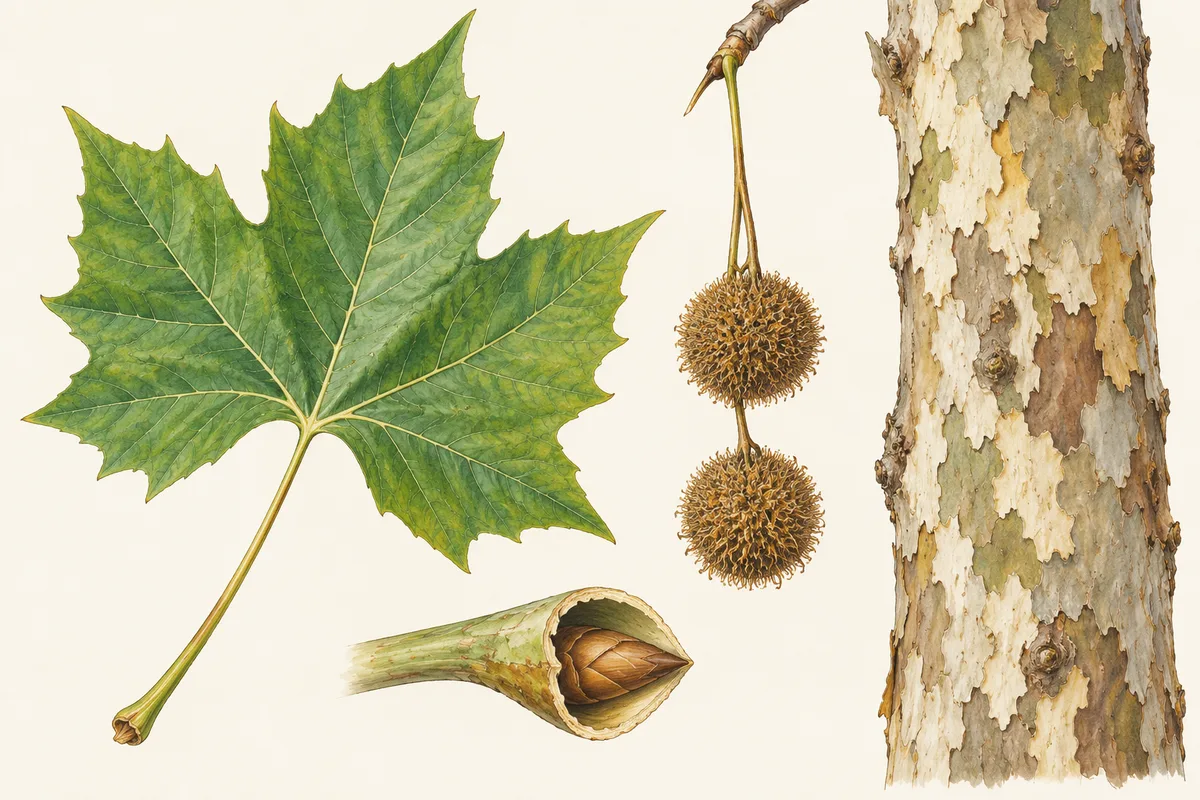
The London plane tree is Platanus × hispanica (also listed as P. × acerifolia), a hybrid of the American sycamore and the oriental plane. Identify it by bark that flakes in large plates to leave olive, gray and cream camouflage patches; by bristly seed balls about 1 inch across that usually hang in pairs on one stalk; and by leathery, maple-like leaves with three to five lobes set alternately on the twig.
- Count the seed balls on one stalk: usually one on the American sycamore, usually two on the London plane, three to six on the oriental plane.
- Leaves one per node mean a plane; leaves in opposite pairs mean a maple, including the British sycamore.
- In Britain, sycamore means a maple (Acer pseudoplatanus); in North America it means a plane tree (Platanus occidentalis).
Field marks at a glance
- Scientific name
- Platanus × hispanica (syn. Platanus × acerifolia)
- Family
- Platanaceae (plane family)
- Type
- Broadleaf, deciduous
- Parentage
- A hybrid of the American sycamore (Platanus occidentalis) and the oriental plane (P. orientalis), first noticed in a London garden in the mid-17th century.
- Leaves
- Alternate, 6 to 7 inches (15–18 cm) wide, thick and leathery, with three to five lobes, maple-like; edges untoothed or nearly so. Yellow-brown to orange-yellow in fall.
- Seed balls
- Bristly balls about 1 inch (2.5 cm) across on long stalks, usually two per stalk; they hang into winter and break up to release hairy seeds.
- Bark
- Olive-green to gray-brown, flaking in large plates to show cream, white and green patches: the camouflage look. Upper trunk and limbs nearly white.
- Buds
- One per node, alternating up the twig, enclosed by the base of the leaf stalk while the leaf is on; round, with two or three scales, and the leaf scar almost circles it.
- Size
- 70 to 100 ft (21–30 m) tall and 65 to 80 ft wide in US landscapes; up to 35 m (115 ft) in Britain. Fast-growing; can live several hundred years.
- Where
- Planted along streets and in parks, especially in London and other large cities; hardy in USDA zones 5 to 8.
- In the app
- Listed in Tree Identifier's Collection under Platanus × acerifolia, alongside the American sycamore.
The London plane is the big street tree with patchwork bark that lines the streets of London and many other large cities in Europe and North America. It is a hybrid of two plane trees, so it has look-alikes on both sides of its family, and in Britain the word "sycamore" adds a maple to the confusion. Three checks settle it: the bark, the seed balls on one stalk, and whether the leaves sit one per node or in pairs.
How to identify a London plane: bark, seed balls, leaves
1. The bark. The Woodland Trust's London plane profile describes olive-green to gray bark with large scaly plates that peel to show creamy bark beneath, a camouflage pattern. The Morton Arboretum adds white, gray and green patches and an upper trunk and limbs that look nearly white.
2. The seed balls. From late summer through winter the tree carries bristly balls about 1 inch across on long stalks. Morton says London plane's hang in pairs from each stalk. Count several stalks: two balls on most of them points to a London plane.
3. The leaves. London plane leaves are alternate, 6 to 7 inches wide, leathery, with three to five lobes like a maple's; Morton gives the edges as untoothed or nearly so, and the Woodland Trust describes five triangular lobes that are not serrated. Pull a leaf off in summer: the swollen base of the stalk encloses the bud, so the bud only appears once the leaf is gone, a mark Virginia Tech also gives for the American sycamore.
If the seed balls are 50 feet up, photograph the bark or one fallen ball and let Tree Identifier suggest a name. The app shows no confidence score and no list of alternatives, so finish with the seed-ball count and the leaf arrangement.
London plane, sycamore, oriental plane and maples compared
| Tree | Seed balls per stalk | Leaves | Bark | Status |
|---|---|---|---|---|
| London plane (Platanus × hispanica) | Usually 2 | Alternate; 3–5 shallow lobes; edges nearly untoothed; leathery | Olive, gray and cream patches; large plates | Hybrid; planted street and park tree |
| American sycamore (P. occidentalis) | Usually 1 | Alternate; 3–5 lobes; coarse teeth | Brown, green, tan and white; old base gray-brown and scaly | Native to eastern North America |
| Oriental plane (P. orientalis) | 3–6 | Alternate; 5–7 deep, narrow lobes | Cream, flaky, in smaller flakes | Native to southeastern Europe and western Asia; planted |
| Sycamore maple (Acer pseudoplatanus), see sycamore | None: paired winged seeds | Opposite; 5 toothed lobes | Pinkish-gray, small plates | Introduced in Britain; the UK's "sycamore" |
| Norway and sugar maple, see maples | None: paired winged seeds | Opposite; 5 lobes, pointed teeth | Furrowed, no camouflage patches | Native or planted |
The American sycamore figures come from Virginia Tech's sycamore fact sheet, which describes a single seed ball on a 3 to 6 inch stalk and leaves 4 to 8 inches wide with coarse teeth. The oriental plane figures come from the University of Florida's oriental planetree fact sheet, which counts three to six fruits per stalk and calls the leaves more deeply lobed than London plane's, and from the New Zealand Plant Conservation Network's Platanus orientalis page, which gives London plane seed balls as typically two, sometimes one to four, per stem against three to six on the oriental plane, and five-lobed leaves against five to seven.
Where the London plane came from
The Woodland Trust says the two parents, American sycamore and oriental plane, grew together in a London nursery garden, the garden of John Tradescant the younger, and crossed by chance; the hybrid was noticed in the mid-17th century and named after the city. Widespread planting began in the late 18th century. The Trust calls it the capital's most common tree, says it has the largest leaf area of any species in Inner London, and links its shedding bark to its tolerance of air pollution.
Botanists list it under two names. Platanus × hispanica is the name used by the Woodland Trust and most European floras; Platanus × acerifolia is the name used by the Morton Arboretum and most US nurseries. They mean the same tree.
The London plane in American cities
In North America the London planetree is planted as a street and park tree. The Morton Arboretum lists it for USDA zones 5 to 8 and gives 70 to 100 feet tall and 65 to 80 feet wide, with fast growth, tolerance of high-pH soil, and moderate drought and salt tolerance. It names canker stain, anthracnose, leaf spots, aphids, plant bug, scale and borers among its problems, and notes that resistance to anthracnose varies by cultivar: 'Bloodgood' shows some, and two cultivars introduced through the Arboretum, 'Morton Circle' and 'Morton Euclid', are listed as resistant to anthracnose and frost cracking.
The University of Florida notes that anthracnose can be devastating to the American sycamore and that the oriental plane, the other parent, is more resistant, which is part of why the hybrid has been favored for streets.
Sycamore: the name that means two trees
Ask about a "sycamore" in Britain and you mean Acer pseudoplatanus, a maple. The Woodland Trust lists it as the London plane's main look-alike, because the five-lobed leaves are so similar; its sycamore profile gives leaves 7 to 16 cm across and paired winged seeds in a narrow V. The fastest field test is the twig: maple leaves and buds sit in opposite pairs, plane leaves one per node. Our sycamore page covers both meanings of the word.
Ask in the United States or Canada and you mean Platanus occidentalis, the London plane's American parent. Tree Identifier's Collection, the 138-species catalog that fills in as you identify, lists both the American sycamore and the London plane, the latter as Platanus × acerifolia. For other trees with hanging spiky fruit, see trees with spiky balls, and for bark patterns in general, how to identify trees by bark.
Look-alikes and how to tell them apart
American sycamore (Platanus occidentalis)
Usually a single seed ball per stalk, not two. Leaves are coarsely toothed rather than nearly smooth-edged, and old trunks turn gray-brown and scaly at the base with the white, peeling bark higher up.
Oriental plane (Platanus orientalis)
Leaves are cut much more deeply, into five to seven narrow lobes, and three to six seed balls hang from each stalk, against about two on the London plane. Mostly a park and avenue tree outside its native southeastern Europe and western Asia.
Sycamore maple (Acer pseudoplatanus), the British sycamore
Leaves and buds sit in opposite pairs, the leaf edges are toothed, and the fruit is a pair of winged seeds in a narrow V, never a ball. The bark is pinkish-gray and cracks into small plates, without cream patches.
Maples with large lobed leaves (Norway, sugar maple)
All maples have opposite leaves and buds and winged seeds; break a Norway maple leaf stalk and milky sap appears. A tree with alternate leaves and seed balls is a plane, whatever its leaf shape.
What a photo can't settle
- Plane trees in parks and streets include London plane cultivars, American sycamores and oriental planes, and backcrosses between them blur the seed-ball count; check several stalks before deciding.
- Seed-ball counts are only visible from late summer to late winter; in spring and early summer you have to rely on leaf lobing and bark.
- A photo of a single leaf can't show whether it was alternate or opposite on the twig, which is the fastest test against a maple; photograph a twig with two or more leaves.
Questions people ask
Is a London plane the same as a sycamore?
No, but it is half American sycamore. The London plane is a hybrid of the American sycamore and the oriental plane, so it shares the camouflage bark and seed balls. It usually carries two seed balls per stalk where the sycamore carries one, and its leaves are nearly untoothed where the sycamore's are coarsely toothed.
Why is it called the London plane?
Because it was first noticed in London. The Woodland Trust says the two parent species grew in the same London nursery garden in the mid-17th century and crossed by chance; widespread planting along London streets began in the late 18th century, and the Trust calls it the capital's most common tree.
Why does London plane bark peel?
The thin outer bark flakes away in large plates, leaving the cream, olive and gray patchwork. The Woodland Trust links this shedding to the tree's tolerance of polluted city air, since the flakes carry away deposits on the bark surface.
Are London plane seed balls a problem?
They are messy rather than harmful. The Morton Arboretum notes that the tree drops many leaves, twigs and fruit, and that the seed balls shatter during winter into hairy seeds. That litter is the main complaint about plane trees on lawns and sidewalks.
Sources
- London Plane (Platanus x hispanica) — Woodland Trust
- London planetree (Platanus × acerifolia) — The Morton Arboretum
- American sycamore (Platanus occidentalis) fact sheet — Virginia Tech Dendrology
- Platanus orientalis: Oriental Planetree (ENH644/ST485) — UF/IFAS Extension, University of Florida
- Platanus orientalis — New Zealand Plant Conservation Network
- Sycamore (Acer pseudoplatanus) — Woodland Trust
Keep reading
- Tree profileSycamore tree: the British maple and the American plane tree
- Tree profileMaple trees (Acer): how to identify them
- Field guideTree bark identification: seven bark types and the trees that have them
- Clue guideWhich tree has spiky balls? Six candidates and how to tell them
- Field guideTree identification in the UK: British trees by leaf, bark and picture