Tree profile
Hazel (Corylus avellana): how to identify it
Yellow catkins on bare twigs in February, round soft leaves with a double row of teeth, nuts in a frilly husk, and a bush of many stems. Here is what to check, season by season.
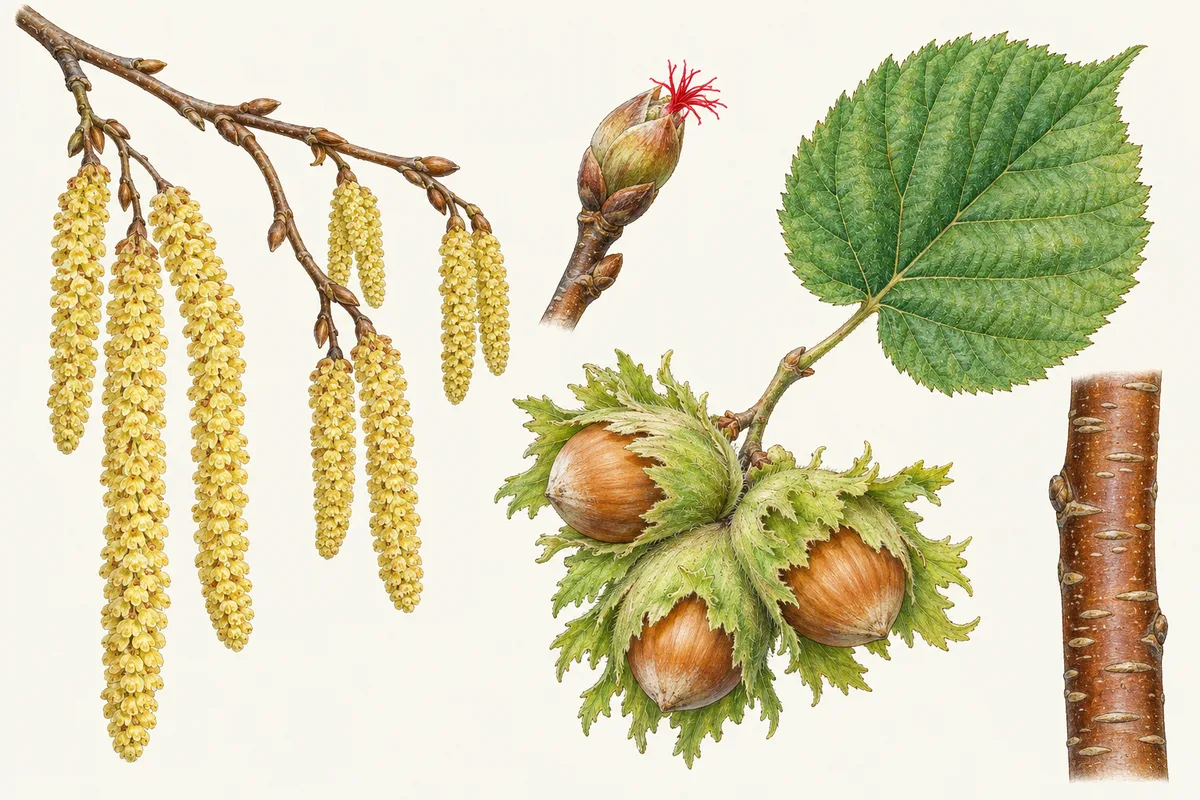
In short
Hazel tree identification starts with the shape: common hazel usually grows as several stems from one base rather than a single trunk. From February it hangs pale yellow catkins, the "lambs' tails", up to 5 cm long, with tiny red female flowers on the same twigs. Its leaves are round to oval, about 10 cm across, doubly toothed and soft with hairs, and its nuts sit in a short leafy husk.
- Hazel's catkins open in February, when most trees are still bare, and the tiny red tufts beside them are the female flowers.
- Rounded, soft, hairy leaves with a double row of teeth and a pointed tip separate hazel from alder, hornbeam, elm and lime.
- Hazel is traditionally coppiced: cut to the base on a cycle of about eight years, it regrows as a ring of straight poles.
Field marks at a glance
- Scientific name
- Corylus avellana
- Family
- Betulaceae (birch family)
- Type
- Broadleaf, deciduous
- Form
- Usually several stems from or near ground level, from a base (stool) that can reach 2 m across. Up to 8–12 m if left to grow; usually under 6 m in Scotland.
- Male catkins
- Pale yellow, up to 5 cm long, hanging in clusters from mid-February, before the leaves: the lambs' tails. Small green catkins already show in autumn.
- Female flowers
- Tiny, red tufts growing from swollen, bud-like flowers on the same branches as the catkins.
- Leaves
- Round to oval with a pointed tip, about 10 cm across, doubly toothed, hairy and soft underneath; yellow in autumn.
- Nuts
- Up to 2 cm, in groups of one to four, each sitting in a short, leafy husk covering about three-quarters of it; ripe brown in September and October.
- Twigs and buds
- Stems bendy and hairy; leaf buds oval, blunt and hairy, alternate along the twig.
- Bark
- Smooth and grey-brown, peeling with age.
- Lifespan
- About 50 to 80 years uncut; coppiced hazel can live for several hundred years.
- Range
- Native across much of Europe, parts of North Africa and western Asia; throughout Britain, including Orkney, Shetland and the Outer Hebrides.
Common hazel (Corylus avellana) is the many-stemmed shrub of British woods and hedges that flowers in the middle of winter. Never eat a berry, nut, seed or pod on the strength of a web page or an app; check with a local expert. It is one of the easiest trees to name in February and one of the easiest to confuse in July, so this page goes season by season.
How to identify hazel: five checks
1. The shape. Trees for Life describes hazel as typically growing several stems or trunks from or near ground level, which is why many people call it a bush. Left alone it can reach 10 m, but in Scotland it usually stays under 6 m.
2. The catkins. Pale yellow male catkins, up to 5 cm long, open in February, when the surrounding trees are still bare. The Woodland Trust's hazel profile calls them catkins resembling lambs' tails, hanging in clusters from mid-February before the leaves.
3. The tiny red flowers. Look closely at the twigs beside the catkins for small, bud-like shapes with crimson tufts. These are the female flowers. They are wind-pollinated and need pollen from another hazel.
4. The leaves. Round to oval, pointed at the tip, doubly toothed (large teeth with smaller teeth on them) and hairy. The Woodland Trust notes they feel soft because of downy hairs underneath. Trees for Life gives a width of about 10 cm. They turn yellow before falling in autumn.
5. The nuts. Oval fruits hang in groups of one to four. Each nut, up to 2 cm, sits in a short, leafy husk that covers about three-quarters of it, and ripens brown in September and October.
When the catkins are too high to see clearly, a photo of a twig in February, or of a leaf and husk in autumn, is a good one to give Tree Identifier. Common hazel is in the app's Collection, the 138-species field guide that fills in as you identify. The app shows no confidence score or alternative species, so confirm the double teeth and soft hairs yourself.
Hazel through the year
- Late winter (February–March): yellow catkins on bare twigs, red female flowers beside them. Trees for Life counts the catkins among the first signs of spring in the forest.
- Spring: leaves open after the catkins; until then the leaf buds are oval, blunt and hairy.
- Summer: round, soft leaves; young nuts form in their green husks. This is the season for confusion with elm, hornbeam and lime, below.
- Autumn (September–October): nuts turn brown and fall; leaves turn yellow. Small green catkins for next year are already visible.
- Winter: smooth grey-brown bark, bendy hairy twigs and the many-stemmed outline. Our winter tree identification guide covers reading buds.
The nuts are eaten by dormice, woodpeckers, nuthatches, jays, wood pigeons and small mammals, according to the Woodland Trust, and Trees for Life adds that red squirrels and rodents spread them by hoarding nuts they then forget. Hazel nuts are also the ones sold as hazelnuts, and cobnuts are a cultivated variety grown in Kent. This page does not cover foraging.
Coppicing: why hazel looks like a ring of poles
Many hazels you meet have been coppiced. The National Trust describes coppicing as felling trees at the base to create a stool from which new shoots grow, a technique that dates back to the Stone Age. It says hazel is usually coppiced on an eight-year cycle, against 15 to 20 years for sweet chestnut. Cutting opens the wood to light, which benefits many plants and animals, dormice among them.
That is why a coppiced hazel looks like a fan of straight, similar-sized poles springing from one low stump. Trees for Life notes the stool can reach 2 m across, and that while uncut hazel lives about 50 to 70 years, coppiced hazel can live for several hundred. The Woodland Trust lists the poles' uses as pea sticks and bean poles, and historically thatching spars, hurdles and furniture. An overgrown coppice, with thick stems from a wide base, still shows the pattern.
Where hazel grows: in Britain, in the understorey of lowland oak, ash or birch woods, in scrub and in hedgerows (Woodland Trust). Trees for Life records it throughout Scotland, including the Outer Hebrides, Orkney and Shetland, common in the western Highlands and forming nearly pure stands in Argyll. It is on the Woodland Trust's list of UK native trees.
Hazel look-alikes: alder, hornbeam, elm and lime
In leaf, without catkins or nuts, four trees can pass for hazel.
Alder. Alder also hangs catkins in late winter, but its leaf is different: the Woodland Trust says the tip is never pointed and is often indented, the leaves are leathery, and the buds are purple or grey on long stalks. Alder keeps small woody cones on its branches through winter, and it grows by rivers, ponds and lakes. See alder.
Hornbeam. Hornbeam leaves are oval with pointed tips and finely toothed, with a pleated look, shaped like a small beech leaf rather than hazel's round outline. Its fruit is a small nut held in a leafy, three-lobed bract, with papery wings, not a hazelnut in a husk. Hornbeam usually grows into a single-trunked tree with pale grey bark. Beech vs hornbeam has the full description.
Wych elm and English elm. The Woodland Trust's wych elm profile gives leaves 7–16 cm long, rough to the touch on the upper surface, with a characteristic asymmetrical base. The Woodland Trust's hazel page names English elm as hazel's look-alike for the same reasons: elm leaves are roughly hairy where hazel's are soft, and lopsided at the base. Run a finger over the leaf: sandpaper means elm. See elm.
Lime. Small-leaved lime leaves are heart-shaped with a pointed tip, 3–8 cm long, and hairless underneath except for reddish-brown tufts where the veins join. Hazel leaves are hairy all over underneath and doubly toothed. Limes grow as tall single-trunked trees. See lime (linden).
American hazelnut and beaked hazel
North America has its own hazels, which grow as shrubs rather than trees. American hazelnut (Corylus americana) grows 6 to 10 ft (about 2–3 m) high as an understorey shrub and along wood edges in eastern North America and Canada, according to the Morton Arboretum, with yellow catkins, tiny pink female flowers, ovate to heart-shaped toothed leaves and nuts in a frilly husk ripening in September and October. Beaked hazel (Corylus cornuta) is a suckering shrub, often in clumps about 6 ft (1.8 m) high, with doubly serrated leaves 2 to 4 in (5–10 cm) long; Virginia Tech Dendrology singles out its bristly husk drawn out into a long, tube-like beak, which American hazelnut lacks. To place a North American hazel, check the husk: frilly is American hazelnut, drawn into a long beak is beaked hazel, and a short leafy husk covering three-quarters of the nut matches the European description above.
Look-alikes and how to tell them apart
Alder (Alnus glutinosa)
Alder also has catkins in late winter, but its leaf tip is never pointed and often notched, its buds are purple and stalked, and its small woody cones stay on the tree all year. It grows by water.
Hornbeam (Carpinus betulus)
Hornbeam leaves are oval, finely toothed and pleated, narrower than hazel's round leaves, and its seeds are winged nutlets in a three-lobed bract, not nuts in a husk. It usually grows a single trunk.
Wych elm (Ulmus glabra)
Wych elm leaves are larger, 7–16 cm, rough on the upper surface like sandpaper, and lopsided at the base. Hazel leaves are soft and almost symmetrical at the base.
Small-leaved lime (Tilia cordata)
Lime leaves are heart-shaped and hairless underneath except for small reddish tufts where the veins join; hazel's are soft-hairy all over the underside and doubly toothed.
What a photo can't settle
- In summer, a hazel leaf can be confused with elm, hornbeam or lime from a single photo; feel for the soft hairs and check the double teeth and leaf base yourself.
- Common hazel, filbert and cultivated cobnut varieties are hard to separate without the nut and its husk.
- Whether a wild nut is safe to eat is never settled by a photo, an app or this page.
Questions people ask
What does a hazel tree look like?
Usually a broad bush of several straight stems from one base, up to about 8 m tall, with smooth grey-brown bark. The leaves are round with a pointed tip, soft and doubly toothed. In February it carries yellow catkins; in autumn, nuts in short leafy husks.
When do hazel catkins appear?
The Woodland Trust says the yellow male catkins hang in clusters from mid-February, before the leaves; Trees for Life says they open in February, when the surrounding trees are still bare. Small green catkins already form the autumn before.
What are the red things on hazel twigs?
They are the female flowers: tiny red tufts growing from swollen buds on the same twigs as the catkins. Wind carries pollen from the catkins of other hazels to them, and they develop into the nuts.
Are hazelnuts and cobnuts from the hazel tree?
Yes. Hazelnuts are the nuts of Corylus avellana, and the Woodland Trust lists the cobnut as a cultivated variety grown in Kent. Never eat a berry, nut, seed or pod on the strength of a web page or an app; check with a local expert.
How long does hazel live?
Left uncut, about 50 to 80 years (Trees for Life gives 50 to 70, the Woodland Trust up to about 80). Coppiced hazel, regularly cut to the base, can live for several hundred years because the stool keeps producing new stems.
Sources
- Hazel (Corylus avellana) — Woodland Trust
- Hazel facts — Trees for Life
- What is coppicing? — National Trust
- American hazelnut (Corylus americana) — The Morton Arboretum
- Beaked hazel fact sheet — Virginia Tech Dendrology
- Alder (Alnus glutinosa) — Woodland Trust
- Wych Elm (Ulmus glabra) — Woodland Trust
Keep reading
- Field guideNative trees of the UK: the full list with one clue for each
- Tree comparisonHornbeam vs beech: how to tell them apart
- Tree profileElms (Ulmus): how to identify an elm tree
- Field guideTree seed identification: from acorn, pod or samara to the tree
- Field guideTree identification in the UK: British trees by leaf, bark and picture