Also in Français
Tree profile
Alder (Alnus): how to identify it
A broadleaf tree that carries tiny woody cones all winter, buds on short stalks and toothed leaves, almost always near water. Here is the order to check them, and how to tell the North American and European alders apart.
In short
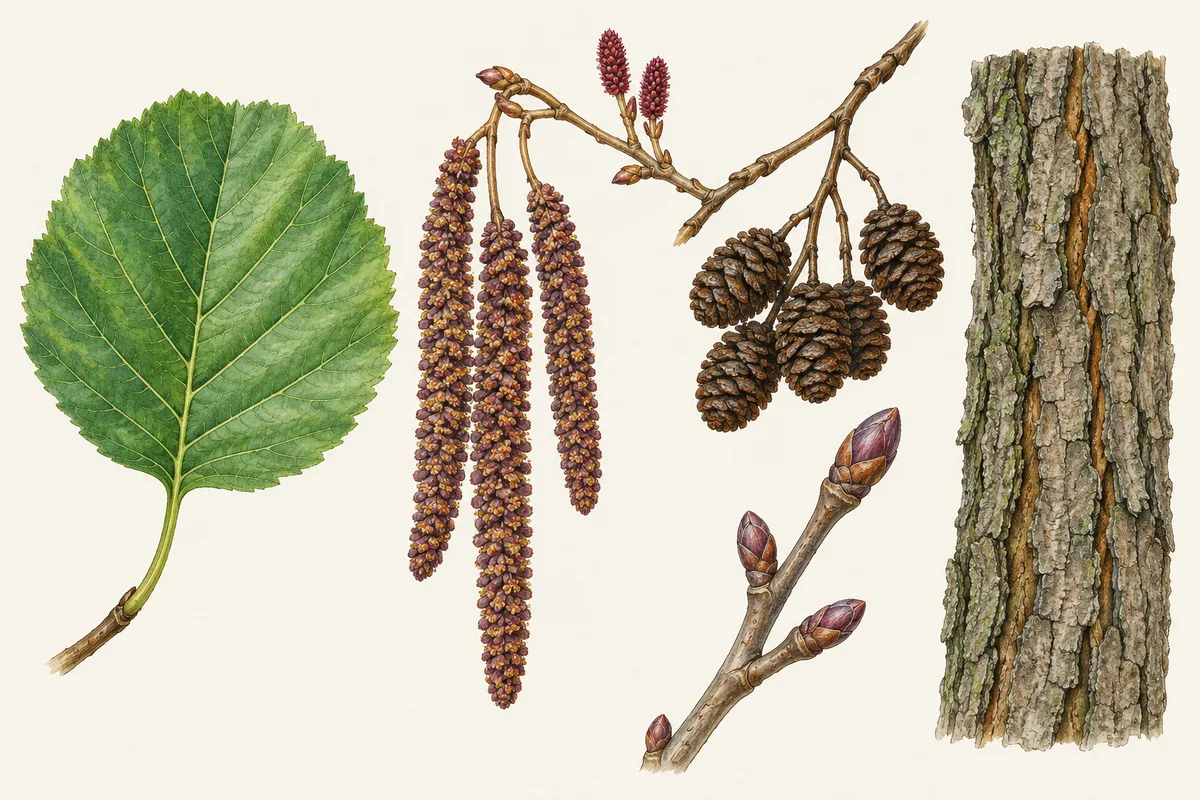
Alder tree identification starts with the fruit: small, woody, cone-like catkins about 1/2 to 1 inch long that stay on the branches all winter, something no birch, hazel or beech does. Confirm with the buds, which sit on short stalks on most alders, and the leaves: alternate, toothed, with a blunt or notched tip on European black alder. Alders grow along streams, lakes and wet ground.
- Woody cones on a broadleaf tree in winter: that alone points to an alder.
- Red alder leaf edges roll under; white alder's lie flat. That is the quickest West Coast test.
- European black alder is listed as a restricted invasive species by the Wisconsin DNR.
Field marks at a glance
- Scientific name
- Alnus rubra, A. rhombifolia, A. incana ssp. rugosa, A. viridis ssp. sinuata, A. glutinosa
- Family
- Betulaceae (birch family)
- Type
- Broadleaf, deciduous
- Cones
- Small, woody, cone-like female catkins, about 1/2 to 1 inch (10 to 25 mm) depending on species, brown when ripe and held on the tree through winter.
- Buds
- On short stalks on red, speckled and black alder, with 2 or 3 scales; Sitka alder's are only slightly stalked or sessile. Common alder buds look purple in winter.
- Leaves
- Alternate, simple, toothed or doubly toothed, about 2 to 5 inches (5 to 12 cm). Red alder's edges roll under. European black alder's tip is never pointed, often notched.
- Catkins
- Male catkins hang in clusters, 3/4 to 2 1/2 inches (2 to 6 cm) on common alder, and turn yellow when shedding pollen; female catkins are small and reddish, then become the cones.
- Bark
- Smooth and gray on young trees: almost white with lichens on red alder, reddish brown with orange horizontal lenticels on speckled alder; dark and fissured on old black alders.
- Habitat
- Stream banks, lakeshores, swamps and wet ground. Alders fix nitrogen with root-nodule bacteria (Frankia), so they also colonize poor, disturbed soil.
- Size
- Red alder 40 to 50 ft, over 100 ft on the best sites; white alder 50 to 80 ft; speckled and Sitka alder shrubby, about 26 ft (8 m) and 20 to 40 ft.
- Range
- Red and white alder: Pacific Coast. Speckled alder: Newfoundland to Yukon, south to Lake Erie. Sitka alder: thickets, often in avalanche tracks. European black alder: Europe, planted and naturalized in North America.
Alders (Alnus) are the broadleaf trees of stream banks, lakeshores and wet ground across North America and Europe, and they carry small woody cones, which is rare for a broadleaf tree. Check three things in this order: the cones, the buds, then the leaf. The bark and the place you found the tree back them up.
What to check first: cones, stalked buds, leaf tip
1. The cones. Look at the branches, or under the tree, for small, hard, brown cones. They are the female catkins: the Woodland Trust says common alder's stay on the tree all year round, and calls alder the only native British deciduous tree to develop cones. Size helps with the species: red alder's are barrel-shaped, 12 to 25 mm (1/2 to 1 inch) (Oregon State University); speckled alder's 13 to 16 mm, short-stalked and hanging in clusters.
2. The buds. Alder buds stand on a short stalk, like a tiny club on a stem. Oregon State describes red alder buds as stalked, with 2 or 3 hairy scales; Natural Resources Canada describes speckled alder buds as blunt and stalked. Sitka alder is the exception: Virginia Tech gives its buds as only slightly stalked or sessile. Common alder buds look purple in winter, and its young twigs feel sticky (Woodland Trust).
3. The leaf. Alder leaves are alternate, simple and toothed, often doubly toothed. Two shapes are worth knowing. On European black alder, the Woodland Trust says, the leaf tip is never pointed and is often indented, giving a racquet-shaped leaf. On red alder, the edge is coarsely toothed and rolled under, and the underside is grayish.
4. Catkins in late winter. Male catkins hang in clusters and turn yellow as they shed pollen, 2 to 6 cm (3/4 to 2 1/2 inches) on common alder. Female catkins start small and red, turn green, then brown as they harden into cones (Woodland Trust).
When the branches are out of reach, a photo of a twig with cones, or of cones on the ground, gives Tree Identifier enough to work with, and European black alder (Alnus glutinosa) is one of the species in the app's Collection. The app shows no confidence score or list of look-alikes, so check the stalked buds yourself before you settle on alder over birch.
The alders of North America
| Alder | Where | Size | Leaf | Bark |
|---|---|---|---|---|
| Red alder (A. rubra) | Pacific Coast, southeast Alaska to southern California, also northern Idaho | 40–50 ft, record over 100 ft | Coarsely toothed, edge rolled under, gray beneath | Smooth, light gray, almost white with lichens |
| White alder (A. rhombifolia) | Southern British Columbia to California, east into Idaho | 50–80 ft | Edge wavy, not rolled under | Pale and smooth young, plated reddish brown old |
| Speckled alder (A. incana ssp. rugosa) | Newfoundland to Yukon and central British Columbia, south to Lake Erie | To 26 ft (8 m), clumped stems | Oval, 2–4 in (5–10 cm), double-toothed, wrinkled, ladder-like veinlets | Reddish brown with conspicuous orange horizontal lenticels |
| Sitka alder (A. viridis ssp. sinuata) | North America, often in avalanche tracks | 20–40 ft, thicket-forming shrub | 2–5 in, sharply doubly toothed, thin, not rolled under | Gray to gray-green, warty lenticels |
| European black alder (A. glutinosa) | Europe; planted and naturalized | To about 92 ft (28 m) in Britain | Blunt or notched tip | Dark and fissured, often with lichen |
Red alder. The USDA Forest Service's Silvics of North America calls it the most common hardwood in the Pacific Northwest. It grows mostly within about 125 miles (200 km) of the ocean and below about 2,500 feet (750 m), in pure stands along stream bottoms and lower slopes, and it is short-lived: it matures at 60 to 70 years, and its maximum age is usually about 100. The pale, lichen-covered trunks of a red alder grove are one of the easiest sights to recognize on the coast.
White alder. Its range overlaps red alder's from southern British Columbia to Oregon and extends through California. Oregon State says summer leaves are the main way to tell them apart: red alder's leaf margin is rolled under, white alder's is not. White alder grows on moist sites along streams and on lower mountain slopes, and its winter buds are slender, dark red and lightly hairy.
Speckled alder. The "speckles" are the orange, horizontal lenticels on its reddish-brown bark. Natural Resources Canada's Trees of Canada describes a clumped, crooked shrub-tree to 8 m on stream banks and swamps, often mixed with black spruce or eastern white-cedar, and intolerant of shade. In winter its immature seed catkins and pollen catkins are already visible on the twigs.
Sitka alder. A thicket-forming shrub or small tree, 20 to 40 feet, common in avalanche tracks, so its stems are often crooked or leaning, according to the Virginia Tech fact sheet. Its cones, 1/2 to 1 inch long, hang in clusters on long stalks and persist through winter.
Alders fix nitrogen, and why that matters for identification
Alder roots carry nodules that host a nitrogen-fixing actinomycete, Frankia. The Forest Service reports up to 290 pounds of nitrogen per acre (320 kg/ha) fixed per year in pure red alder stands. The Woodland Trust gives the same reason common alder can grow in nutrient-poor soils where few other trees thrive.
For identification, this helps you look in the right place. The Forest Service notes that red alder germinates and grows well on moist mineral soil in full sunlight, and speckled alder, according to Natural Resources Canada, is intolerant of shade: expect alders on open, wet, recently disturbed ground rather than deep in a closed forest. A stand of pale-barked broadleaf trees on such a site in the Pacific Northwest is a good candidate for red alder.
European black alder: Britain, and an invasive in parts of the US
In Britain this is simply alder or common alder, the only native British member of its genus. The Woodland Trust gives mature trees around 28 m (92 ft) and a typical life of about 60 years, on moist ground near rivers, ponds and lakes. Its wood lasts when wet, so it was used for boats, sluice gates and water pipes, and much of Venice is built on alder piles. Siskins, redpolls and goldfinches eat the seeds, and otters nest among the roots. For other trees to learn first in Britain, see tree identification in the UK.
In North America the same tree is called European black alder. It has been planted widely and has spread on its own in some regions. The Wisconsin Department of Natural Resources lists it as a restricted invasive species under its NR 40 rule, with all cultivars and hybrids exempt, as summarized in the University of Wisconsin–Madison Extension's guide to NR 40 and invasive plants. Other states keep their own lists; check yours before planting one.
Alder vs birch, hazel and beech
Birch. Alder belongs to the birch family, and the two are confused more than any other pair. Birch fruit is a soft, cone-like catkin that breaks apart to release its seed in fall and winter, while alder cones stay woody and intact on the twig long after they open. Birch bark often peels in papery strips; alder bark doesn't. The birch page covers paper, gray, yellow and river birch.
Hazel. Hazel also hangs long yellow catkins before its leaves appear, from mid-February in Britain. The Woodland Trust's hazel page describes its leaves as round to oval, doubly toothed, hairy and pointed at the tip, soft to the touch. A common alder leaf has a blunt or notched tip and no soft down, and an alder carries old cones where a hazel carries nuts. See the hazel page for the details.
Beech. In winter, beech is told by its smooth gray bark and long cigar-shaped buds, as the beech page explains; it never carries cones. In summer, each beech leaf vein runs straight into a single tooth, while alder leaves are doubly toothed on most species.
If you want to come back to a stand of alders to see the catkins open in late winter, Tree Identifier's Tree Map pins each located identification so you can find it again.
Look-alikes and how to tell them apart
Birch (Betula)
Birch also has cone-like catkins, but they are soft and break apart to release seed in fall and winter, while alder cones stay woody and whole on the twig. Birch bark often peels in papery strips; alder bark does not peel.
Hazel (Corylus)
Hazel leaves are round to oval, soft and hairy, with a pointed tip, and the shrub bears nuts in leafy husks rather than woody cones. Both hang long yellow catkins in late winter, so check for last year's cones before deciding.
Beech (Fagus)
Beech has smooth, solid gray bark even on big trunks, long cigar-shaped buds and one straight vein running into each leaf tooth. Its fruit is a spiny husk, never a woody cone.
What a photo can't settle
- Natural Resources Canada treats speckled alder as a subspecies of gray alder (Alnus incana), and floras draw the lines between these alders differently; a photo can name an alder but rarely settles the subspecies.
- In summer, before the new cones ripen, a young alder can look like a birch or a hazel in a photo. Look for last year's cones and the stalked buds, which a photo of a single leaf doesn't show.
- A young alder too small to bear cones lacks the most reliable feature; check the stalked buds, or come back once it fruits.
Questions people ask
How do you identify an alder tree?
Look for small woody cones, about 1/2 to 1 inch long, on a broadleaf tree near water; alders keep them all winter. Then check the buds, which sit on short stalks on most alders, and the leaves: alternate and toothed, with edges rolled under on red alder and a blunt or notched tip on European black alder.
Do alder trees have cones?
Yes. The female catkins of alders turn into small, hard, woody cones that open to shed seed but stay on the twig. The Woodland Trust says alder is the only native British deciduous tree with cones, and they stay on the tree all year round.
How do you tell red alder from white alder?
Feel the leaf edge. Oregon State University notes that red alder's margin is rolled under (revolute), while white alder's is not; summer leaves are the main way to separate them. Red alder bark is light gray to almost white with lichens; mature white alder bark turns plated and reddish brown.
Is European black alder invasive?
In parts of North America, yes. The Wisconsin DNR lists European black alder (Alnus glutinosa) as a restricted invasive species under its NR 40 rule, with cultivars and hybrids exempt. Check your own state's invasive species list before planting it.
Why do alders grow near water?
Alders tolerate wet, poorly drained soil better than most trees. The Woodland Trust describes common alder's natural habitat as moist ground near rivers, ponds and lakes, and the USDA Forest Service finds pure red alder stands along stream bottoms and lower slopes.
Is alder a hardwood?
Yes, botanically: alder is a broadleaf tree in the birch family. The USDA Forest Service calls red alder the most common hardwood in the Pacific Northwest. In Britain, alder wood was used for boats, sluice gates and water pipes because it lasts when wet, the Woodland Trust says.
Sources
- Red alder (Alnus rubra), Silvics of North America — USDA Forest Service
- Alnus rubra (red alder) — Oregon State University, Landscape Plants
- Alnus rhombifolia (white alder) — Oregon State University, Landscape Plants
- Speckled alder (Alnus incana ssp. rugosa) — Natural Resources Canada, Trees of Canada
- Sitka alder fact sheet — Virginia Tech Dendrology
- Alder (Alnus glutinosa) — Woodland Trust
- The DNR NR-40 Rule and Invasive Plants (Laura G. Jull) — University of Wisconsin–Madison Division of Extension
- Hazel (Corylus avellana) — Woodland Trust
Keep reading
- Tree profileBirches (Betula): how to identify a birch tree
- Tree profileWillow trees (Salix): how to identify them
- Tree profileBeech (Fagus): how to identify a beech tree
- Field guideTree identification in the UK: British trees by leaf, bark and picture
- Canada field guideTree identification in Canada, region by region