Clue guide
Which tree has yellow flowers? Region first, then the flower shape
Yellow-flowering trees differ completely between the East, Texas and the Southwest, and Florida. Note where you are and the month, then check whether the flowers hang, stand upright or form balls.
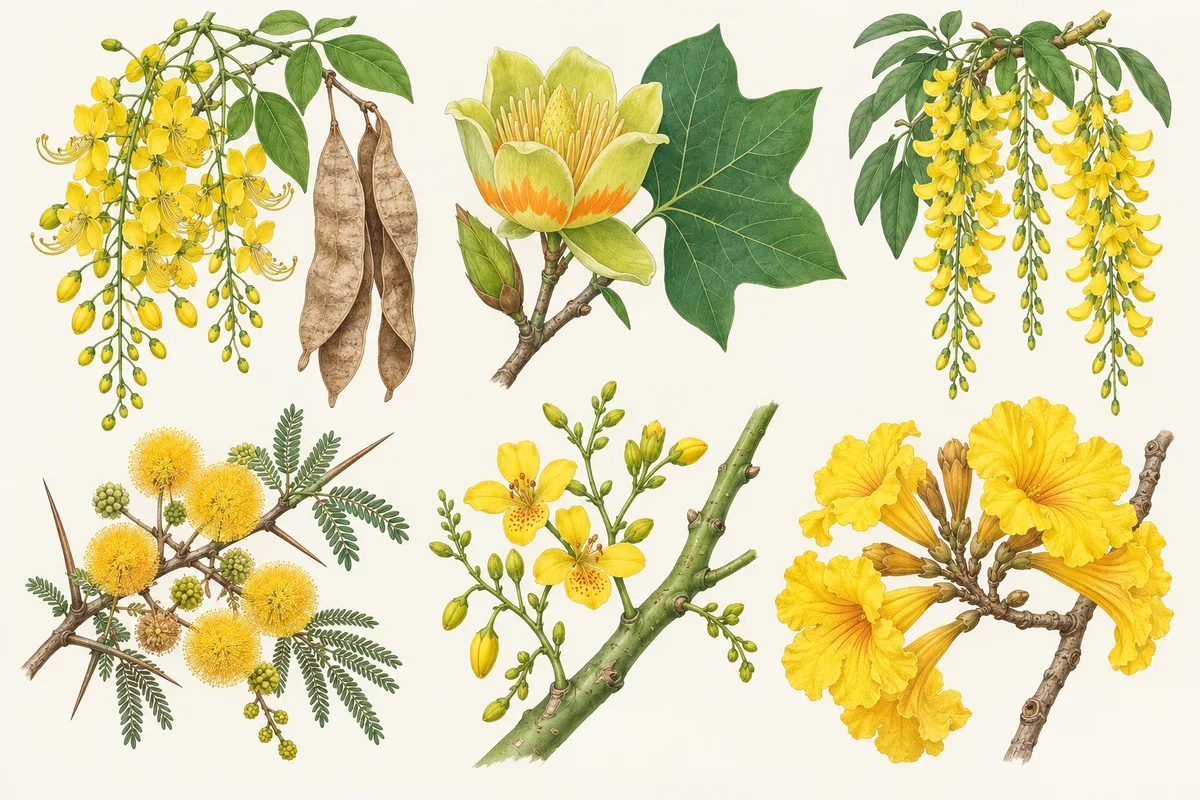
In short
A tree with yellow flowers in the East is usually a golden rain tree (upright sprays in July, then papery lanterns), a tulip tree (tulip-shaped cups in May) or a golden chain tree (long hanging clusters, all parts reported toxic). In Texas, look at huisache, retama and mesquite; in the desert, green-barked palo verde; in Florida, golden trumpet and golden shower trees.
- Yellow flowers hanging down in long chains in May or June are a golden chain tree (laburnum); NC State lists every part as poisonous, especially the seeds.
- Yellow flowers on a tree with green bark and twigs, in Texas or the desert Southwest, mean a palo verde or retama.
- A yellow-flowering tree in July in the East or Midwest is almost always a golden rain tree; very few other trees bloom yellow that late.
A tree with yellow flowers is easiest to name if you start with your region, because the East, Texas and the desert Southwest, and Florida grow almost entirely different yellow bloomers. Then look at how the flowers are held: upright sprays, hanging chains, balls or single cups. Never eat a berry, nut, seed or pod on the strength of a web page or an app; check with a local expert. Golden chain tree and golden shower tree have seeds listed as poisonous.
Yellow-flowering trees at a glance
| Tree | Region | When | The one feature that settles it |
|---|---|---|---|
| Golden rain tree (Koelreuteria paniculata) | Planted East, Midwest, Texas | July | Upright sprays 12–15 in; papery lantern pods |
| Tulip tree (Liriodendron tulipifera) | East | May–early June | Tulip-shaped cups high in the crown; 4-lobed leaves |
| Golden chain tree (Laburnum) | Planted, cooler regions | May–June | Hanging chains of pea flowers; 3-part leaves |
| Cornelian cherry (Cornus mas) | Planted | Late March–early April | Tiny yellow clusters; opposite leaves |
| Sassafras (Sassafras albidum) | East | March–May | Greenish-yellow, before mitten-shaped leaves |
| Norway maple (Acer platanoides) | Planted, cold-hardy | Spring, before leaves | Yellow-green clusters; milky sap in leaf stalk |
| Huisache (Acacia farnesiana) | South Texas; native in Florida | Spring; late winter in Florida | Fragrant gold balls; paired thorns |
| Honey mesquite (Prosopis glandulosa) | Texas, statewide | Spring–early summer | Yellow spikes 2–4 in; long thorns |
| Retama, Jerusalem-thorn (Parkinsonia aculeata) | South and southwest Texas | Spring, after rains | Green twigs; strap-like leaves |
| Blue palo verde (Parkinsonia florida) | Sonoran Desert | Spring | Bluish-green bark and trunk |
| Golden trumpet tree (Handroanthus chrysotrichus) | Florida, zones 10A–11 | Spring | Trumpets on a near-bare tree |
| Golden shower (Cassia fistula) | Florida, zones 10B–11 | Spring to summer, again in fall | Hanging clusters 8–18 in; 2-ft pods |
East and Midwest: golden rain tree, tulip tree, golden chain
Golden rain tree is the yellow tree of high summer. NC State's profile describes upright panicles 12 to 15 inches long of bright yellow, star-shaped flowers half an inch wide with red centers, blooming in July; fallen flowers make a golden carpet beneath. The fruit settles it from August to October: papery, three-sided capsules 1.5 to 2 inches long, like small Chinese lanterns, turning from green to yellow to light brown. The leaves are feather-like, 6 to 18 inches long, with deeply lobed leaflets near the base. NC State notes that it seeds itself easily and is on the National Park Service Mid-Atlantic Exotic Plant Management Team's invasive plant list.
Tulip tree (tulip poplar) blooms in May and early June, but the flowers are easy to miss. The NC State profile describes upright, cup-shaped flowers 1.5 to 2 inches long, with six green-to-yellow petals and an orange band near the base, opening high in the crown after the leaves are full grown; many people first notice them when petals fall. Confirm with the leaf: four lobes and a broad, squared-off tip, unlike any other eastern tree. Tulip trees reach 80 to 120 feet.
Golden chain tree is the answer to "yellow flowers hanging down". NC State's common laburnum profile describes sweet-scented, pea-like yellow flowers densely packed in hanging clusters 4 to 10 inches long in May and June, on a small tree to 30 feet with leaves of three leaflets 1 to 3 inches long. It dislikes the heat and humidity of the Deep South. NC State rates its poison severity as high and lists all parts as poisonous, with the seeds, which contain the alkaloid cytisine, as the main concern. Note that NC State also lists "golden rain tree" as one of laburnum's common names: hanging flowers mean laburnum, upright sprays mean Koelreuteria.
Early spring in the East: small yellow flowers before the leaves
Three trees bloom yellow in early spring with flowers so small that the tree reads as a yellow-green haze.
- Cornelian cherry, a planted dogwood, has small yellow flowers in clusters from late March to early April, according to NC State's Cornelian cherry profile. The leaves that follow are opposite, glossy and smooth-edged; the bark is flaky and scaly.
- Sassafras carries 2-inch clusters of greenish-yellow flowers with no petals before its leaves, from March to May, with male and female flowers on separate trees, per NC State's sassafras profile. Its leaves come in three shapes on one tree: oval, mitten-shaped and three-lobed, and young twigs smell spicy when broken.
- Norway maple flowers yellow-green in spring before its leaves, and NC State's Norway maple profile calls it one of the most floriferous maples. Break a leaf stalk later in the season: milky sap confirms it. NC State notes it has been labeled invasive in several northeastern states. Other maples are on the maple page.
Black locust is sometimes searched as a yellow-flowered tree, but its hanging pea flowers are white or cream; see trees with white flowers and the locust page.
Texas: huisache, retama and mesquite
In Texas, most yellow-flowering trees are thorny legumes with finely divided leaves, so check the thorns and the flower shape together.
Huisache has round, fragrant puff-balls. Texas A&M Forest Service's Trees of Texas describes bright orange-gold flowers in spherical clusters up to 0.75 inch across in spring, very fragrant, on feather-like leaves 1 to 4 inches long with minute leaflets, and a pair of straight thorns up to 2 inches long at the base of each leaf. It is widespread in South Texas. The Forest Service adds that its flowers were once collected for French perfume.
Retama (Jerusalem-thorn) is the one with green twigs. Its Trees of Texas entry gives showy clusters of yellow-orange, five-petaled flowers about half an inch long in warm spring weather or after rains, twigs and branches that stay distinctly green up to 2 inches thick, thorns up to 1 inch, and long, strap-like leaf stalks 8 to 16 inches long whose tiny leaflets often drop. It grows throughout South and southwest Texas, especially along the Rio Grande.
Honey mesquite has yellow flower spikes, not balls. The Forest Service's mesquite entry describes cylindrical spikes 2 to 4 inches long of small yellow flowers in spring or early summer, then pods 4 to 9 inches long, on a thorny tree found across Texas, though rarely in East Texas. For its thorns, see trees with thorns.
The desert Southwest: palo verde, yellow flowers and green bark
Blue palo verde answers "yellow flowers and green bark". University of Arizona Extension's Yavapai County plant profile describes bluish-green bark, bright yellow flowers, leaflets under a quarter inch long and flat seed pods, on a tree 20 to 40 feet tall that grows along dry washes. The University of Arizona Campus Arboretum's tree of the week adds that it is native to the Sonoran Desert, that its green stems perform photosynthesis, that the flowers are small, five-petaled and pea-like, and that it drops all its leaves in dry periods.
Florida: golden trumpet, golden shower and sweet acacia
Golden trumpet tree puts on its main show in spring. UF/IFAS's fact sheet describes bright yellow, trumpet-shaped flowers in dense clusters 2.5 to 8 inches long at the branch tips, at their heaviest in April and May while the leaves are briefly down. The leaves are divided into five leaflets about 4 inches long, silvery above and tan and fuzzy beneath, and hairy brown pods about 8 inches long follow. It grows in USDA zones 10A to 11.
Golden shower hangs its flowers. UF/IFAS's fact sheet describes thick hanging clusters 8 to 18 inches long of yellow flowers on slightly drooping branches, from spring to early summer and again in early fall, followed by dark brown, cylindrical pods about 2 feet long that stay on the tree through winter. UF/IFAS states that the seeds inside are poisonous. It grows in zones 10B to 11.
Sweet acacia is the Florida name for the same species as huisache, and UF/IFAS lists it as native. Its fact sheet describes very fragrant, bright yellow puff-like flowers mainly in late winter, then sporadically through the year, on a thorny shrub or small tree 15 to 25 feet tall.
How to tell them apart in the field
- How are the flowers held? Hanging chains: golden chain or golden shower. Upright sprays: golden rain tree. Balls: huisache or sweet acacia. Spikes: mesquite. Single cups high up: tulip tree. Trumpets: golden trumpet tree.
- Thorns? Huisache, mesquite and retama have them; the eastern trees do not.
- Bark color. Green or bluish-green: palo verde or retama.
- Leaf. Four lobes with a flat tip: tulip tree. Three leaflets: golden chain. Mittens: sassafras.
A photo while it is in bloom
Take one photo that shows a flower cluster and a leaf together. Tree Identifier names a tree from one photo; tulip tree and sassafras are in its Collection, and it also names trees outside it, such as palo verde. It shows no confidence score, so check the answer against the flower shape and thorns above, and use the follow-up chat to ask, for example, how retama differs from palo verde. Its Toxicology notes are AI-written: for seeds and pods, ask a local expert.
What a photo can't settle
- Golden rain tree is also a common name for laburnum, so a name alone can mislead; check whether the flowers stand upright (golden rain tree) or hang (laburnum).
- Mesquite, huisache, retama and palo verde vary widely in size and form, from shrubs to trees; a photo with leaves and thorns in view helps more than one of a flower.
- No page or app can say whether a seed or pod is safe; several trees here have seeds listed as poisonous.
Questions people ask
What tree has yellow flowers hanging down?
A golden chain tree (laburnum), with pea-like yellow flowers in hanging clusters 4 to 10 inches long in May and June, on a small tree with three-part leaves. In south Florida, golden shower tree hangs much longer clusters, 8 to 18 inches, on drooping branches. NC State lists all parts of the golden chain tree as poisonous.
What tree has yellow flowers and green bark?
A palo verde. University of Arizona Extension describes blue palo verde with bluish-green bark and bright yellow flowers along desert washes; its green stems carry out photosynthesis. In Texas, retama (Jerusalem-thorn) has green twigs and branches, yellow-orange flowers and thorns up to 1 inch long.
What tree has yellow flowers in Texas?
Huisache (fragrant orange-gold balls in spring, paired thorns), retama (yellow-orange flowers on green twigs, mostly South and southwest Texas) and honey mesquite (yellow flower spikes 2 to 4 inches long, statewide). Planted golden rain trees also bloom yellow in summer. Texas A&M Forest Service describes all four.
What tree has yellow flowers in Florida?
In spring, golden trumpet tree: bright yellow trumpets on a nearly leafless tree with fuzzy, silvery leaflets. In summer, golden shower tree, with long hanging yellow clusters and 2-foot pods. Sweet acacia, a native thorny shrub or small tree, bears fragrant yellow puff-balls mainly in late winter.
What tree has yellow flowers in early spring?
In the East, Cornelian cherry (small yellow clusters in late March and early April), sassafras (greenish-yellow clusters before the leaves, March to May) and Norway maple (yellow-green clusters before its leaves). All three are easy to overlook, because the flowers are small.
Sources
- Koelreuteria paniculata (golden rain tree) — North Carolina Extension Gardener Plant Toolbox, NC State University
- Liriodendron tulipifera (tulip tree, tulip poplar) — North Carolina Extension Gardener Plant Toolbox, NC State University
- Laburnum anagyroides (golden chain tree) — North Carolina Extension Gardener Plant Toolbox, NC State University
- Huisache (Acacia farnesiana), Trees of Texas — Texas A&M Forest Service
- Jerusalem-thorn, retama (Parkinsonia aculeata), Trees of Texas — Texas A&M Forest Service
- Parkinsonia florida, blue paloverde — University of Arizona Cooperative Extension, Yavapai County Native and Naturalized Plants
- Handroanthus chrysotrichus: Golden Trumpet Tree (ENH-772/ST614) — UF/IFAS Extension, University of Florida
- Cassia fistula: Golden Shower (ST127) — UF/IFAS Extension, University of Florida
Keep reading
- Clue guideWhich tree has white flowers? Start with the month
- Clue guideWhich tree has purple flowers? Check the month, then the leaves
- Tree profileMaple trees (Acer): how to identify them
- Tree profileLocust trees: how to identify black locust and honey locust
- Clue guideWhich tree has red berries? Sort it by leaf and season