Clue guide
Which trees have yellow leaves in fall? Sort them by leaf shape
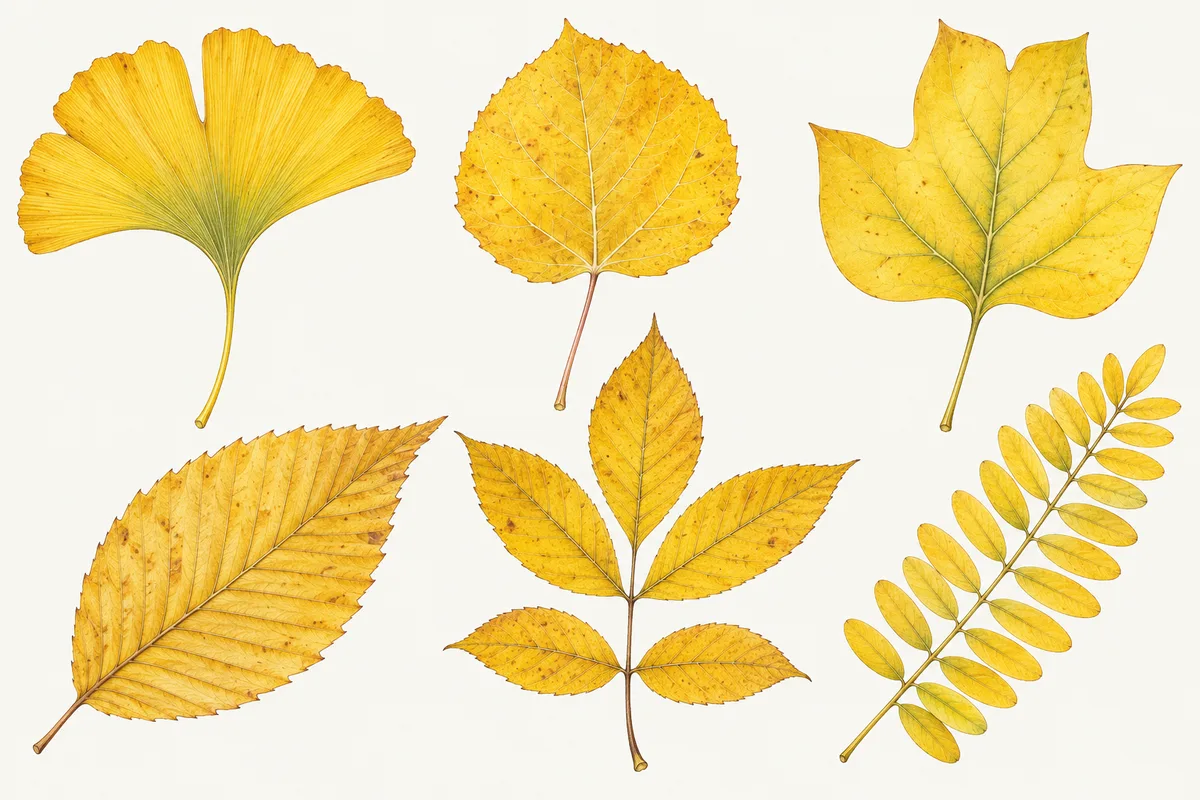
Gold and yellow are the commonest fall colors, so the leaf shape does the naming. Fan, feather, lobed hand, round blade on a flat stalk, heart or needle.
In short
Trees with yellow leaves in fall include ginkgo (fan-shaped leaves), quaking aspen and cottonwood (flattened leaf stalks that make the leaves flutter), birches (pale bark with horizontal marks), tulip tree (four-lobed leaves), honey locust (tiny leaflets), hickories and black walnut (long compound leaves), American beech, redbud and Norway or silver maple. Tamarack is a conifer whose needles turn gold.
- Small yellow leaves raining down like confetti usually come from honey locust, whose leaflets are only 1 to 1 1/2 inches long.
- A conifer that turns gold and drops its needles is a larch, such as tamarack, not a dying pine.
- Yellow comes from carotenoids that were in the leaf all summer; red needs pigments made in fall, which these trees make little of.
Yellow is one of the commonest fall colors in North America, so the color alone will not name a tree. What will: the shape of the leaf, whether it is simple or compound, and one more clue such as the bark or the leaf stalk. The short version of the chemistry is that yellow pigments were in the leaf all summer and show once the green fades; the trees with red leaves in fall guide explains why other trees turn red instead. Several of these trees carry berries, nuts or pods in fall: never eat a berry, nut, seed or pod on the strength of a web page or an app; check with a local expert.
Trees with yellow fall leaves at a glance
| Tree | Leaf shape | Fall color | The feature that settles it | Our page |
|---|---|---|---|---|
| Ginkgo (Ginkgo biloba) | Fan-shaped, 2–3 in, in clusters | Vivid yellow | Veins that fork repeatedly, fanning out from the stalk | — |
| Quaking aspen (Populus tremuloides) | Nearly round, 1–3 in, fine teeth | Golden yellow | Flattened leaf stalk; chalky white bark | Poplar |
| Eastern cottonwood (P. deltoides) | Triangular, 3–6 in | Yellow, often dropping early | Flattened stalk with 2 glands at the top | Poplar |
| Paper and river birch (Betula) | Oval to triangular, double-toothed | Yellow to golden | Thin bark with horizontal lenticels | Birch |
| American beech (Fagus grandifolia) | Oval, 2–5 in, straight parallel veins | Golden bronze | Smooth gray bark; dry leaves stay into winter | Beech |
| Tulip tree (Liriodendron tulipifera) | 4 lobes, flat or notched top | Golden yellow | Leaf outline like a tulip | Poplar |
| Honey locust (Gleditsia triacanthos) | Compound, 15–30 leaflets of 1–1 1/2 in | Yellow | Branched thorns (except thornless forms); long twisted pods | Locust |
| Shagbark hickory (Carya ovata) | Compound, 5–7 leaflets | Yellow to golden brown | Bark in long plates curling away from the trunk | Hickory |
| Black walnut (Juglans nigra) | Compound, 15–23 leaflets, 12–24 in | Bright, clear yellow; drops early | Round green husks that stain hands | Walnut |
| Norway maple (Acer platanoides), invasive | 5 sharply pointed lobes, opposite | Yellow-green to yellow | Milky sap from a snapped leaf stalk | Maple |
| Silver maple (A. saccharinum) | 5 deep lobes, silvery underside | Yellow, brown and green | Deep cuts between lobes; silver underside | Maple |
| Bigleaf maple (A. macrophyllum) | 5 deep lobes, up to 12 in across | Yellow to gold or brown | Size of the leaf; West Coast only | Maple |
| American elm (Ulmus americana) | Oval, 4–6 in, toothed, lopsided base | Plain yellow | Uneven leaf base | Elm |
| Eastern redbud (Cercis canadensis) | Heart-shaped, 3–5 in, smooth edge | Yellow | Flat brown pods hanging into winter | Redbud |
| Tamarack (Larix laricina), a conifer | Soft needles in tufts | Yellow, then bare | A conifer that drops all its needles | Tamarack |
Leaf and bark details are from the NC State Extension Gardener Plant Toolbox unless noted; fall colors from NC State, Iowa State Extension's Trees and Shrubs with Great Fall Color, Oregon State University for bigleaf maple and The Morton Arboretum for American beech.
Fan-shaped leaves: ginkgo
No other tree has a fan-shaped leaf with veins that fork again and again from the stalk. The NC State profile describes leaves 2 to 3 inches long, often in clusters of three to five on short shoots, with yellow fall color; the Morton Arboretum calls it outstanding. Ginkgo is native to China and widely planted in the US. Female trees drop plum-like seeds whose pulp smells foul when ripe, which is why NC State notes that most ornamental ginkgoes in the US are male. Ginkgo is in Tree Identifier's Collection.
Round or triangular leaves on flat stalks: aspen and cottonwood
Roll the leaf stalk between finger and thumb. A stalk flattened like a ribbon means a poplar, and the leaves flutter in the slightest wind.
Quaking aspen has nearly round leaves about 3 inches long with fine teeth, turning golden yellow in fall, according to NC State, on smooth, silvery white-green bark that turns chalky white with black patches. Because aspen spreads by root suckers, a whole grove is often one clone and turns at the same time; the poplar page explains why neighboring groves can change color on different dates.
Eastern cottonwood has larger, triangular leaves 3 to 6 inches long with two small glands where the stalk meets the blade. NC State gives its fall color as yellow but notes that leaves may drop early. Look along streams and riverbanks.
Pale bark and toothed leaves: birches and beech
Birches turn yellow too. The Morton Arboretum describes paper birch leaves changing to yellow in fall, and NC State notes that river birch's modest yellow color drops early and quickly. The bark settles the species: chalky white and peeling on paper birch, salmon to cinnamon and shaggy on river birch. The birch page covers the wintergreen twig test for yellow and black birch.
American beech turns a golden bronze, according to The Morton Arboretum, and its dried leaves often hang on well into winter. The smooth, silver-gray bark and leaves with straight, parallel veins that end in small teeth make it easy to confirm. See the beech page.
American elm turns what NC State calls an undistinguished yellow. Its leaves are 4 to 6 inches long, rough, toothed, with a lopsided base where one side meets the stalk lower than the other.
Lobed leaves: tulip tree and the yellow maples
Tulip tree (tulip poplar or yellow-poplar) has a leaf no other tree shares: four lobes and a flat or notched top, like a tulip seen from the side. The NC State profile describes bright green leaves 3 to 8 inches across that turn golden yellow in fall. It is one of the tallest eastern hardwoods, 80 to 120 feet, with gray bark in a diamond pattern of flat ridges. Despite the name it is a magnolia relative, not a poplar.
Maples that turn yellow all have leaves in opposite pairs:
- Norway maple turns yellow-green to yellow, the Morton Arboretum notes, and NC State calls its fall color an unremarkable yellow. Snap a leaf stalk: it oozes milky sap. The Morton Arboretum lists it as invasive, and the Connecticut Invasive Plant List (October 2025) includes it, with a prohibition date of October 2030.
- Silver maple has five deep lobes and silvery undersides, and NC State describes a combination of yellow, brown and green in fall.
- Bigleaf maple is the West Coast maple, with leaves up to 12 inches across. Oregon State University gives its fall foliage as yellow to gold or brown.
- Sugar maple turns yellow to orange, sometimes red, and is compared with red maple on the red maple vs sugar maple page.
Compound leaves: honey locust, hickories and walnut
Honey locust answers the search for a tree with small yellow leaves in fall. The NC State profile describes feathery compound leaves 5 to 8 inches long with 15 to 30 oval leaflets, each only 1 to 1 1/2 inches; Iowa State lists the fall color as yellow. Wild trees carry stout thorns up to 3 inches long, with one or three branches; NC State also lists a thornless variety, inermis, so a planted tree may have no thorns at all. Twisted, reddish-brown pods 12 to 18 inches long often hang on into winter. The locust page compares honey locust with black locust.
Shagbark hickory has compound leaves 8 to 14 inches long with 5 to 7 leaflets, turning yellow to golden brown, according to NC State. Old trees are easy to name by their bark, which separates into long plates that curve away from the trunk. See the hickory page for the other hickories.
Black walnut carries the longest leaves on this list, 12 to 24 inches with 15 to 23 leaflets. NC State notes that the leaves come out late and drop early, with a fall color of bright clear yellow; the walnut page covers the green husks.
Heart-shaped leaves and needles: redbud and tamarack
Eastern redbud has heart-shaped leaves 3 to 5 inches wide with smooth edges and an attractive yellow fall color, NC State notes. Flat brown seed pods 2 to 4 inches long often stay on the tree into winter. The redbud page covers its pink spring flowers.
Tamarack is the conifer that turns gold. Its soft needles grow in tufts on short spur shoots; in autumn they turn yellow and fall, and the tree stands bare until spring. Iowa State lists larch fall color as yellow. A conifer that is gold in October and bare in December is a larch, not a dying pine: the tamarack page explains how to tell it from European and western larch.
Yellow fall trees by region
- Northeast and Great Lakes: sugar maple, birches, American beech, quaking and bigtooth aspen, tamarack in bogs, and Norway maple on streets.
- Southeast: tulip tree, hickories, river birch, redbud and black walnut; planted ginkgo.
- Midwest: honey locust, cottonwood along rivers, shagbark hickory, black walnut, silver maple and American elm.
- Texas and the Southwest: cottonwood along streams and quaking aspen high in the mountains; NC State gives cottonwood's native range as reaching Texas, New Mexico and Arizona.
- West Coast and the Rockies: bigleaf maple on the Pacific Coast and quaking aspen groves in the Rockies.
Yellow autumn leaves in the UK
Many of Britain's native trees turn yellow in autumn. The Woodland Trust says silver birch's small, triangular, toothed leaves fade to yellow; field maple leaves fade to a rich, golden yellow; hazel leaves turn yellow before falling; and aspen (Populus tremula, the European species) turns a vibrant yellow or occasionally red. Planted ginkgo and tulip tree add more gold in parks.
Using a photo to name a yellow tree
Yellow leaves fall fast, and a pile under one tree often mixes several species. Photograph a leaf still on the branch, with enough twig to show whether leaves are paired or alternate, or a whole compound leaf for locust, hickory and walnut. Tree Identifier names a tree from one photo, and ginkgo, tulip tree, honey locust, paper birch and silver birch are among the species in its Collection. It gives one name without a confidence score, so check the leaf against the table above. The follow-up chat can answer questions such as how honey locust differs from black locust.
What a photo can't settle
- Yellow is also the color of stress: drought, flooding or root damage can turn leaves yellow in summer. This page is about normal fall color, not tree health.
- Hickories are hard to tell apart from a yellow leaf alone; the bark, buds and nut husk settle the species.
- Leaves of many yellow trees drop quickly, sometimes in a single windy day, so a photo of fallen leaves may mix several trees.
Questions people ask
What tree has small yellow leaves in fall?
Honey locust. Its feathery compound leaves carry 15 to 30 leaflets only 1 to 1 1/2 inches long, NC State Extension notes, and Iowa State lists its fall color as yellow. Quaking aspen (leaves 1 to 3 inches) and birches also have small yellow leaves.
What tree has the brightest yellow leaves in fall?
Ginkgo is the usual answer: the Morton Arboretum calls its yellow autumn color outstanding, and its fan-shaped leaves are unlike any other tree's. Tulip tree turns golden yellow, quaking aspen golden yellow, and black walnut a bright, clear yellow, according to NC State Extension.
What maple trees have yellow leaves in fall?
Norway maple turns yellow-green to yellow, silver maple a mix of yellow, brown and green, and bigleaf maple on the West Coast yellow to gold or brown. Sugar maple runs from yellow to orange. To tell Norway maple apart, snap a leaf stalk: it oozes milky sap.
Is there a conifer that turns yellow in fall?
Yes. Larches, including tamarack (Larix laricina), are deciduous conifers: their soft needle tufts turn yellow in autumn and drop, and the tree stands bare until spring. Iowa State lists larch fall color as yellow. Bald cypress is another deciduous conifer, but it turns brownish orange.
Why do some trees turn yellow instead of red?
Yellow and orange carotenoids are in the leaf all season and appear once the green chlorophyll breaks down, while red anthocyanins are made in late summer and fall, according to Iowa State Extension. Trees that make little anthocyanin turn yellow. The red fall leaves guide explains the chemistry in more detail.
Sources
- Trees and Shrubs with Great Fall Color — Iowa State University Extension and Outreach, Yard and Garden
- Ginkgo biloba (ginkgo) — North Carolina Extension Gardener Plant Toolbox, NC State University
- Populus tremuloides (quaking aspen) — North Carolina Extension Gardener Plant Toolbox, NC State University
- Gleditsia triacanthos (honey locust) — North Carolina Extension Gardener Plant Toolbox, NC State University
- Liriodendron tulipifera (tulip poplar) — North Carolina Extension Gardener Plant Toolbox, NC State University
- Acer macrophyllum (bigleaf maple) — Landscape Plants, Oregon State University
- American beech (Fagus grandifolia) — The Morton Arboretum
- Silver birch (Betula pendula) — Woodland Trust
Keep reading
- Clue guideWhich trees have red leaves in fall? Sort them by leaf shape
- Tree profilePoplars, cottonwoods and aspens (Populus): how to identify them
- Tree profileBirches (Betula): how to identify a birch tree
- Tree profileTamarack (Larix laricina): how to identify it
- Tree profileLocust trees: how to identify black locust and honey locust