Clue guide
Which tree has long seed pods? Sort it by leaf, pod and region
Check whether the leaves are big and simple or split into many small leaflets, then measure a pod and note your region. Together they narrow a long-podded tree to one or two names.
In short
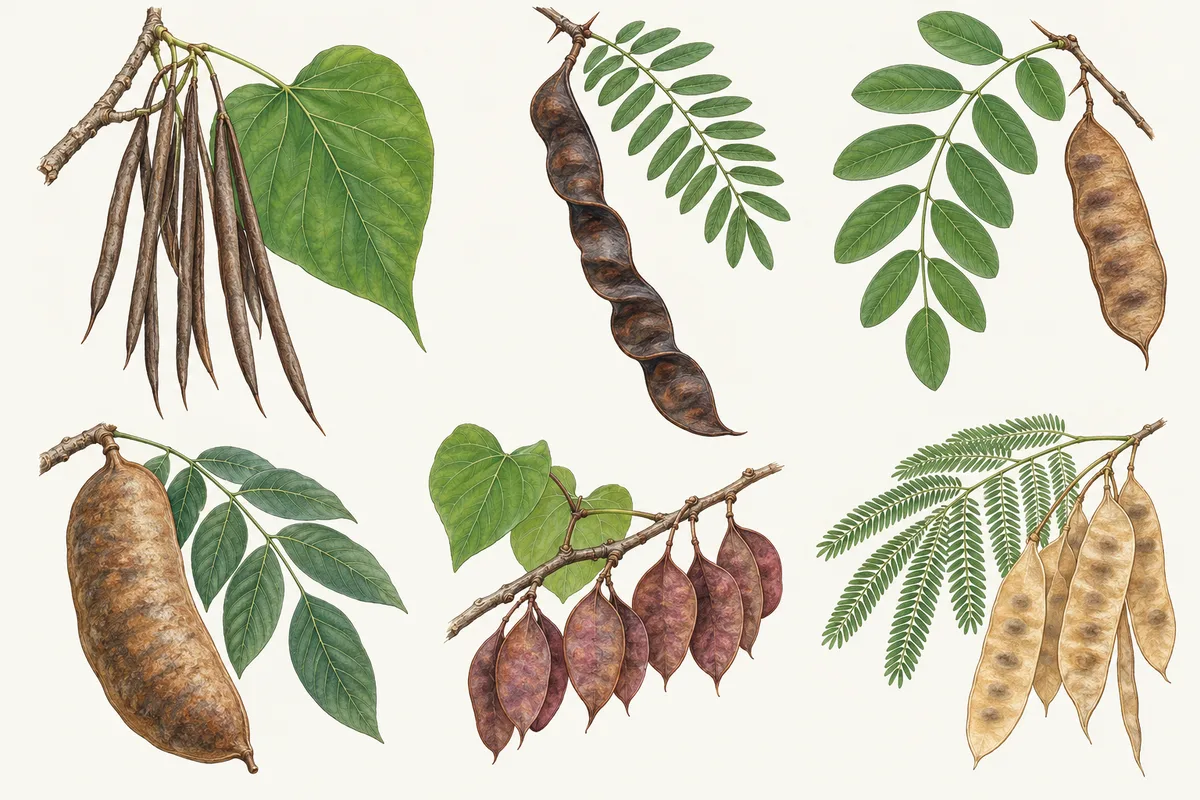
A tree with long seed pods is most often a catalpa (round, pencil-thin "beans" 8 to 22 inches long under huge heart-shaped leaves), a honey locust (flat, twisting red-brown pods 6 to 8 inches long, feathery leaves), a black locust (flat pods 2 to 4 inches) or a Kentucky coffeetree (thick pods 3 to 8 inches). In Texas, think mesquite and desert willow; in Florida, royal poinciana and golden shower.
- Leaf type sorts long-podded trees fastest: big simple leaves mean catalpa or desert willow; feathery compound leaves mean a locust, mimosa, mesquite or poinciana.
- A pod round in cross-section, like a long thin bean, is a catalpa; flat pods belong to the legume family (locusts, coffeetree, mimosa, mesquite, redbud).
- Several long-podded trees are reported toxic: USDA NRCS for Kentucky coffeetree's seeds and pulp, NC State Extension for all parts of laburnum, UF/IFAS for golden shower seeds.
Long pods hang on a tree for months and pile up underneath, so they are often the first thing people notice. Never eat a berry, nut, seed or pod on the strength of a web page or an app; check with a local expert. Several trees below are reported toxic, and this guide is only for putting a name on the tree.
Long-podded trees by leaf and region
| Tree | Pod | Leaf | Where |
|---|---|---|---|
| Northern and southern catalpa (Catalpa speciosa, C. bignonioides) | Round in cross-section, 8–22 in (20–56 cm), brown in fall, splits lengthwise | Simple, heart-shaped, 5–12 in (13–30 cm), often in threes | Midwest and South, planted everywhere |
| Desert willow (Chilopsis linearis) | Pencil-thin, 6–12 in (15–30 cm), about 1/4 in wide | Simple, narrow, willow-like | Texas and the Southwest |
| Eastern redbud (Cercis canadensis) | Flat, 2–4 in (5–10 cm), green to brown | Simple, heart-shaped, 3–5 in | Eastern US |
| Honey locust (Gleditsia triacanthos) | Flat, red-brown, leathery, 6–8 in (15–20 cm), twists as it dries | Feathery, 15–30 small leaflets | East and Midwest, planted widely |
| Black locust (Robinia pseudoacacia) | Flat, light brown, 2–4 in (5–10 cm) | Compound, 7–19 oval leaflets about 1 in | Naturalized across the US |
| Kentucky coffeetree (Gymnocladus dioicus) | Thick, reddish brown, 3–8 in (8–20 cm) long, 1 1/2–2 in wide | Doubly compound, 1–3 ft (30–90 cm) long | Midwest |
| Mimosa or silk tree (Albizia julibrissin) | Flat, brown, 4–8 in (10–20 cm) | Doubly compound, leaflets about 3/8 in | South, planted |
| Honey mesquite (Prosopis glandulosa) | Reddish brown, 7–20 cm (3–8 in), constricted between seeds | Doubly compound; stout spines at the nodes | Texas and the Southwest |
| Royal poinciana (Delonix regia) | Dark brown, 1–2 ft (30–60 cm) | Doubly compound, fern-like | South Florida |
| Golden shower (Cassia fistula) | Cylindrical, 1–2 ft (30–60 cm), green to black | Compound, 4–8 pairs of large leaflets | South Florida |
| Golden chain tree (Laburnum) | Long, flattened, splits when ripe | 3 leaflets | Planted; common in the UK |
Pod and leaf data come from the sources linked in each section below, with catalpa, locust and redbud from the pages on this site that cite Virginia Tech Dendrology, the Missouri Botanical Garden and NC State Extension.
Big simple leaves: catalpa, desert willow and redbud
Catalpa is the long-pod tree most people mean. Its pods are stiff, hang straight down and are round in cross-section, like a long thin bean: Virginia Tech gives 10 to 18 inches (25–46 cm) for northern catalpa and 8 to 14 for southern, the Missouri Botanical Garden up to 22 inches. They ripen dark brown in fall, split lengthwise and often stay on through winter. The leaves settle it: heart-shaped, 5 to 12 inches long, often in whorls of three. Large white, purple-spotted flowers come first, in late spring or summer. The catalpa page separates the two species and the look-alike paulownia, whose fruit is a short, egg-shaped capsule instead. For more big-leaved trees, see trees with heart-shaped leaves.
Desert willow looks like a small catalpa with willow leaves. NC State's desert willow profile describes narrow, lance-shaped simple leaves, trumpet-shaped pink, lavender or white flowers that resemble catalpa, and seed pods about 1/4 inch wide and 6 to 12 inches long holding winged seeds. It is not a willow; NC State lists "willowleaf catalpa" among its names. Native to Texas, New Mexico, Arizona, Utah and Mexico, it grows 15 to 25 feet (5–8 m).
Eastern redbud has heart-shaped leaves too, but short pods. NC State's redbud profile describes flat, oblong pods, green turning brown and roughly 2 to 4 inches long, that form by summer after the pink to purple spring flowers and can hang into winter. If a heart-leaved tree's pods are under 4 inches and flat, it is a redbud, not a catalpa.
Feathery compound leaves: locusts, coffeetree and mimosa
Honey locust has the longest pods among the common eastern legumes: flat, leathery, red-brown, 6 to 8 inches long, drying and twisting, under fine feathery leaves of 15 to 30 small leaflets. Wild trees carry large branched thorns; many planted ones are thornless and podless. Black locust pods are much shorter, flat and light brown, 2 to 4 inches, and its leaflets are oval and about an inch long. The locust page gives the four checks that separate them.
Kentucky coffeetree has the biggest leaves of any native tree: the USDA NRCS fact sheet gives doubly compound leaves 1 to 3 feet long with leaflets 2 to 3 inches. Virginia Tech's fact sheet describes a reddish-brown, flat but thickened pod 3 to 8 inches long and 1 1/2 to 2 inches wide, holding six or more dark seeds in a sticky pulp, ripening in late summer. Stout twigs with a large heart-shaped leaf scar make it easy in winter. NRCS states that the leaves, seeds and pulp are poisonous and toxic to livestock, humans and pets, and that male cultivars such as 'Espresso' produce no fruit.
Mimosa (silk tree) pairs feathery leaves with pink powder-puff flowers. NC State's mimosa profile gives doubly compound leaves with leaflets about 3/8 inch long, flowers from May to July, and flat, brown pods 4 to 8 inches long that mature from August to November and may stay on the tree through winter. Mimosa is native to Asia, from Iran to Japan, and NC State states that it is listed as invasive by the NC Invasive Plant Council.
Texas and the Southwest: mesquite and desert willow
For "long seed pods and small leaves" in Texas, start with honey mesquite. The USDA NRCS plant guide describes a shrub or tree 4 to 6 m (13–20 ft) tall with one or two stout spines at the nodes, doubly compound leaves of 6 to 15 leaflets per division, yellow flowers in spikes 7 to 9 cm long, and straight reddish-brown pods 7 to 20 cm (3–8 in) long, constricted between the seeds. It grows on plains and dry ranges. Desert willow, above, is the other native Texas tree with long pods; honey locust, mimosa and catalpa are the planted ones.
Florida: royal poinciana and golden shower
Royal poinciana is planted across south Florida for its flowers. UF/IFAS's fact sheet gives dark brown pods 1 to 2 feet (30–60 cm) long that hang on through winter and drop in spring, fern-like doubly compound leaves with leaflets about 1/2 inch, and bright red or orange flowers from May to July. It is native to Madagascar and grows in USDA zones 10B to 11.
Golden shower pods are round in cross-section, like catalpa's, but far darker. UF/IFAS's fact sheet describes cylindrical pods 1 to 2 feet long, green turning black, that persist through winter, hanging chains of yellow flowers 8 to 18 inches long, and compound leaves of 4 to 8 pairs of leaflets 3 to 6 inches long. UF/IFAS states that the seeds are poisonous. It is native to India, Malaysia and Southeast Asia.
Michigan, Ohio and the Great Lakes
In the northern states, the cold rules out the tropical trees and leaves four candidates: catalpa (the Missouri Botanical Garden lists northern catalpa for USDA zones 4 to 8), honey locust (zones 4a to 9b, per NC State), black locust (naturalized throughout the United States and southern Canada, per the USDA Forest Service) and Kentucky coffeetree (zones 3 to 8, per USDA NRCS). Round pods mean catalpa; long, twisted, flat pods honey locust; short flat pods black locust; thick, heavy pods Kentucky coffeetree.
UK: laburnum and the Indian bean tree
In Britain, a garden tree with long pods is most often a laburnum (golden chain tree). NC State's laburnum profile describes hanging chains of yellow flowers in May and June, leaves of three leaflets, and a long, flattened pod that splits when ripe. NC State rates its poison severity as high, states that all parts are poisonous, and that the seeds are extremely poisonous to humans, goats and horses. The other is the Indian bean tree, the name the RHS uses for southern catalpa, with slender bean-like pods after white flowers in late summer.
Wisteria has long, hanging pods too, but it is a woody vine, not a tree, even when it is trained up a wall or into a tree's crown.
Using a photo
Pods on the ground are easy to photograph, but many trees share flat pods, so frame a pod together with a leaf if you can. Tree Identifier names a tree from one photo, and southern catalpa, honey locust, black locust, eastern redbud, mimosa, royal poinciana, golden shower and Chinese wisteria are in its Collection. It shows no confidence score or alternatives, so check the answer against the pod and leaf table. Use the follow-up chat to ask how two candidates differ, never whether a pod is safe to eat. For acorns, nuts and winged seeds, see tree seed identification and trees with helicopter seeds.
What a photo can't settle
- Many honey locusts and Kentucky coffeetrees in yards are fruitless cultivars, so a tree with no pods may still be one of them: identify it by the leaves and bark.
- Pod lengths vary with the tree, the year and the source; use the ranges as a guide and add the leaf before you settle on a name.
- No page or app can tell you a pod is safe to eat or handle. Treat any identification as a name to check, not a permission.
Questions people ask
What tree has long, thin, bean-like seed pods?
A catalpa. Its pods hang straight down, stiff and round in cross-section, 10 to 18 inches on northern catalpa by Virginia Tech's measure and up to 22 by the Missouri Botanical Garden's, ripening brown in fall and often staying on through winter. Huge heart-shaped leaves in whorls of three confirm it.
What tree has long seed pods and small leaves?
A tree with feathery compound leaves: honey locust (pods 6 to 8 inches, twisting as they dry), mimosa (flat brown pods 4 to 8 inches, pink powder-puff flowers), honey mesquite in Texas (reddish-brown pods constricted between the seeds), or royal poinciana in south Florida (dark brown pods 1 to 2 feet long).
What tree has long seed pods in Texas?
Honey mesquite is the classic answer: USDA NRCS describes stout spines at the nodes and reddish-brown pods about 3 to 8 inches long. Desert willow, native to Texas and the Southwest, has pencil-thin pods 6 to 12 inches long and catalpa-like flowers. Honey locust, mimosa and catalpa are planted across the state.
What tree has long seed pods in the UK?
Usually laburnum (golden chain tree), with yellow flower chains in May and June followed by flat pods, or the Indian bean tree, the British name the RHS uses for southern catalpa, with slender bean-like pods. NC State Extension reports all parts of laburnum as poisonous.
Are long tree seed pods poisonous?
Some are reported toxic. USDA NRCS states that Kentucky coffeetree leaves, seeds and pulp are poisonous to livestock, humans and pets; NC State Extension that all parts of laburnum are poisonous; UF/IFAS that golden shower seeds are poisonous. Never eat a pod or seed on the strength of a web page or an app.
Sources
- Kentucky coffeetree fact sheet — Virginia Tech Dendrology
- Kentucky Coffeetree (Gymnocladus dioicus) Plant Fact Sheet — USDA Natural Resources Conservation Service
- Albizia julibrissin (mimosa, silk tree) — North Carolina Extension Gardener Plant Toolbox, NC State University
- Honey Mesquite (Prosopis glandulosa) Plant Guide — USDA Natural Resources Conservation Service
- Chilopsis linearis (desert willow) — North Carolina Extension Gardener Plant Toolbox, NC State University
- Delonix regia: Royal Poinciana (ST228) — UF/IFAS Extension, University of Florida
- Cassia fistula: Golden Shower (ST127) — UF/IFAS Extension, University of Florida
- Laburnum anagyroides (golden chain tree) — North Carolina Extension Gardener Plant Toolbox, NC State University
Keep reading
- Tree profileCatalpa tree: how to recognize northern and southern catalpa
- Tree profileLocust trees: how to identify black locust and honey locust
- Field guideTree seed identification: from acorn, pod or samara to the tree
- Clue guideTrees with heart-shaped leaves, and how to tell them apart
- Clue guideWhich tree has helicopter seeds? Read the wings