Clue guide
Which tree has helicopter seeds? Read the wings
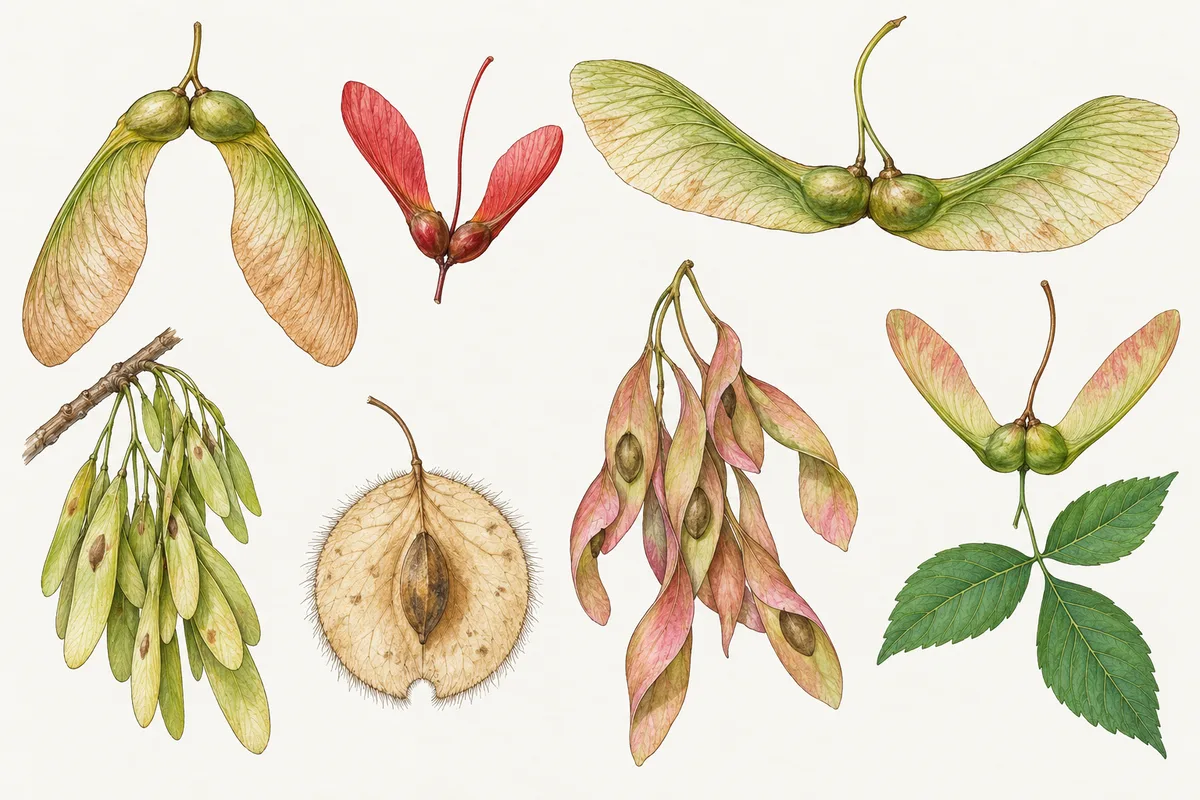
Count the wings first (a joined pair or one per seed), then check the angle between them, the size and the month. Those four clues name most helicopter-seed trees.
In short
A tree with helicopter seeds is almost always a maple: its winged seeds (samaras) come in joined pairs. Red and silver maples drop them in late spring, sugar maple, Norway maple and boxelder in fall. Single-winged helicopters come from ashes (paddle-shaped), elms (round papery wafers), tree of heaven (twisted) and tulip tree (in a cone-like cluster).
- Two wings joined at the seeds mean a maple; one wing per seed means an ash, elm, tree of heaven, tulip tree or hoptree.
- The angle between a maple's wings separates species: horseshoe-shaped on sugar maple, about 60 degrees on red maple, about 90 on silver maple, nearly flat on Norway maple.
- Season is the quick check: helicopters spinning down in May and June come from red or silver maple; in fall and winter from sugar maple, Norway maple, boxelder or ash.
Helicopter seeds are samaras: dry fruits with a papery wing that makes them spin as they fall. They are one of the best clues to a tree, because the wing shape differs from genus to genus. Never eat a berry, nut, seed or pod on the strength of a web page or an app; check with a local expert. This guide is for naming the tree.
Helicopter seeds by wing, size and season
| Tree | Wings | Size | When they fall | Page |
|---|---|---|---|---|
| Sugar maple (Acer saccharum) | Pair, horseshoe-shaped | About 1 in (2.5 cm) | Fall | Maple |
| Red maple (Acer rubrum) | Pair, slightly spread, about 60° | 1/2–3/4 in (1.3–2 cm), often reddish | Late spring–early summer | Maple |
| Silver maple (Acer saccharinum) | Pair, spread about 90°, the largest native maple seed | Wings 1 1/2–2 1/2 in (4–6 cm) | Late spring | Maple |
| Norway maple (Acer platanoides) | Pair, widely spread, nearly flat | 1 1/2–2 in (4–5 cm) | Late summer, persists into winter | Maple |
| Boxelder (Acer negundo) | Pair, V-shaped, under 45° | 1–1 1/2 in (2.5–4 cm), tan | Fall, persists all winter | Boxelder |
| Ashes (Fraxinus) | One paddle-shaped wing | White ash: one wing on a full, rounded seed | Fall, dispersing over winter | Ash |
| Elms (Ulmus) | Round papery wafer, seed in the middle | American elm: 3/8–1/2 in (1–1.3 cm) | Spring | Elm |
| Tree of heaven (Ailanthus altissima) | One twisted wing, seed in the center | 1–1 1/2 in (2.5–4 cm), in long clusters | Late summer, dispersing through winter | Tree of heaven |
| Tulip tree (Liriodendron tulipifera) | One wing, in a cone-like cluster | Each about 1 1/2 in (4 cm) | Late fall and winter | — |
| Hoptree (Ptelea trifoliata) | Round wafer | About 1 in (2.5 cm) | Summer | — |
Sizes and seasons come from the Virginia Tech Dendrology fact sheets linked below; the wing angles from Natural Resources Canada's maple key and Virginia Tech.
Paired wings: how to tell the maples apart
A pair of seeds joined at the base, each with its own wing, is a maple. Four checks separate the common ones: the angle between the wings, the size, the color and the month.
Sugar maple. Virginia Tech's fact sheet describes two-winged, horseshoe-shaped samaras about 1 inch long, in clusters, brown when mature in fall.
Red maple. Clusters of samaras 1/2 to 3/4 inch long with slightly divergent wings on long slender stems, light brown and often reddish, ripening in late spring and early summer (Virginia Tech). Natural Resources Canada's maple key gives the angle between the wings as about 60 degrees. NC State Extension's red maple profile describes the young samaras as red, pink or yellow, which answers "tree with red helicopter seeds".
Silver maple. The biggest helicopters in the eastern woods: divergent wings 1 1/2 to 2 1/2 inches long, maturing in late spring and germinating as soon as they land (Virginia Tech). NRCan describes the keys as very large, forming an angle of about 90 degrees.
Norway maple. Widely divergent wings, 1 1/2 to 2 inches long, with a relatively flat seed cavity, maturing in late summer and staying on into winter (Virginia Tech). The wings spread almost into a straight line. A snapped leaf stalk bleeding milky sap confirms it. Vermont Invasives lists Norway maple in Vermont as a quarantined Class B noxious weed.
Boxelder. Paired, V-shaped samaras 1 to 1 1/2 inches long, in drooping clusters, light tan when ripe in fall and hanging on through winter (Virginia Tech). NRCan's Manitoba maple factsheet describes incurved wings at an angle usually under 45 degrees. Only female trees carry them, and the compound leaves set boxelder apart from every other maple; the boxelder page has the details, and the maple page compares the leaves and buds of all of them.
In short: horseshoe-shaped and fall-ripening, sugar maple; about 60 degrees and small, red maple; about 90 degrees and huge, silver maple; nearly flat, Norway maple; a narrow V on a tree with compound leaves, boxelder.
Single wings: ash, elm, tree of heaven, tulip tree and hoptree
Ash. White ash bears a one-winged, dry, flattened samara with a full, rounded seed cavity, maturing in fall and dispersing over winter (Virginia Tech). Ash leaves are opposite and compound, 8 to 12 inches long with about 7 leaflets. See the ash page.
Elm. American elm's samaras are rounded, flat, papery wafers 3/8 to 1/2 inch across, deeply notched at the tip and hairless except for the edge, ripening in spring (Virginia Tech). The elm page covers the other elms.
Tree of heaven. An oblong, twisted samara 1 to 1 1/2 inches long with the seed in the center, hanging in long clusters, ripening in late summer and dispersing through winter (Virginia Tech). Leaflets with one or two gland-tipped teeth near the base and a rank smell when crushed confirm it. The Pennsylvania Department of Agriculture lists tree of heaven as a Class B noxious weed; see the tree of heaven page.
Tulip tree (yellow-poplar). An oblong, cone-like cluster of one-winged samaras, about 2 inches long; each samara is about 1 1/2 inches. The fruit matures from August to October and sheds its seeds through late fall and winter, and the base of the cluster stays on into spring like a small wooden flower high in the tree (Virginia Tech).
Hoptree. A shrub or small tree up to 20 feet with three-leaflet leaves and a round, wafer-like, papery samara about 1 inch across, light brown, maturing in summer (Virginia Tech).
Tiny wings and leafy wings: birch, hornbeam and linden
Not every winged seed spins like a helicopter. Birch catkins break apart in fall into tiny winged seeds, which Virginia Tech's river birch sheet describes. Hornbeam carries a small nut about 1/8 to 1/4 inch (3–6 mm) long held in a three-lobed leafy bract, according to the Woodland Trust. Lindens (limes in Britain, basswood in North America) hang round nutlets about 1/4 inch across under a curving, leafy bract that acts as a wing, ripening in fall (Virginia Tech).
Helicopter seeds in the UK
In Britain the commonest helicopter tree is sycamore, a maple native to central, eastern and southern Europe. The Woodland Trust says its V-shaped seeds can be told from similar maples because the angle between the wings is narrower. Norway maple has a wider angle, per the Woodland Trust, and field maple, the UK's only native maple, carries wings set in a straight line (Woodland Trust). Ash develops winged "keys" in late summer and autumn that fall in winter and early spring (Woodland Trust). Lime's leafy bract and hornbeam's three-lobed bract, above, complete the British list. In North America "sycamore" means a plane tree with seed balls, not helicopters; the sycamore page explains the two.
Helicopter seeds in Canada
Canadians often call maple samaras "keys", the word Natural Resources Canada uses. The common ones are sugar maple, red maple, silver maple, Norway maple in towns, and Manitoba maple, the Canadian name for boxelder, whose keys hang in drooping clusters with incurved wings (NRCan). In British Columbia, NRCan's key notes that bigleaf maple's paired keys have nearly parallel wings and vine maple's spread widely. The Canada guide places these trees by region.
Using a photo
Samaras are easy to photograph flat on a palm or on pavement. Include a leaf from the same tree if you can, since seeds blow far. Tree Identifier names a tree from one photo, and sugar maple, red maple, Norway maple, Japanese maple, European ash, American elm, tulip tree, small-leaved lime and hornbeam are in its Collection. It shows no confidence score or alternatives, so check the answer against the wing angle and season. For pods, nuts and acorns, see tree seed identification and trees with long seed pods.
What a photo can't settle
- Samaras on the ground may have blown in from a neighbor's tree, so confirm with the leaves of the tree above you.
- Male trees of boxelder, and many ashes, carry no seeds at all, and some maples skip years, so the seed test is not always available.
- Wing angles vary within a species and even on one tree; compare several pairs, not one.
Questions people ask
What tree drops helicopter seeds in spring?
Red maple or silver maple. Virginia Tech gives red maple samaras 1/2 to 3/4 inch long, often reddish, ripening in late spring and early summer, and silver maple the largest of any native maple, wings 1 1/2 to 2 1/2 inches, maturing in late spring. American elm's round papery wafers also fall in spring.
What tree has red helicopter seeds?
Usually a red maple. NC State Extension describes its samaras as red, pink or yellow on drooping stems, turning tan or brown when mature, and Virginia Tech as light brown and often reddish. In Britain, field maple seeds are often green and red, per the Woodland Trust, but their wings sit in a straight line.
What tree has helicopter seeds in the UK?
Most often sycamore, a maple that is not native to the UK. The Woodland Trust tells it from Norway maple by the wing angle, narrower on sycamore and wider on Norway maple, and from field maple, the UK's only native maple, whose wings sit in a straight line. Ash 'keys' hang in clusters through winter.
Are maple helicopter seeds edible or poisonous to dogs?
This page does not answer either question. Never eat a seed on the strength of a web page or an app, and ask a vet or a poison control center if a pet has eaten something. Tree Identifier's Toxicology notes are AI-written and are not a safety verdict.
What is the tree with seeds that spin like helicopters but grow singly?
An ash, an elm, a tree of heaven, a tulip tree or a hoptree. Ash wings are single and paddle-shaped; elm seeds sit in the middle of a round wafer; tree of heaven samaras are twisted with the seed in the center; tulip tree samaras come in a cone-like cluster; hoptree's are round wafers about an inch across.
Sources
- Sugar maple fact sheet — Virginia Tech Dendrology
- Red maple fact sheet — Virginia Tech Dendrology
- Silver maple fact sheet — Virginia Tech Dendrology
- Norway maple fact sheet — Virginia Tech Dendrology
- Maples (Acer): identification key — Natural Resources Canada, Trees, insects and diseases of Canada's forests
- White ash fact sheet — Virginia Tech Dendrology
- Tree-of-heaven fact sheet — Virginia Tech Dendrology
- Sycamore (Acer pseudoplatanus) — Woodland Trust