Data guide
The most common trees in the US, by number of trees
The US Forest Service counts trees on inventory plots across the country. Here is what tops the count, how the leaders change by region, and how to recognize each one.
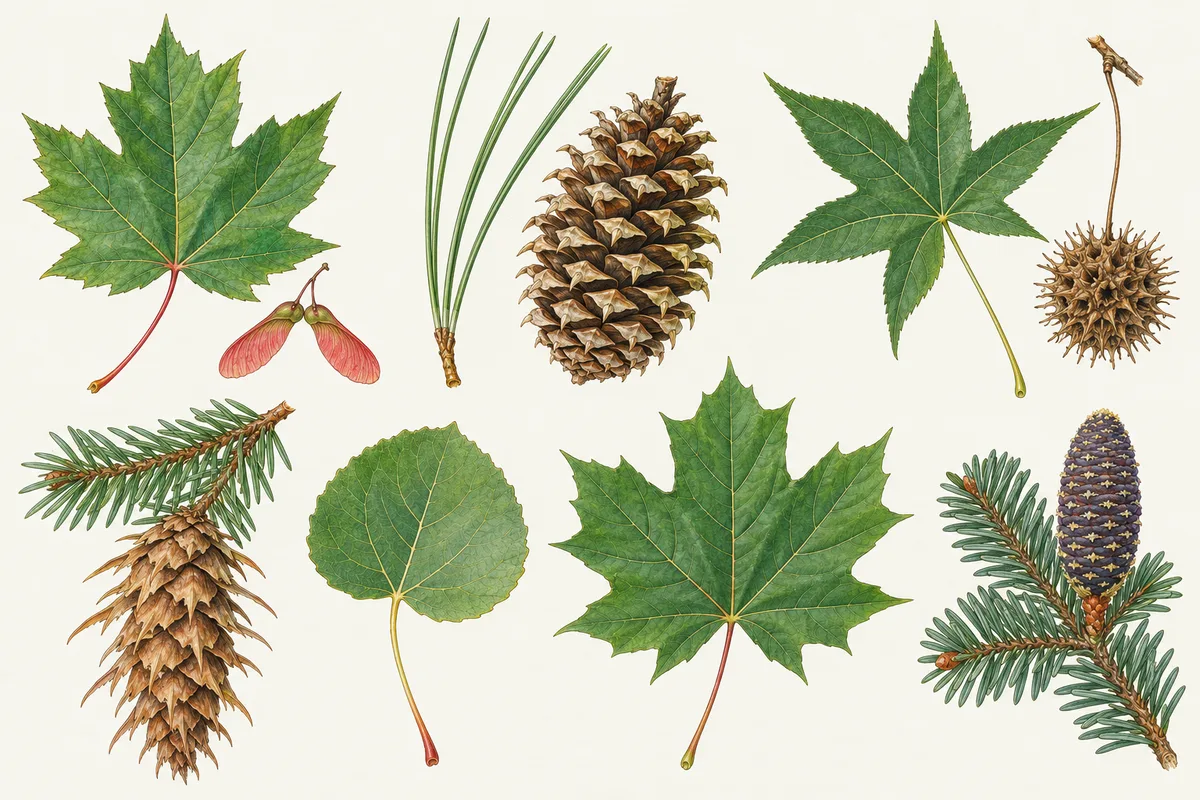
In short
The most common trees in the US, counted on forest land in the lower 48 states, are red maple (about 22.5 billion trees), loblolly pine (19.9 billion), sweetgum (15.3 billion), balsam fir (14.2 billion) and quaking aspen (10.6 billion), in the US Forest Service's inventory database as queried on October 21, 2026. Ranked by biomass, Douglas-fir comes first. On city streets, Norway maple and London plane lead.
- Red maple is the most numerous tree in the lower 48 states: about 22.5 billion of the 342 billion live trees in the Forest Service inventory, or 6.6 percent.
- Twenty species make up just over half of all those trees; the inventory records 427 species in all.
- Rankings depend on the measure: Douglas-fir holds the most aboveground biomass (3.0 billion tons), more than twice red maple's 1.4 billion.
- Each region has its own leader: red maple in the North, loblolly pine in the South, Gambel oak in the Rockies, Douglas-fir on the Pacific Coast.
Which trees are the most common in the US depends on what you count: trees, wood or the trees lining your street. This page uses the US Forest Service's Forest Inventory and Analysis (FIA) program, which measures trees on a grid of plots across the country, as summarized in Forest Resources of the United States, 2017 (published 2019 to support the Forest Service's 2020 RPA Assessment). Every figure below comes from that report unless another source is named, and each tree gets one feature to check in the field.
The 20 most common trees in the US
The Forest Service's Forest Inventory and Analysis (FIA) program publishes its plot data through a public database, EVALIDator. We asked it for the number of live trees on forest land by species, for the 48 conterminous states, using each state's most recent inventory (plots measured between 2013 and 2026; queried October 21, 2026). It counts every live tree from 1 inch (2.5 cm) in diameter, so saplings count as much as old giants. The total is about 342 billion trees of 427 species, and these 20 make up just over half of them:
| Rank | Tree | Live trees (est.) | Share | The one feature to check | Our page |
|---|---|---|---|---|---|
| 1 | Red maple (Acer rubrum) | 22.5 billion | 6.6% | Opposite leaves with 3 to 5 lobes and toothed edges; red, shiny twigs | Red maple vs sugar maple |
| 2 | Loblolly pine (Pinus taeda) | 19.9 billion | 5.8% | Needles 6 to 9 in (15 to 23 cm), usually three per bundle | Pine |
| 3 | Sweetgum (Liquidambar styraciflua) | 15.3 billion | 4.5% | Star-shaped leaves with 5 to 7 lobes; spiny "gumball" fruit | Tree with spiky balls |
| 4 | Balsam fir (Abies balsamea) | 14.2 billion | 4.1% | Flat, blunt needles about 3/4 in (19 mm); resin blisters on smooth bark | Spruce vs fir |
| 5 | Quaking aspen (Populus tremuloides) | 10.6 billion | 3.1% | Nearly round leaves on a flattened stalk that make them flutter | Poplar and aspen |
| 6 | Douglas-fir (Pseudotsuga menziesii) | 10.2 billion | 3.0% | Cones with three-pointed bracts sticking out between the scales | Spruce vs fir |
| 7 | Lodgepole pine (Pinus contorta) | 9.6 billion | 2.8% | Two twisted needles per bundle, 1 1/2 to 3 in | Pine |
| 8 | American beech (Fagus grandifolia) | 8.7 billion | 2.6% | Smooth, light gray bark; long, sharp, cigar-shaped buds | Beech |
| 9 | Sugar maple (Acer saccharum) | 8.6 billion | 2.5% | Opposite leaves with 5 rounded lobes and few, blunt teeth | Red maple vs sugar maple |
| 10 | Gambel oak (Quercus gambelii) | 7.8 billion | 2.3% | Leaves with 5 to 9 rounded lobes; often a thicket | Oak |
| 11 | Subalpine fir (Abies lasiocarpa) | 6.9 billion | 2.0% | Very narrow, spire-shaped crown; flat needles curving upward | Spruce vs fir |
| 12 | Water oak (Quercus nigra) | 5.4 billion | 1.6% | Small leaves widest near the tip, often with three shallow lobes | Oak |
| 13 | Yellow-poplar or tulip tree (Liriodendron tulipifera) | 5.0 billion | 1.5% | Four-lobed leaves with a squared-off tip | Trees with yellow leaves in fall |
| 14 | Winged elm (Ulmus alata) | 4.9 billion | 1.4% | Small, lopsided elm leaves; twigs with two corky wings | Elm |
| 15 | Eastern redcedar (Juniperus virginiana) | 4.9 billion | 1.4% | A juniper: scale leaves and blue, berry-like cones | Cedar |
| 16 | Ponderosa pine (Pinus ponderosa) | 4.9 billion | 1.4% | Long needles, mostly three per bundle; orange bark in jigsaw plates | Pine |
| 17 | Eastern hophornbeam (Ostrya virginiana) | 4.7 billion | 1.4% | Bark in thin, shreddy strips; fruit in hop-like clusters of papery sacs | — |
| 18 | Blackgum (Nyssa sylvatica) | 4.5 billion | 1.3% | Glossy, smooth-edged oval leaves that turn scarlet in fall | Trees with red leaves in fall |
| 19 | White oak (Quercus alba) | 4.3 billion | 1.3% | Rounded lobes without bristle tips; pale, scaly bark | White oak |
| 20 | Black cherry (Prunus serotina) | 4.2 billion | 1.2% | Dark bark in small curled plates; finely toothed leaves | Cherry |
Measure: number of live trees at least 1 inch d.b.h. on forest land, 48 conterminous states, FIA EVALIDator, each state's latest evaluation (Texas statewide). Every estimate in the table has a sampling error under 3.5 percent. Field features come from the Virginia Tech Dendrology fact sheets for each species.
The order differs a little from the Forest Service's own Forest Resources of the United States, 2017, which used older plots and put red maple (25 billion), loblolly pine (22 billion), balsam fir (16 billion), sweetgum (15 billion) and Douglas-fir (11 billion) at the top. Red maple leads in both.
Why red maple? The 2017 report describes red maple as a species that "responds positively to disturbances". It names its profuse seeding, shade tolerance and low appeal to deer, together with decades of fire suppression, as reasons it has been increasing across its range.
Ranked by wood instead of trees
Counting trees favors species with many small stems. Weighing them gives a different list. By aboveground live-tree biomass:
- Douglas-fir holds the most of any species, 3.0 billion tons (2017 report).
- Loblolly pine follows with 2.1 billion tons, 8 percent of the national total and 20 percent of the South's.
- Red maple, though the most numerous tree, holds 1.4 billion tons, less than half of Douglas-fir's.
So if a search asks for the most common tree "by volume" or "for lumber", the honest answer for the US is Douglas-fir, with loblolly pine the leader in the South.
Most common trees by region
The 2017 report gives the leaders for four regions and for coastal Alaska. Ranks within each region are by number of live trees unless the line says biomass.
| Region | Most numerous | Next | Feature to check |
|---|---|---|---|
| North | Red maple, also the most biomass (798 million tons) | By biomass: balsam fir, quaking aspen, sugar maple, northern white-cedar | Red maple: opposite, toothed 3- to 5-lobed leaves |
| South | Loblolly pine, about 22 billion stems | Sweetgum, 15 billion trees | Loblolly: three needles per bundle |
| Rocky Mountains | Gambel oak, 7.5 billion trees | Lodgepole pine, 7 billion | Gambel oak: rounded lobes, often a thicket |
| Pacific Coast (excluding Alaska) | Douglas-fir, about 6 billion trees | Western hemlock, 2.4 billion | Western hemlock: drooping leader, short needles of two lengths |
| Coastal Alaska | Western hemlock, 3 billion trees | Mountain hemlock, 1.6 billion; Sitka spruce has more biomass | Sitka spruce: stiff, very sharp needles |
How to recognize the regional leaders that are not in the top 20:
- Northern white-cedar (Thuja occidentalis): flat sprays of scale leaves 1 to 2 mm long and small upright cones 7 to 12 mm (about 1/2 in) with 5 or 6 pairs of scales, per Natural Resources Canada. The cedar guide separates it from junipers called "red cedar".
- Western hemlock (Tsuga heterophylla): flat needles 1/4 to 3/4 in (6 to 19 mm) in two alternating lengths, with two white bands underneath; cones about 1 in.
- Mountain hemlock (Tsuga mertensiana): needles the same color on all sides, crowded in star-like clusters; longer cones, 1 to 3 in.
- Sitka spruce (Picea sitchensis): four-sided needles about 1 in long with a very sharp tip, each on a woody peg; Virginia Tech calls it the largest of all spruces.
For the Northwest in more detail, see the Pacific Northwest tree guide; for every needle tree, the conifer identification key.
The trees you see in towns and on streets
Forest statistics leave out the trees most people walk past. City tree inventories cover them. A 2022 study in eLife by McCoy, Goulet-Scott and colleagues (read it) compiled 5,660,237 inventoried trees from 63 of the largest US cities. Its findings:
- Maples and oaks were the dominant genera across the country.
- The most common species were Norway maple, green ash, crape myrtle and London plane.
- Naturally occurring (native) species made up a median of 45.6 percent of a city's trees, with a range from 0.51 to 87.4 percent. Introduced species were more common in drier cities.
How to tell the four street leaders:
- Norway maple (Acer platanoides): a maple whose leaf stalk leaks milky sap when snapped; leaves with 5 to 7 lobes. A purple-leaved form, 'Crimson King', is widely planted. Compare it in the maple guide.
- Green ash (Fraxinus pennsylvanica): opposite, compound leaves with 7 to 9 leaflets; bark with corky ridges forming diamonds. See the ash guide.
- Crape myrtle (Lagerstroemia indica): a small, often multi-stemmed tree with smooth bark peeling in patches of brown and green, and white, pink, red or purple flower clusters about 8 in (20 cm) long in late summer.
- London plane (Platanus × hispanica): large, maple-like leaves 5 to 9 in (13 to 23 cm) and bark flaking into cream, olive and yellow patches. The London plane guide separates it from American sycamore.
In your own yard, the trees are whatever a builder or a previous owner planted. Our guide to identifying trees in your yard covers the paper trail and the common planted species.
How to use this list in the field
A ranking is a shortcut, not proof. Use it this way:
- Start with the regional leaders. In the North, a maple with toothed leaves is more likely red maple than anything rarer. In the South, a pine with three long needles is likely loblolly.
- Check the one feature in the tables above before you accept the name.
- Rule in the look-alikes. Red maple is confused with silver and sugar maple; loblolly with shortleaf and slash pine; balsam fir with Fraser fir and eastern hemlock. The field method gives the order of checks.
If the leaves are out of reach, Tree Identifier can suggest a name from one photo of a fallen leaf, a cone, the bark or the whole tree, with the scientific name and key traits. It shows no confidence score or list of look-alikes, so confirm the answer with the feature in the tables. The app's Collection includes several trees on this page, among them Douglas-fir, sweetgum and American sycamore.
What "most common in America" leaves out
- Alaska's interior and Hawaii. The national top five are for the conterminous states. The report gives coastal Alaska separately (above).
- Canada. The Forest Service inventory stops at the border. For "most common trees in North America", combine this list with Canada's: see the Canada tree guide and the most common trees in Canada.
- Small trees and shrubs. The count starts at 1 inch in diameter and covers species FIA records as trees, so shrubs such as sumac and most hawthorns barely register.
What a photo can't settle
- Forest Service counts cover forest land, so yard, street and park trees are not in the national ranking; the city section below uses a separate study.
- The count includes every live tree from about 1 inch (2.5 cm) in diameter, so a species with many small saplings can outrank one with fewer, larger trees.
- A photo of a young maple or a pine seedling may not show the features that separate close relatives, such as red and sugar maple or loblolly and shortleaf pine.
Questions people ask
What is the most common tree in the United States?
Red maple. The US Forest Service's inventory counts about 22.5 billion red maples on forest land in the lower 48 states, more than any other species (our query of its database, October 21, 2026). Loblolly pine is second with about 19.9 billion trees.
What is the most common tree in America by volume or biomass?
Douglas-fir. The same Forest Service report gives it the nation's largest store of aboveground live-tree biomass, 3.0 billion tons, ahead of loblolly pine at 2.1 billion tons. Red maple, the most numerous tree, holds 1.4 billion tons.
What is the most common tree in North America?
For the United States, the Forest Service count puts red maple first. Canada keeps its own National Forest Inventory, so a single North American ranking needs both inventories. Our Canada guide lists the trees to learn in each Canadian region.
What are the most common street trees in US cities?
A 2022 study of 5.66 million inventoried city trees in 63 large US cities found maples and oaks were the dominant genera, and the most common species were Norway maple, green ash, crape myrtle and London plane.
Why is red maple so common?
The Forest Service report links red maple's spread to its generalist traits, including profuse seeding, shade tolerance and being unappetizing to deer, and to fire suppression, which favors it over oaks and pines. It describes red maple as increasing across its range.
Sources
- EVALIDator (FIADB-API 2.0): number of live trees on forest land by species, 48 conterminous states — USDA Forest Service, Forest Inventory and Analysis
- Forest Resources of the United States, 2017 (Gen. Tech. Rep. WO-97) — USDA Forest Service
- Species clustering, climate effects, and introduced species in 5 million city trees across 63 US cities — eLife (McCoy, Goulet-Scott et al., 2022)
- Virginia Tech Dendrology fact sheets (red maple, loblolly pine, balsam fir, sweetgum, Douglas-fir and others) — Virginia Tech, Department of Forest Resources and Environmental Conservation
- Eastern white-cedar factsheet — Natural Resources Canada, Canadian Forest Service
Keep reading
- Tree comparisonRed maple vs sugar maple: how to tell them apart
- Tree profileLondon plane tree (Platanus × hispanica): how to identify it
- Tree profilePines (Pinus): how to identify a pine tree
- Tree comparisonSpruce vs fir: how to tell them apart
- Canada field guideTree identification in Canada, region by region