Regional guide
Trees of the Pacific Northwest, by region
British Columbia, Washington and Oregon share one short list of trees. Which ones you meet depends on which side of the Cascades and Coast Mountains you stand.
In short
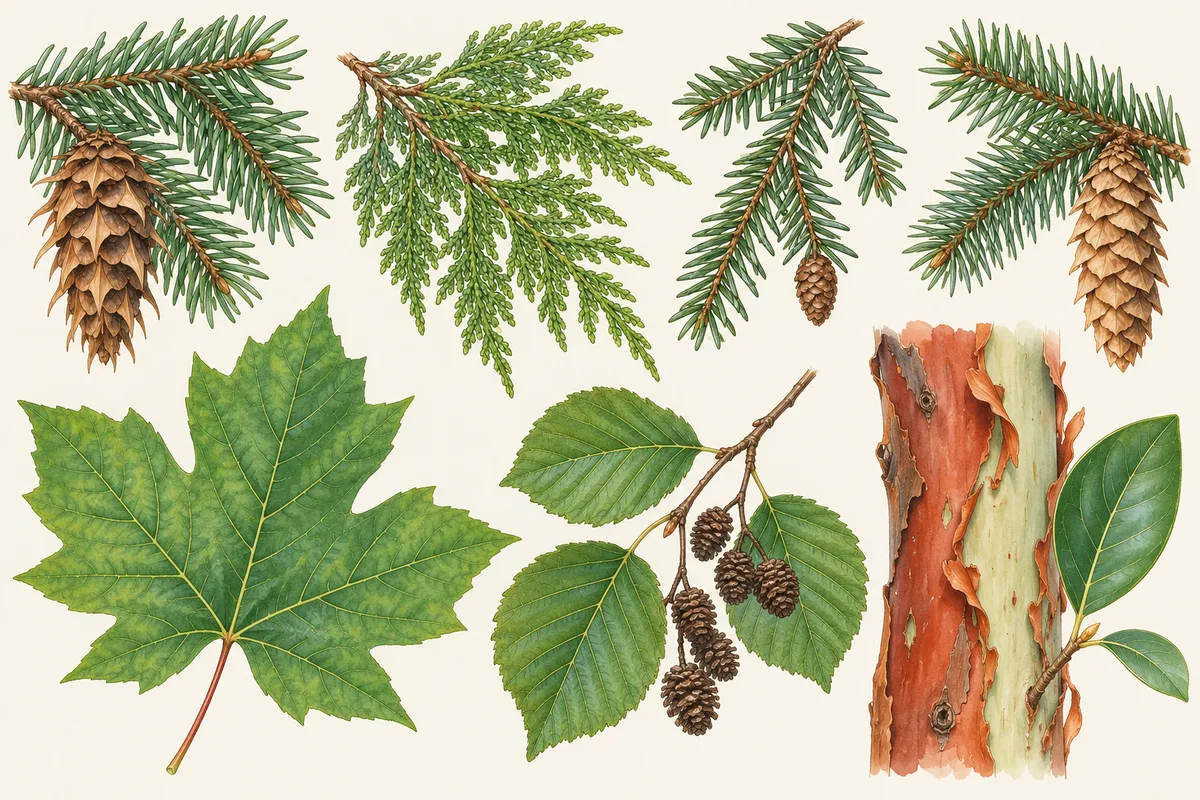
The trees of the Pacific Northwest sort by region. On the wet coast west of the Cascades and Coast Mountains, learn Douglas-fir, western redcedar, western hemlock, Sitka spruce, red alder and bigleaf maple. In the dry interior east of the mountains, ponderosa pine, western larch and lodgepole pine. In rain-shadow pockets near the sea, Pacific madrone (arbutus in Canada) and Oregon white oak (Garry oak).
- Douglas-fir is the most numerous tree in the Pacific Coast states, about 6 billion trees in the Forest Service's 2017 estimate, with western hemlock second.
- Arbutus (Pacific madrone) is the only native broadleaf evergreen tree in Canada, according to British Columbia's Tree Book.
- Washington's state tree is the western hemlock (1947); Oregon's is the Douglas-fir; British Columbia's is the western redcedar.
Three states and a province share one forest flora, but the Cascades and Coast Mountains split it in two. West of the mountains, Pacific storms drop heavy rain and the forest is tall, dark and evergreen. East of them, in the rain shadow, it turns dry and open. Higher up, a third set of trees takes over. Start with your side of the mountains, then use needles, bark and cones. Descriptions follow British Columbia's Tree Book, Oregon State University's Common Trees of the Pacific Northwest and the Virginia Tech Dendrology fact sheets.
The trees to learn first, by region
| Tree | Where in the Northwest | The one feature that settles it | Our page |
|---|---|---|---|
| Douglas-fir | Coast and interior | Hanging cones with three-pointed bracts between the scales | Spruce vs fir |
| Western redcedar | Wet coast, interior wet belt | Flat sprays of scale leaves with a white butterfly pattern underneath; stringy bark | Cedar |
| Western hemlock | Wet coast, interior wet belt | Drooping top; short flat needles of two lengths | Conifer key |
| Sitka spruce | Coastal fog belt | Stiff, very sharp needles on woody pegs | Spruce vs fir |
| Grand fir | Southern coast; Kootenay and Columbia valleys in BC | Flat needles in two neat rows; upright cones | Spruce vs fir |
| Bigleaf maple | Wet coast (in BC, only the southwest) | Leaves 6 to 12 in (15 to 30 cm) across | Maple |
| Vine maple | Wet coast (in BC, mostly the southwest) | Round leaves with 7 to 9 shallow lobes; multi-stemmed | Maple |
| Red alder | The whole coast | Leaf edges rolled under; small woody cones all winter | Alder |
| Black cottonwood | Both sides, west of the Rockies | Sticky, fragrant buds; leaves silvery underneath | Poplar |
| Pacific yew | Understory, wet forests | Flat needles, green beneath; red fleshy cup around the seed | Yew |
| Pacific dogwood | Southern coast, under conifers | 4 to 6 large white bracts around a flower head | Dogwood |
| Pacific madrone (arbutus) | Dry, rocky sites near the sea | Peeling orange-red bark; evergreen leaves | — |
| Oregon white oak (Garry oak) | Rain-shadow lowlands | Rounded lobes; acorns in a shallow cap | Oak |
| Ponderosa pine | Dry interior | Needles 5 to 10 in, in threes; orange puzzle-piece bark | Pine |
| Lodgepole pine | Interior; shore pine on the coast | Two twisted needles per bundle | Pine |
| Western larch | Southern interior valleys | Soft needle tufts that turn gold and drop in fall | Tamarack |
If you only learn four, learn the big conifers of the wet side: Douglas-fir, western redcedar, western hemlock and Sitka spruce.
The wet coast, west of the Cascades and Coast Mountains
This is the rainforest side: Vancouver Island, the BC coast, the Olympic Peninsula and the lowlands around Puget Sound and western Oregon.
- Douglas-fir (Pseudotsuga menziesii): flat needles 3/4 to 1 1/4 in (2 to 3 cm), fragrant when crushed. The cones, 3 to 4 in (7.5 to 10 cm) long, hang down and carry three-pronged bracts that OSU calls "pitchfork-shaped". The Tree Book places the coastal variety on the southern mainland coast and across Vancouver Island except its northern tip. It is Oregon's state tree.
- Western redcedar (Thuja plicata): tiny scale leaves in flat sprays with a white, butterfly-shaped pattern underneath; small, upturned cones about 1/2 in (1.3 cm) with 5 to 6 pairs of scales; thin, stringy, reddish-brown bark that comes off in long strips; and a trunk base often swollen and fluted. It grows to 200 ft (60 m). The cedar guide separates it from junipers and true cedars.
- Western hemlock (Tsuga heterophylla): needles 1/4 to 3/4 in (6 to 19 mm), flat, in two distinctly different sizes on the same twig, with two white bands beneath. Cones about 1 in (2.5 cm). Look up: the leader and branch tips droop. It is Washington's state tree, adopted in 1947 (Washington State Legislature).
- Sitka spruce (Picea sitchensis): stiff, very sharp needles about 1 in long, each on a woody peg; cones 1 1/2 to 3 1/2 in with thin scales notched at the edge. OSU says it grows only along the Pacific coast and near sea level; the Tree Book places it in a narrow band up to about 700 m (2,300 ft), most common in the coastal fog belt and on river flood plains.
- Grand fir (Abies grandis): flat needles 3/4 to 2 in, notched at the tip, arranged in two flat rows with white bands below; upright, barrel-shaped cones 2 to 4 in that fall apart on the branch. In BC it grows on the southern coast and around the Kootenay and Columbia rivers.
- Bigleaf maple (Acer macrophyllum): leaves 6 to 12 in (15 to 30 cm) across, sometimes larger, with 5 deep lobes and milky sap in the leaf stalk; fuzzy-headed seed pairs. In BC it is restricted to the southwest corner.
- Vine maple (Acer circinatum): round leaves 2 to 4 in across with 7 to 9 shallow lobes; seed wings spread in a straight line; a multi-stemmed shrub or small tree, 20 to 40 ft, often arching under conifers.
- Red alder (Alnus rubra): oval, double-toothed leaves 3 to 6 in with edges tightly rolled under; small woody cones that hang all winter; smooth gray bark often patched white with lichens. OSU notes there are few creeks in western Oregon not overhung by alders, and red alder is the only abundant one. The Tree Book places it along the entire BC coast. See the alder guide.
- Black cottonwood (Populus trichocarpa, also listed as Populus balsamifera ssp. trichocarpa): large, sticky, fragrant buds; leaves dark green above and silvery below. Virginia Tech calls it the tallest broadleaf tree in the West, to 200 ft. The Tree Book says it grows west of the Rocky Mountains.
- Pacific yew (Taxus brevifolia), called western yew in BC: a small understory tree with flat needles about 1 in long, pointed but not sharp, green below without white bands; thin, scaly reddish bark; a red, fleshy cup (aril) around one seed. More on yews in the yew guide.
- Pacific dogwood (Cornus nuttallii): opposite leaves 3 to 5 in with curving veins; 4 to 6 large white bracts around a small flower head; tight clusters of red fruits. The Tree Book places it on the southern coast and Vancouver Island south of Port Hardy. See the dogwood guide.
Never eat a berry, nut, seed or pod on the strength of a web page or an app; check with a local expert.
Rain-shadow pockets: arbutus and Garry oak
Inside the wet region are dry, sunny pockets, such as southeastern Vancouver Island and the Gulf Islands, where rocky, fast-draining soils hold little water. Two broadleaf trees mark them.
- Pacific madrone, arbutus in Canada (Arbutus menziesii): thin bark peeling in patches of orange, red, brown and green; glossy, leathery evergreen leaves 3 to 5 in; clusters of small white urn-shaped flowers; orange-red berries with a pebbly skin. BC's Tree Book calls it "the only native broadleaf evergreen tree in Canada" and says it generally grows within 8 km (5 miles) of the ocean, often on rocky bluffs.
- Oregon white oak, Garry oak in Canada (Quercus garryana): leathery, glossy leaves 3 to 6 in with 5 to 9 rounded, irregular lobes; acorns about 1 in in a shallow cap; gray, furrowed bark. In BC it grows on southeastern Vancouver Island and the Gulf Islands, with isolated groups in the lower Fraser Valley, forming open meadows the Tree Book describes as threatened by urban development. OSU says that in Oregon it seldom grows west of the Coast Range summit and reaches eastern Oregon only along the Columbia Gorge. More oaks in the oak guide.
The dry interior, east of the mountains
Cross the Cascades or the Coast Mountains into eastern Washington and Oregon or BC's southern Interior, and the forest opens up.
- Ponderosa pine (Pinus ponderosa): needles 5 to 10 in (13 to 25 cm), in bundles of three, tufted near branch ends; cones 3 to 5 in with a stiff prickle on each scale; old bark in yellow-orange plates shaped like jigsaw puzzle pieces. The Tree Book calls it "the characteristic tree of the southern Interior".
- Lodgepole pine (Pinus contorta): two twisted needles per bundle, 1 to 3 in; small cones that may stay closed for years. OSU notes that trees along the coast are commonly called shore pine. The Tree Book says it grows throughout BC's Interior from mid elevation to subalpine sites.
- Western larch (Larix occidentalis): a conifer that drops its needles. Soft needles 1 to 1 3/4 in, in tufts on short spur shoots, turning golden in fall; small cones with bristle-like bracts. The Tree Book places it in valleys and lower mountain slopes of the southern Interior. The tamarack page covers larches in general.
- Interior Douglas-fir and trembling (quaking) aspen also grow here: the Tree Book places interior Douglas-fir throughout southern BC and north to Takla Lake, and aspen throughout the province east of the Coast Ranges.
The mountains: near the tree line
Higher up on both sides, three conifers take over:
- Subalpine fir (Abies lasiocarpa): a narrow, spire-shaped crown and upright cones. The Tree Book gives 600 to 2,250 m (2,000 to 7,400 ft) through most of BC's Interior.
- Mountain hemlock (Tsuga mertensiana): blue-green needles the same color on all sides, crowded in star-like clusters; cylindrical cones 1 to 3 in, longer than western hemlock's. It grows from mid elevation to timberline in the coastal mountains.
- Engelmann spruce (Picea engelmannii): a high-elevation spruce with sharp needles on woody pegs; the Tree Book places it at high elevations throughout the BC Interior.
To sort any needle tree in this list, the conifer identification key asks three questions; the spruce vs fir guide handles the most common confusion.
The most common trees in the Pacific Northwest
By number of trees, Douglas-fir leads. The US Forest Service's Forest Resources of the United States, 2017 estimates about 6 billion live Douglas-firs in its Pacific Coast region (excluding Alaska), with 2.4 billion tons of aboveground biomass, and western hemlock next at 2.4 billion trees. The most common trees in the US puts those numbers in the national ranking.
State and provincial trees follow the same few species: western hemlock for Washington (1947), Douglas-fir for Oregon (per OSU), and western redcedar for British Columbia (see the Canada tree guide for every provincial tree).
Free guides for BC, Washington and Oregon
Checked on 21 October 2026:
- Tree Book: Learning to Recognize Trees of British Columbia, BC Ministry of Forests. Free online, with a downloadable PDF. Its introduction says British Columbia has "about 40 different species of native trees", and each species page has a "where to find" section.
- Common Trees of the Pacific Northwest, Oregon State University. A free website with a step-by-step key for conifers and broadleaves, genus descriptions and a "mystery tree" quiz. Its stated purpose is to help you "identify common conifers and broadleaves in the Pacific Northwest".
- Trees to Know in Oregon and Washington (EC 1450) by Edward C. Jensen, OSU Extension. A book, revised January 2021 and reviewed 2025, with more than 400 color photos, 70 maps, identification keys and over 50 ornamental trees. The catalog page links a PDF and sells print copies.
In the field, a quick first answer can come from a photo: Tree Identifier names a tree from one picture of a cone, a needle spray, a leaf or the bark, and its follow-up chat can answer a question such as "is this grand fir or western hemlock?". It shows no confidence score, so check the result against the one feature in the table above. The app's Collection includes Douglas-fir and western redcedar, and its Tree Map keeps each find you locate.
What a photo can't settle
- Gardens and streets in Vancouver, Seattle and Portland are full of planted trees from other regions, which a native-tree list will not cover.
- Shore pine and inland lodgepole pine are the same species, Pinus contorta, but look quite different; a photo of one stunted coastal tree can be hard to place.
- Young western hemlock, grand fir and Pacific yew all have flat needles; a photo of one sprig may not settle it, so check the needle underside and the cones.
Questions people ask
What is the most common tree in the Pacific Northwest?
Douglas-fir. The US Forest Service's Forest Resources of the United States, 2017 estimates about 6 billion live Douglas-firs in the Pacific Coast states (Alaska excluded), ahead of western hemlock at 2.4 billion. Douglas-fir also holds the most biomass of any US tree.
What is the difference between arbutus and madrone?
None: they are two names for the same tree, Arbutus menziesii. Canadians call it arbutus; in Washington, Oregon and California it is Pacific madrone or madrona. BC's Tree Book notes that madrone is a Spanish word for the strawberry tree, a close relative.
Is Garry oak the same as Oregon white oak?
Yes. Both names mean Quercus garryana. In British Columbia it grows on southeastern Vancouver Island and the Gulf Islands, with a few groups in the lower Fraser Valley; in Oregon, OSU says it seldom grows west of the Coast Range summit and reaches eastern Oregon only along the Columbia Gorge.
What are the main evergreen trees in Washington State?
On the wet side west of the Cascades: Douglas-fir, western hemlock (the state tree), western redcedar, Sitka spruce near the coast and grand fir. East of the Cascades: ponderosa pine and lodgepole pine, with western larch, a conifer that drops its needles every fall.
Is there a free guide to British Columbia trees?
Yes. The BC Ministry of Forests publishes the Tree Book: Learning to Recognize Trees of British Columbia online, with a free PDF download. It says the province has about 40 native tree species and gives keys, descriptions and where to find each one.
Sources
- Tree Book: Learning to Recognize Trees of British Columbia — British Columbia Ministry of Forests
- Common Trees of the Pacific Northwest — Oregon State University, College of Forestry
- Trees to Know in Oregon and Washington (EC 1450) — Oregon State University Extension Service
- Western redcedar fact sheet — Virginia Tech Dendrology
Keep reading
- Tree profileCedar trees: how to identify red, white and true cedars
- Tree comparisonSpruce vs fir: how to tell them apart
- Tree profilePines (Pinus): how to identify a pine tree
- Field guideConifer identification: three questions about the needles, then the cone
- Canada field guideTree identification in Canada, region by region