Field guide
New Zealand native trees: how to identify the ones you meet
New Zealand's forest trees evolved in isolation and match nothing in a European or American guide. Learn a handful of natives by one clue each and most of the bush starts to make sense.
In short
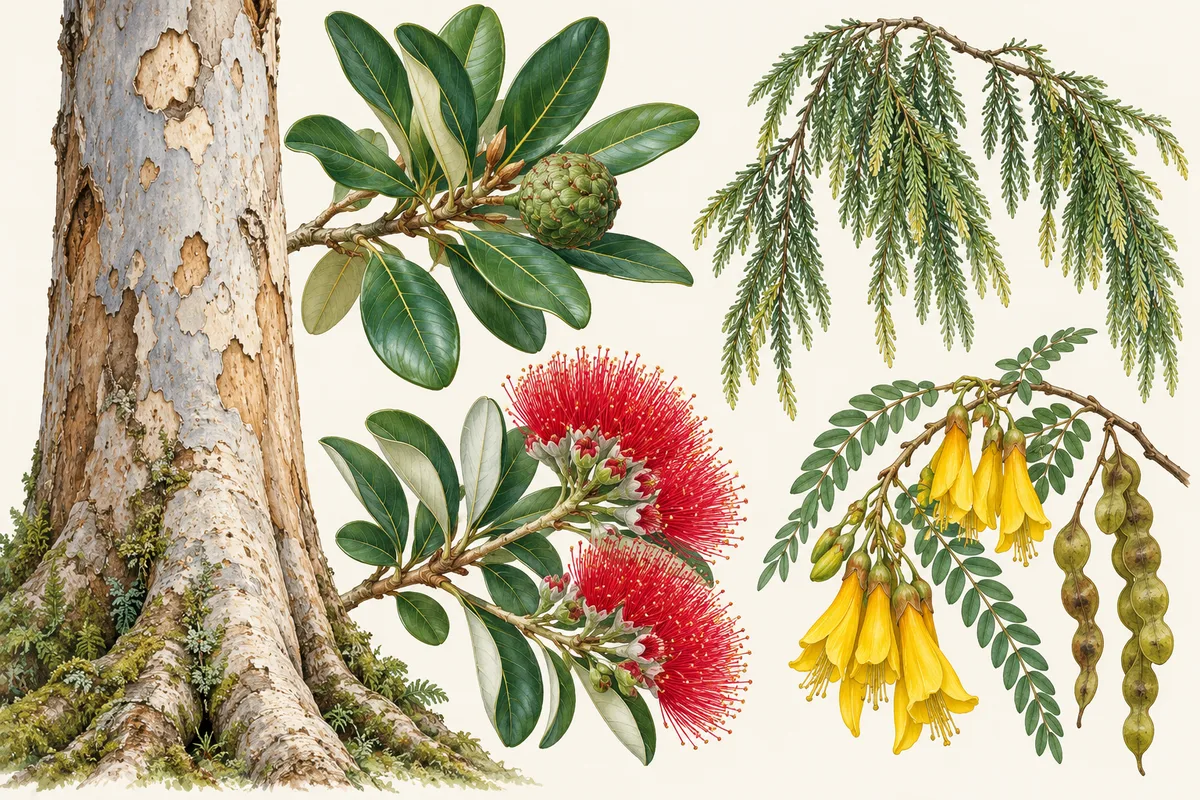
New Zealand native trees identification works best one tree at a time. Kauri sheds blue-grey bark in thick flakes and grows only in the north of the North Island; rimu has weeping, drooping branchlets; tōtara has stiff, sharp-tipped leaves and stringy bark; red beech has small toothed leaves 2 to 4 cm long; pōhutukawa flowers red around Christmas; kōwhai hangs out yellow flowers in spring.
- Kauri, rimu and tōtara are conifers, though none has pine needles or a pine cone you would recognise.
- Pōhutukawa is told from its cousin rātā by the hairs on the underside of its leaves.
- Kōwhai is reported poisonous in all parts, especially the seeds, by the NZ Plant Conservation Network.
New Zealand's native trees evolved in isolation, so a European or American field guide is little help. The good news is that the trees you meet most often each have one strong clue. Learn these seven and you can name most of a walk through the bush.
Seven natives and the clue that names each
Start with what you can see from the track: the trunk, the leaves on a low branch, or the flowers on the ground.
| Tree | Māori and scientific name | The clue that settles it | Where it grows naturally |
|---|---|---|---|
| Kauri | kauri, Agathis australis | Straight bare trunk; blue-grey bark in thick, scalloped flakes | Northern North Island only |
| Rimu | rimu, Dacrydium cupressinum | Long, weeping branchlets on young trees; tiny overlapping scale leaves | Throughout, North Cape to Rakiura/Stewart Island |
| Tōtara | tōtara, Podocarpus totara | Stiff, sharp-tipped leaves 15–30 mm; thick, stringy reddish-grey bark | Most of the North and South Islands |
| Red beech | Fuscospora fusca | Leaves 2–4 cm with 6–8 pairs of sharp teeth | North Island from 37°S, all the South Island |
| Pōhutukawa | pōhutukawa, Metrosideros excelsa | Red flowers around Christmas; hairy leaf undersides | Upper half of the North Island |
| Kōwhai | kōwhai, Sophora microphylla | Hanging yellow flowers in spring; leaves of 30–50 tiny leaflets | Main islands, scarce in parts of Northland |
| Cabbage tree | tī kōuka, Cordyline australis | Tufts of narrow leaves up to 1 m long on bare stems | Common in open country on both main islands |
Sources: the New Zealand Plant Conservation Network's species pages and the Department of Conservation's native plant pages, all read on 21 October 2026 and linked in the sections below.
If a crown is too high to reach, Tree Identifier can suggest a name from one photo of the bark, a leaf or a flower. It shows one name and no list of look-alikes, so confirm it against the clue in the table.
Kauri: the bark tells you
The New Zealand Plant Conservation Network's kauri page describes forest trees 30 to 60 m tall with trunks 3 to 4 m across, occasionally up to 7 m, bare of branches for most of their height. The bark is blue-grey and peels off in large, thick flakes with scalloped edges; the underbark and the undersides of fallen flakes are rust-brown.
Adult leaves are thick and leathery, oblong and blunt, about 20 to 35 mm long. Juvenile leaves are much longer, 50 to 100 mm, narrow and pinkish-green. Female cones are round, 50 to 75 mm across. Kauri grows wild only in the North Island, from Te Paki south to around Kawhia in the west and Te Puke in the east, though it is planted further south. It was assessed as At Risk – Declining in 2023.
The Department of Conservation says the 1,500-year-old Tāne Mahuta is 51.5 m tall with a girth of 13.77 m. Kauri dieback, caused by the soil-borne Phytophthora agathidicida, infects trees through their roots and has no known cure. In kauri forest, stay on the tracks, keep soil off your gear and use the cleaning stations where they are provided.
Rimu and tōtara: the podocarps
Rimu and tōtara are conifers of the podocarp family. Neither carries a woody cone: their seeds sit on small fleshy, coloured structures.
Rimu. The network's rimu page calls it a distinctive species that could not be confused with any other native conifer. Young trees have many slender branches with drooping branchlets, so they look like they are weeping. Adult leaves are small, rigid and overlapping, pressed flat against branchlets that hang down. The dark brown bark peels in large, thick flakes and leaves pale, watermark-like scars. Mature trees reach about 60 m, bare of branches for roughly three-quarters of the trunk. Each seed sits in a fleshy red to deep-orange cup.
Tōtara. Its species page gives a tree up to 30 m tall with thick, corky, furrowed and somewhat stringy bark, reddish-grey in colour. The leaves are brownish-green, leathery and stiff, 15 to 30 mm long with a sharp tip, so a handful of foliage prickles. The red, swollen fruit carries a single seed. Tōtara is most often confused with Podocarpus laetus, which has thinner bark and sharper leaf tips.
Beech forest: read the leaf teeth
The native beeches are told apart on leaf size, leaf teeth and tiny pits on the leaf underside. Start with red beech, a tall tree of lowland to montane forest: the network's red beech page gives leaves 20 to 40 mm long with coarse, sharp teeth, 6 to 8 pairs, and a small hairy pit at the vein junctions. It grows to 30 m on a trunk often strongly buttressed, with flaky bark, from latitude 37° south in the North Island (except Mount Taranaki) and throughout the South Island.
If the leaves are much smaller than 20 mm or lack those coarse teeth, you are looking at another beech. Measure a leaf in the hand: a ruler settles more than a photo here.
Pōhutukawa, kōwhai and the cabbage tree
Pōhutukawa. The Department of Conservation calls it New Zealand's Christmas tree, for its blazing red flowers around Christmas. Mainland pōhutukawa grows naturally in the upper half of the North Island, north of New Plymouth and Gisborne, though it is planted throughout. It is told from rātā, its relative in the same genus, by the hairs on the underside of its leaves. Possums and myrtle rust both threaten it.
Kōwhai. The network's kōwhai page describes Sophora microphylla as a tree up to about 25 m with weeping branches, leaves up to 150 mm long made of 30 to 50 small, spaced leaflets 4.5 to 12.5 mm long, and yellow flowers hanging in clusters of up to seven from about August to October. Young plants have zig-zagging, interlacing branches. The pods are brown, four-winged and 50 to 200 mm long. The same page states that all parts of the plant are poisonous, especially the ripe yellow seeds. Never eat a berry, nut, seed or pod on the strength of a web page or an app; check with a local expert.
Cabbage tree. Tī kōuka (Cordyline australis) is not built like other trees: tufts of long narrow leaves, up to a metre long, sit on bare stems. The Department of Conservation gives a height of 12 to 20 m, scented flowers in early summer, and a range through farmland, wetlands and scrub of the North and South Islands, up to 1,000 m above sea level.
Using a photo, and what the app knows
None of the trees above is in Tree Identifier's 138-species Collection, the field-guide catalog that fills in as you identify; the nearest is a South American southern beech. A photo of any of them still returns a name, and you can ask the Tree Expert assistant a follow-up question, for example how to separate two beeches. The app needs an internet connection, so take the photo and identify it once you are back in coverage.
For conifers beyond the podocarps, see our conifer identification guide; for the very different trees across the Tasman, see Australian native trees. Bark-first methods that also work here are in how to identify trees by bark.
What a photo can't settle
- Kōwhai species and nursery hybrids are hard to separate: the NZ Plant Conservation Network notes many garden plants are hybrids with other kōwhai, so a photo may name the genus but not the species.
- The beeches separate on leaf size, teeth and tiny leaf pits (domatia) at the vein junctions, details that are often lost in a photo taken from the ground.
- Juvenile podocarps look very different from adults: rimu and silver pine seedlings are easily confused, the network notes.
Questions people ask
How do I identify a kauri tree?
Look at the trunk: a straight, mostly branchless column with blue-grey bark peeling in thick flakes with scalloped edges, rust-brown underneath. Adult leaves are thick and leathery, 20 to 35 mm long and blunt. Kauri grows naturally only in the northern North Island, south to about Kawhia and Te Puke.
What is the difference between pōhutukawa and rātā?
Both are Metrosideros in the myrtle family with red flowers. The Department of Conservation says pōhutukawa is easily told from rātā by the hairs on the underside of its leaves. Mainland pōhutukawa grows naturally in the upper half of the North Island, north of New Plymouth and Gisborne.
Is kōwhai poisonous?
The NZ Plant Conservation Network states that all parts of kōwhai are poisonous, especially the ripe yellow seeds, and that the main toxin is cytisine. Never eat a berry, nut, seed or pod on the strength of a web page or an app; check with a local expert.
How do I tell rimu from tōtara?
Rimu's young trees have long, weeping branchlets, and adult leaves are tiny scales pressed flat to the twig; its bark falls in thick flakes. Tōtara has stiff, leathery, sharp-tipped leaves 15 to 30 mm long and thick, corky, stringy reddish-grey bark.
How tall do cabbage trees grow?
The Department of Conservation gives 12 to 20 metres for the cabbage tree, tī kōuka (Cordyline australis), with narrow leaves up to a metre long and scented flowers in early summer. It is common in farmland, wetlands and scrub of both main islands.
Sources
- Agathis australis (kauri) — New Zealand Plant Conservation Network
- Kauri: New Zealand native plants — Department of Conservation
- Dacrydium cupressinum (rimu) — New Zealand Plant Conservation Network
- Podocarpus totara var. totara (tōtara) — New Zealand Plant Conservation Network
- Fuscospora fusca (red beech) — New Zealand Plant Conservation Network
- Pōhutukawa — Department of Conservation
- Sophora microphylla (kōwhai) — New Zealand Plant Conservation Network
- Cabbage tree/tī kōuka: Native plants — Department of Conservation