Field guide
Australian native trees: how to identify the main groups
Most trees in the Australian bush belong to six groups, each with one clue you can check in the field. Name the group first, then work down to the species.
In short
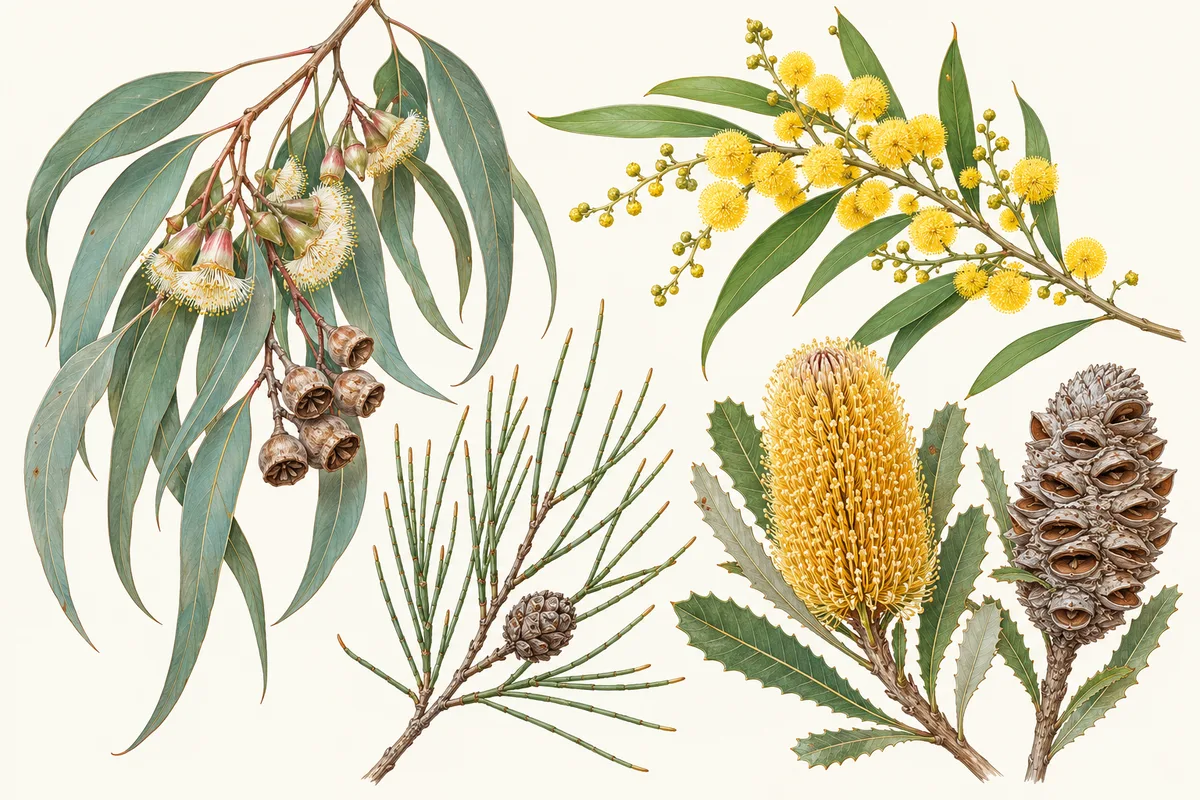
Australian native trees identification starts with the group, not the species. Eucalypts carry a cap on each flower bud and woody gumnuts; wattles have flattened leaf stalks called phyllodes and fluffy yellow flower heads; she-oaks have jointed green branchlets with tiny teeth in whorls; banksias hold woody cones of split follicles; paperbarks have papery bark and brush-like flowers; cypress pines carry scale leaves in threes.
- Eucalypts are the core of the bush: ANPSA counts over 900 species across Eucalyptus, Corymbia and Angophora (read 21 October 2026).
- A mature wattle usually has no true leaves: the green blades are phyllodes, flattened leaf stalks.
- She-oaks are not oaks: their needles are jointed branchlets, and the real leaves are tiny teeth in rings of 4 to 20.
Australia's native trees look unfamiliar to anyone trained on oaks and maples, but most of what you meet in the bush falls into six groups. Each has one feature you can check without a microscope. Find that feature first, and the field narrows from thousands of species to a few dozen.
Name the group first: six clues for the Australian bush
Walk up to the tree and check these in order. The first one that fits is usually the answer.
| Group | Clue that settles it | Fruit | What else to look at |
|---|---|---|---|
| Eucalypts (gums, stringybarks, ironbarks, boxes) | Each flower bud wears a cap that falls off as it opens | Woody capsule, the gumnut | Bark type; leaves dotted with oil glands |
| Wattles (Acacia) | Flat leaf-like phyllodes, or feathery bipinnate leaves on young plants | A pod that splits open | Fluffy yellow or cream balls or rods of flowers |
| She-oaks (Casuarina, Allocasuarina) | Drooping green "needles" that snap at joints, ringed with tiny teeth | Small woody cone | Number of teeth per ring |
| Banksias (Banksia) | Dense flower spikes on a woody central stalk | Woody "cone" studded with two-valved follicles | Leaf edges, toothed to smooth |
| Paperbarks (Melaleuca) | Stamens joined in bundles, flowers in spikes or heads | Small capsules along the stem | Papery bark peeling in layers on many species |
| Native conifers (Callitris, Araucaria) | Scale leaves in whorls of three, or stiff spiral leaves | Cones | Cone scale count |
The descriptions come from the National Herbarium of New South Wales's PlantNET flora: the Eucalyptus, Acacia, Casuarinaceae, Banksia, Melaleuca and Callitris treatments, all read on 21 October 2026.
When the branches are out of reach, Tree Identifier can suggest a name from one photo of the bark, a fallen gumnut or a flower. It returns a single name with no list of alternatives, so check the group clue above before you accept it.
Eucalypts: bark first, then buds and gumnuts
"Eucalypt" covers three related genera of the myrtle family. The Australian Native Plants Society (ANPSA) counts over 900 species: about 800 Eucalyptus, about 115 Corymbia (the bloodwoods and spotted gums) and 13 Angophora. PlantNET says Eucalyptus alone has over 800 species, all but 16 endemic to Australia, with about 240 in New South Wales.
Bark sorts them into everyday groups. Botanists split eucalypts into "rough barks", whose bark stays on the trunk, and "smooth barks", which shed it in patches or ribbons. ANPSA defines the common names:
- Gums: smooth bark, shed regularly; the name comes from the sticky kino some species ooze.
- Stringybarks: bark that pulls away in long fibres.
- Ironbarks: hard, deeply furrowed bark that stays on.
- Boxes: persistent bark with short fibres.
- Bloodwoods: timber with pockets of dark red kino.
- Peppermints: crushed leaves smell of peppermint.
Then check the buds. In Eucalyptus and Corymbia each bud is covered by an operculum, a cap that drops off as the flower opens. Angophora has no cap, and its adult leaves are opposite, where Eucalyptus leaves usually look alternate. Fruit shape and size, and whether the valves stick out of the gumnut, separate species within a group.
Expect two leaf forms. Young eucalypts grow juvenile leaves, often opposite and a different colour, before switching to the adult leaves of the crown. The Hunter Region Landcare Network's guide to identifying a gum tree works through a real example: bark first, then leaves, then the number of buds in each cluster, then the gumnut's disc and valves. Even then, it concludes with two candidates. Our eucalyptus page covers the species planted most often overseas.
Wattles: phyllodes and fluffy flowers
PlantNET puts Acacia at about 960 species in Australia, more than 235 of them in New South Wales. Seedlings grow feathery bipinnate leaves. On mature plants those are usually replaced by phyllodes, flattened leaf stalks that look like simple leaves.
The flowers are tiny and packed into round, oval or cylindrical heads, so a wattle in bloom looks covered in yellow or cream pom-poms or bottle-shaped rods. The fruit is a pod, leathery or woody, that usually splits open.
The Australian National Botanic Gardens describes the national floral emblem, the golden wattle (Acacia pycnantha), as having bright green, leathery phyllodes 6 to 20 cm long and large, fragrant flower heads of up to 80 small flowers in spring. It grows in open forest and woodland understorey in South Australia, Victoria, New South Wales and the ACT, and was proclaimed the emblem in 1988. National Wattle Day is 1 September.
She-oaks: jointed branchlets, not needles
A she-oak looks like a weeping pine until you pull a "needle" apart: it snaps cleanly at a joint. PlantNET describes the family Casuarinaceae as trees and shrubs with slender, wiry, jointed branchlets; the true leaves are reduced to small teeth in whorls of 4 to 20 at each joint, and the segment between two whorls is called an article. Female flowers ripen into a small woody cone that releases winged seeds. Australia has 3 genera and 68 species, in every state.
To split the two main genera, look at a ripe cone and its seeds. Casuarina has 6 to 20 teeth per whorl, thin cone bracteoles that stick out well beyond the cone, and dull grey or yellow-brown seeds. Allocasuarina has 4 to 14 teeth per whorl, thick bracteoles that barely stick out, and shining red-brown to black seeds.
Banksias, paperbarks and bottlebrushes
Banksias carry dense, many-flowered spikes on a woody central stalk. After flowering, the stalk becomes a woody "cone" studded with follicles that split into two hard valves to release the seed. PlantNET counts about 76 species in Australia, nearly all endemic, in every state. The leaves vary from finely toothed to smooth-edged, which helps separate species.
Paperbarks (Melaleuca) have flowers in spikes or heads with many stamens joined into bundles opposite the petals, which gives the brush look. PlantNET counts about 215 species in Australia, about 210 of them endemic, and uses papery versus hard or corky bark as a split in its key. The red-flowered bottlebrushes grown in gardens have the same brush of stamens.
Native conifers: cypress pines and araucarias
Neither group belongs to the true pines, the genus Pinus, despite the common names.
- Cypress pines (Callitris) carry tiny scale leaves in whorls of three and cones with usually 6 scales in a single ring. PlantNET lists 17 species in Australia, in every state.
- Araucarias, the family of hoop pine and bunya pine, have needle-like or flat leaves arranged in spirals and big woody cones. Australia has 3 genera and 6 species of the family, in Queensland and New South Wales. One of them, the Wollemi pine, grows wild only in Wollemi National Park.
For needle and cone keys that work elsewhere, see our conifer identification guide.
Native trees in the app's Collection
Tree Identifier's Collection, the field-guide catalog that fills in as you identify, includes five Australian trees: blue gum eucalyptus, mountain ash, the paperbark tree, crimson bottlebrush and Norfolk Island pine. Most wattles, she-oaks and banksias are not in it, though a photo of any of them still returns a name. The app needs an internet connection, which matters in the outback.
Across the Tasman the flora is entirely different: see our guide to New Zealand native trees.
What a photo can't settle
- Eucalypts change leaf form between juvenile and adult growth, so a photo of one leaf rarely settles the species; field guides use bark, buds and gumnuts together.
- Many species differ only in fruit or seed details too small to read in a photo, such as the number of teeth per whorl in a she-oak or the shape of a eucalypt's disc and valves.
- A photo can name a tree but not say whether it grows wild or was planted, and natives from one state are widely planted in another.
Questions people ask
What is the most common native tree in Australia?
As a group, the eucalypts. The National Herbarium of NSW says Eucalyptus species dominate most plant communities in every state, except in the wettest, coldest and driest parts of the continent.
How many kinds of eucalyptus are there?
ANPSA puts the eucalypts at over 900 species: about 800 Eucalyptus, about 115 Corymbia and 13 Angophora. The National Herbarium of NSW says Eucalyptus alone has over 800 species, all but 16 endemic to Australia, with about 240 in New South Wales.
Is a she-oak an oak?
No. She-oaks belong to the Casuarinaceae, a separate family. What look like pine needles are slender, jointed green branchlets; the true leaves are reduced to small teeth in whorls of 4 to 20 at each joint. The fruit is a small woody cone, not an acorn.
What is Australia's national floral emblem?
The golden wattle, Acacia pycnantha, gazetted on 1 September 1988. The Australian National Botanic Gardens describes bright yellow, fragrant flower heads of up to 80 small flowers in spring and leathery phyllodes 6 to 20 cm long. 1 September is National Wattle Day.
How do I tell a wattle from a eucalypt?
Look at the flowers and fruit. Wattles have fluffy yellow or cream balls or rods of tiny flowers and seed pods like a pea's. Eucalypts have buds with a cap that falls off as the flower opens, and woody gumnuts. Eucalypt leaves are usually dotted with oil glands.
Sources
- Eucalypts: Eucalyptus, Corymbia, Angophora — Australian Native Plants Society (Australia)
- Genus Eucalyptus — PlantNET, National Herbarium of New South Wales
- Genus Acacia — PlantNET, National Herbarium of New South Wales
- Golden Wattle (Acacia pycnantha) — Australian National Botanic Gardens
- Family Casuarinaceae — PlantNET, National Herbarium of New South Wales
- Genus Banksia — PlantNET, National Herbarium of New South Wales
- Genus Melaleuca — PlantNET, National Herbarium of New South Wales
- Genus Callitris — PlantNET, National Herbarium of New South Wales
Keep reading
- Tree profileEucalyptus (gum trees): how to identify them
- Field guideNew Zealand native trees: how to identify the ones you meet
- Field guideTree bark identification: seven bark types and the trees that have them
- Field guideHow to identify trees by their leaves
- Photo guideHow to identify a tree from a photo