Tree profile
Eucalyptus (gum trees): how to identify them
ANPSA counts over 900 eucalypts in Australia, and a few of them are planted from California to Florida. The flower bud and the gumnut tell you it is a eucalypt; bark and fruit size tell you which one.
In short
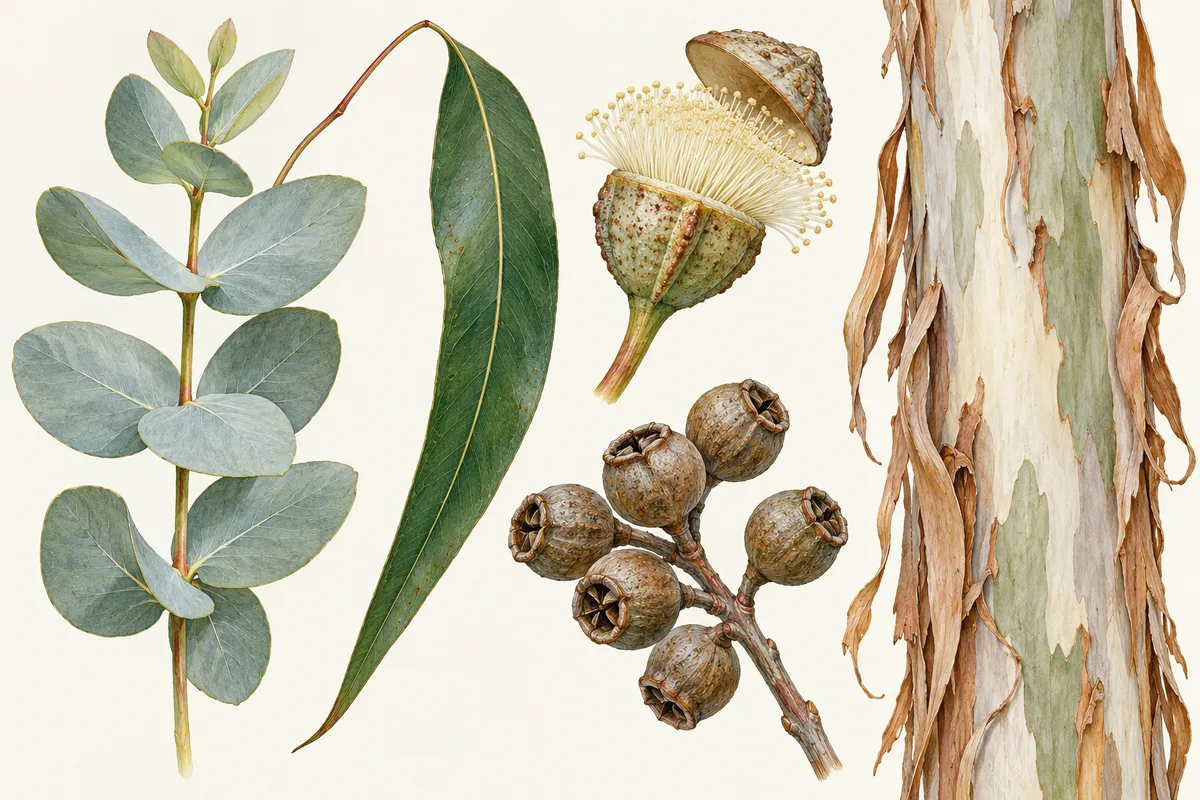
Eucalyptus tree identification rests on three checks. Each flower bud wears a cap (operculum) that drops off as the flower opens, leaving a woody capsule, the gumnut. Young shoots carry juvenile leaves, often opposite and blue-gray, while the crown has long, often sickle-shaped adult leaves dotted with oil glands. Then read the bark, smooth and shedding or rough and persistent.
- No cap on the buds and opposite adult leaves means Angophora, the close relative, not Eucalyptus.
- Tasmanian blue gum has a single big warty bud with about four ribs; river red gum has small buds with a strongly beaked cap.
- Cal-IPC lists blue gum as invasive in California with a Limited rating, escaped mainly along the coast (read October 21, 2026).
Field marks at a glance
- Scientific name
- Eucalyptus
- Family
- Myrtaceae (myrtle family)
- Type
- Broadleaf, evergreen
- Flower buds
- In Eucalyptus and Corymbia each bud is covered by a cap, the operculum, shed as the flower opens to show a puff of stamens. Angophora has no cap.
- Fruit
- A hard, woody capsule, the gumnut, that opens by valves at the top. Its shape and size, and whether the valves stick out, separate species.
- Juvenile leaves
- Often opposite and differently colored from adult leaves; on blue gum they are blue-gray, stalkless and 1.6–4.1 in (4–10.5 cm) long on square, winged stems.
- Adult leaves
- Usually alternate, long and narrow, often sickle-shaped, hanging from the twig; ANPSA notes glands containing volatile oils.
- Bark
- Smooth barks shed in ribbons or patches (the gums); rough barks stay on as stringybark, ironbark or box bark.
- Size
- Varies widely by species: river red gum to about 130 ft (40 m), Tasmanian blue gum to about 230 ft (70 m).
- Native range
- Most species are Australian; rainbow eucalyptus grows wild in New Guinea, Indonesia and the Philippines.
Eucalypts are trees of the myrtle family that dominate many Australian landscapes and are planted in California, Hawaii, Texas and Florida. Because a single genus holds hundreds of species, identification goes in two steps: first confirm it is a eucalypt, then narrow it down with bark, buds and fruit.
Three checks that confirm a eucalypt
1. The capped bud. The Australian Native Plants Society (ANPSA) explains that in Eucalyptus and Corymbia each flower bud is covered by an operculum, a bud cap, which falls off as the flower opens. Look for green or gray-green buds, single or in clusters at the base of the leaves, each topped by its cap.
2. The gumnut. After flowering, the bud base hardens into a woody capsule that opens by valves at the top. ANPSA notes that fruit shape and size help identify species, and that many eucalypts hold their seed until fire or the death of the plant releases it, so old gumnuts stay on the branches.
3. Two kinds of leaves. Juvenile leaves often differ from adult leaves in color and arrangement, usually opposite pairs on young shoots. Adult leaves are usually long, narrow and hanging, and ANPSA notes they carry glands containing volatile oils, the source of the eucalyptus smell when you crush one.
Then read the bark. Eucalypts with smooth bark shed it in patches or long ribbons, the "gums"; others keep rough bark: stringybarks pull away in long fibers, ironbarks are hard and deeply furrowed, boxes have short-fibered bark. If the bark peels but there are no capped buds, the tree is probably something else: our guide to trees with peeling bark covers birches, sycamores, crape myrtles and other peelers.
If the buds are 50 feet up, Tree Identifier can suggest a name from a photo of the bark, a fallen gumnut or the whole tree. It gives one name, with no list of alternatives, so check the bud cap and the gumnut before you accept it.
Eucalyptus you are likely to meet
The three below are among the most planted outside Australia. Figures are from EUCLID, the Australian eucalypt identification key (4th edition), read on October 21, 2026.
| Species | Bark | Buds | Fruit | Size |
|---|---|---|---|---|
| Tasmanian blue gum (E. globulus) | Mostly smooth, white, cream or gray, shedding in large strips; rough slabs at the base | Single, large, warty, blue-gray, about 4 ribs, 0.6–1 in (1.4–2.5 cm) long | 0.4–0.6 in long, up to 1.1 in wide (1–1.5 × 1.4–2.7 cm), 4-ribbed | To about 230 ft (70 m) |
| River red gum (E. camaldulensis) | Smooth, white to pale gray with yellow, pink or brown patches; loose flakes at the base | Small, under 0.4 in (0.6–0.9 cm), cap strongly beaked | Hemispherical, under 0.4 in (0.4–1 cm) wide | To about 130 ft (40 m) |
| Lemon-scented gum (Corymbia citriodora) | Smooth throughout, whitish to pink or coppery, often powdery | Pear-shaped, in clusters of three | Urn- or barrel-shaped, 0.3–0.6 in (0.8–1.5 cm) | To about 165 ft (50 m) |
Tasmanian blue gum is the eucalyptus Cal-IPC tracks as invasive along the California coast. EUCLID's blue gum page describes juvenile leaves that are opposite, stalkless and blue-gray with a waxy bloom, 1.6–4.1 in (4–10.5 cm) long, on square, winged stems, and glossy green, usually sickle-shaped adult leaves 4.7–12 in (12–30 cm) long. The single, warty, ribbed bud is the giveaway. In its homeland it grows mainly in lowland Tasmania and the southern tip of Victoria.
River red gum, in EUCLID's words, is the most widespread eucalypt in Australia, lining streams in every mainland state and dominating the Murray-Darling river system. Its adult leaves are lance- to sickle-shaped, 3–12 in (8–30 cm) long, the same color on both sides. Small buds with a beaked cap and tiny fruits separate it from blue gum at a glance. Its scientific name comes from a tree grown in a garden at Camalduli, Italy, in the early 1800s.
Lemon-scented gum is a Corymbia. EUCLID notes its leaves smell of lemon when crushed in the typical subspecies, and that it is popular in horticulture in Australia and overseas.
Eucalyptus in the United States
California. The California Invasive Plant Council lists Tasmanian blue gum with a Limited rating: invasive, but with minor impacts statewide or too little information for a higher score. It says the tree is found throughout California and has escaped mainly along the coast, and lists impacts on fire danger, native plants and wildlife.
Hawaii, Florida, Texas and Southern California. Rainbow eucalyptus (E. deglupta) is the one with striped bark. Its Wikipedia entry describes smooth, orange-tinted bark shedding in strips that expose streaks of pale green, red, orange, gray and purplish brown, a native range in New Guinea, Indonesia and the Philippines, and plantings in frost-free Hawaii, Southern California, Texas and Florida. It is the only eucalypt that usually grows in rainforest.
Pets. The ASPCA lists eucalyptus as toxic to dogs, cats and horses, naming the essential oil eucalyptol, with signs such as salivation, vomiting, diarrhea, depression and weakness. Tree Identifier's Toxicology tool writes AI notes for people, dogs and cats, but in an emergency call a veterinarian or a poison helpline.
Eucalypt or not: the close relatives
Angophora, Corymbia and Melaleuca all belong to the same myrtle family and can fool you at first sight.
- Angophora, the apple gums, is the only one ANPSA says has no cap on the bud; its adult leaves are opposite, where Eucalyptus adult leaves are alternate.
- Corymbia, the bloodwoods and spotted gums, has capped buds like Eucalyptus; ANPSA counts about 115 species against about 800 Eucalyptus.
- Melaleuca, the paperbarks and tea trees, has no cap at all. The National Herbarium of New South Wales describes flowers in spikes or heads with many stamens joined in bundles, and counts about 215 species in Australia.
For the wider picture of the bush, from wattles to she-oaks, see our guide to Australian native trees.
In the app's Collection
Tree Identifier's Collection, the 138-species field-guide catalog that fills in as you identify, includes two eucalypts: the blue gum eucalyptus and the mountain ash (Eucalyptus regnans). River red gum, lemon-scented gum and rainbow eucalyptus are not in it, though a photo of any of them still returns a name. Under each result you can ask a follow-up question, such as how its buds differ from blue gum's. For bark-first methods that work on any tree, see how to identify trees by bark.
Look-alikes and how to tell them apart
Angophora (apple gums)
Angophora flowers open without a cap, its adult leaves are opposite, and its fruits are often strongly ribbed. Eucalyptus buds always shed a cap and adult leaves look alternate.
Corymbia (bloodwoods, spotted and lemon-scented gums)
Corymbia buds also have caps, so it is a eucalypt in the broad sense. Lemon-scented gum carries pear-shaped buds in threes and urn-shaped fruit; crush a leaf for the lemon scent.
Paperbarks and tea trees (Melaleuca)
Melaleuca flowers have no cap, and their many stamens are joined in bundles, in spikes or heads that give a bottlebrush look. A eucalyptus bud always sheds a cap.
What a photo can't settle
- Juvenile and adult leaves look like different trees, and a sucker or young tree may show only juvenile leaves, so a photo of foliage alone often fails at species level.
- Many eucalypts differ mainly in bud and gumnut details: the shape of the cap, the number of buds per cluster, the disc and valves. Photograph a cluster of buds and a few fruits next to a coin.
- Gumnuts on the ground may have blown in from a neighboring tree; match them to the buds on the branch above.
Questions people ask
What does a eucalyptus tree look like?
Usually a tall evergreen with long, narrow leaves hanging from the twigs, smooth bark peeling in ribbons or rough fibrous bark, and clusters of capped buds that turn into woody gumnuts. Young growth often has rounder, blue-gray leaves arranged in pairs, very different from the crown.
Is tea tree the same as eucalyptus?
No. Both belong to the myrtle family, but tea trees and paperbarks are Melaleuca, a separate genus. Their flowers have no cap and their stamens are joined in bundles, giving a bottlebrush look; eucalyptus buds shed a cap and leave a woody gumnut.
Is eucalyptus invasive in California?
The California Invasive Plant Council lists Tasmanian blue gum with a Limited rating: invasive, but with minor or locally limited impacts statewide. It says the tree is found throughout California and has escaped mainly along the coast. Cal-IPC also notes effects on fire danger and native plants and wildlife.
Is eucalyptus toxic to dogs and cats?
The ASPCA lists eucalyptus as toxic to dogs, cats and horses, naming the essential oil eucalyptol, with signs including salivation, vomiting, diarrhea, depression and weakness. If a pet has chewed leaves, call your veterinarian or a pet poison helpline.
Why does a rainbow eucalyptus have colored bark?
Rainbow eucalyptus (Eucalyptus deglupta) sheds its smooth bark in strips, exposing fresh bark in streaks of pale green, red, orange, gray and purplish brown. It is native to New Guinea, Indonesia and the Philippines and is planted in frost-free Hawaii, Florida, Texas and Southern California.
Sources
- Eucalypts: Eucalyptus, Corymbia, Angophora — Australian Native Plants Society (Australia)
- Eucalyptus globulus subsp. globulus — EUCLID: Eucalypts of Australia, 4th edition (Centre for Australian National Biodiversity Research)
- Eucalyptus camaldulensis subsp. camaldulensis — EUCLID: Eucalypts of Australia, 4th edition (Centre for Australian National Biodiversity Research)
- Corymbia citriodora — EUCLID: Eucalypts of Australia, 4th edition (Centre for Australian National Biodiversity Research)
- Genus Melaleuca — PlantNET, National Herbarium of New South Wales
- Eucalyptus globulus (Tasmanian blue gum) — California Invasive Plant Council
- Eucalyptus — ASPCA Animal Poison Control
- Eucalyptus deglupta — Wikipedia