Clue guide
Which tree has peeling bark? Sort it by the color underneath
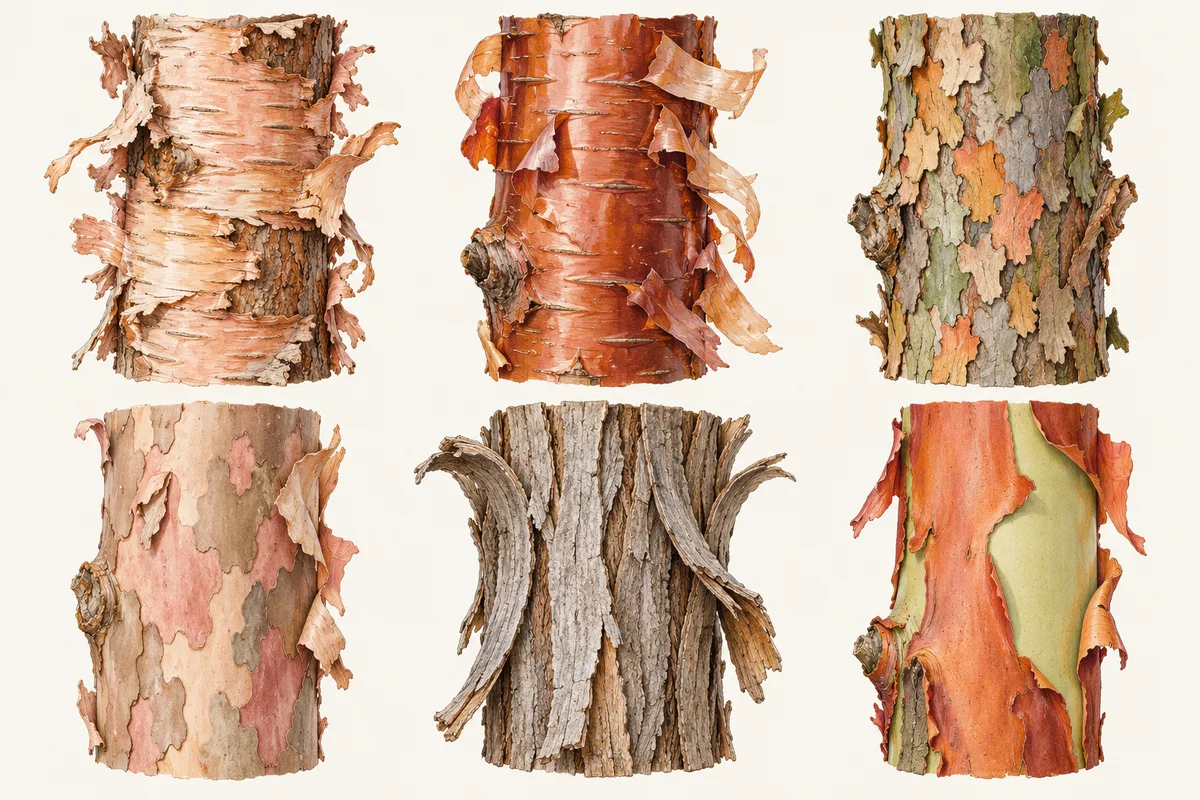
Look at what the peel reveals (white, cream, salmon, red, green or a patchwork), then at the leaf and your region. That narrows a peeling-barked tree to one or two names.
In short
A tree with peeling bark is most often a birch (paper birch peels in white sheets, river birch in salmon to cream curls), an American sycamore (patches flaking to white), a lacebark elm or crape myrtle (mottled patchwork, small leaves), a paperbark maple (cinnamon curls), a shagbark hickory (long loose plates) or, in the West and Florida, a madrone or gumbo limbo with red peeling bark.
- Read what lies under the peel: white means paper birch or sycamore, salmon to cream means river birch, cinnamon to rose-brown means paperbark maple, red-orange means madrone or gumbo limbo.
- On these species peeling is how the bark grows, not a sign of disease: the New York Botanical Garden explains that thin-barked trees shed it as the trunk widens.
- In Florida, a spongy, whitish, many-layered peeling bark on a tree with bottlebrush flowers is melaleuca, a Category I invasive species and a federal and Florida noxious weed.
Peeling bark is one of the easiest bark clues to see and one of the most useful, because only a handful of trees peel on purpose. Look at the color the peel exposes, then at the leaf and your region. On these species shedding bark is normal: the New York Botanical Garden explains that thin-barked trees shed as their trunks widen, names crape myrtle, sycamore and river birch as popular examples, and advises letting the tree shed it naturally.
Peeling-barked trees by the color underneath
| Tree | How it peels | Color revealed | Leaf | Where |
|---|---|---|---|---|
| Paper birch (Betula papyrifera) | Horizontal papery strips | Chalky white outside, orange inner bark | 3–5 in (8–13 cm), oval, doubly toothed | North |
| River birch (Betula nigra) | Papery scales and curls | Salmon to rust, cream to orange-brown layers | 1 1/2–3 in (4–8 cm), diamond-shaped | Southeast, planted widely |
| American sycamore (Platanus occidentalis) | Patches | Brown, green, tan and white; white high up | 4–9 in (10–23 cm) wide, 3–5 lobes | East and Midwest |
| Lacebark elm (Ulmus parvifolia) | Irregular flakes | Brown, tan, gray, olive, cinnamon | 1–2 1/2 in (2.5–6 cm) | Planted |
| Crape myrtle (Lagerstroemia indica) | Thin, smooth sheets | Pale brown to gray | Small, smooth-edged, mostly opposite | South, planted |
| Paperbark maple (Acer griseum) | Papery curls that stay on the tree | Rose-brown under purple-brown | 3 leaflets, silvery beneath | Planted |
| Shagbark hickory (Carya ovata) | Long plates loose at both ends | Gray | Compound, usually 5 leaflets | East and Midwest |
| Pacific madrone (Arbutus menziesii) | Thin layers | Smooth red-orange | Shiny, leathery | British Columbia to California |
| Eucalypts (Eucalyptus) | Sheets and ribbons | Cream, white, pink or cinnamon patches | Long, aromatic | Planted in California and Florida |
| Gumbo limbo (Bursera simaruba) | Thin layers or curly strips | Coppery red outside, olive green beneath | Compound, 3–9 leaflets | South Florida |
| Melaleuca (Melaleuca quinquenervia) | Spongy, many-layered | Whitish | Up to 5 in (13 cm), narrow, parallel veins | South Florida (invasive) |
Data come from the Virginia Tech Dendrology, NC State Extension, USDA Forest Service and UF/IFAS pages linked in each section.
White or cream underneath: paper birch and sycamore
Paper birch peels in horizontal, papery strips of chalky to creamy white bark, with orange inner bark where it has come away (Virginia Tech). It is a northern tree; the white bark guide separates it from the white birches that barely peel.
American sycamore sheds thin bark in patches, leaving what Virginia Tech's fact sheet calls "camouflage" bark of brown, green, tan and white; older trunks turn gray-brown and scaly at the base. The white shows best on the upper trunk and limbs, and big maple-like leaves and round seed balls on long stalks confirm it. In cities, London plane, a hybrid of the American sycamore and the Oriental plane, also has seed balls and peeling bark; the sycamore page tells them apart.
Salmon, cinnamon or red underneath
River birch is the peeling tree of the Southeast and of countless yards. Virginia Tech's river birch sheet describes young bark as smooth and salmon to rust, later peeling in papery scales and developing coarse scales on old trunks; leaves are diamond-shaped, 1 1/2 to 3 inches long, doubly toothed with a wedge-shaped base. The birch page compares all the birches.
Paperbark maple is a small planted maple, 20 to 30 feet (6–9 m), from central China. NC State's profile describes purple-brown outer bark peeling back in papery curls to reveal rose-brown inner bark, curls that stay on the tree instead of falling. Its leaves are unusual for a maple: three leaflets, silvery and finely hairy underneath.
Pacific madrone is the red-barked tree of the West Coast. The USDA Forest Service's Silvics of North America describes smooth reddish-orange bark on trunk and limbs, peeling off in thin layers, and shiny, tough, leathery leaves. Its range runs from the east coast of Vancouver Island and mainland British Columbia south to San Diego County, and it is common on the western slopes of the Coast Ranges in Washington, Oregon and California.
Mottled patchwork and small leaves: lacebark elm and crape myrtle
Lacebark elm, also called Chinese elm, is the answer to "peeling bark and small leaves". NC State's lacebark elm profile gives leaves 1 to 2 1/2 inches long and bark exfoliating in irregular patterns in brown, tan, gray, olive and cinnamon. Unlike most elms, it blooms in late summer and sets small papery seeds in fall. Native to China, Korea and Japan, it grows 40 to 50 feet (12–15 m), and NC State warns that it can be weedy through self-seeding. The elm page compares it with American and Siberian elm.
Crape myrtle is the answer to "peeling bark and pink flowers". NC State's crape myrtle profile describes thin, smooth, pale brown to gray bark that peels and exfoliates, mostly opposite, smooth-edged leaves, and flowers from July to September: rose to red on the wild species, white, pink, red or purple on cultivars. Brown, six-part seed capsules about 1/2 inch wide stay on through winter. Plants range from 6 to 30 feet (2–9 m) depending on the variety.
Long shaggy plates: shagbark hickory
Shagbark hickory peels in a different way: Virginia Tech's fact sheet describes smooth gray young bark breaking into long, wide plates attached at the middle that curve away from the trunk. The plates stay gray, so nothing colorful shows underneath. Compound leaves and nuts in thick husks confirm it; the hickory page separates the hickories.
Florida: gumbo limbo and melaleuca
Gumbo limbo is native to south Florida, the West Indies, Central America and northern South America. UF/IFAS's fact sheet describes resinous, smooth, peeling coppery bark that comes off in thin layers or curly strips to reveal olive green beneath, compound leaves of 3 to 9 leaflets, and a height of 25 to 50 feet (8–15 m). UF/IFAS Gardening Solutions notes the nickname "tourist tree": the red, peeling bark recalls a sunburned visitor.
Melaleuca, also called paperbark, is an Australian tree with whitish, spongy, many-layered peeling bark, narrow leaves up to 5 inches (13 cm) long with nearly parallel veins, and small white flowers crowded in bottlebrush spikes, according to the UF/IFAS Plant Directory. The same page lists it as a Florida Invasive Species Council Category I invasive and as a plant on both the Federal Noxious Weed List and the Florida Noxious Weed List.
Eucalypts are the other Florida and California candidates. The Australian National Botanic Gardens describes their bark shedding as an annual summer event, with cinnamon patches on blue gum and pink turning to white on brittle gum.
Using a photo
Peeling bark photographs well because the pattern and colors are distinctive. Take one photo of the trunk at chest height, close enough that the peel fills the frame, and one of a leaf. Tree Identifier names a tree from one photo, and paper birch, American sycamore, crape myrtle, melaleuca and Tasmanian blue gum are in its Collection. It shows no confidence score or alternatives, so check its answer against the color-underneath table. For smooth, ridged and plated barks, see the bark identification guide.
What a photo can't settle
- Young trees of most species on this page have smooth bark; the peeling pattern develops with trunk size and may not show on a sapling.
- Lacebark elm and crape myrtle are planted as many cultivars, and their bark colors vary between them; a photo can name the species but rarely the cultivar.
- This page names trees. Bark lost to injury, sunscald or disease is a tree-health question for a certified arborist, and no photo app settles it.
Questions people ask
What tree has peeling bark that is white underneath?
Paper birch, whose chalky white bark peels in horizontal strips, and American sycamore, whose light gray outer bark flakes off to expose white to cream inner bark, mostly on the upper trunk and limbs. In south Florida, melaleuca has whitish, spongy, many-layered peeling bark.
What tree has peeling bark that is red underneath?
On the West Coast, Pacific madrone, with smooth red-orange bark that peels off in thin layers. In south Florida, gumbo limbo, whose coppery bark peels in thin layers or curls. Paperbark maple peels in purple-brown curls over rose-brown bark, and river birch shows salmon to orange-brown layers.
What tree has peeling bark and pink flowers?
Crape myrtle. NC State Extension describes thin, smooth, pale brown to gray, peeling bark and flowers from July to September; the wild species is rose to red, and cultivars bloom white, pink, red or purple. It is planted throughout the South.
Is peeling bark a sign that my tree is sick?
Not on the species on this page: they shed bark as their trunks widen, and the New York Botanical Garden advises letting the tree shed it naturally rather than pulling it off. Bark falling away from bare wood on a tree that normally keeps its bark is a different matter for an arborist.
What tree has peeling bark and small leaves?
Lacebark (Chinese) elm, with leaves about 1 to 2 1/2 inches long and mottled bark flaking in brown, tan, gray, olive and cinnamon. Crape myrtle also has small, smooth-edged leaves and peeling bark, but it carries big flower clusters in summer and six-part seed capsules in winter.
Sources
- River birch fact sheet — Virginia Tech Dendrology
- Lagerstroemia indica (crape myrtle) — North Carolina Extension Gardener Plant Toolbox, NC State University
- Ulmus parvifolia (lacebark elm) — North Carolina Extension Gardener Plant Toolbox, NC State University
- Acer griseum (paperbark maple) — North Carolina Extension Gardener Plant Toolbox, NC State University
- Pacific Madrone (Arbutus menziesii), Silvics of North America — USDA Forest Service
- Bursera simaruba: Gumbo-Limbo (ST104) — UF/IFAS Extension, University of Florida
- Melaleuca quinquenervia — UF/IFAS Plant Directory, University of Florida
- Why do some trees shed their bark? — New York Botanical Garden, LuEsther T. Mertz Library
Keep reading
- Field guideTree bark identification: seven bark types and the trees that have them
- Clue guideWhich tree has white bark? Sort it by peel, leaf and region
- Tree profileBirches (Betula): how to identify a birch tree
- Tree profileHickory trees (Carya): how to identify them
- Tree profileElms (Ulmus): how to identify an elm tree