Clue guide
Which tree has white bark? Sort it by peel, leaf and region
Check first whether the white bark peels, then look at the leaf and where the tree grows. Those three clues narrow a white-barked tree to one or two names.
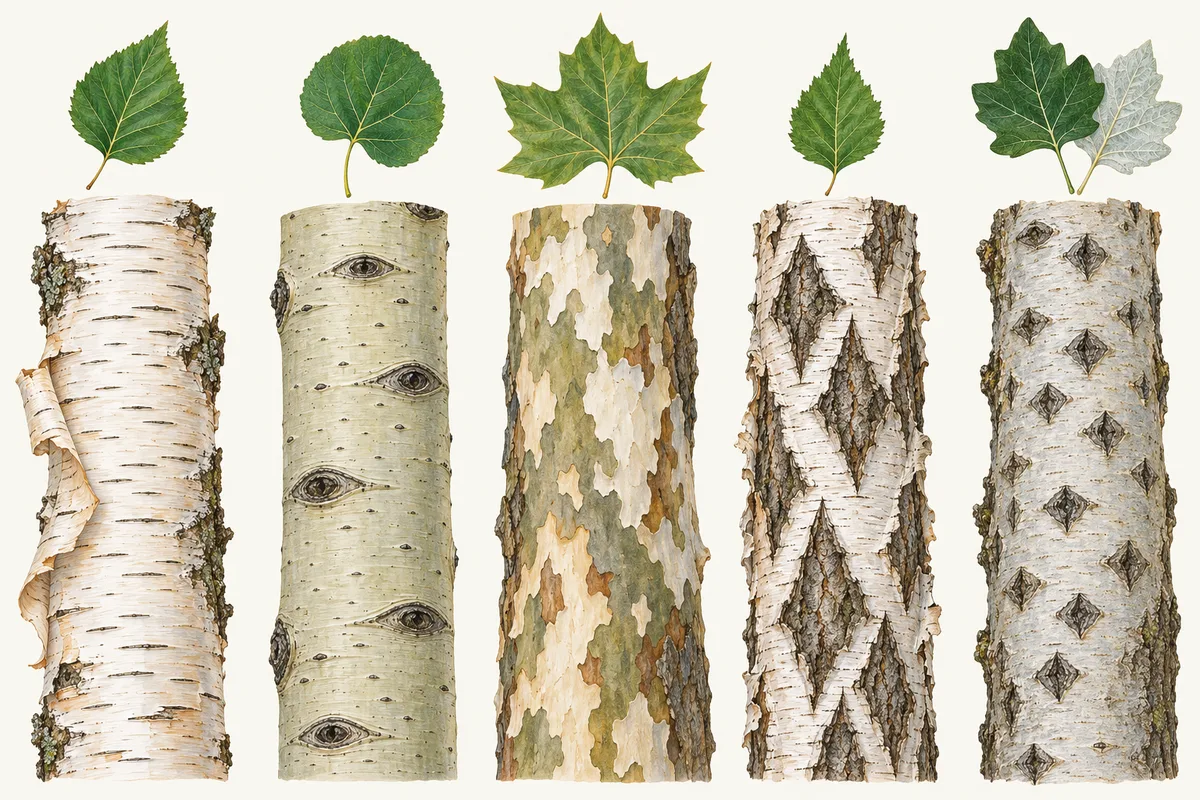
In short
A tree with white bark is most often a paper birch (chalky white bark peeling in papery strips), a gray or European white birch (white but barely peeling), a quaking aspen (smooth, creamy white, leaves trembling on flat stalks), an American sycamore (white patches high in the crown) or a white poplar (leaves white and woolly underneath). Smooth gray bark that never peels is usually a beech.
- Peel test first: paper birch peels freely in sheets; gray birch, European white birch and aspen stay mostly smooth.
- On sycamore, the white is the inner bark showing where the outer bark has flaked off, most visible on upper limbs.
- Most white-barked trees turn yellow in fall; bright red leaves over a pale trunk usually mean a young red maple, whose bark is light gray, not white.
White bark is one of the few clues you can read from a car window, but at least ten trees in North America and Britain show it. The fastest way to sort them is three questions in order: does the bark peel, what does the leaf look like, and where is the tree growing.
White-barked trees by peel, leaf and region
| Tree | Bark | Leaf clue | Where |
|---|---|---|---|
| Paper birch (Betula papyrifera) | Chalky to creamy white, peeling in horizontal papery strips; orange inner bark | 3–5 in (8–13 cm), oval, doubly toothed | Northern US and Canada |
| Gray birch (Betula populifolia) | Gray to chalky white, smooth, generally doesn't peel | 2–3 in (5–8 cm), triangular, long drawn-out tip | Northeast |
| European white (silver) birch (Betula pendula) | White, peels a little; thick and black at the base | 2–4 in (5–10 cm), triangular, long tip; drooping twigs | Planted; native in Britain and Europe |
| Himalayan birch (Betula utilis var. jacquemontii) | White | Birch leaf; ask the nursery tag or a botanic garden | Planted in yards and parks |
| Quaking aspen (Populus tremuloides) | Smooth, creamy yellowish white to very light green | Round, fine teeth, flattened stalk | North, Rockies, West |
| White poplar (Populus alba) | Smooth, milky greenish white, later dark diamond splits | 2–4 in (5–10 cm), maple-like, white and woolly beneath | Planted; escapes along roads |
| American sycamore (Platanus occidentalis) | Brown, green and tan patches; white on upper limbs | 4–9 in (10–23 cm) wide, 3–5 lobes | East and Midwest |
| American beech (Fagus grandifolia) | Smooth, thin, gray, never peels | Straight parallel veins, one tooth per vein | East |
| Eucalypts (Eucalyptus, Corymbia) | Smooth, shed in sheets, white in some species | Long, leathery, aromatic | Planted in California and Florida |
| Red maple, young (Acer rubrum) | Smooth and light gray, not truly white | 3 lobes, opposite, red in fall | East |
Bark and leaf data come from the Virginia Tech Dendrology and NC State Extension pages linked below; the Himalayan birch range from the Royal Botanic Garden Edinburgh, the eucalypt bark from the Australian National Botanic Gardens.
White bark that peels: paper birch
If the bark comes away in thin, papery, horizontal sheets, start with paper birch. The Virginia Tech fact sheet describes young stems as reddish brown with pale lenticels, turning chalky to creamy white and peeling in horizontal strips, with orange inner bark and a darker, sometimes furrowed base. The tree reaches about 70 feet (21 m), often with several trunks. NC State Extension's paper birch profile adds that mature trees develop black markings on the white bark and that leaves turn yellow to golden yellow in fall.
Paper birch is a northern tree. NC State notes that it is stressed by summer heat and humidity and is not recommended for planting south of USDA zone 7, so a white, peeling birch in Georgia or Texas is more likely a planted cultivar or a river birch, whose peel is salmon to cream rather than white. In Canada the same tree is usually called white birch. For peeling barks of other colors, see trees with peeling bark.
White bark that barely peels: gray, European and Himalayan birches
Three birches are white but hold their bark tighter. Gray birch stays gray to chalky white and generally doesn't peel; its Virginia Tech sheet describes a small tree, rarely over 30 feet (9 m), with triangular leaves ending in a long, drawn-out tip. European white birch, a planted birch from Europe, has white bark that peels only a little and a base that turns thick, black and furrowed (Virginia Tech); its fine branches droop.
Himalayan birch cultivars are planted in yards and parks for their white trunks. The Royal Botanic Garden Edinburgh describes the white-barked variety jacquemontii as restricted in the wild to the Western Himalaya. The birch page separates all the birches by bark, leaf and twig smell.
White bark that stays smooth: aspen, white poplar and beech
Quaking aspen bark is smooth and creamy yellowish white to very light green, later furrowing and darkening near the base (Virginia Tech). The leaf stalk is flattened, which is why the leaves tremble in the slightest wind: if you searched "tree with white bark and leaves that tremble", this is it. Aspen is a small tree, 30 to 40 feet (9–12 m), often in thickets, and it is the white-barked tree of Colorado, Utah and the Rockies.
White poplar is the answer to "white bark and silver leaves". Virginia Tech's European white poplar sheet gives coarsely toothed, sometimes lobed, maple-like leaves 2 to 4 inches long, and bark that stays smooth and milky greenish white for several years before lenticels enlarge into dark splits and ridges. It coppices readily and often forms thickets. Vermont Invasives describes the leaf underside as bright white and hairy, notes that the tree is native to Europe, and lists it as a watch-list species in Vermont. The poplar page compares it with aspens and cottonwoods.
American beech is often called white but is really smooth gray. The Virginia Tech fact sheet describes its bark as smooth, thin and gray even on the largest trunks, and it never peels. Straight, parallel leaf veins, each ending in a tooth, confirm it; the beech page has the rest.
White on the upper branches: American sycamore
A big tree whose lower trunk is a patchwork of brown, green and tan but whose upper limbs glow white is an American sycamore. NC State's sycamore profile explains why: the light gray outer bark flakes off to expose inner bark that is white to cream-colored. The USDA Forest Service's Silvics of North America cites its distinctive white, exfoliating bark as the reason it is widely planted as a shade tree. Leaves are 4 to 9 inches (10–23 cm) wide with 3 to 5 lobes, and round seed balls hang on long stalks into winter. Sycamores reach 75 to 100 feet (23–30 m) and are common along streams in the East and Midwest. In Britain "sycamore" means a maple; the sycamore page explains both.
Warm climates: eucalypts with white trunks
In California, Florida and other frost-light areas, a tall, smooth trunk that is white in places and patched gray or pink in others may be a planted eucalypt. The Australian National Botanic Gardens describes the annual summer bark shedding of smooth-barked gums: brittle gum turns intense pink before peeling, then shows a creamy color that soon becomes the classic white trunk, while blue gum trunks show cinnamon patches. Crush a leaf: eucalyptus leaves are aromatic. Naming the species of a eucalypt takes its flower buds and fruit capsules, not the bark alone.
White bark and red, yellow or silver leaves
Most white-barked trees turn yellow in fall: NC State gives yellow to golden yellow for paper birch. So a pale trunk under red leaves usually is not a birch. The usual answer is a young red maple: NC State's red maple profile describes young bark as smooth and light gray, and leaves turning red in early fall. Look for opposite leaves with three main lobes. Silver leaves with white bark point to white poplar, and trembling leaves on flat stalks to aspen.
In the UK and Canada
In Britain, white bark almost always means silver birch or downy birch. The Woodland Trust describes silver birch bark that sheds layers like tissue paper, turns black and rugged at the base and develops dark diamond-shaped fissures; silver birch shoots are hairless and warty, downy birch shoots soft and hairy. White poplar and planted Himalayan birch are the other candidates. In Canada, the common white-barked trees are paper (white) birch and trembling aspen; the Canada guide places them by region.
Using a photo
Bark photos are harder for any app than leaf photos, but birches are among the easier barks. Photograph the trunk at chest height in even light, then a leaf if you can reach one. Tree Identifier names a tree from one photo, and paper birch, European white birch, American sycamore, American beech and Tasmanian blue gum are in its Collection. It shows no confidence score or alternatives, so check the answer against the peel test and the leaf. The follow-up chat under a result can tell you how that species' bark changes with age. The bark identification guide covers the other bark types.
What a photo can't settle
- Young trunks of most birches are reddish brown, not white; the white color comes with age, so a sapling photo rarely settles a birch.
- Gray birch, European white birch and planted Himalayan birch cultivars look alike in a bark photo; the leaf shape and how much the bark peels separate them better.
- Bark color changes with lichens, soot and shade. Treat a name from a bark photo as a lead and confirm it with a leaf.
Questions people ask
What tree has white bark that peels?
Paper birch. Virginia Tech describes its mature bark as chalky to creamy white, peeling in horizontal papery strips, with orange inner bark showing where it has peeled. European white (silver) birch peels only a little, and gray birch generally does not peel at all.
What tree has white bark and silver leaves?
White poplar (Populus alba), a European tree planted in North America. Its leaves are shiny dark green above and bright white and hairy underneath, so the crown flashes silver in wind, and young bark is smooth and greenish white. Vermont lists it as a watch-list species.
Is there a tree with white bark and red leaves?
Not among the common white-barked trees: paper birch turns yellow to golden yellow in fall. Red fall leaves over a smooth, pale trunk usually belong to a young red maple, whose bark NC State describes as smooth and light gray, darkening and ridging with age.
What tree has white bark that is not a birch?
Quaking aspen (smooth, creamy white, flat leaf stalks), American sycamore (white inner bark on upper limbs, big maple-like leaves), white poplar (white-backed leaves), and in warm climates some eucalypts, whose smooth trunks turn white after shedding. American beech is smooth and gray rather than white.
What tree has white bark with black marks?
Usually a birch. Paper birch develops black markings on white bark, and European white birch turns thick and black at the base. The Woodland Trust describes silver birch bark in Britain as white above, black and rugged at the base, with dark diamond-shaped fissures as it matures.
Sources
- Paper birch fact sheet — Virginia Tech Dendrology
- Betula papyrifera (paper birch) — North Carolina Extension Gardener Plant Toolbox, NC State University
- Quaking aspen fact sheet — Virginia Tech Dendrology
- European white poplar fact sheet — Virginia Tech Dendrology
- Platanus occidentalis (American sycamore) — North Carolina Extension Gardener Plant Toolbox, NC State University
- American beech fact sheet — Virginia Tech Dendrology
- Eucalypt bark (media release) — Australian National Botanic Gardens
- Silver birch (Betula pendula) — Woodland Trust
Keep reading
- Tree profileBirches (Betula): how to identify a birch tree
- Tree profilePoplars, cottonwoods and aspens (Populus): how to identify them
- Tree profileSycamore tree: the British maple and the American plane tree
- Field guideTree bark identification: seven bark types and the trees that have them
- Clue guideWhich tree has peeling bark? Sort it by the color underneath