Garden guide
Tree roots near a house, which trees cause trouble and how far away to plant them
Roots rarely push through a foundation. The real risks are drying clay soil under shallow footings, roots entering already-cracked drains, and paving lifted near the trunk.
In short
Tree roots near a house cause trouble mainly on shrinkable clay soil. The RHS lists willow, poplar, oak, eucalyptus and cypresses as high water demand trees whose drying can reach as far from the trunk as the tree is tall; for most other trees it stays within half the height. The Morton Arboretum adds that willows, poplars and silver maples are the trees most linked to clogged sewer pipes.
- Plant a high water demand tree such as willow, poplar or oak at least its mature height from the house on clay; for lower-demand trees, half the mature height is the RHS's guide.
- Roots get into drains through cracks and leaky joints that already exist; the Morton Arboretum says broken pipes are rare, blocked damaged pipes are not.
- On clay, cutting down a big old tree can make the ground swell (heave), so get a surveyor's advice before felling it.
Tree roots near a house worry many owners, and most of the time the tree is not the problem. Roots do not drill through concrete. They take water from the soil, they grow into openings that already exist, and they thicken near the surface. Whether that matters depends on three things you can check: your soil, the kind of tree, and how far away it stands. The figures below come from the Royal Horticultural Society (RHS) for UK clay soils and from US extension services and the Morton Arboretum.
Which trees, how far: the short version
| Tree group | Examples | Main risk | Rule of thumb for distance |
|---|---|---|---|
| High water demand broadleaves | Willow, poplar, oak, eucalyptus | Drying clay under shallow foundations | At least the tree's mature height |
| High water demand conifers | Cypresses, false cypress (Chamaecyparis), Leyland cypress | Drying clay; tall hedges | Mature height; keep hedges no taller than their distance from the wall |
| Trees of wet ground | Willow, poplar, silver maple | Roots entering cracked drains and sewers | Keep well away from drain runs |
| Low water demand trees | Catalpa, hazel, sweetgum, tulip tree, magnolia, mulberry, elder, fir, monkey puzzle, ginkgo, larch, spruce, pine | Lifting paving within about 1 m of the trunk | Half the mature height |
| Most other trees | Intermediate | Half the mature height |
Groups and distances are from the RHS guide to trees near buildings, which says high water demand trees can dry soil out to a distance equal to their height while intermediate and low demand trees are unlikely to reach beyond half their height. The drain list is from the Morton Arboretum. The RHS stresses that most trees never cause problems.
Clay soil and subsidence: the real foundation risk
On clay, soil shrinks as it dries and swells as it wets. In a long dry summer, a big, thirsty tree can draw so much water from clay under a house that the ground drops beneath the foundations. The RHS calls this a seasonal soil moisture deficit and says 5 to 10 mm of movement is usually needed before cracks develop, typically around windows and doors. Gardens on sand or chalk rarely have this problem.
The RHS identifies the houses most at risk as buildings from before the 1950s of up to four storeys, often on shallow footings; houses built after about 1980 generally have deeper foundations and are much less likely to be affected. It also says oak accounts for the highest number of subsidence cases in the UK. In the US, the Morton Arboretum makes the same point from the other side: roots are rarely the cause of foundation problems, but on shallow foundations over soil that shrinks in drought they can dry the soil enough to contribute to settling.
Removing the tree is not always the cure. On soils with a permanent moisture deficit, such as London clay, the RHS warns that felling a large tree can let the clay swell for years, lifting the house (heave), and that underpinning may then be the only fix. Get a surveyor's opinion before felling.
Drains, sewers and paving
Roots grow where water and air are, and a leaking pipe offers both. The Morton Arboretum says instances of pipes being broken by roots are rare, but blockage of damaged pipes is not uncommon, and names poplars, willows and silver maples, species of naturally wet places, as the trees most often linked to clogged pipes. Blocked lines may need clearing every year, and replacing the cracked pipe is the only permanent fix. The RHS agrees that watertight modern drains are generally not troubled, while older drains with poor seals and rigid joints are most at risk.
Illinois Extension describes silver maple's root system as excessively vigorous, able to clog sewer pipes and break sidewalks, on a tree that reaches 50 to 75 feet. Lifted paving is the commonest visible damage from any tree: the RHS says most of it happens within about 1 metre of the trunk, and the Morton Arboretum suggests at least 4 feet between a tree and pavement, smaller trees or a root barrier. Light sheds and garages can be lifted too; the RHS says heavier structures are not.
How roots really grow: shallow and wide
Most people picture a root system as a mirror of the crown, with a deep taproot. Illinois Extension says over 90% of tree root biomass is in the upper 18 inches of soil, almost half of it in the top 6 inches, and that roots spread up to about 3 times the canopy width: only about half the canopy width in heavy clay, up to 5 times in loose sand. The RHS gives roots up to three times the tree's height. That is why a tree 10 metres from a wall can still have roots under it, and why distance alone is not the whole story: it is the water those roots take, on clay, that matters.
For street-side and small-garden planting, Iowa State Extension gives minimums based on mature height: 2 feet from the trunk to any pavement or structure for small trees under 30 feet, 4 feet for medium trees under 50 feet, and 6 feet for large trees, with more planting area always better. Those minimums protect the tree and the paving; they are not foundation distances on clay.
How to recognise the high-risk trees
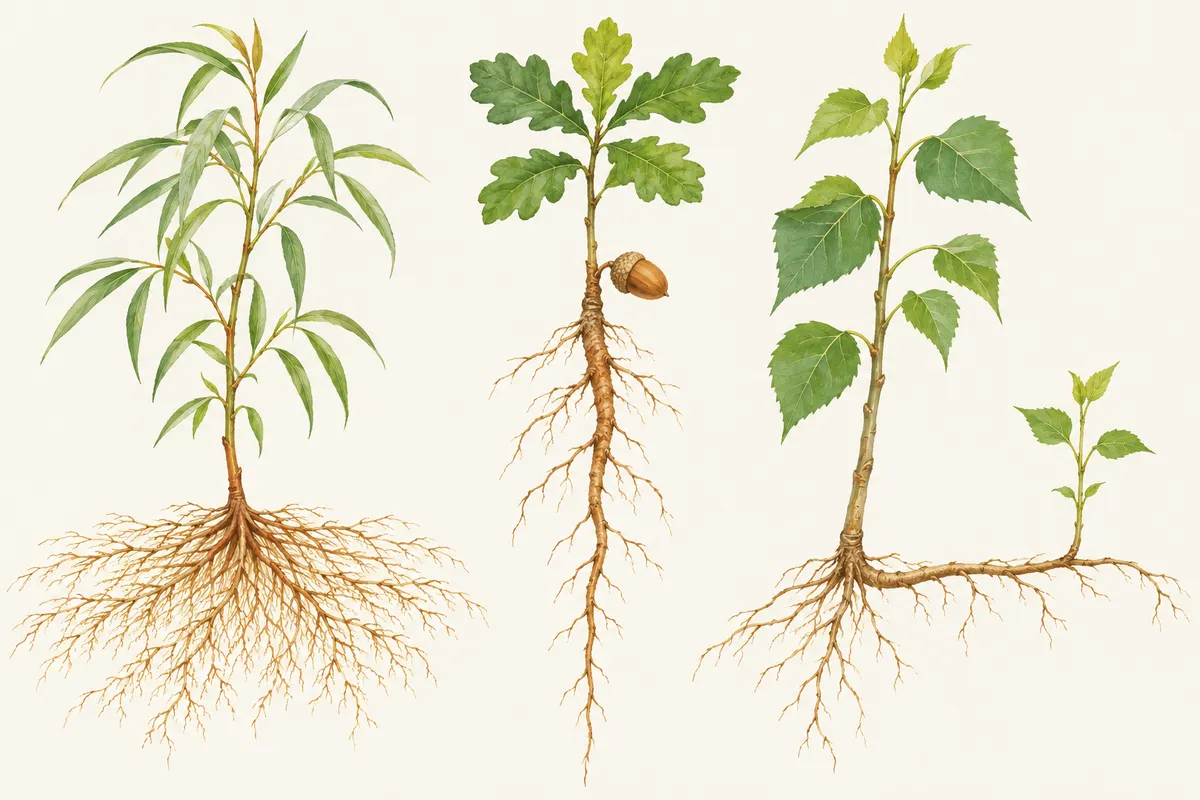
- Willows: long, narrow leaves, flexible twigs, often near water; weeping forms trail to the ground. See the willow page.
- Poplars: triangular or heart-shaped leaves on flattened stalks that make them flutter, and fluffy seeds in early summer. See the poplar page.
- Silver maple: deeply cut five-lobed leaves, silvery white beneath, fast-growing and brittle. See silver maple.
- Oaks: lobed or toothed leaves and acorns. See the oak page.
- Cypress hedges: flat sprays of scale leaves, clipped into tall screens, often Leyland cypress.
Using a photo before you plant or worry
Before you blame a tree for a crack, name it. Photograph a leaf and the bark; Tree Identifier names the tree from one photo and gives its scientific name, which is what the RHS water-demand groups use. The follow-up chat under the result can tell you how large the species usually grows, so you can compare its mature height with its distance from the wall. Tree Identifier's Diagnose tool looks at a tree's health from a photo; it cannot see roots, soil or foundations. For anything structural, the person to call is a surveyor, a structural engineer or a certified arborist. The guide to identifying trees in your yard helps you name the rest of the garden.
What a photo can't settle
- A photo can name the tree, but not your soil type, the depth of your foundations or the state of your drains, which decide the risk more than the species does.
- Distances in this guide are rules of thumb from the RHS and US extension services; building regulations, insurers and local tree protection rules can be stricter, so check them before planting or felling.
- Cracks in a house have many causes. Only a surveyor or structural engineer can say whether a tree is involved.
Questions people ask
How far should a tree be planted from a house?
On shrinkable clay, the RHS says a high water demand tree such as willow, poplar or oak can dry the soil out to a distance equal to its height, and other trees rarely beyond half their height. So plant at least the mature height away for the thirsty trees and half of it for the rest.
Can tree roots damage a foundation?
Rarely directly. The RHS says roots are unlikely to penetrate sound footings, and the Morton Arboretum says roots are rarely the cause of foundation problems. The usual mechanism is indirect: on clay soil, a thirsty tree dries and shrinks the soil under shallow foundations in a dry summer, and the house subsides.
Which trees have the most invasive roots?
For drains, the Morton Arboretum names poplars, willows and silver maples, trees of naturally wet places. For clay subsidence, the RHS lists eucalyptus, poplar, oak and willow among broadleaves, plus cypresses (Cupressus, Chamaecyparis and Leyland cypress), and says oak accounts for the most UK subsidence cases.
How deep do tree roots go?
Mostly not deep. Illinois Extension says over 90% of root biomass is in the upper 18 inches of soil and almost half in the top 6 inches. Sideways, roots can reach up to about 3 times the canopy spread, from half the canopy width in heavy clay to 5 times in loose sand.
Should I cut down a tree that is close to my house?
Not on a hunch. The RHS says predicting risk is unreliable, that it is usually best to act once a tree causes real damage, and that on permanently dry clay such as London clay, felling a large tree can cause heave. Have a surveyor or arborist look at cracks first.
Sources
- Trees near buildings — Royal Horticultural Society
- Tree Root Problems — The Morton Arboretum
- Clearing misconceptions around tree roots — University of Illinois Extension (Ryan Pankau, The Garden Scoop)
- How much space does a tree's root system need to grow properly? — Iowa State University Extension and Outreach
- Silver Maple (Acer saccharinum), Hort Answers — University of Illinois Extension