Tree profile
Silver maple tree (Acer saccharinum): how to identify it
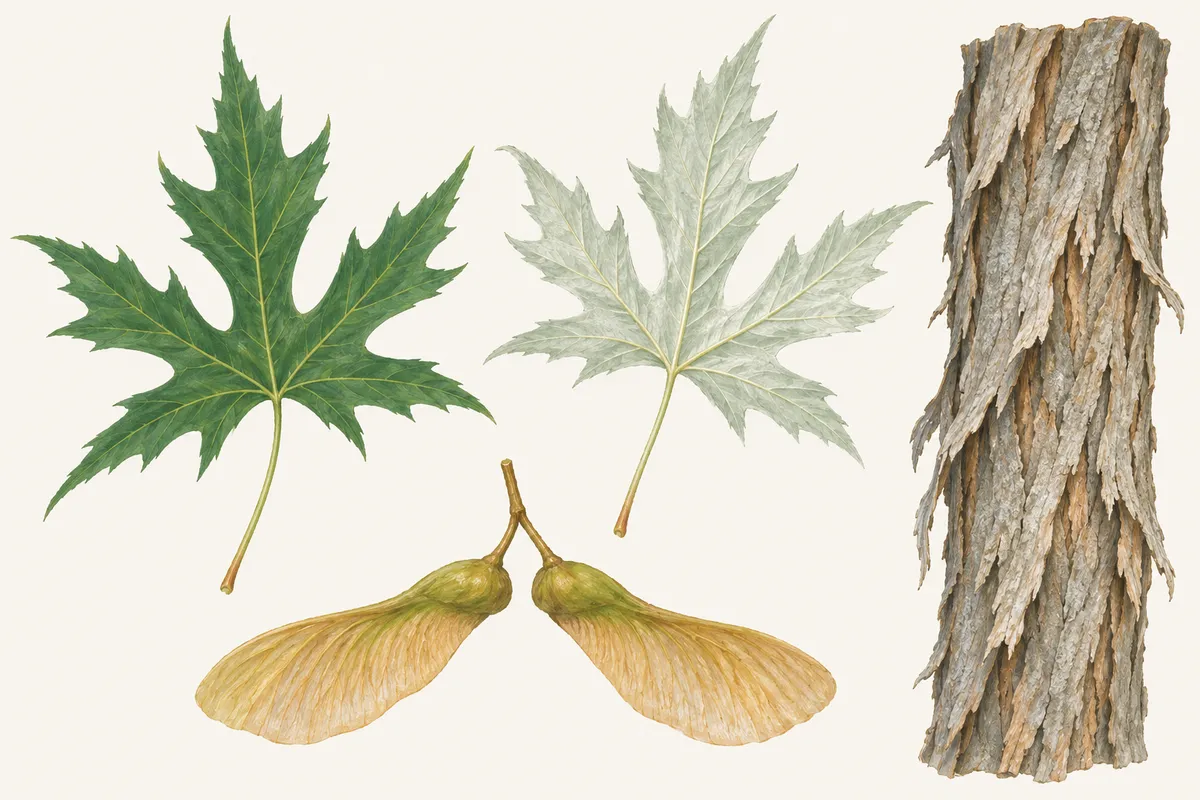
A leaf cut almost to the center, silver-white beneath, the largest seeds of any native maple dropping in May, and a short trunk that forks low into several leaders: the riverbank maple.
In short
For silver maple tree identification, check the leaf: opposite, 2 1/2 to 5 inches long, with five lobes cut deeply toward the center, coarse teeth and a silvery white underside that flashes in the wind. Confirm with the seeds, paired wings 1 1/2 to 2 1/2 inches long that fall in late spring, twigs that smell unpleasant when crushed, and gray bark in long strips loose at the ends.
- Deep cuts plus a silver-white underside make silver maple; red maple is cut shallower and is only pale beneath.
- Silver maple drops the largest seeds of any native maple, in spring, not fall.
- A short trunk splitting low into several leaders, with long branches that droop and then turn up at the tips, is the silhouette to look for.
Field marks at a glance
- Scientific name
- Acer saccharinum
- Family
- Sapindaceae (soapberry family); Virginia Tech lists the older Aceraceae
- Type
- Broadleaf, deciduous
- Leaves
- Opposite, simple, 2 1/2 to 5 inches long (Virginia Tech), 3 to 6 inches (Morton Arboretum), with five deep lobes, the notches cut far toward the center, and coarse teeth.
- Leaf underside
- Pale silvery white, against a light green upper side; the whole crown flashes silver in a breeze.
- Twigs and buds
- Stouter than red maple's, often chestnut-brown, with an unpleasant smell when crushed; reddish brown buds with large scales; flower buds in dense, conspicuous clusters.
- Flowers
- Small, greenish yellow to reddish, without petals, in dense clusters on bare twigs; the first maple to bloom, as early as February and into May.
- Samaras
- Paired, wings 1 1/2 to 2 1/2 inches, widely spread, the largest of any native maple; ripe and falling April to June, sprouting as soon as they land.
- Bark
- Smooth and light gray when young; on older trees broken into long, thin strips loose at the ends, curling outward.
- Form
- Short trunk that splits into several subtrunks; long, slender branches that droop, then curve upward at the tips.
- Fall color
- Yellow-green to pale yellow; rarely red.
- Size and age
- 50 to 70 ft in landscapes (Morton Arboretum); 90 to 120 ft in the wild, living 130 years or more (USDA Forest Service).
- Range and site
- New Brunswick and southern Quebec to Minnesota and Oklahoma, south to central Georgia and northwestern Florida; stream banks, floodplains and lake edges.
Silver maple (Acer saccharinum) is the big, fast maple of riverbanks and older neighborhoods: a tree with a low-forking trunk, a crown that turns silver whenever the wind flips the leaves, and a lawn full of oversized helicopter seeds every May. The leaf usually settles it at a glance; the seeds, the twigs and the shape confirm it.
How to identify a silver maple: four checks
1. Opposite leaves, cut deep. Leaves and buds grow in pairs, which confirms a maple; the maple identification page covers that test. Virginia Tech's silver maple fact sheet then describes five deep palmate lobes with coarsely toothed edges, 2 1/2 to 5 inches long. The notches run so far toward the center that the lobes look like long, narrow fingers.
2. A silver-white underside. Turn the leaf over. The upper side is light green and the underside pale silvery white, the source of the name. In a breeze the whole crown flickers silver and green, a clue you can see from a car.
3. Seeds the size of your palm. Silver maple's paired samaras are the largest of any native maple: Virginia Tech gives divergent wings 1 1/2 to 2 1/2 inches long, and the USDA Forest Service's Silvics of North America measures about 2 inches at maturity. They ripen and fall from April to June. Our guide to trees with helicopter seeds sets them beside the other winged seeds.
4. Smelly twigs and clustered flower buds. In winter, Virginia Tech describes twigs stouter than red maple's, often chestnut-brown, that give off an unpleasant smell when crushed. The reddish brown buds have large scales, and the round flower buds sit in dense, conspicuous clusters along the twig.
When the leaves hang out of reach, a photo of a fallen leaf turned upside down, or of a seed pair, gives Tree Identifier the most to work with. Treat any answer as a lead and check the underside, the seed size and the twig smell above.
Silver maple through the seasons
- Late winter. Silver maple is the first maple in North America to bloom, the Forest Service says, as early as February and continuing into May, before the leaves. The small, petal-less flowers are greenish yellow to reddish and pack the twigs in dense clusters, giving the bare crown a soft haze. Virginia Tech notes that male and female flowers grow on the same tree.
- Spring. The big seeds follow quickly and fall from April to June. They need no winter chilling and can germinate as soon as they land, so a silver maple's neighborhood fills with seedlings within weeks.
- Summer. Deeply cut leaves, silver beneath, on long slender branches that hang down and then turn up at the tips.
- Fall. The Morton Arboretum describes fall color as yellow-green. A bright red tree with silver-maple leaves is more likely a hybrid (see below).
Bark, trunk and crown shape
The bark is smooth and light gray on young trees. On older trunks, Virginia Tech says, it breaks into long, thin strips loose at the ends, coarser than red maple's scaly plates; Morton describes long, wide strips that curl upward at the ends. Old silver maples look shaggy from top to bottom.
The shape is often the first thing to give the tree away from a distance. Virginia Tech describes a short trunk that usually splits into several subtrunks, with long, slender branches that droop and then curve upward. The result is a broad crown on several leaders rather than one straight trunk. Trees can pass 100 feet; the Forest Service gives 90 to 120 feet for mature trees, and Morton 50 to 70 feet tall and 30 to 50 feet wide for planted ones.
Those forks and the brittle wood explain the broken limbs. The Forest Service calls the species highly susceptible to ice damage because of its brittle wood, and Morton lists weak wood and branch structure that breaks in high winds and ice. A big maple with several snapped-off leaders after a storm is very often a silver maple.
Where silver maple grows
The Forest Service traces the native range from New Brunswick, central Maine and southern Quebec west through southeastern Ontario and northern Michigan to Minnesota, and south to Oklahoma, central Georgia and northwestern Florida. It is absent from the higher Appalachians.
In the wild, it is a tree of water. It grows on stream banks, floodplains and lake edges, best on moist, well-drained alluvial soils, and it withstands temporary flooding better than most of its neighbors, which gives it the advantage there. American sycamore grows on the same riverbanks; its leaves can look maple-like, but they are alternate, as the sycamore vs maple page shows. A large maple on a dry ridge is far more likely red or sugar maple.
In towns it was planted heavily for its speed. The Forest Service reports some trees adding half an inch to an inch in trunk diameter a year, and seedlings growing 12 to 36 inches in their first season. It also sprouts readily from the root collar and from stumps up to about 12 inches across, so a cut silver maple often comes back as a ring of shoots. How far to keep it from a house and its drains is covered in the guide to tree roots near a house.
Silver maple vs red maple and the Freeman hybrid
Red maple is the tree most often confused with silver maple: both bloom on bare twigs in the same weeks, both drop their seeds by early summer, and both grow along rivers. The short version: red maple leaves are cut shallower, have fine rather than coarse teeth and are only whitish beneath; its seeds are 1/2 to 3/4 inch, about a third the size; its twigs are shiny red and do not smell. The silver maple vs red maple page compares every part side by side.
The two also cross. The Forest Service reports that silver maple crosses readily with red maple when red maple is the seed parent, and that the hybrids have intermediate leaves and grow faster than red maple. Nurseries sell selections of this hybrid, Freeman maple, under names such as Autumn Blaze. Oregon State University describes Autumn Blaze as having deeply cut, five-lobed leaves like silver maple with excellent orange-red fall color, and notes that leaf measurements could not reliably separate Freeman maple from either parent. A young street maple with silver-maple leaves and a scarlet fall crown is most likely a Freeman cultivar.
For syrup, silver maple can be tapped, but the Forest Service reports that its sap had the lowest sugar content of five maples tested in Ontario, though the syrup was satisfactory. If you mark trees for tapping, Tree Identifier's Tree Map pins each one identified with location turned on, ready for late winter.
Look-alikes and how to tell them apart
Red maple (Acer rubrum)
Shallower V-shaped notches, fine teeth, a whitish but not silver underside, shiny red twigs with no smell when crushed, and seeds only 1/2 to 3/4 inch long.
Freeman maple (Acer × freemanii)
The red × silver hybrid, sold as cultivars such as Autumn Blaze. Oregon State University describes leaves intermediate between the parents and seed wings of intermediate length; Autumn Blaze has deeply cut leaves like silver maple but orange-red fall color.
Sugar maple (Acer saccharum)
Smooth edges between the lobe points, U-shaped notches cut much less deeply, a green underside, sharp brown winter buds and horseshoe-shaped seeds about 1 inch long that ripen in fall.
American sycamore (Platanus occidentalis)
Shares riverbanks with silver maple and has lobed leaves, but they are alternate, not opposite, and shallowly lobed. The bark peels in brown, green and white patches and round seed balls hang on long stalks.
What a photo can't settle
- Red and silver maple hybridize, and Oregon State University notes that leaf measurements could not reliably separate Freeman maple from its parents; a planted maple with in-between leaves may not be settled by a photo.
- Tree Identifier gives one name with no confidence score or look-alike list, so check the underside, the seeds and the twig smell yourself.
- Cut-leaved and weeping cultivars, such as those in the Morton Arboretum's collection, have even deeper, narrower lobes than the wild tree.
Questions people ask
How do I know if I have a silver maple?
Turn a leaf over: silver maple is silvery white beneath, and its five lobes are cut deep toward the center with coarse teeth. Then check for very large paired seeds in late spring, twigs that smell unpleasant when crushed, and bark in long strips loose at the ends. Three matches make it a silver maple.
Why are silver maples considered bad trees?
For yards, mainly the wood and the roots. The Morton Arboretum lists weak wood and branch structure that breaks in wind and ice, vigorous roots that can invade sewer pipes, and seedlings that spread through lawns and gardens, and notes that many authorities recommend against planting it. Along rivers it is a valuable native floodplain tree.
When do silver maples drop their seeds?
In late spring. The USDA Forest Service gives April to June for ripening and dispersal, mainly by wind. The seeds need no winter chilling and can germinate as soon as they land, which is why silver maple seedlings appear in gutters and flower beds within weeks.
Does silver maple turn red in fall?
Rarely. The Morton Arboretum describes silver maple fall color as yellow-green. A deeply cut maple leaf that turns bright orange-red is more likely a Freeman maple cultivar such as Autumn Blaze, which Oregon State University describes with excellent orange-red fall color.
How fast does a silver maple grow?
Very fast. The USDA Forest Service reports some trees adding 1/2 to 1 inch in trunk diameter a year, one Vermont tree about 2 inches a year, and seedlings growing 12 to 36 inches in their first year. Plantation trees in southern Ontario averaged 81 feet tall at 43 years.
Sources
- Silver maple fact sheet — Virginia Tech Dendrology
- Silver Maple (Acer saccharinum), Silvics of North America — USDA Forest Service
- Silver maple (Acer saccharinum) — The Morton Arboretum
- Acer × freemanii (Freeman maple, hybrid red maple) — Oregon State University, Landscape Plants
- Red maple fact sheet — Virginia Tech Dendrology
Keep reading
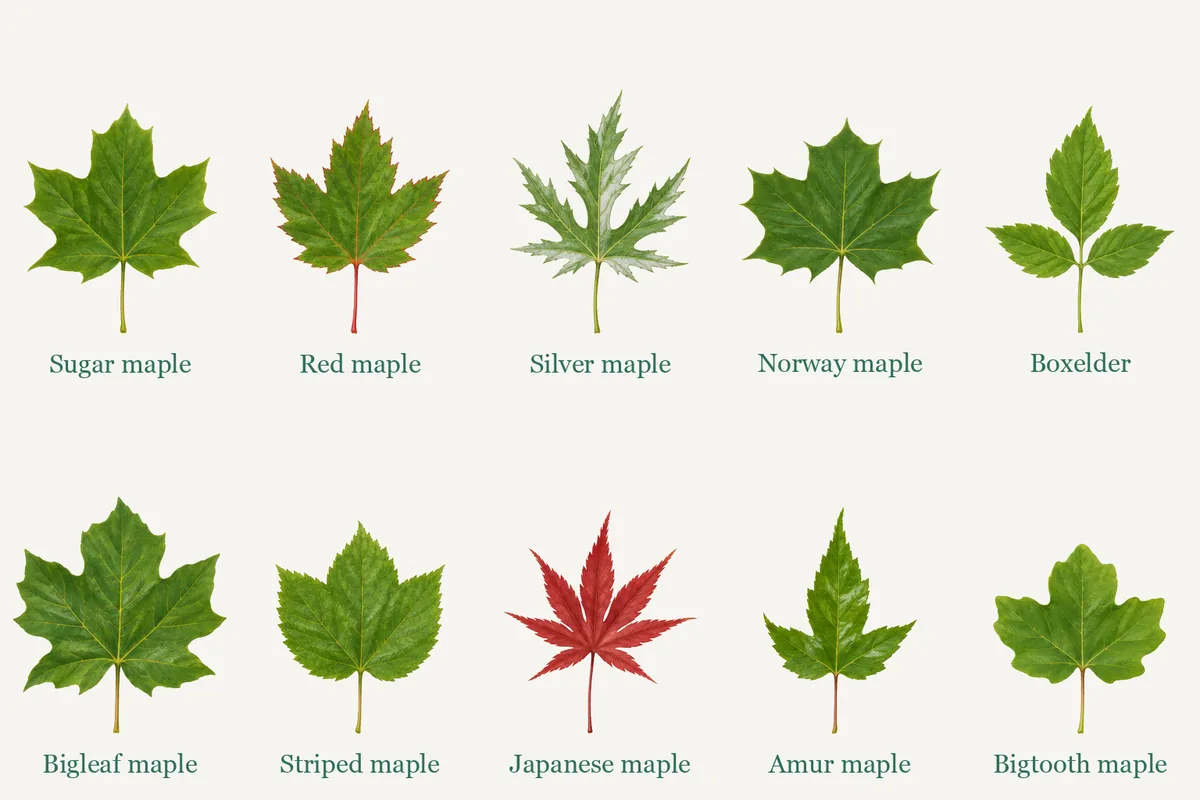
- Tree profileMaple trees (Acer): how to identify them
- Tree comparisonSilver maple vs red maple: how to tell them apart
- Clue guideWhich tree has helicopter seeds? Read the wings
- Clue guideWhich tree has silver leaves? Check which side is silver, then the leaf shape
- Tree comparisonSycamore vs maple: how to tell them apart