Clue guide
Which tree has silver leaves? Check which side is silver, then the leaf shape
Turn a leaf over first. A tree silver only underneath is a different list from a tree silver on both sides, and the leaf shape then settles most cases.
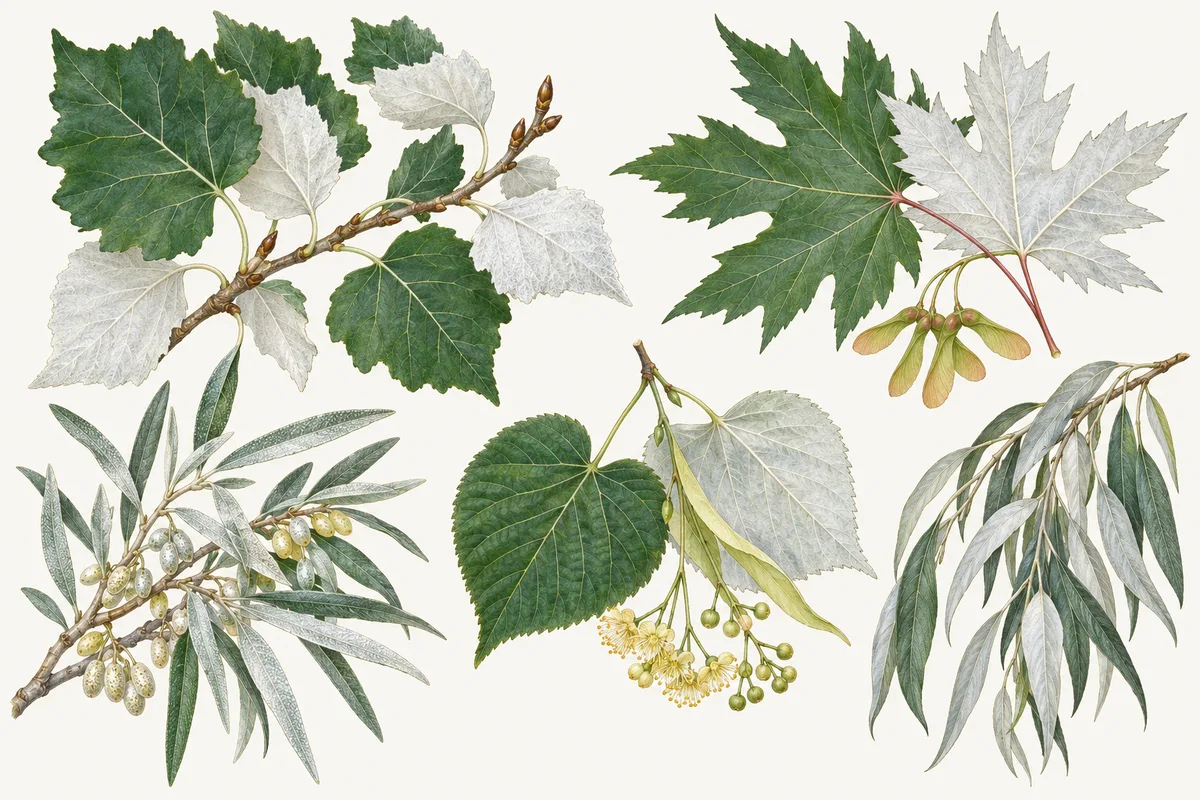
In short
A tree with silver leaves is most often silver only underneath: silver maple has deeply five-lobed leaves with a silvery underside, white poplar has a white, woolly underside and woolly leaf stalks, and silver linden has heart-shaped leaves fuzzy silver-white below. Narrow leaves silvery on both sides point to Russian olive; narrow, opposite, leathery leaves to olive.
- Silver only underneath: silver maple (opposite, five deep lobes), white poplar (alternate, woolly, lobed), silver linden (heart-shaped), whitebeam (oval, felted).
- Silver on both sides and narrow: Russian olive (alternate, scaly) or olive (opposite, leathery).
- Round, coin-like blue-gray leaves are a silver dollar eucalyptus; silvery-blue needles are blue spruce or blue Atlas cedar.
Silver foliage comes from two things: a coat of fine hairs or scales on the leaf, or a waxy bloom. Both are easy to see, so this clue narrows the list quickly once you ask one question: is the leaf silver on both sides, or only underneath? Trees with silver undersides look green until wind turns the leaves over, then the whole crown flashes pale. Trees silver on both sides look gray-green even on a still day. Start there, then read the leaf shape and the leaf arrangement on the twig.
Trees with silver leaves, sorted by which side is silver
| Tree | Silver where | Leaf shape and arrangement | Our page |
|---|---|---|---|
| Silver maple (Acer saccharinum) | Underside | Opposite, 3–6 in, five deep lobes | Maple |
| White poplar (Populus alba) | Underside, white and woolly; stalk woolly | Alternate, 3–5 lobes, coarse teeth | Poplar |
| Silver linden (Tilia tomentosa) | Underside, fuzzy silver-white | Alternate, heart-shaped, toothed | Linden |
| Whitebeam (Sorbus aria, UK) | Underside, white felt | Alternate, oval, irregular teeth | Whitebeam |
| White willow (Salix alba) | Underside, silky silver hairs | Alternate, long and slender | Willow |
| Olive (Olea europaea) | Underside silvery; top gray-green | Opposite, narrow, leathery, evergreen | none yet |
| Russian olive (Elaeagnus angustifolia) | Both sides, silvery scales | Alternate, narrow, smooth edge | Russian olive |
| Silver dollar eucalyptus (Eucalyptus cinerea) | Both sides, blue-gray bloom | Round and coin-like when young | Eucalyptus |
| Blue spruce (Picea pungens) | Needles bluish to silvery-white | Stiff, sharp single needles | Spruce |
| Blue Atlas cedar (Cedrus atlantica) | Needles sea green to silvery blue | Short needles in tufts of 10–30 | Cedar |
Leaf data come from NC State Extension, the Woodland Trust and the RHS pages linked below.
Silver underneath and lobed: silver maple and white poplar
Silver maple is the tree most people mean. The NC State silver maple profile describes opposite leaves 3 to 6 inches long with five deeply cut lobes, medium green above and silvery beneath, on a tree 50 to 80 feet tall native to eastern and central North America, usually along streams and floodplains. Older bark breaks into long, thin scales that give the trunk a shaggy look.
White poplar looks similar from a distance but is alternate-leaved and far whiter. The NC State white poplar profile describes leaves 3 to 6 inches long with three to five lobes and coarse teeth, a silvery-green upper surface and a white, woolly underside, with woolly leaf stalks as well. Young bark is smooth and greenish-gray, darkening and furrowing on old trunks. It comes from Europe and Central Asia, spreads by root suckers into colonies, and NC State notes it is prohibited in Connecticut and restricted in Wisconsin. Rub the underside: if white fuzz comes off on your finger, it is white poplar. The poplar page covers the other poplars.
Silver underneath, not lobed: silver linden, whitebeam and white willow
Silver linden is a street and park tree with the heart-shaped leaf of every linden. The NC State silver linden profile describes glossy green upper surfaces and a fuzzy silvery-white underside, toothed edges, a lopsided base and a tree 50 to 70 feet tall from southeastern Europe and western Asia. Its fragrant, creamy-white flowers hang under a long strap-shaped bract in June and July, later than other lindens.
Whitebeam is the British and European answer. The Woodland Trust's whitebeam page describes thick, oval leaves with irregular teeth, dark shiny green above and covered in white, felt-like hair below, on a tree up to 20 m with smooth grey bark, white flowers in May and scarlet berries in late summer.
White willow has the narrow willow leaf. The Woodland Trust's white willow page explains that its leaves look paler than most willows because the underside carries a felt of fine, silky, silvery-white hairs, on a tree up to 25 m with a leaning crown, deeply fissured grey-brown bark and a liking for riverbanks. See the willow page for the weeping and crack willows.
Silver on both sides: Russian olive, olive and silver dollar eucalyptus
Russian olive is a small, often thorny tree. The NC State Russian olive profile describes narrow, lance-shaped, alternate leaves 1½ to 4 inches long with smooth edges and silvery scales on both sides, a plant 12 to 30 feet tall, and small olive-like fruit that are silver in late summer and turn red in fall. It is from Asia and is listed as invasive by the North Carolina Invasive Plant Council; NC State notes it has taken over stream banks mainly in the central and western United States. Never eat a fruit on the strength of a web page or an app. The Russian olive page covers autumn olive, its closest look-alike.
Olive has a similar narrow leaf but carries it in opposite pairs. The NC State olive profile describes leathery, evergreen leaves up to about 3 inches long, grayish-green on top and silvery with fine hairs beneath, on a tree 20 to 30 feet tall grown outdoors in USDA zones 8 to 10, with bark that becomes furrowed, gnarled and twisted with age. Opposite leaves separate olive from Russian olive at a glance.
Silver dollar eucalyptus (Eucalyptus cinerea) is grown for its round, coin-like young leaves. NC State's Eucalyptus cinerea profile describes juvenile leaves that are opposite, round, stalkless and blue-green or ash-colored, and adult leaves that become alternate, lance-shaped and 3 to 4½ inches long. The eucalyptus page covers the other gums.
Silvery needles: blue spruce and blue Atlas cedar
Searches for an "evergreen tree with silver leaves" often mean a conifer. The NC State blue spruce profile describes stiff, sharply pointed needles under an inch long, dull green to bluish to silvery-white, on a tree 30 to 60 feet tall native to the central Rocky Mountains, with hanging cones 2 to 4 inches long. Blue Atlas cedar looks silver-blue too, but its needles grow in tufts: the NC State Atlas cedar profile gives clusters of 10 to 30 needles 0.7 to 1.5 inches long, from sea green to almost silvery blue, with barrel-shaped cones standing upright on the upper branches. Single needles that prick your hand mean spruce; tufts on short spurs mean cedar.
When leaves turn silver: silver leaf disease
If a plum, cherry or other fruit tree that used to be green now has silvery leaves, the cause may be disease rather than species. The RHS silver leaf page explains that the fungus Chondrostereum purpureum enters through wounds, mainly pruning cuts, gives leaves a silvery sheen that is most noticeable on plums, and kills the affected branch. Hosts include plums, apples, apricots, almonds, cherries, hawthorns and poplars. Cut an affected branch: an irregular dark stain in the center of the wood points to silver leaf, while cold or drought can silver leaves without staining the wood, which the RHS calls false silver leaf.
Using a photo
A silver underside rarely shows in a photo taken from below, so turn a leaf over and photograph it, then photograph the whole tree. Tree Identifier names a tree from one photo, and white willow, olive, blue spruce, blue Atlas cedar and Tasmanian blue gum (Eucalyptus globulus) are in its Collection; silver maple, white poplar and silver linden are not. It shows no confidence score or alternatives, so check its answer against the leaf arrangement and the side that is silver in the table above, and use the follow-up chat to ask how that species differs from its look-alikes. For leaf shapes in general, see how to identify trees by their leaves.
What a photo can't settle
- A leaf underside is hard to show in one photo. Photograph the leaf turned over, then the whole tree, or the silver may not register.
- Cultivars of many trees, such as silver-variegated maples and blue conifer forms, have silvery foliage that the wild species lacks; an app may name the species, not the cultivar.
- A tree whose green leaves suddenly turn silver may be diseased. Judging tree health is outside this guide; the RHS and your local extension service can help.
Questions people ask
What tree has leaves that are silver underneath?
Silver maple, white poplar, silver linden, whitebeam and white willow all have leaves that are green on top and silver or white below. Silver maple leaves are opposite with five deep lobes; white poplar leaves are alternate, lobed and woolly; silver linden leaves are heart-shaped; whitebeam leaves are oval and toothed; white willow leaves are long and slender.
What tree has silver leaves and white bark?
White poplar is the usual answer: NC State describes young trunks as smooth and greenish-gray, with a white, woolly leaf underside that flashes in wind. In Britain, whitebeam has smooth grey bark and white-felted leaf undersides. A birch has white bark but green leaves, so check the leaf underside before deciding.
What small tree has silver leaves?
Russian olive is the common one in North America: NC State gives 12 to 30 feet, narrow leaves with silvery scales on both sides and occasional thorns. Olive, 20 to 30 feet in warm climates, has narrow, opposite, leathery leaves that are silvery below. Silver dollar eucalyptus is often grown small and has round, coin-like juvenile leaves.
What evergreen tree has silver leaves?
Among broadleaf trees, olive and the eucalypts. Among conifers, blue spruce has stiff, sharply pointed needles that range from bluish to silvery-white, and blue Atlas cedar carries short needles in tufts of 10 to 30, from sea green to almost silvery blue, according to NC State Extension.
Why have my plum tree's leaves turned silver?
It may be silver leaf, a fungal disease caused by Chondrostereum purpureum. The RHS says it gives leaves a silvery sheen, most noticeably on plums, and leaves an irregular dark stain in the centre of a cut branch. Cold or drought can silver leaves too, but that false silver leaf leaves no stain in the wood.
Sources
- Acer saccharinum (Silver Maple) — North Carolina Extension Gardener Plant Toolbox, NC State University
- Populus alba (Abele, Silver Poplar, White Poplar) — North Carolina Extension Gardener Plant Toolbox, NC State University
- Tilia tomentosa (European White Lime, Silver Linden, White Lime) — North Carolina Extension Gardener Plant Toolbox, NC State University
- Elaeagnus angustifolia (Russian Olive) — North Carolina Extension Gardener Plant Toolbox, NC State University
- Olea europaea (Common Olive, European Olive, Olive) — North Carolina Extension Gardener Plant Toolbox, NC State University
- White willow (Salix alba) — Woodland Trust
- Whitebeam (Sorbus aria) — Woodland Trust
- Silver leaf — Royal Horticultural Society