Tree profile
Russian olive (Elaeagnus angustifolia): how to identify it
A small, thorny tree that looks dusted with silver from leaf to twig. The leaf undersides and the fruit tell it from its closest look-alike, autumn olive.
In short
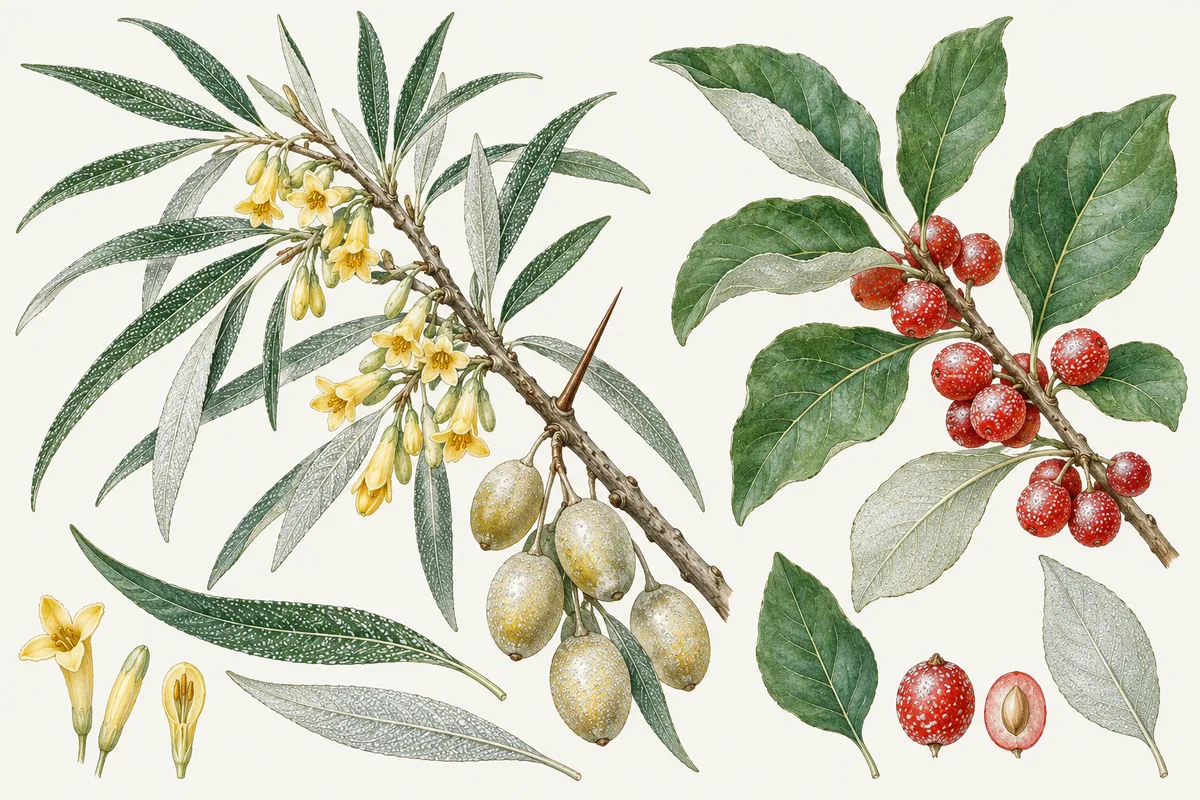
Russian olive tree identification rests on silver: narrow, smooth-edged leaves 1.5 to 4 inches long covered in silvery scales on both sides, silvery young twigs that often carry thorns, and small, olive-shaped fruit about half an inch long that is silvery to yellowish in late summer. It is a shrub or small tree, usually 12 to 30 feet tall.
- Leaves silvery on both faces, narrow like a willow's and with no teeth: Russian olive.
- Leaves green above and silvery only underneath, with red, silver-speckled berries: autumn olive.
- The olive of groves and pots is a different plant: evergreen, with leaves in opposite pairs.
- Both Russian and autumn olive are listed as invasive by agencies in several states; never eat the fruit of a tree you have not identified with certainty.
Field marks at a glance
- Scientific name
- Elaeagnus angustifolia
- Family
- Elaeagnaceae (oleaster family)
- Type
- Broadleaf, deciduous
- Leaves
- Alternate, simple, narrow (lanceolate to oblong), smooth-edged, 1.5 to 4 inches long and 2/3 to 1 inch wide (NC State); Utah State gives 1 1/2 to 3 inches. Silvery scales on both surfaces, silver-gray to gray-green.
- Twigs and thorns
- Young twigs silvery and scaly, turning brown with age; occasionally thorny (NC State), sometimes spiny (Utah State).
- Buds
- Small, round, gray-brown, with four exposed silvery scales (Utah State).
- Flowers
- Small, fragrant, tubular, silvery-white to yellow, about 3/8 inch, without petals; April to June in North Carolina, May in Utah.
- Fruit
- Olive-like, 1/4 to 1/2 inch, silvery to silver-yellow and mealy, ripening August to October. NC State notes it can turn red in fall.
- Bark
- Gray-brown to dark brown, with shallow furrows separated by narrow plates.
- Size and form
- Shrub or small tree 12 to 30 feet tall with a loose, irregular, spreading crown.
- Origin and status
- Native to Asia and southern Europe; widely planted in the Great Plains and the West and now naturalized. Listed as invasive by the NC Invasive Plant Council; a declared noxious weed in three Utah counties.
Russian olive (Elaeagnus angustifolia) is a small, sometimes thorny tree from Asia and southern Europe that looks as if it had been dusted with silver. It was widely planted across the Great Plains and the West and has since spread on its own (Utah State). Its name misleads: it is not an olive. Three checks identify it, in this order: the leaf faces, the twigs, then the fruit.
How to identify a Russian olive: leaves, twigs, fruit
1. Look at both sides of a leaf. Russian olive leaves are alternate, simple, narrow and smooth-edged. NC State's Russian olive profile gives them as 1.5 to 4 inches long and 2/3 to 1 inch wide, silver-gray to gray-green, with silvery scales on both surfaces. Rub a leaf between your fingers: the scales feel slightly rough and leave the leaf looking frosted from every angle. A narrow leaf that is silver on top as well as underneath is the first strong sign.
2. Check a young twig. Utah State University's Russian olive page describes silvery twigs that are sometimes spiny, and small, round, gray-brown buds with four exposed silvery scales. NC State notes that young branches are silvery and older ones brown, and that the plant is occasionally thorny. Thorns help, but a tree without them is not ruled out.
3. Find the fruit. From late summer into fall, look for small, olive-shaped fruit. Utah State gives a silver-yellow drupe 1/4 to 1/2 inch across, ripening in August and September; NC State describes olive-like fruit about half an inch long, silver in late summer, which can turn red in fall. Penn State Extension calls it green and mealy. In every description it is dull and scaly rather than glossy.
If the leaves are silvery on both faces, the twigs are scaly and silver, and the fruit is small and olive-shaped, you have a Russian olive. In spring, the flowers add one more clue: small, fragrant, tubular flowers, silvery-white to yellow, about 3/8 inch long and without petals, in May (Utah State) or from April to June farther south (NC State).
Russian olive vs autumn olive
Autumn olive (Elaeagnus umbellata) is the look-alike most people meet, especially in the East, and NC State lists the two as often confused. Penn State Extension's autumn olive identification video page calls them nearly identical and says the clearest difference is the fruit. Two tests settle most trees:
| Feature | Russian olive | Autumn olive |
|---|---|---|
| Top of the leaf | Silvery-scaly, silver-gray | Dull or pale green |
| Underside of the leaf | Silvery | Silvery-white, with brown scales |
| Leaf shape | Narrow, lanceolate, flat edge | Lanceolate to ovate, wavy edge |
| Fruit | 1/4–1/2 in, silvery to yellowish, mealy | Up to 1/2 in, bright red, speckled with silver, in clusters |
| Usual size | Shrub or small tree, 12–30 ft | Multi-stemmed shrub, up to about 20 ft |
NC State's autumn olive profile describes leaves 2 to 4 inches long with wavy margins, dull green above with brown scales beneath, white fragrant flowers in clusters of 1 to 7, and red fruit dotted with silver or brown scales. Penn State adds that autumn olive can reach 20 feet tall and 30 feet wide, with sharp, stout spines on its stems. In practice: green on top means autumn olive, silver on top means Russian olive, and red speckled berries in clusters confirm autumn olive.
Russian olive vs willow and the true olive
For other trees with silvery foliage, see trees with silver leaves.
Willows. From a distance, a Russian olive's narrow, pale leaves and loose crown suggest a willow. Pull a leaf. Willow leaves are finely toothed and green on top, and a willow bud is wrapped in a single cap-like scale (see the willow identification page). Russian olive leaves have smooth edges, silver scales on both faces, and buds with four visible scales.
The olive tree. The olive of groves and patios (Olea europaea) is a different family. NC State's olive profile describes a broadleaf evergreen with leathery leaves up to 3 inches long in opposite pairs, gray-green above and silver below, and green oval fruit about 1.5 inches long that ripens to black; it grows outdoors in USDA zones 8 to 10. Russian olive loses its leaves in winter, its leaves alternate along the twig, and its fruit is a third of the size or less.
Other thorny trees. If the tree has thorns but green leaves, it is something else: hawthorn, honey locust or another thorny tree. The trees with thorns guide sorts them by where the thorns grow.
Where Russian olive grows and why it matters
Utah State says Russian olive is native to Asia and southern Europe and was widely planted in the Great Plains and the West, where it has naturalized. NC State gives native origins in Asia, Russia and India and a size of 12 to 30 feet tall and 12 to 20 feet wide.
Its status depends on where you are, so attribute it to the agency that set it:
- North Carolina: NC State reports that the NC Invasive Plant Council lists Russian olive as invasive, and lists autumn olive as well, noting that several states have banned the sale of autumn olive.
- Utah: Utah State says Russian olive is declared a noxious weed in Carbon, Duchesne and Uintah counties, calls it very aggressive and weedy, and says it should not be planted.
- Elsewhere: check your state's invasive or noxious-weed list before planting or removing one.
The invasive trees guide lists the other trees US agencies treat as invasive.
About the fruit: people often search whether Russian olive or autumn olive berries are edible. This page does not answer that. Never eat fruit from a tree identified from a web page or a photo, and see the trees with red berries guide for the other red-fruited trees that grow alongside autumn olive.
Using a photo to confirm it
Tree Identifier names a tree or shrub from one photo. For a Russian olive, the most useful picture is a twig held so that you see the top of one leaf and the underside of another, with fruit if there is any; a second photo of a thorn helps. The app shows no confidence score and no list of look-alikes, so check its answer against the leaf-face test above. If it suggests Russian olive and you want to tell it from autumn olive, ask the follow-up chat about the leaf undersides and fruit color, and save the location on the Tree Map if you plan to report it to your county or state invasive-species program. Russian olive is not among the 138 species in the app's Collection, so a find is saved in your History rather than filling a Collection card.
Look-alikes and how to tell them apart
Autumn olive (Elaeagnus umbellata)
Turn a leaf over. Autumn olive leaves are dull green on top and silvery (with brown scales) only underneath, 2 to 4 inches long with wavy edges. Its fruit is bright red, speckled with silver, in clusters. Russian olive leaves are silvery on both faces and its fruit is silvery to yellowish.
Willows (Salix)
Willow leaves are just as long and narrow but finely toothed, green on top, and the buds are wrapped in a single cap-like scale. Russian olive leaves have smooth edges and silvery scales, and its buds show four scales.
Olive (Olea europaea)
The true olive is evergreen and its leaves grow in opposite pairs, gray-green above and silver below, with fruit about 1.5 inches long ripening to purplish-black. Russian olive drops its leaves in fall, its leaves are alternate and its fruit is about half an inch.
What a photo can't settle
- Russian olive and autumn olive grow side by side and NC State lists them as often confused. A photo of the top of a leaf alone may not separate them: photograph the underside and the fruit too.
- Sources disagree on fruit color: Penn State describes Russian olive fruit as green and mealy, Utah State as silver-yellow, and NC State says it can turn red in fall. Use the leaf faces as the main test.
- Invasive and noxious-weed status is set state by state and county by county. A photo app cannot tell you whether you must remove a tree; your state agency or extension office can.
Questions people ask
Do all Russian olive trees have thorns?
No. NC State describes the branches as occasionally thorny and Utah State says the twigs are sometimes spiny, so a tree without thorns can still be a Russian olive. Check the leaves instead: narrow, smooth-edged and silvery on both sides.
What is the difference between Russian olive and autumn olive?
Russian olive leaves are narrow and silvery on both faces, and its fruit is silvery to yellowish and mealy. Autumn olive leaves are green above and silvery only beneath, and its fruit is bright red with silver speckles, in clusters. Penn State calls the two nearly identical in most other ways.
Is Russian olive related to the olive tree?
No. Russian olive belongs to the oleaster family (Elaeagnaceae); the olive of groves belongs to the olive family. The olive is evergreen with opposite leaves and much larger fruit. The name comes from the small, olive-shaped fruit and the gray, olive-like leaves.
Can you eat Russian olive fruit?
This page does not give edibility advice. Never eat fruit from a tree you have not identified with certainty, and do not rely on a web page or an app to decide. Russian olive and autumn olive grow side by side with other shrubs that carry small berries.
Is Russian olive invasive?
Several agencies treat it as invasive. NC State reports that the NC Invasive Plant Council lists it, and Utah State says it is a declared noxious weed in Carbon, Duchesne and Uintah counties and should not be planted because it has caused serious environmental degradation. Check your own state's list.
Sources
- Elaeagnus angustifolia (Russian olive) — NC State Extension, North Carolina Extension Gardener Plant Toolbox
- Russian Olive — Utah State University Extension, Forestry
- Elaeagnus umbellata (Autumn olive) — NC State Extension, North Carolina Extension Gardener Plant Toolbox
- Autumn Olive: Accurate Identification — Penn State Extension
- Olea europaea (Common Olive, European Olive, Olive) — NC State Extension, North Carolina Extension Gardener Plant Toolbox