Field guide
Invasive tree identification, one field test per tree
A short list of nonnative trees turns up on most US state invasive lists. Each has one feature you can check by hand, and each state decides its own rules.
In short
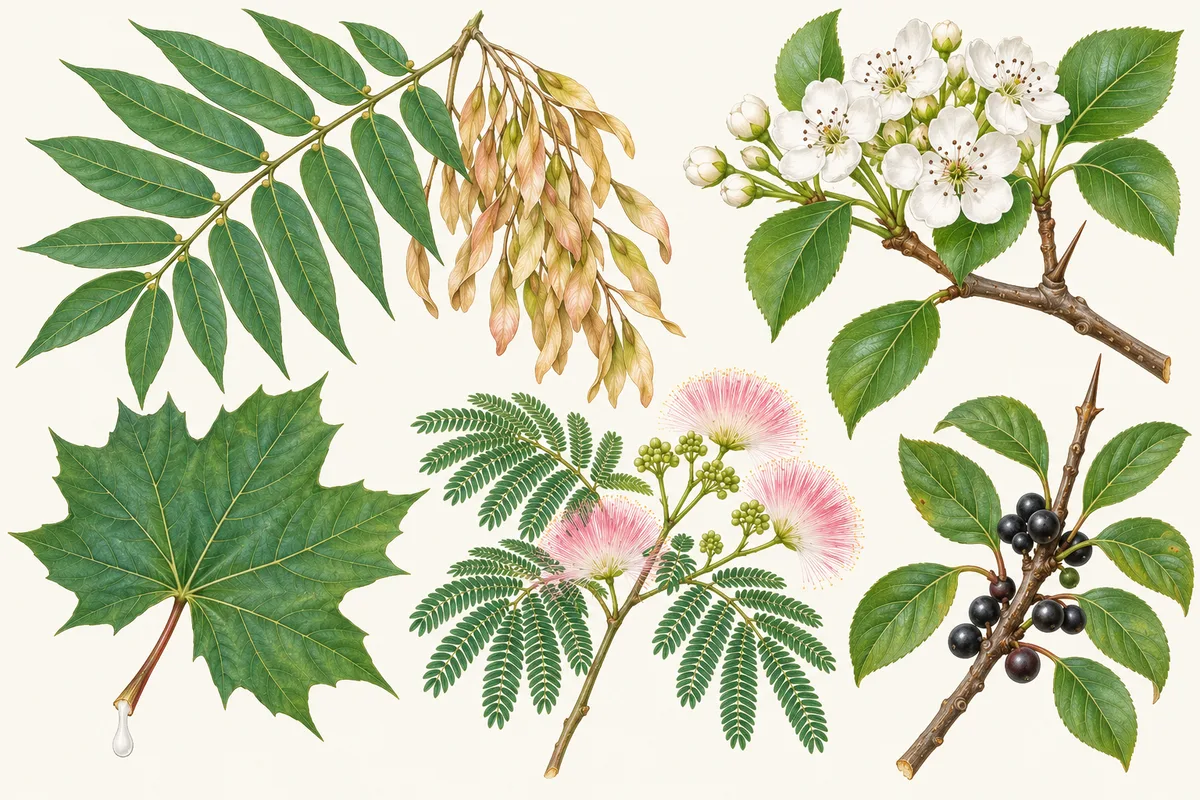
Invasive tree identification in the US comes down to a few field tests: tree of heaven has a notched gland at the base of each leaflet and smells foul when crushed, Norway maple bleeds milky sap from a snapped leaf stalk, and Callery pear blooms white and smelly before its leaves open. Chinese tallow and chinaberry are the southern ones to learn. Whether a tree is "invasive" legally depends on your state agency's list.
- Minnesota classes tree of heaven as a Prohibited Eradicate noxious weed (added 2017): it may not be sold or propagated there.
- Ohio's invasive plant rule ended sales of Callery pear on January 7, 2023; existing trees do not have to be removed.
- A tree can be native in one state and listed in another: Minnesota lists black locust, a native of the eastern US, as a Restricted noxious weed.
Invasive tree identification is a two-step job: put a name on the tree, then check what your own state says about that name. This page covers the first step for nine nonnative trees that recur on US lists, with the one test that separates each from its native look-alikes, and it says which agency lists each one, as read on 21 October 2026.
Nine invasive trees and who lists them
| Tree | Field test | Who lists it (as read on 21 Oct 2026) |
|---|---|---|
| Tree of heaven (Ailanthus altissima) | Leaves 18–24 in, 10–41 leaflets, notched gland at each leaflet base; foul smell | Minnesota: Prohibited Eradicate (2017). Ohio: invasive plant rule. NC Invasive Plant Council |
| Callery or Bradford pear (Pyrus calleryana) | White flowers before the leaves, fetid smell; glossy oval leaves to 3 in | Ohio: sales ended Jan 7, 2023. Minnesota: Restricted (2023). Missouri: sale ban passed in 2025 (per MDC) |
| Norway maple (Acer platanoides) | Milky sap from a snapped leaf stalk; samaras spread in a straight line | Minnesota: Specially Regulated (2020), sold only with a warning label |
| Chinese tallow (Triadica sebifera) | Milky sap; white waxy "popcorn" seeds in fall | NC Invasive Plant Council; NC State notes listings in FL, AR, CA, OK, TX, NC and GA |
| Chinaberry (Melia azedarach) | Leaves twice-divided, 12–24 in; yellow marble-like fruit through winter | NC Invasive Plant Council and many southern states |
| Brazilian peppertree (Schinus terebinthifolia) | 5–9 leaflets, aromatic when crushed; red fruit Nov–Jan | Florida Noxious Weed; FISC Category 1; UF/IFAS assessment: invasive |
| Common and glossy buckthorn (Rhamnus cathartica, Frangula alnus) | Shrub or small tree, black fruit | Minnesota: Restricted (since 1999) |
| Russian olive and autumn olive (Elaeagnus) | Shrubs or small trees, usually in thickets | Ohio: Russian olive on the invasive plant rule. Minnesota: autumn olive Restricted (2026) |
| Black locust (Robinia pseudoacacia), outside its native range | Native to the eastern US; listed where it spreads | Minnesota: Restricted (2017) |
Statuses come from the Minnesota Department of Agriculture noxious weed list, the Ohio Department of Agriculture rule summarized by Ohio State University, NC State Extension, the Missouri Department of Conservation and UF/IFAS. They are examples, not a full list for any state: always check your own state agency.
Compound leaves: tree of heaven first
Most invasive-tree questions in the eastern US are about a fast-growing tree with long, feather-like leaves on a vacant lot or a roadside. NC State Extension describes tree of heaven with leaves 18 to 24 inches long carrying 10 to 41 leaflets. The test is at the base of each leaflet: a notched, glandular base with the only teeth on the leaflet, and a smooth edge above it. Crushed leaves and broken stems smell strongly; descriptions range from rancid to peanut butter. The bark is smooth and pale gray, and female trees carry large drooping clusters of flat, twisted, reddish-brown winged seeds.
Sumacs and black walnut are the usual confusions; the sumac page also covers poison sumac, which should not be touched. Their leaflets are toothed along the whole edge and have no gland at the base. The tree of heaven page has the full look-alike table and the spotted lanternfly connection.
Two southern trees also have big divided leaves. Chinaberry has leaves divided twice, 12 to 24 inches long, with toothed, pointed leaflets; NC State describes fragrant lilac-colored flowers in spring and wrinkled yellow fruit about half an inch long that hangs on through winter. NC State reports the fruit as poisonous to people, cats and dogs: never eat it. Brazilian peppertree, across the Florida peninsula, has 5 to 9 leaflets that are strongly aromatic when crushed and small peppercorn-like fruit that ripens red from November to January, according to UF/IFAS.
White spring blossoms that smell: Callery pear
In March or early April, roadsides in the East and Midwest fill with white-flowering trees before anything else has leaves. The Missouri Department of Conservation describes Callery pear flowers with five rounded white petals, blooming before the leaves, and a scent many people find revolting. Leaves are glossy, oval, finely round-toothed and up to 3 inches long, often turning red or purple in fall. The fruit is round, up to half an inch across, greenish yellow with whitish spots. Planted Bradford pears are thornless, but wild seedlings and sprouts have twigs that end in thorns, which is how escaped trees in old fields give themselves away.
Ohio's rule ended sales of Callery pear on January 7, 2023, after a five-year grace period, and does not require existing trees to be removed. The Bradford pear page covers serviceberry and wild plum, the white-flowering natives it is confused with.
Maple leaves with milky sap: Norway maple
Norway maple looks like a sugar maple until you break a leaf. NC State gives leaves about 7 inches across with five sharply pointed lobes, a leaf stalk that exudes milky sap when snapped, and samaras whose wings spread in a nearly straight line. Fall color is a late, plain yellow. NC State notes the tree has been labeled invasive in several northeastern states; Minnesota allows its sale only with a label telling buyers to plant it where seedlings will be controlled. Native sugar maple has clear sap and horseshoe-shaped seeds, as the Norway maple vs sugar maple page shows.
Milky sap and popcorn seeds: Chinese tallow
Along the Gulf Coast and in the Carolinas, a small tree with broad, long-pointed leaves and bright red fall color is often Chinese tallow. NC State describes leaves about 1 to 3 inches long with a tapering base, a long pointed tip and conspicuous yellow veins, milky white sap from any damaged part, and three-parted capsules that split to show three white, waxy seeds that hang on like popcorn. No native tree in the Southeast combines those seeds with milky sap. The Chinese tallow page covers it in full.
Shrubs that become small trees
Several listed plants start as shrubs and reach small-tree size. Minnesota has listed common and glossy buckthorn as Restricted noxious weeds since 1999, autumn olive since 2026, and Siberian peashrub and saltcedar more recently. Ohio's rule lists Russian olive. The buckthorn page and the Russian olive page give the field tests. These are usually found in thickets along woodland edges rather than as single yard trees.
Black locust is the reminder that "invasive" depends on place. It is native to the eastern US, yet Minnesota lists it as a Restricted noxious weed. The same happens in reverse: Minnesota added European rowan to its Specially Regulated list in 2026, with a three-year phase-out before its sale is prohibited.
Using a photo
A photo is useful for the first step, putting a name on the tree. Tree Identifier names a plant from one photo, and Norway maple and mimosa are among the species in its Collection. Photograph a whole leaf flat, plus the leaflet base for tree of heaven or a snapped leaf stalk for Norway maple. The app shows no confidence score or list of alternatives, so confirm the result with the field test in the table, and ask follow-up questions, such as how chinaberry differs from a native ash, in the chat under the result. The app does not know your state's current law: for removal rules, ask your state department of agriculture or extension office.
What a photo can't settle
- Whether a tree is legally invasive is set by each state, and lists change. A photo app can name a tree; it cannot tell you the current law where you live.
- Cultivars of Callery pear, Norway maple and other listed trees can look quite different from the wild form; leaves, twigs and fruit together settle more than one photo.
- Seedlings and stump sprouts are harder to identify than mature trees, and young tree of heaven is easy to confuse with sumac.
Questions people ask
How do I know if a tree in my yard is invasive?
Put a name on it first, then look the name up on your state's list: the department of agriculture's noxious weed list or the state invasive plant council's list. A tree listed in Minnesota or Ohio may not be listed where you live, and lists change, so check the current version.
Do I have to cut down an invasive tree?
It depends on the state and the class. Ohio's rule says existing Callery pears do not have to be removed. Minnesota's Prohibited Eradicate class, which includes tree of heaven, requires eradication. Ask your state department of agriculture or extension office before you act.
What invasive tree looks like sumac or walnut?
Tree of heaven. NC State gives it leaves 18 to 24 inches long with 10 to 41 leaflets, each with a notched, glandular base and a smooth edge above it. Sumac and walnut leaflets are toothed along the whole edge and have no such gland.
Which invasive trees have milky sap?
Norway maple, whose snapped leaf stalk oozes milky sap, and Chinese tallow, which NC State says emits milky white sap from all parts when damaged. Native sugar maple and red maple have clear sap.
Sources
- Minnesota Noxious Weed List — Minnesota Department of Agriculture
- Ohio's Invasive Plant Rule — Buckeye Yard and Garden onLine, The Ohio State University
- Ailanthus altissima (tree-of-heaven) — North Carolina Extension Gardener Plant Toolbox, NC State University
- Acer platanoides (Norway maple) — North Carolina Extension Gardener Plant Toolbox, NC State University
- Callery Pear (Bradford Pear) — Missouri Department of Conservation
- Triadica sebifera (Chinese tallow tree) — North Carolina Extension Gardener Plant Toolbox, NC State University
- Melia azedarach (chinaberry) — North Carolina Extension Gardener Plant Toolbox, NC State University
- Schinus terebinthifolia (Brazilian peppertree) — UF/IFAS Center for Aquatic and Invasive Plants, Plant Directory
Keep reading
- Invasive tree profileTree of heaven (Ailanthus altissima): how to identify it
- Invasive tree profileBradford pear and Callery pear (Pyrus calleryana): how to identify them
- Tree comparisonNorway maple vs sugar maple: how to tell them apart
- Tree profileMimosa tree identification: how to recognize the silk tree
- Tree profilePaulownia tree identification: the empress or princess tree