Tree profile
Mimosa tree identification: how to recognize the silk tree
Pink powder puffs over feathery leaves in early summer, then flat straw-colored pods that hang on all winter. Here is how to confirm a mimosa and rule out honey locust and tree of heaven.
In short
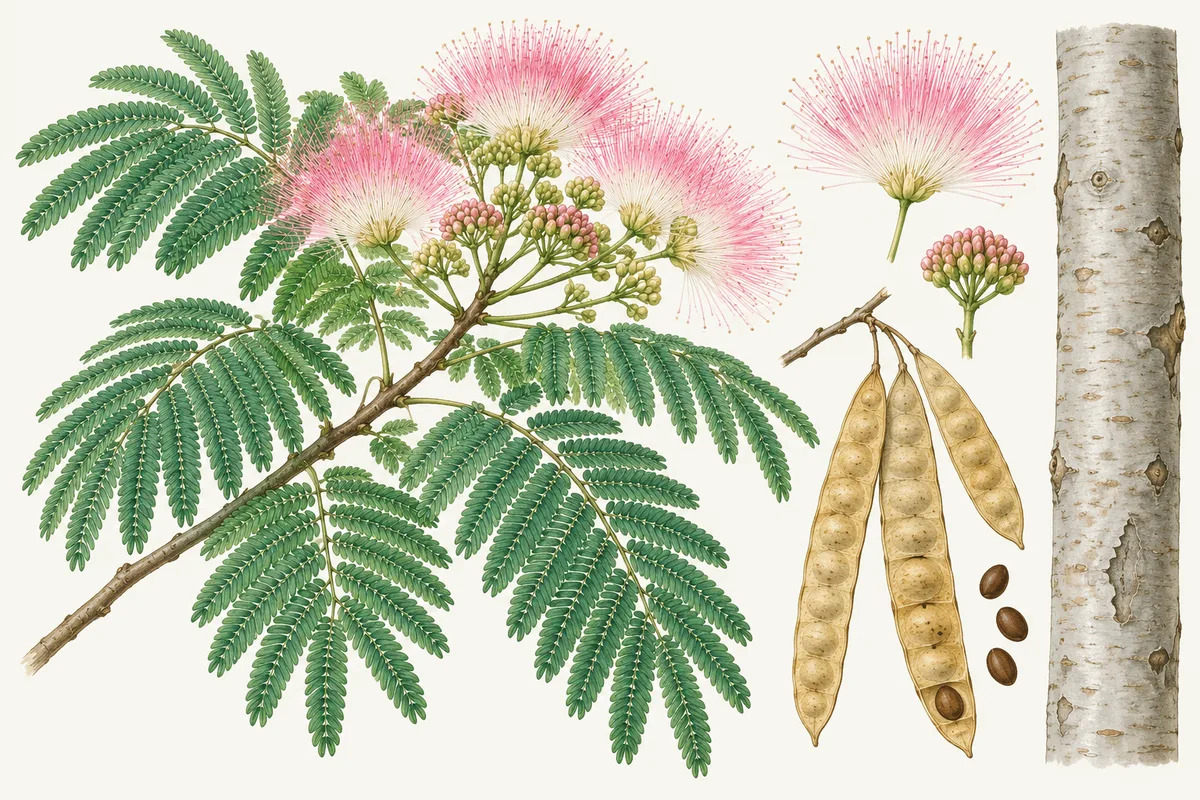
For mimosa tree identification, look for three things: feathery, twice-divided leaves 10 to 20 inches long made of leaflets only about 3/8 inch long; fragrant pink powder-puff flowers from May to July; and flat, straw-colored pods about 6 inches long that stay on the tree into winter. The mimosa, or silk tree (Albizia julibrissin), is a low, spreading Asian tree 20 to 40 feet tall.
- Leaflets about 3/8 inch long on a doubly divided leaf, folding up at night and in rain, are the mimosa leaf signature.
- Honey locust has bigger leaflets (1/2 to 1 1/2 inches), branched thorns on wild trees and twisted red-brown pods; mimosa has no thorns.
- Florida (UF/IFAS) and the North Carolina Invasive Plant Council rate mimosa invasive; check your own state's list.
Field marks at a glance
- Scientific name
- Albizia julibrissin
- Family
- Fabaceae (pea or legume family)
- Type
- Broadleaf, deciduous
- Leaves
- Alternate and bipinnately compound (twice divided), feathery and fern-like. NC State gives leaf stalks 10 to 20 inches long, with 4 to 6 pairs of side branches (pinnae) on young trees and up to 20 to 30 pairs on mature ones.
- Leaflets
- Tiny and numerous: 10 to 20 per pinna in NC State's count (UF/IFAS counts 13 to 30 pairs), each about 3/8 inch (6 to 25 mm) long, smooth-edged and hairless. They fold together at night and in rain.
- Flowers
- Fragrant pink powder puffs 1 to 3 inches across, each a head of 15 to 25 flowers with long silky threads, pink at the tips and white at the base. May to July, at the base of the current year's twigs.
- Pods
- Flat, thin, straw-colored to light brown legumes 3 to 8 inches long (about 6 inches typical) and about 1 inch wide, holding 5 to 16 seeds. They ripen in late summer and hang on into winter.
- Bark and twigs
- Bark thin, light brown to gray and nearly smooth, marked with lens-shaped lenticels. Young stems are bright green, later light brown. No thorns or spines anywhere.
- Form
- Low-branching, open, umbrella-like crown, often with several trunks; 20 to 40 ft (6 to 12 m) tall and as wide or wider.
- Season
- Leaves come out late in spring and usually drop green, without fall color, after the first frost. In winter, the hanging pods and the flat-topped, spreading shape are the clues.
- Range
- Native to Asia from Iran to Japan; introduced to the US as an ornamental in the 1700s. Naturalized from New York and Massachusetts south through the Southeast and west to California, per the USDA Forest Service (2010).
The mimosa, or silk tree, is the small, flat-topped tree that fills Southern yards and roadsides with pink powder puffs in early summer. Its botanical name is Albizia julibrissin; it is a legume from Asia, not a true Mimosa. Three checks confirm it in any season: the feathery leaf with tiny leaflets, the pink flowers in summer, and the flat pods in fall and winter.
How to identify a mimosa tree in three checks
1. The feathery, twice-divided leaf. A mimosa leaf is a long central stalk carrying many pairs of side branches, each lined with tiny leaflets, which gives the fern-like look. The NC State Extension profile describes leaf stalks 10 to 20 inches long with up to 20 to 30 pairs of side branches on mature trees, each branch 2 to 4 inches long and carrying 10 to 20 leaflets about 3/8 inch long. Leaflets that small are the fastest way to rule out honey locust. The leaflets fold together at night and in rain, so a tree that looks half-closed at dusk is a good sign.
2. The pink powder puffs. From May to July the tree carries fragrant, rounded flower heads 1 to 3 inches across, made of 15 to 25 silky threads. The North Carolina Forest Service invasive species leaflet (March 2010) describes pink, feathery tufts with white bases. No other common US tree combines pink puffs with fern-like leaves.
3. The flat pods. After bloom come flat, thin pods. The same leaflet gives straw-colored pods about 6 inches long that ripen in August and September and stay on the tree into winter; NC State gives 4 to 8 inches long, about 1 inch wide, with 5 to 10 seeds. Never eat a berry, nut, seed or pod on the strength of a web page or an app; check with a local expert.
The tree's shape helps from a distance. The North Carolina Forest Service describes a fast-growing tree with a low-branching, open, spreading form, 20 to 40 feet tall, on one or several trunks, with thin, light, nearly smooth bark marked by lens-shaped lenticels.
Tree Identifier can name a mimosa from one photo of a leaf, a flower head or a pod, and mimosa (Albizia julibrissin) is in the app's Collection, its 138-species catalog that fills in as you identify. The app gives no confidence score and no look-alike list, so check the leaflet size yourself before you accept the name.
Mimosa vs honey locust, tree of heaven and jacaranda
Several trees with divided leaves get mistaken for mimosa, and Virginia Tech's honeylocust fact sheet lists mimosa as a honey locust look-alike.
| Tree | Leaf | Leaflet length | Flowers | Fruit | Thorns |
|---|---|---|---|---|---|
| Mimosa | Twice divided | About 3/8 in | Pink puffs, May–July | Flat, straw-colored pod, about 6 in | None |
| Honey locust | Once or twice divided | 1/2–1 1/2 in | Small, greenish | Red-brown, leathery, twisted pod, 6–8 in | Branched (wild trees) |
| Tree of heaven | Once divided, 1–3 ft | 2–6 in | Small, yellow-green clusters | Twisted winged seeds | None |
| Jacaranda | Twice divided | About 1/4 in | Lavender to violet trumpets | Round, disk-like capsule, about 3 in | None |
- Honey locust is the closest match in leaf, and thornless cultivars remove its best mark. Compare leaflet size, then the pods. Our black and honey locust page covers both locusts.
- Tree of heaven has much bigger leaflets, each with glandular teeth near the base, and twisted winged seeds, per Virginia Tech's tree of heaven fact sheet; see our tree of heaven page.
- Jacaranda shares the fern-like leaf, with secondary leaflets about 1/4 inch, but the UF/IFAS jacaranda fact sheet describes lavender to violet trumpet flowers and rates the tree hardy only in USDA zones 9B to 11.
- Woman's tongue tree (Albizia lebbeck) is a relative found in south Florida. The UF/IFAS plant directory separates the two by leaflet pairs per pinna: 13 to 30 in mimosa, 4 to 8 in woman's tongue. It also notes mimosa is uncommon south of Lake Okeechobee.
Where mimosa grows, and where it is listed invasive
Mimosa is native to Asia from Iran to Japan and was brought to the United States as an ornamental in the 18th century; the North Carolina Forest Service traces it to 1745. The USDA Forest Service's Fire Effects Information System review (Meyer, 2010) records it as far north as New York and Massachusetts, in the southern Midwest, across the south-central and southeastern states except tropical Florida, and in New Mexico, Arizona, Utah and California.
Invasive status is set state by state:
- Florida: the UF/IFAS assessment rates it invasive in the north, central and south zones (page updated May 2026), and the UF/IFAS plant directory lists it as a Florida Invasive Species Council Category I species.
- North Carolina: NC State Extension calls it an invasive species in the state, listed by the NC Invasive Plant Council.
- Elsewhere: the USDA Forest Service review (2010) says Tennessee and Georgia also classify it as a weed that spreads easily into native communities, that managers in Alabama, Arkansas and Kentucky consider it a problem weed, and that the Forest Service's Southern Region prohibits planting it on National Forest lands.
The reasons it spreads are visible in the field. The North Carolina Forest Service notes that animals and water carry the seeds, whose hard coats keep them viable for years, and that the tree forms colonies from root sprouts. It favors roadsides, vacant lots and stream banks, and is rarely seen above 3,000 feet in the North Carolina mountains because it is not cold-hardy there.
Mimosa through the year
- Late spring: leaves come out late, after most trees.
- May to July: pink puffs at the base of the new shoots; the scent carries.
- August to November: green pods turn straw-colored and the seeds ripen; NC State gives seed drop from September to November.
- Winter: leaves drop green after the first frost with no fall color. The flat-topped, spreading crown hung with pale pods is the winter clue.
Mimosa is often short-lived. The USDA Forest Service review describes mimosa wilt, a soil-borne Fusarium fungus that causes wilting and death; trees often decline within 10 to 20 years in Georgia studies, and a dead tree may leave a mass of root sprouts behind. A thicket of feathery sprouts around a dead stump on a roadside is often what is left of a mimosa.
For other summer bloomers, see trees with pink flowers; for the pods, see trees with long seed pods. If you want to find a particular mimosa again next June, Tree Identifier's Tree Map keeps each identification you save with its location.
Look-alikes and how to tell them apart
Honey locust (Gleditsia triacanthos)
Honey locust leaflets are 1/2 to 1 1/2 inches long, two to four times a mimosa's, and wild trees carry large branched thorns. Its pods are red-brown, leathery and twisted, 6 to 8 inches long, and its flowers are small and greenish, never pink puffs.
Tree of heaven (Ailanthus altissima)
Tree of heaven leaves are divided only once, into 11 to 41 leaflets 2 to 6 inches long, each with large glandular teeth near its base. A broken twig gives off a strong odor, and the fruit is a twisted winged seed, not a pod.
Jacaranda (Jacaranda mimosifolia)
Jacaranda also has fern-like, twice-divided leaves, but its flowers are lavender-blue trumpets, not pink puffs, and its fruit is a round, disk-like brown capsule about 3 inches across. UF/IFAS rates it hardy only in USDA zones 9B to 11.
Woman's tongue tree (Albizia lebbeck)
A close relative found in south Florida. UF/IFAS separates them by counting leaflet pairs on one side branch of the leaf: 4 to 8 in woman's tongue, 13 to 30 in mimosa. Mimosa is uncommon south of Lake Okeechobee.
What a photo can't settle
- A thornless, podless honey locust cultivar and a mimosa out of flower can look alike in a distant photo; photograph a single leaf close enough to see the leaflet size.
- White-flowered mimosa cultivars and the rarer Albizia species of south Florida exist; leaflet counts per pinna, not a photo of the crown, separate them.
- Whether a mimosa is legally restricted where you live depends on your state's list, which an identification app does not check.
Questions people ask
Is a mimosa tree the same as a silk tree?
Yes. Mimosa, silk tree, Persian silk tree and pink silk tree are all names for Albizia julibrissin. It belongs to the genus Albizia, not Mimosa, so it is a different plant from the sensitive plant, Mimosa pudica, although NC State notes that silk tree leaflets also react to touch.
Is the mimosa tree invasive?
In much of the Southeast, yes. UF/IFAS rates it invasive in north, central and south Florida, and NC State Extension says the NC Invasive Plant Council lists it as invasive in North Carolina. The USDA Forest Service (2010) notes Tennessee and Georgia list it too. Status differs by state, so check your own state's invasive plant list.
Are mimosa tree pods poisonous?
NC State Extension states that the seeds contain a neurotoxin that can be toxic to livestock and dogs. Never eat a berry, nut, seed or pod on the strength of a web page or an app, and ask a vet or poison center if a pet has chewed pods.
Why do mimosa leaves close at night?
Mimosa leaflets fold together at night and during rain, and NC State notes they are also sensitive to touch. The movement is normal and is a useful field check: a feathery tree whose leaflets are folded shut on a cloudy evening is very likely a mimosa.
How do you tell a mimosa from a honey locust?
Look at the leaflets and the trunk. Mimosa leaflets are about 3/8 inch long and the tree has no thorns; honey locust leaflets are 1/2 to 1 1/2 inches and wild trees carry branched thorns. Mimosa pods are thin and straw-colored; honey locust pods are red-brown, leathery and twisted.
Sources
- Albizia julibrissin (Mimosa, Persian Silk Tree) — NC State Extension Gardener Plant Toolbox
- Albizia julibrissin (Mimosa), Invasive Species Leaflet No. 13 — North Carolina Forest Service, March 2010
- Albizia julibrissin, silktree (Fire Effects Information System) — USDA Forest Service (R. Meyer, 2010)
- Albizia julibrissin, UF/IFAS Assessment of Non-Native Plants in Florida's Natural Areas — UF/IFAS, University of Florida
- Albizia julibrissin (Mimosa tree) — UF/IFAS Center for Aquatic and Invasive Plants, Plant Directory
- Honeylocust fact sheet — Virginia Tech Dendrology
- Tree-of-heaven fact sheet — Virginia Tech Dendrology
- Jacaranda mimosifolia: Jacaranda (ENH-488/ST317) — UF/IFAS Extension, University of Florida
Keep reading
- Clue guideWhich tree has pink flowers? Spring and summer are two different lists
- Clue guideWhich tree has long seed pods? Sort it by leaf, pod and region
- Tree profileLocust trees: how to identify black locust and honey locust
- Invasive tree profileTree of heaven (Ailanthus altissima): how to identify it
- Clue guideWhich tree has fern-like leaves? Count the divisions first