Clue guide
Which tree has fern-like leaves? Count the divisions first
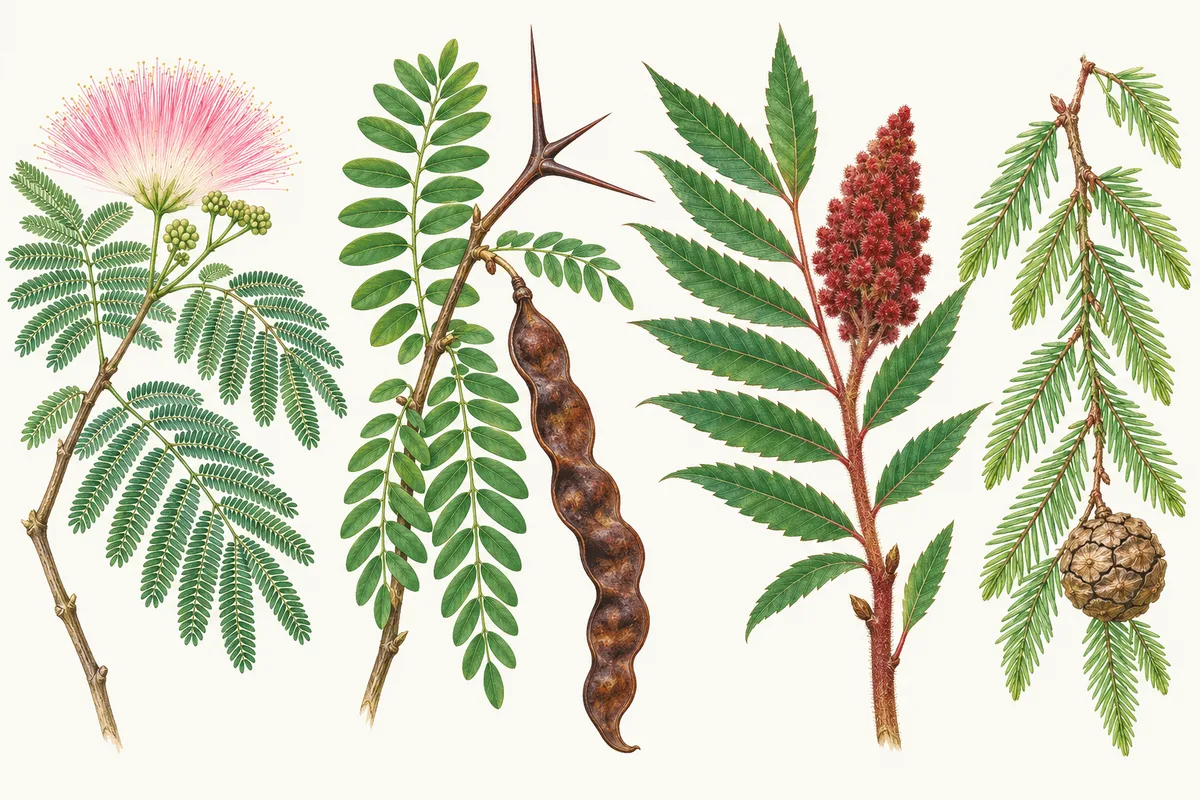
Most trees with fern-like leaves are legumes with twice-divided leaves, a few are once-divided, and two are conifers with soft needles. One look at a single leaf tells you which group you have.
In short
A tree with fern-like leaves is most often a honey locust (shiny leaflets under 1.5 inches, branched thorns or thornless), a mimosa (pink powder-puff flowers, leaflets about 3/8 inch that fold at night) or, in the South and California, a jacaranda. In the Midwest, also check Kentucky coffeetree and staghorn sumac. Soft needles in two flat rows mean bald cypress.
- Pull off one whole leaf: if its side stalks carry their own rows of leaflets, it is twice-divided (honey locust, mimosa, coffeetree, jacaranda, royal poinciana).
- Fern-like leaves in Michigan, Ohio, Minnesota or Ontario are usually honey locust, Kentucky coffeetree or staghorn sumac; in Florida and Texas, mimosa, jacaranda or royal poinciana.
- A 'fern' that turns orange-brown and drops its whole twigs in fall is a bald cypress, a deciduous conifer.
A tree with fern-like leaves is easiest to name from one whole leaf held in your hand. Pull one off and count how many times it divides, then check the leaflet size, the flowers or pods, and your region. Never eat a berry, nut, seed or pod on the strength of a web page or an app; check with a local expert. Several trees below carry pods, and at least one is listed as poisonous.
The fern-like leaf test: once-divided, twice-divided or needles
"Fern-like" covers three different leaf types, and each points to a short list.
- Twice-divided (bipinnate). The main leaf stalk carries side stalks, and each side stalk carries its own rows of small leaflets. This is the classic fern look. Candidates: honey locust (partly), mimosa, Kentucky coffeetree, jacaranda, royal poinciana.
- Once-divided (pinnate) with many leaflets. A single stalk with a long row of leaflets on each side. Candidates: staghorn sumac, tree of heaven, and many honey locust leaves.
- Soft, flat needles in two rows. A conifer that looks like a fern frond. Candidates: bald cypress and its look-alike, dawn redwood.
| Tree | Leaf type | Leaflet size | The feature that settles it | Region |
|---|---|---|---|---|
| Honey locust (Gleditsia triacanthos) | Once- or twice-divided, 5–8 in | About 1–1.5 in, 15–30 per leaf | Three-forked thorns, or a thornless street tree; twisted pods 12–18 in | Central and eastern US, Ontario |
| Mimosa (Albizia julibrissin) | Twice-divided, stalk 10–20 in | About 3/8 in | Pink powder-puff flowers, May–July; leaflets fold at night | South and East, planted |
| Kentucky coffeetree (Gymnocladus dioicus) | Twice-divided, up to 3 ft long | 1–3 in | Huge leaves, thick pods up to 10 in on female trees | Central and eastern US, Ontario |
| Jacaranda (Jacaranda mimosifolia) | Twice-divided, 9–18 in | About 1/4 in | Lavender-blue flowers, mostly May | Zones 9B–11 (Florida, Texas, California) |
| Royal poinciana (Delonix regia) | Twice-divided, 8–20 in | About 1/2 in | Red or orange flowers, May–July; pods 1–2 ft | South Florida, zones 10B–11 |
| Staghorn sumac (Rhus typhina) | Once-divided, 16–24 in | 2–5 in, 11–31 per leaf, toothed | Velvety red-brown twigs; upright red fruit clusters | Eastern North America, Quebec to Georgia |
| Tree of heaven (Ailanthus altissima) | Once-divided, 18–24 in | 10–41 per leaf | A few teeth near the leaflet base only; foul smell when crushed | Invasive across much of the US |
| Bald cypress (Taxodium distichum) | Flat needles 1/4–3/4 in | n/a | Needles in two rows, alternate; orange-brown in fall, then bare | Southeast, planted north |
Leaf, flower and range data come from the NC State Extension Gardener Plant Toolbox, except jacaranda and royal poinciana, which come from UF/IFAS. Measurements are as those sources give them, read on 21 October 2026.
Midwest and Northeast: honey locust, Kentucky coffeetree, staghorn sumac
Most "fern-like leaves" searches from Michigan, Ohio, Minnesota, Illinois, Pennsylvania and Ontario end at one of these three.
Honey locust is the fern-like tree of Midwestern streets and parking lots. The NC State profile describes alternate leaves 5 to 8 inches long with 15 to 30 oval leaflets about 1 to 1.5 inches each; some leaves are twice-divided with 4 to 7 pairs of side stalks. The small leaflets give the crown its light, lacy shade, and they turn yellow in fall. Wild trees carry stout, three-forked spines 2 to 3 inches long, while thornless selections such as 'Skyline' and 'Sunburst' are the ones usually planted. Reddish-brown, twisted pods 12 to 18 inches long hang on into winter. Honey locust is native to central and eastern North America and is found in Ontario. The locust page separates it from black locust, whose leaflets are fewer and rounder.
Kentucky coffeetree looks like a honey locust drawn at twice the scale. NC State's coffeetree profile gives twice-divided leaves about 3 feet long and 2 feet wide, with 5 to 9 pairs of side stalks and leaflets 1 to 3 inches long. New leaves come out pinkish-bronze in late spring, so the tree is one of the last to leaf out. Only female trees bear the flat, thick, reddish-brown pods, up to 10 inches long. NC State lists the leaves, seeds and pod pulp as poisonous, and warns that the pulp can be mistaken for honey locust's.
Staghorn sumac is a large shrub or small tree that forms colonies along roadsides and woodland edges. The NC State profile describes once-divided leaves 16 to 24 inches long with 11 to 31 toothed, lance-shaped leaflets 2 to 5 inches long, and young twigs covered in reddish-brown hairs, like a deer's antlers in velvet. Female plants carry upright clusters of hairy, bright red fruit. It grows from Quebec, Ontario and Minnesota south to Georgia. The cut-leaf cultivars sold as 'Laciniata' and 'Tiger Eyes' have the most fern-like leaves of all.
The South, Florida and California: mimosa, jacaranda, royal poinciana
Here the fern-like trees usually have showy flowers, and the flower color is the shortcut.
Mimosa (silk tree), pink. The NC State profile describes leaf stalks 10 to 20 inches long lined with pairs of side stalks, 4 to 6 pairs on young trees and 20 to 30 on mature ones, each carrying 10 to 20 leaflets about 3/8 inch long. The leaves fold down at night and in rain, and the leaflets close when touched. The leaves drop after the first frost without changing color. Mimosa is native to Asia and is listed as invasive by the NC Invasive Plant Council, as NC State notes. The mimosa page covers it in full.
Jacaranda, lavender-blue. UF/IFAS gives twice-divided leaves 9 to 18 inches long, with primary leaflets about 5 inches long and around 20 secondary leaflets about 1/4 inch each. It flowers from April to August, mostly in May, and leaves round, flat, hard brown capsules about 3 inches across. UF/IFAS does not consider it a problem species in Florida and gives USDA zones 9B to 11.
Royal poinciana, red or orange. The UF/IFAS fact sheet describes leaves 8 to 20 inches long with 10 to 20 pairs of primary leaflets, each with 25 to 35 pairs of secondary leaflets about 1/2 inch long: the finest-cut leaf on this page. Flowers cover the crown from May to July, followed by dark brown pods 1 to 2 feet long. It grows outdoors only in zones 10B to 11, so in the US it is a south Florida, Hawaii and Puerto Rico tree.
Long leaves that smell: tree of heaven, the sumac look-alike
A fast-growing tree with very long once-divided leaves, on a vacant lot or a highway verge, may be tree of heaven. The NC State profile gives leaves 18 to 24 inches long with 10 to 41 leaflets. The test: each leaflet is smooth-edged except for a notch or a few teeth near its base, and a crushed leaf smells foul, some say like peanut butter. Staghorn sumac's leaflets are toothed all along the edge and its twigs are velvety. NC State calls tree of heaven a non-native invasive tree, reported invasive in 30 states and Hawaii, and a host for the spotted lanternfly. The tree of heaven page has the full leaflet-gland test and the walnut and ash look-alikes.
Soft needles that look like a fern: bald cypress
If the "fern" is a tall conifer by a pond or in a parking lot island, it is probably a bald cypress. The NC State profile describes flat, linear needles 1/4 to 3/4 inch long in two rows along each branchlet, giving a soft, feathery look. Unlike most conifers it is deciduous: the needles turn orange to cinnamon-brown and the whole branchlets drop in fall, leaving the tree bare in winter. Knobby "knees" rise from the roots when it grows in or near water, and round, wrinkled cones 3/4 to 1 inch across show in October. It is native from Delaware to Florida and west to Texas, and planted much farther north. Dawn redwood, a Chinese conifer planted in parks, looks almost the same; the bald cypress page sets the two side by side.
Not a true fern-like leaf: cut-leaf Japanese maple
Laceleaf Japanese maples have simple leaves, not compound ones, but the lobes are cut so finely that the leaf reads as a fern frond. Check the twig: Japanese maple leaves grow in opposite pairs, and each leaf, however lacy, joins the twig with one stalk. A compound leaf of a honey locust or mimosa has a long central stalk with many separate leaflets.
Using a photo
A single leaf laid flat on a pale background, with a flower or pod beside it if there is one, is the photo that helps most. Tree Identifier names a tree from one photo, and honey locust, mimosa, jacaranda, royal poinciana, bald cypress, dawn redwood and Japanese maple are among the species in its Collection. It shows no confidence score or list of alternatives, so check the answer against the leaflet sizes in the table. The follow-up chat under each result can answer questions such as how a honey locust differs from a Kentucky coffeetree, and the Tree Map remembers where the tree stands so you can come back when it flowers.
What a photo can't settle
- Thornless honey locust cultivars and young Kentucky coffeetrees can look alike in a photo of a single leaf; the leaflet size and the pods settle it.
- Many legumes with twice-divided leaves are planted in warm climates; a photo of the leaves alone may name the group but not the exact species, so photograph the flowers or pods too.
- Kentucky coffeetree pods and seeds are reported poisonous by NC State. Never treat a name from a page or an app as permission to eat any part of a tree.
Questions people ask
What tree has fern-like leaves and thorns?
Honey locust in its wild form. NC State describes stout, rigid, three-forked spines 2 to 3 inches long on the trunk and branches. Most honey locusts planted on streets and in yards are thornless selections such as 'Skyline' and 'Sunburst', so a smooth trunk does not rule it out.
What tree has fern-like leaves and pink fuzzy flowers?
Mimosa, also called silk tree. NC State describes fragrant pink pom-pom clusters of 15 to 25 silky threads from May to July, above twice-divided leaves whose leaflets fold down at night and in rain. NC State notes it is listed as invasive by the NC Invasive Plant Council.
What tree has fern-like leaves and purple flowers?
A jacaranda, if you are in Florida, south Texas or southern California. UF/IFAS describes lavender to violet-purple flowers from April to August, mostly in May, over twice-divided leaves 9 to 18 inches long with secondary leaflets about 1/4 inch. It grows outdoors only in USDA zones 9B to 11.
What tree has fern-like leaves in Michigan or Ohio?
Usually honey locust, the most planted tree with fine, feathery leaves in Midwestern towns. Kentucky coffeetree has much larger leaves, up to 3 feet long, with leaflets 1 to 3 inches. A small tree with fuzzy twigs and long, toothed leaflets in roadside thickets is staghorn sumac.
Is there an evergreen tree with fern-like leaves?
Few in cold climates. Royal poinciana in south Florida is listed by UF/IFAS as semi-evergreen as well as deciduous, depending on conditions. Bald cypress looks evergreen in summer but drops its needles every fall, and jacaranda is listed as deciduous.
Sources
- Gleditsia triacanthos (honey locust) — North Carolina Extension Gardener Plant Toolbox, NC State University
- Albizia julibrissin (mimosa, silk tree) — North Carolina Extension Gardener Plant Toolbox, NC State University
- Gymnocladus dioicus (Kentucky coffeetree) — North Carolina Extension Gardener Plant Toolbox, NC State University
- Rhus typhina (staghorn sumac) — North Carolina Extension Gardener Plant Toolbox, NC State University
- Ailanthus altissima (tree of heaven) — North Carolina Extension Gardener Plant Toolbox, NC State University
- Taxodium distichum (bald cypress) — North Carolina Extension Gardener Plant Toolbox, NC State University
- Jacaranda mimosifolia: Jacaranda (ENH-488/ST317) — UF/IFAS Extension, University of Florida
- Delonix regia: Royal Poinciana (ENH-391/ST228) — UF/IFAS Extension, University of Florida
Keep reading
- Clue guideWhich tree has long seed pods? Sort it by leaf, pod and region
- Tree profileLocust trees: how to identify black locust and honey locust
- Invasive tree profileTree of heaven (Ailanthus altissima): how to identify it
- Clue guideWhich tree has pink flowers? Spring and summer are two different lists
- Field guideHow to identify trees by their leaves