Tree profile
Bald cypress (Taxodium distichum): how to identify it
A conifer that drops its needles every fall, grows knees out of the water and swells at the base. Here is the order to check its marks, and how to tell it from dawn redwood.
In short
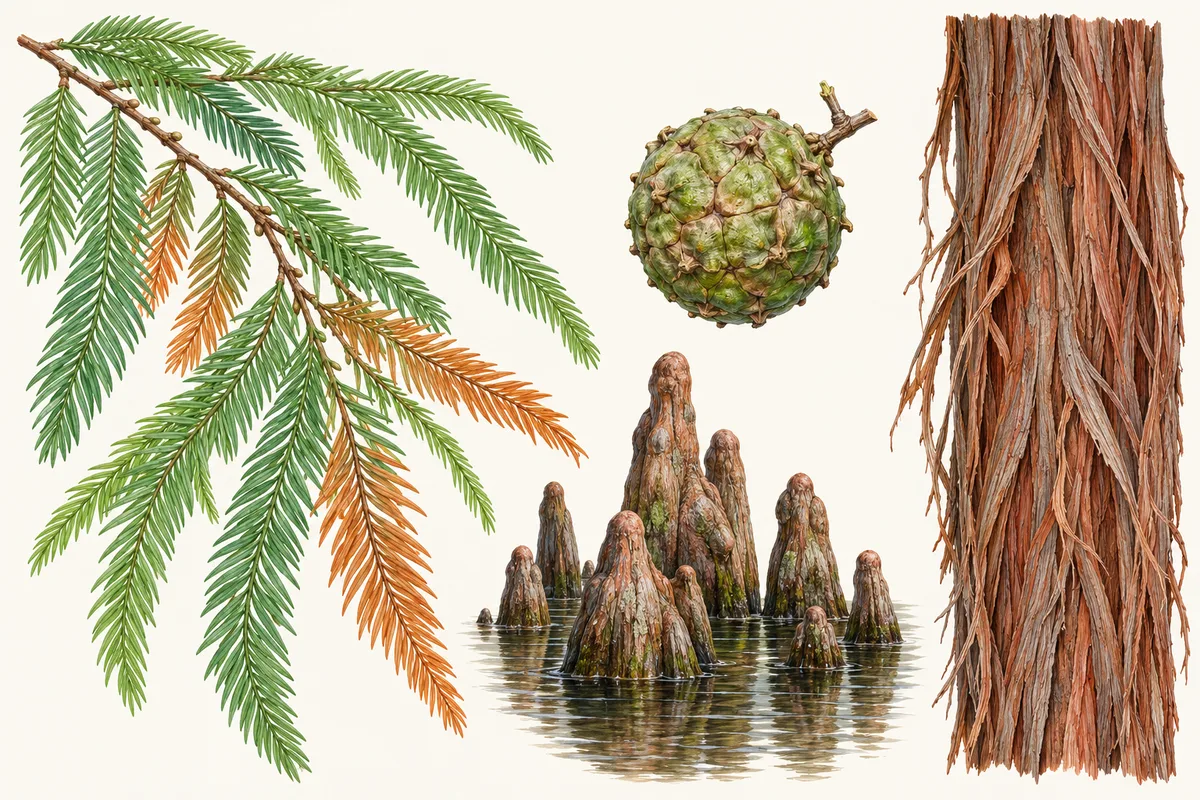
A bald cypress tree is a deciduous conifer: its flat, soft needles, 1/4 to 3/4 inch long, alternate along the twig in two flat rows, turn orange to cinnamon-brown in fall and drop with the small branchlets. Confirm with round cones about 1 inch across, a flared, fluted trunk base and, near water, knobby knees rising from the roots. Dawn redwood is the look-alike: its needles are opposite.
- A conifer that goes bare in winter is a bald cypress, a dawn redwood or a larch; look at how the needles are arranged to tell which.
- Alternate needles mean bald cypress; needles in opposite pairs mean dawn redwood.
- Knees are not a sure sign: they form mostly on flooded sites and may be missing on yard trees.
Field marks at a glance
- Scientific name
- Taxodium distichum
- Family
- Cupressaceae (cypress family)
- Type
- Conifer, deciduous
- Needles
- Flat, soft, linear, 1/4 to 3/4 inch (6 to 19 mm) long, alternate, spirally attached but spread in two flat rows along each branchlet. Yellowish green in spring, sage green in summer.
- Fall
- Needles turn orange to cinnamon-brown, then the small branchlets fall with the needles still attached. The tree stands bare all winter.
- Cones
- Round, 1/2 to about 1 3/8 inch (13 to 36 mm) across, on short stalks, with 9 to 15 four-sided scales; green, turning brownish purple as they ripen from October to December.
- Pollen catkins
- Drooping clusters of tiny male cones, 3 to 5 inches long, shedding pollen in March and April.
- Bark and trunk
- Reddish-brown, peeling in long narrow strips on younger trees. The base flares and is often fluted with sharp ridges; trunks reach 3 to 6 ft across.
- Knees
- Knobby, cone-shaped growths rising from the roots, from a few centimeters to more than 12 ft tall; mostly on flooded sites.
- Form and size
- Pyramidal when young, flat-topped and irregular with age. 50 to 70 ft in landscapes (NC State); the largest virgin-forest trees were 140 to 150 ft.
- Native range
- Atlantic Coastal Plain from southern Delaware to southern Florida, Gulf coast to southeastern Texas, and up the Mississippi Valley to southern Illinois and southwestern Indiana.
- Habitat
- Swamps, bayous, river edges and floodplains, often in standing water; tolerates long flooding, and planted trees grow in ordinary moist, well-drained soil.
Bald cypress (Taxodium distichum) is the tree of southern swamps and bayous, and it is also planted in parks and yards well outside them. It is a conifer that loses its needles every fall, which is where the "bald" comes from. Three marks identify it: the way the needles are arranged, the fall color and needle drop, and the swollen trunk base and knees. Dawn redwood, planted in the same parks, is the tree to rule out.
What to check first: needles, then the base, then the cones
1. The needles. Hold a green branchlet up to the light. Bald cypress needles are flat, soft and narrow, 1/4 to 3/4 inch long, and alternate along the twig, spirally attached but spread into two flat rows so the spray looks like a feather, according to the NC State Extension Plant Toolbox. They are yellowish green in spring and sage green in summer. If you see a pair of needles directly across from each other all along the twig, you are looking at dawn redwood instead.
2. The trunk base and knees. Older trees develop a wide, flared base that narrows up the trunk, often fluted with ridges. Near water, look for knees: knobby, cone-shaped growths that rise from the roots. The USDA Forest Service's Silvics of North America records knees from a few centimeters to more than 12 feet tall, depending on the average water level.
3. The cones. In late summer and fall look for round cones, 1/2 to about 1 3/8 inches across, on short stalks. The Forest Service describes 9 to 15 four-sided scales, turning from green to brownish purple as the cones ripen from October to December; each cone holds 16 seeds on average.
If the needles are out of reach, a photo of a fallen branchlet, a cone or the base of the trunk is enough for Tree Identifier to suggest a name. Bald cypress and dawn redwood are both in the app's Collection. The app shows no confidence score and no list of look-alikes, so check the needle arrangement yourself before trusting the answer.
Why a bald cypress goes brown and bare in fall
Most conifers stay green all year, so a bald cypress turning orange in October can look like a dying pine. It is not. Bald cypress is a deciduous conifer: NC State gives its fall color as orange to cinnamon-brown, and the small side branchlets drop soon after with the needles still attached. On the ground under the tree you will find whole feathery sprays rather than single needles, which is a good winter clue.
Only a few conifers do this in North America. The other two you are likely to meet are dawn redwood, a planted tree from China, and the larches, such as tamarack, which carry most of their needles in tufts on short spur shoots instead of in flat sprays. The conifer identification guide covers the evergreen conifers that keep their needles.
In March and April, bald cypress sheds pollen from drooping clusters of tiny male cones 3 to 5 inches long (USDA Forest Service). Those tassels hanging from the twigs are another sign that the tree is alive and a bald cypress.
Bald cypress vs dawn redwood
The two trees are relatives, both deciduous conifers in the cypress family, both planted in wet spots of parks and campuses, and NC State lists each as a tree the other is often confused with. These marks, from NC State's pages on bald cypress and dawn redwood and The Morton Arboretum, tell them apart:
| Feature | Bald cypress | Dawn redwood |
|---|---|---|
| Needle arrangement | Alternate, in two flat rows | Opposite pairs, crowded on short shoots |
| Needle length | 1/4–3/4 in | Under 1 in |
| Fall color | Orange to cinnamon-brown | Russet |
| Seed cones | Round, about 1 in, on short stalks | Barrel-shaped, up to 1 in long, hanging on stalks up to 1 1/2 in |
| Bark | Reddish-brown, peeling in narrow strips on younger trees | Reddish-brown, peeling in long strips; deeply fissured on old trees |
| Base | Flared and fluted; knees near water | Buttressed, widening and fluted with age |
| Origin | Native to the southeastern US | Native to China; found alive in 1941, in US gardens since the late 1940s |
The needle test is the one to trust. The Morton Arboretum gives dawn redwood a mature height of 70 to 100 feet and USDA hardiness zones 4 to 8. For how dawn redwood relates to the two giant redwoods of California, see redwood vs sequoia.
Bald cypress vs pondcypress
Pondcypress grows with bald cypress on the southeastern coastal plain. The Forest Service treats it as a variety of the same species (var. nutans) that grows in shallow ponds and wet areas and reaches west only to southeastern Louisiana. Its typical needles are nearly scale-like and pressed against branchlets that point upward, unlike the flat, spreading sprays of bald cypress. The Forest Service adds three more clues: pondcypress is less likely to have knees and its knees are shorter and more rounded, the ridges on its fluted base are rounded rather than sharp, and its bark is usually more coarsely ridged. It also warns that the two are often hard, and sometimes impossible, to tell apart, because fast-growing pondcypress shoots carry two-ranked needles like bald cypress.
Cypress knees and where bald cypress grows
Knees. The Forest Service says knees are less likely to form when the tree is not flooded, though small knees appear on some unflooded trees, and that "research has found no physiological function for cypress knees"; they may aid aeration but are not critical for survival. NC State repeats the common idea that they help bring oxygen to roots in oxygen-poor mud. Either way, a lawn tree with no knees can still be a bald cypress.
Range. Bald cypress grows wild along the lower Atlantic Coastal Plain from southern Delaware to southern Florida, along the Gulf coastal plain to southeastern Texas, and up the Mississippi Valley to southeastern Oklahoma, southeastern Missouri, southern Illinois and southwestern Indiana. More than 90 percent of natural stands sit on flat ground or in shallow depressions below 100 feet of elevation, often flooded, sometimes 10 feet deep or more. Isolated stands grow at 1,000 to 1,750 feet on the Edwards Plateau of Texas (USDA Forest Service). NC State notes that it tolerates a wide range of soils, so planted trees turn up on dry ground well outside that range.
Size and age. The largest virgin-forest trees were 140 to 150 feet tall and 7 to 12 feet across. Height growth stops at about 200 years. To find a tree again in a different season, for its fall color or its cones, Tree Identifier's Tree Map keeps a pin for every located identification.
Look-alikes and how to tell them apart
Dawn redwood (Metasequoia glyptostroboides)
Dawn redwood needles and side branchlets grow in opposite pairs; bald cypress needles alternate. Dawn redwood cones hang on stalks up to 1 1/2 inches long and are barrel-shaped; bald cypress cones are round on short stalks. Fall color is russet rather than orange.
Pondcypress (Taxodium distichum var. nutans)
Pondcypress needles are mostly short and scale-like, pressed against branchlets that point upward, while bald cypress needles spread flat in two rows. Its knees are fewer, shorter and rounder, and the ridges on its fluted base are rounded, not sharp.
Tamarack (Larix laricina)
Tamarack also drops its needles in fall, but most of them grow in tufts on short spur shoots, never alternate in flat two-ranked sprays. It is a tree of northern bogs, and its small cones are egg-shaped rather than round.
What a photo can't settle
- Pondcypress and bald cypress can be hard, and sometimes impossible, to tell apart, according to the USDA Forest Service, and fast-growing pondcypress shoots carry two-ranked needles like bald cypress.
- In winter, without needles, bald cypress and dawn redwood are best told apart by the arrangement of buds and branchlet scars (alternate or opposite), which a distant photo will not show.
- Knees depend on flooding, so their absence does not rule out bald cypress.
Questions people ask
Is a bald cypress an evergreen?
No. Bald cypress is a deciduous conifer: it bears cones like a pine but drops its needles every fall, after they turn orange to cinnamon-brown. The small side branchlets fall with the needles attached, and the tree stays bare until new needles open in spring.
How do you tell a bald cypress from a dawn redwood?
Look at a branchlet. Dawn redwood needles grow in opposite pairs, like the leaflets of a small fern; bald cypress needles alternate along the twig. Dawn redwood cones hang on long stalks and are barrel-shaped; bald cypress cones are round on short stalks. In fall dawn redwood turns russet, bald cypress orange to cinnamon-brown.
Why does a bald cypress have knees?
Nobody has settled it. NC State Extension says knees are believed to help bring oxygen to roots in oxygen-poor mud, but the USDA Forest Service says research has found no physiological function for them. They are less likely to form when the tree is not flooded, so many yard trees have none.
Where do bald cypress trees grow?
Wild, along the Atlantic Coastal Plain from southern Delaware to southern Florida, the Gulf coast to southeastern Texas, and up the Mississippi Valley to southern Illinois and southwestern Indiana, mostly in swamps and floodplains below 100 feet of elevation. Planted trees grow well beyond that range, on ordinary moist soil.
How old can a bald cypress get?
Very old. The USDA Forest Service reports that trees of 400 to 600 years were common in virgin stands, with a few near 1,200 years, but warns that those ring counts probably included false rings: in plantations of known age, ring counts averaged about 1.6 times the real age.
Sources
- Baldcypress (Taxodium distichum), Silvics of North America — USDA Forest Service
- Taxodium distichum — NC State Extension Gardener Plant Toolbox
- Metasequoia glyptostroboides — NC State Extension Gardener Plant Toolbox
- Dawn redwood — The Morton Arboretum
Keep reading
- Tree comparisonRedwood vs sequoia: coast redwood, giant sequoia and dawn redwood
- Tree profileTamarack (Larix laricina): how to identify it
- Field guideConifer identification: three questions about the needles, then the cone
- Winter field guideWinter tree identification, from buds to bark
- Field guideHow to identify trees, step by step