Tree comparison
Redwood vs sequoia: coast redwood, giant sequoia and dawn redwood
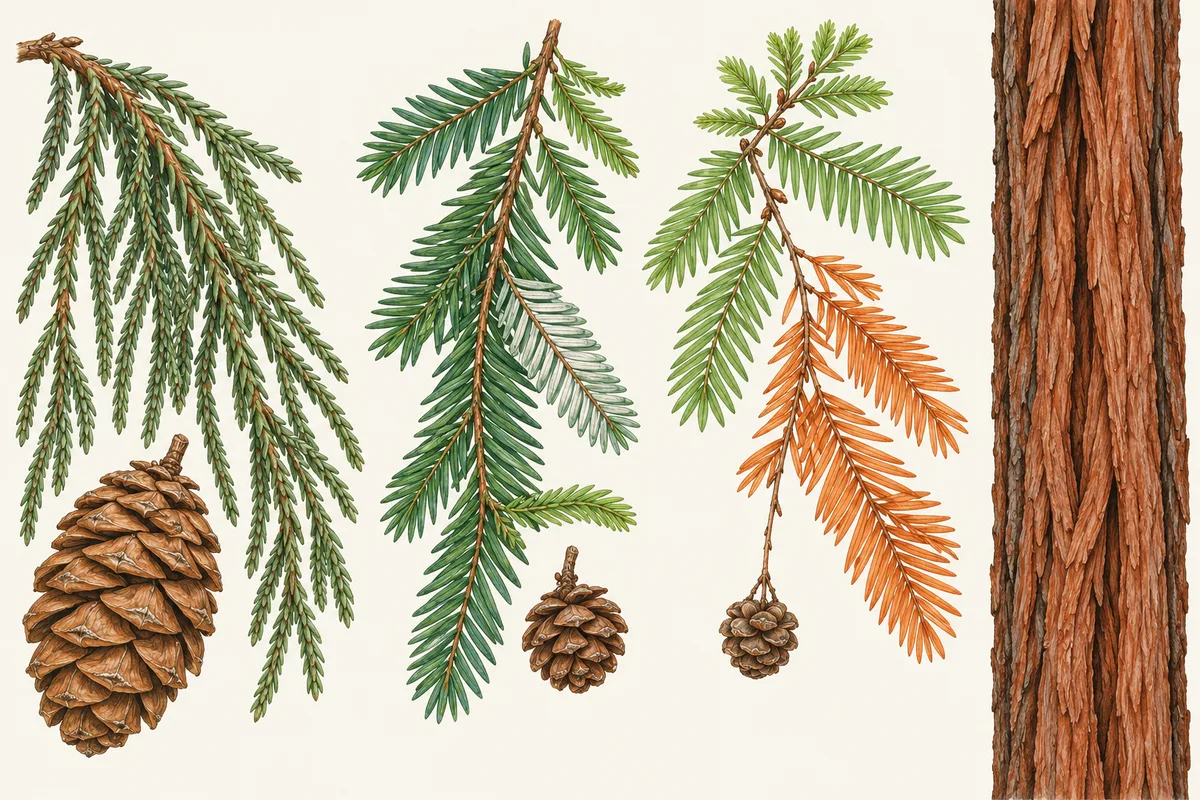
Flat two-ranked needles or short awl-shaped scales, a 1-inch cone or a 2- to 3-inch one, fog belt or Sierra Nevada. Then rule out the deciduous dawn redwood.
In short
Redwood vs sequoia: the coast redwood (Sequoia sempervirens) has flat needles 1/2 to 1 inch long in two rows with white bands beneath, cones about 1 inch long, and grows in California's coastal fog belt. The giant sequoia (Sequoiadendron giganteum) has short awl-shaped scales pointing up the twig, cones 2 to 3 1/2 inches long, and grows only in the Sierra Nevada.
- Flat needles in two rows with two white bands below: coast redwood. Short scale-like or awl-shaped leaves hugging the twig: giant sequoia.
- Coast redwood is the taller tree (367.8 ft measured by the Forest Service); giant sequoia is the bigger one by volume (General Sherman).
- A redwood-like tree that drops its needles in fall, with opposite leaves, is a dawn redwood from China.
Field marks at a glance
- Scientific name
- Sequoia sempervirens, Sequoiadendron giganteum and Metasequoia glyptostroboides
- Family
- Cupressaceae (cypress family)
- Type
- Conifer, evergreen
- Leaves
- Coast redwood: flat needles, 1/2 to 1 inch, in two rows, sharp tips, two white bands beneath. Giant sequoia: scale-like to awl-shaped, 1/8 to 1/2 inch, triangular in cross-section, pointing up the twig.
- Cones
- Coast redwood: 0.5 to 1.1 inches (13–29 mm). Giant sequoia: 2 to 3.5 inches (5–9 cm), oval, many staying green and closed for years.
- Bark
- Coast redwood: reddish brown, hard, furrowed, over 12 inches (30 cm) thick on old trees. Giant sequoia: reddish brown, spongy and fibrous, deeply furrowed.
- Native range
- Coast redwood: a coastal strip 5 to 35 miles wide from southwest Oregon to southern Monterey County, sea level to about 3,000 ft. Giant sequoia: about 75 groves on the west slope of the Sierra Nevada, mostly 4,590 to 7,050 ft.
- Height
- Coast redwood: trees over 200 ft are common; 367.8 ft (112.1 m) measured in 1964. Giant sequoia: mature trees average about 250 ft, tallest known 310 ft (94.5 m).
- Age
- Coast redwood: oldest found nearly 2,200 years. Giant sequoia: 3,200 years from a stump ring count.
- Sprouting
- Coast redwood sprouts from stumps and root crowns, often more than 100 sprouts per stump. Giant sequoia over about 20 years old normally does not.
- Dawn redwood
- Metasequoia glyptostroboides: soft, feathery needles in opposite pairs, shed every fall after turning copper to red-bronze; native to China.
People say "redwood" and "sequoia" for the same giant California trees, but there are three species behind the words: the coast redwood, the giant sequoia, and the dawn redwood from China. The first two grow wild in different parts of California and are easy to separate with a shoot and a cone in hand. The third is the one you are more likely to meet in a city park.
Redwood vs sequoia, side by side
Pick a shoot from a low branch or the ground, and a cone if you can find one. Leaf and cone sizes below come from NC State Extension's plant profiles of coast redwood and giant sequoia; range, height and age come from the USDA Forest Service's Silvics of North America.
| Feature | Coast redwood | Giant sequoia |
|---|---|---|
| Scientific name | Sequoia sempervirens | Sequoiadendron giganteum |
| Leaves | Flat needles, 1/2–1 in, in two rows | Scale-like to awl-shaped, 1/8–1/2 in, pointing up the twig |
| Leaf underside | Two white bands | No flat underside: triangular in cross-section |
| Cone | About 1 in (13–29 mm) | 2–3.5 in (5–9 cm), oval |
| Bark | Reddish brown, hard, furrowed | Reddish brown, spongy, fibrous, deeply furrowed |
| Wild range | Coastal fog belt, southwest Oregon to Monterey County | About 75 groves, west slope of the Sierra Nevada |
| Elevation | Sea level to about 3,000 ft (915 m) | Mostly 4,590–7,050 ft (1,400–2,150 m) |
| Tallest measured | 367.8 ft (112.1 m), Forest Service, 1964 | 310 ft (94.5 m) |
| Oldest known | Nearly 2,200 years | 3,200 years |
| Stump sprouts | Yes, often more than 100 per stump | Only young trees, up to about 20 years |
The needles settle it fastest. Run a coast redwood shoot between your fingers and it feels flat and comb-like, like a yew or hemlock, with sharp tips. A giant sequoia shoot feels like a rough cord: the tiny leaves overlap and press along the twig, closer to a juniper or cedar than to a yew.
Needles and cones up close
NC State describes coast redwood leaves as needle-like, flat, two-ranked, bright green above, with two white stomatal bands beneath, 0.5 to 1 inch long. Turn the shoot over: those two pale stripes on a flat needle are a coast redwood signature among the three.
Giant sequoia leaves are scale-like to awl-shaped, triangular in cross-section, 1/8 to 1/2 inch, and point upward along the shoot. There is no flat blade to turn over.
The cones differ by size. The Forest Service's redwood silvics gives 0.5 to 1.1 inches for coast redwood, about the size of a large olive. The giant sequoia silvics gives 2 to 3.5 inches, closer to a hen's egg, and adds that a mature tree may carry 10,000 to 30,000 cones, about two-thirds of them green and closed; cones may hold viable seed for 20 years or more. A green, closed, egg-sized cone on the ground under a big red-barked tree points to giant sequoia.
Size, age and where each grows wild
The two trees do not share a range. The Forest Service maps coast redwood along an irregular coastal strip 5 to 35 miles (8–56 km) wide, from two groves on the Chetco River in southwest Oregon to Salmon Creek Canyon in southern Monterey County, from sea level to about 3,000 ft. The National Park Service's Redwood National and State Parks adds that the trees can reach 2,000 years and regularly reach 600. Giant sequoia grows in about 75 groves along a 260-mile (420 km) belt of the Sierra Nevada's west slope, mostly between 4,590 and 7,050 ft, with the lowest natural trees at 2,720 ft and the highest at 8,860 ft.
So "which is bigger" has two answers. Coast redwood is taller: the Forest Service measured one at 367.8 ft (112.1 m) in 1964, and Save the Redwoods League gives 380 ft for the tallest known tree, Hyperion. Giant sequoia is heavier. The National Park Service lists the General Sherman Tree at 274.9 ft tall, 102.6 ft around at the ground, with an estimated 52,500 cubic feet of wood, the largest tree by volume in the world. The Forest Service gives the greatest known giant sequoia age as 3,200 years.
Regrowth differs too. A cut coast redwood stump is often ringed by more than 100 sprouts, and the Park Service notes that new trees grow from stumps and burls as clones. Giant sequoias normally sprout from stumps only up to about age 20, according to the Forest Service.
Dawn redwood, the redwood that drops its needles
Dawn redwood (Metasequoia glyptostroboides) is the third redwood and the one most often planted outside California. NC State Extension's dawn redwood profile calls it a deciduous conifer native to central and western China, known first from fossils and found alive in the 1940s. Its needles are soft and feathery, arranged in opposite pairs, and turn brownish copper to red-bronze before falling in autumn. Mature trunks broaden and flute at the base, and the cones, up to an inch long, hang on long stalks. It grows up to about 100 ft.
Its common confusion is not with the California giants but with bald cypress, another deciduous conifer. NC State gives bald cypress alternate leaves and round cones 3/4 to 1 inch across; dawn redwood's leaves are opposite. The bald cypress page covers knees and swamp habitat, and tamarack is the third conifer that goes bare in winter.
Identifying a planted redwood or sequoia
Outside California, location stops helping. Both California species are grown in parks, campuses and large gardens, so work from the shoot: flat two-rowed needles with white bands for coast redwood, cord-like awl leaves for giant sequoia, soft opposite needles that fall in winter for dawn redwood. The conifer identification guide explains how to read needles, scales and cones on other evergreens.
Tree Identifier can name a redwood from one photo of a shoot or a cone, and all three species are in the app's Collection. Use the follow-up chat to ask about the tree's range or age, and save the find to the Tree Map so you can come back to it in another season, when a dawn redwood will either be green or bare.
Look-alikes and how to tell them apart
Dawn redwood (Metasequoia glyptostroboides)
Check the needles in winter: dawn redwood is bare, coast redwood and giant sequoia stay green. In summer, its soft needles sit in opposite pairs along the twig, and its cones hang on long stalks.
Bald cypress (Taxodium distichum)
Also drops its needles in fall, but they are alternate, not opposite, and its cones are round, 3/4 to 1 inch across. Knobby knees often rise from the roots near water.
What a photo can't settle
- Planted trees outside California break the range test: in a park or garden anywhere, use the needles and cones, not location.
- Coast redwood foliage varies on one tree; the Forest Service notes feathery foliage on sprouts along the trunk, and cultivars with short, awl-like leaves exist. Look at several shoots before deciding.
- Tree Identifier names one species from one photo, with no confidence score and no list of alternatives. A distant shot of a giant trunk can fit either tree, so add a close photo of a shoot or a cone.
Questions people ask
Is a sequoia a redwood?
Yes, in everyday use. Save the Redwoods League counts three redwood species: coast redwood, giant sequoia and dawn redwood. All three are in the cypress family, but each is in its own genus, so the coast redwood (Sequoia) and the giant sequoia (Sequoiadendron) are different trees, not two names for one.
Which is bigger, a redwood or a sequoia?
The coast redwood is taller: the Forest Service records 367.8 ft, and Save the Redwoods League gives 380 ft for Hyperion. The giant sequoia is bigger by volume: the National Park Service lists General Sherman, 274.9 ft tall with an estimated 52,500 cubic feet of wood, as the largest tree by volume in the world.
Which lives longer, redwood or sequoia?
Giant sequoia. The Forest Service gives 3,200 years from a stump ring count, with many living trees estimated at 2,000 to 3,000 years. The oldest coast redwood found so far is nearly 2,200 years old, and the National Park Service says coast redwoods regularly reach 600.
Can you see redwoods and sequoias in the same park?
Not as wild trees. Coast redwoods grow in a fog belt near the Pacific, from southwest Oregon to Monterey County. Giant sequoias grow in about 75 groves high on the west slope of the Sierra Nevada, mostly above 4,500 ft. Their natural ranges do not overlap, though both are planted in parks and gardens.
Do redwood trees lose their needles?
Coast redwood and giant sequoia keep their foliage all year. Dawn redwood, the third redwood, is a deciduous conifer: NC State Extension says its needles turn brownish copper or red-bronze in fall before they drop.
Sources
- Redwood (Sequoia sempervirens), Silvics of North America — USDA Forest Service
- Giant Sequoia (Sequoiadendron giganteum), Silvics of North America — USDA Forest Service
- About the Trees — National Park Service, Redwood National and State Parks
- The General Sherman Tree — National Park Service, Sequoia & Kings Canyon National Parks
- Sequoia sempervirens — NC State Extension Gardener Plant Toolbox
- Sequoiadendron giganteum — NC State Extension Gardener Plant Toolbox
- Metasequoia glyptostroboides (Dawn Redwood) — NC State Extension Gardener Plant Toolbox
- Coast Redwoods — Save the Redwoods League
Keep reading
- Field guideConifer identification: three questions about the needles, then the cone
- Tree profileTamarack (Larix laricina): how to identify it
- Tree profileBald cypress (Taxodium distichum): how to identify it
- Tree profileCedar trees: how to identify red, white and true cedars
- Regional guideTrees of the Pacific Northwest, by region