Tree profile
Paulownia tree identification: the empress or princess tree
Huge velvety leaves in pairs, violet foxglove-like flowers on bare branches in April, and clusters of woody capsules and fuzzy brown buds all winter. Here is how to confirm it in every season.
In short
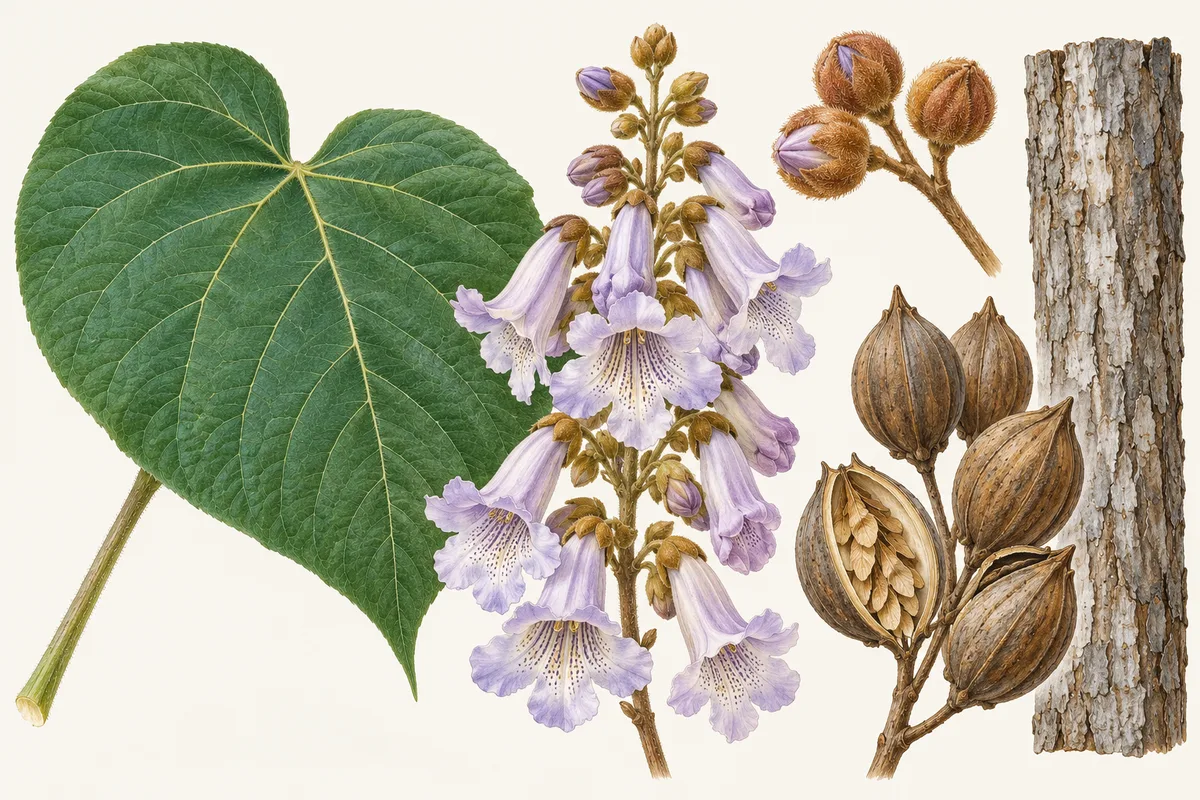
For paulownia tree identification, check three things: big, velvety, heart-shaped leaves 5 to 12 inches long set in opposite pairs; upright clusters of fragrant, pale violet tubular flowers in April and May, before the leaves; and egg-shaped woody capsules 1 to 2 inches long that hang on through winter beside fuzzy brown flower buds. Paulownia tomentosa is also called empress tree or princess tree.
- Opposite, velvety, heart-shaped leaves plus violet flowers before the leaves mean paulownia, not catalpa.
- In winter, look for two things at once: clusters of split, egg-shaped capsules and clusters of fuzzy brown flower buds already formed for spring.
- Saplings and stump sprouts grow leaves up to 2 feet long, sometimes lobed, so a young paulownia looks nothing like the adult tree.
Field marks at a glance
- Scientific name
- Paulownia tomentosa
- Family
- Paulowniaceae (paulownia family)
- Type
- Broadleaf, deciduous
- Leaves
- Opposite (sometimes nearly so), simple, broadly oval to heart-shaped, 5 to 12 inches (13 to 30 cm) long, velvety on both surfaces and paler beneath. Edges smooth on adult trees; coarse teeth or lobes on young trees.
- Sprout leaves
- Leaves on seedlings, saplings and root or stump sprouts can reach 2 feet (60 cm), about twice the adult size.
- Flowers
- Pale violet to lavender, tubular, 1.5 to 2 inches long, with five unequal lobes, dark spots and yellow stripes inside; vanilla-scented. Upright clusters 8 to 14 inches tall in April and May, before the leaves.
- Fruit
- Woody, egg-shaped capsules 1 to 2 inches long, sticky and green in summer, dark brown in fall and winter, in clusters that stay on the tree. Each splits into compartments holding up to about 2,000 tiny winged seeds.
- Winter buds
- Fuzzy brown flower buds in branched clusters, formed in early fall and held all winter, often beside last year's capsules. Leaf buds are small, with no end bud on the twig.
- Twigs and pith
- Stout, light brown twigs speckled with pale lenticels; round leaf scars. Cut a twig lengthwise: the pith is chambered or hollow by the second year.
- Bark
- Thin, gray-brown, with shallow fissures and pale vertical cracks; smoother patches between.
- Size and growth
- 30 to 50 ft (9 to 15 m), up to about 60 ft, with a rounded crown of heavy, awkward branches. Young trees can grow up to 15 ft in a year.
Paulownia is the fast-growing tree with huge velvety leaves that turns roadsides, stream banks and rocky slopes violet in April across the eastern United States. Its botanical name is Paulownia tomentosa, and it goes by empress tree, princess tree and royal paulownia; it is native to China. The tree carries a field mark in every season, so it can be named in winter as easily as in bloom.
How to identify a paulownia tree in any season
Spring: violet flowers on bare branches. In April and May, before the leaves, paulownia holds upright clusters of pale violet, tube-shaped flowers. Vermont Invasives describes clusters 8 to 12 inches tall of fragrant flowers with five unequal lobes; the NC State Extension profile gives clusters up to about 14 inches, flowers 1.5 to 2 inches long with dark spots and yellow stripes, and a vanilla scent. A tall tree flowering violet with no leaves yet is almost certainly a paulownia.
Summer: giant velvety leaves in pairs. The leaves are simple, heart-shaped to broadly oval and 5 to 12 inches long, velvety on both surfaces and paler beneath. They grow in opposite pairs, which separates paulownia from most big-leaved trees. Virginia Tech's royal paulownia fact sheet notes that young trees may show coarse teeth or lobes.
Fall: egg-shaped capsules. Clusters of woody, egg-shaped capsules 1 to 2 inches long follow the flowers, sticky and green at first, then brown. UF/IFAS's princess-tree fact sheet says the leaves fall within about a week of the first frost with no fall color.
Winter: capsules and fuzzy buds together. The capsules stay on the tree and split in late winter, releasing up to about 2,000 tiny winged seeds each, according to Vermont Invasives. Next to them hang branched clusters of fuzzy brown flower buds, which UF/IFAS says form in early fall and open in early spring. Very cold weather can kill those buds, UF/IFAS adds, and they then drop.
Any season: the pith. Cut a twig lengthwise. Vermont Invasives describes chambered or sometimes hollow pith; Virginia Tech says it is hollow by the second year. Stout twigs speckled with pale lenticels and round leaf scars complete the picture.
Tree Identifier can name paulownia from one photo of the flowers, a leaf or a capsule cluster, and Paulownia tomentosa is in the app's Collection of 138 species that fills in as you identify. It gives one name with no confidence score and no look-alike list, so confirm with the leaf arrangement or the pith.
Paulownia vs catalpa and other big-leaved trees
Catalpa is the tree most often confused with paulownia. The North Carolina Forest Service invasive species leaflet (March 2010) names southern catalpa and points to its long, slender persistent beans and whorled leaves. Our catalpa page covers that pair in detail; the table below adds the other trees people mistake for paulownia.
| Tree | Leaves | Flowers | Fruit |
|---|---|---|---|
| Paulownia | Opposite, heart-shaped, velvety both sides, 5–12 in | Pale violet, April–May, before leaves | Egg-shaped woody capsule, 1–2 in |
| Catalpa | In whorls of three or pairs, 5–12 in | White, spotted, late spring–summer, with leaves | Long thin bean, 8 in or more |
| Tree of heaven | Alternate, compound, 11–41 leaflets | Small, yellow-green | Twisted winged seeds |
| Jacaranda | Fern-like, twice divided | Lavender to violet trumpets, spring | Round, disk-like capsule |
| Linden | Alternate, toothed, lopsided base | Pale yellow, under a leafy bract | Pea-sized nutlets |
Jacaranda grows outdoors only in USDA zones 9B to 11, according to the UF/IFAS jacaranda fact sheet, so in most of the paulownia's range it is not a candidate. For more spring bloomers in this color, see trees with purple flowers.
Young paulownia and stump sprouts
A paulownia sapling is the version people photograph most and recognize least. Vermont Invasives notes that leaves on root sprouts can reach 2 feet, and the North Carolina Forest Service says young plants and stump sprouts carry leaves up to twice the adult size, which can be 5 to 10 inches on mature trees. These leaves may be toothed or lobed and the stems green and soft, so a first-year sprout can look like a giant weed.
Three checks help with a sapling:
- Arrangement: paulownia leaves are opposite. Tree of heaven has alternate, compound leaves 1 to 3 feet long with 11 to 41 leaflets, per Virginia Tech's tree-of-heaven fact sheet.
- Texture: rub a leaf; paulownia is velvety on both sides.
- Pith: cut a woody stem; hollow or chambered pith points to paulownia.
Sprouting also explains how paulownia persists. NC State notes that it resprouts from roots after cutting, and the North Carolina Forest Service says young trees can grow up to 15 feet per year.
Where paulownia grows, and where it is listed invasive
The North Carolina Forest Service leaflet says paulownia has been planted in North America from Montreal to Florida and west to Missouri and Texas, and has spread mainly in the eastern and southern US, especially in North Carolina's foothills and mountains. It can flower within 8 to 10 years, and a mature tree can produce millions of seeds that the wind spreads. It favors disturbed ground: roadsides, stream banks, forest edges and steep rocky slopes.
Its status varies by state:
- North Carolina: NC State Extension calls it an invasive species in the state, listed by the NC Invasive Plant Council, the North Carolina Forest Service, the USDA National Invasive Species Information Center and the Invasive Plant Atlas of the United States.
- Florida: UF/IFAS reports that its assessment of non-native plants rates paulownia invasive and not recommended.
- Vermont: Vermont Invasives lists princess tree as a watch-list species.
Paulownia also appears among the trees with heart-shaped leaves, where it is compared with redbud, linden and catalpa. If you are tracking where seedlings come up, Tree Identifier's Tree Map keeps each saved identification with its location.
Look-alikes and how to tell them apart
Northern and southern catalpa (Catalpa speciosa, C. bignonioides)
Catalpa flowers are white with purple and yellow spots and open among the leaves in late spring or summer. Its fruit is a long, thin bean 8 inches or more, and its leaves often grow in whorls of three. The North Carolina Forest Service names the long, slender persistent beans and whorled leaves as the catalpa marks.
Tree of heaven (Ailanthus altissima)
Both colonize roadsides fast, but tree of heaven leaves are compound, 1 to 3 feet long with 11 to 41 leaflets, and alternate. Paulownia leaves are single, heart-shaped and opposite. Tree of heaven fruit is a twisted winged seed, not a woody capsule.
Jacaranda (Jacaranda mimosifolia)
Jacaranda also opens violet trumpet flowers in spring, but its leaves are fern-like and twice divided, with leaflets about 1/4 inch. It is hardy outdoors only in USDA zones 9B to 11, per UF/IFAS.
Linden or basswood (Tilia)
A linden sapling has heart-shaped leaves too, but they are alternate, finely toothed and lopsided at the base. Linden flowers are pale yellow and hang from a strap-like leafy bract in early summer.
What a photo can't settle
- Paulownia saplings with lobed leaves 2 feet across do not match photos of adult trees; check that the leaves are opposite and velvety, or cut a twig to see the chambered pith.
- This page describes Paulownia tomentosa. If other Paulownia species or hybrids are planted near you, a photo may name the genus without settling which one a tree is.
- Out of flower and without capsules, a paulownia sapling and a catalpa sapling can look alike in a photo; leaf arrangement and pith settle it on the spot.
Questions people ask
What is the difference between a paulownia and a catalpa?
Paulownia flowers are pale violet and open in April and May before the leaves; catalpa flowers are white and open among the leaves. Paulownia fruit is an egg-shaped woody capsule 1 to 2 inches long; catalpa's is a long, thin bean. Paulownia leaves are opposite and velvety on both sides; catalpa leaves are often in threes.
Is paulownia invasive?
In parts of the US, yes. NC State Extension says it is invasive in North Carolina, listed by the NC Invasive Plant Council and the North Carolina Forest Service. UF/IFAS rates it invasive and not recommended in Florida, and Vermont puts it on its watch list. Status is set state by state, so check your state's list.
Are empress tree and princess tree the same tree?
Yes. Empress tree, princess tree, royal paulownia and royal empress tree are all names for Paulownia tomentosa, a tree native to China, per NC State Extension. The names refer to one species; this page describes that species.
What does a paulownia look like in winter?
Look up for clusters of dark brown, egg-shaped capsules, often split open, and clusters of fuzzy brown flower buds that formed in early fall for next spring. The twigs are stout and speckled, and a cut twig shows chambered or hollow pith. No other common eastern tree carries both at once.
Why does a young paulownia have giant leaves?
Fast growth. Vermont Invasives notes that leaves on root sprouts can reach 2 feet, and the North Carolina Forest Service says young plants and stump sprouts carry leaves up to twice the adult size. Those leaves may also be toothed or lobed, which is why saplings are often misidentified.
Sources
- Royal paulownia fact sheet — Virginia Tech Dendrology
- Paulownia tomentosa (Empress Tree, Princess Tree, Royal Paulownia) — NC State Extension Gardener Plant Toolbox
- Princess Tree (Paulownia tomentosa) — Vermont Invasives
- Paulownia tomentosa (Princess Tree), Invasive Species Leaflet No. 14 — North Carolina Forest Service, March 2010
- Paulownia tomentosa: Princess-Tree (ENH-592/ST433) — UF/IFAS Extension, University of Florida
- Tree-of-heaven fact sheet — Virginia Tech Dendrology
- Jacaranda mimosifolia: Jacaranda (ENH-488/ST317) — UF/IFAS Extension, University of Florida
Keep reading
- Tree profileCatalpa tree: how to recognize northern and southern catalpa
- Clue guideWhich tree has purple flowers? Check the month, then the leaves
- Clue guideTrees with heart-shaped leaves, and how to tell them apart
- Invasive tree profileTree of heaven (Ailanthus altissima): how to identify it
- Clue guideWhich tree has large leaves? Sort it by size, shape and region