Clue guide
Which tree has large leaves? Sort it by size, shape and region
Measure one leaf, decide whether it is a single blade or made of many leaflets, and note your region. Those three facts narrow a big-leaved tree to one or two names.
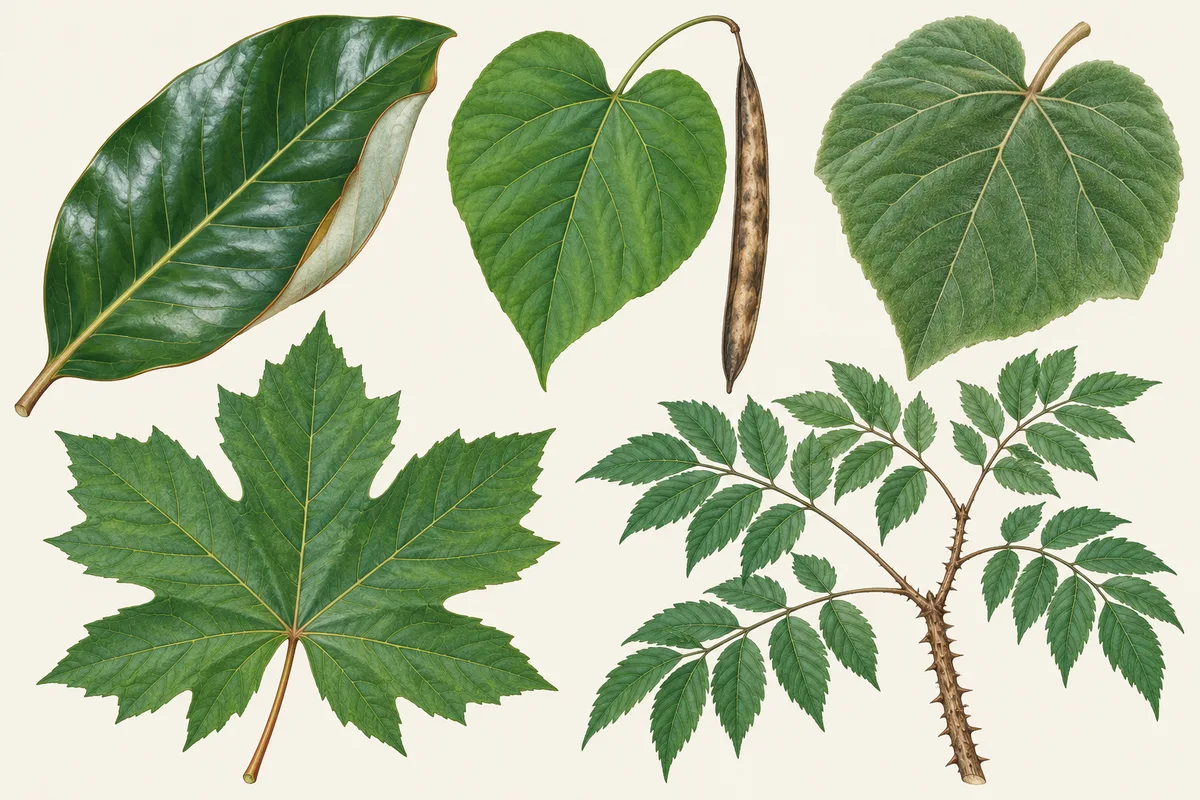
In short
A tree with large leaves in North America is most often a catalpa (heart-shaped, 6 to 12 inches, in whorls of three), a princess tree (heart-shaped, velvety, opposite), a bigleaf magnolia (up to 3 feet long, silvery beneath), a bigleaf maple in the Pacific Northwest (12 inches across) or a sycamore. Huge leaves split into many leaflets point to tree of heaven or devil's walking stick.
- Check first whether the 'leaf' is one blade or a stalk carrying many leaflets: the biggest leaves in North America are compound.
- Heart-shaped and 6 to 12 inches: catalpa (whorled, smooth) or princess tree (opposite, velvety on both sides).
- A single blade longer than your forearm, silvery underneath, in the Southeast is bigleaf magnolia.
Big leaves catch the eye in any yard or park, but "big" covers three very different things: a giant single blade like a magnolia's, a large heart-shaped leaf like a catalpa's, and a huge compound leaf made of dozens of leaflets. Measure one leaf, decide which of the three you have, then use your region. Never eat a berry, nut, seed or pod on the strength of a web page or an app; check with a local expert.
Large-leaved trees by size and shape
| Tree | Leaf size | The feature that settles it | Our page |
|---|---|---|---|
| Devil's walking stick (Aralia spinosa) | Compound, 2–5 ft (0.6–1.5 m) | Sharp spines on stems and leaf stalks | none yet |
| Bigleaf magnolia (Magnolia macrophylla) | Up to 3 ft × 1 ft (90 × 30 cm) | Single blade, silvery and hairy beneath | Magnolia |
| Tree of heaven (Ailanthus altissima) | Compound, 1–3 ft (30–90 cm) | 11–41 leaflets; strong smell when crushed | Tree of heaven |
| Bigleaf maple (Acer macrophyllum) | Usually up to 12 in (30 cm) across | Maple lobes; Pacific coast only | Maple |
| Northern catalpa (Catalpa speciosa) | 6–12 in (15–30 cm) | Heart-shaped, whorled; long bean pods | Catalpa |
| Princess tree (Paulownia tomentosa) | 5–12 in (13–30 cm) | Heart-shaped, opposite, velvety on both sides | Paulownia |
| Pawpaw (Asimina triloba) | 6–12 in (15–30 cm) long | Drooping, smells of green pepper when crushed | none yet |
| Southern magnolia (Magnolia grandiflora) | 5–10 in (13–25 cm) | Evergreen, leathery, rusty-brown beneath | Magnolia |
| American sycamore (Platanus occidentalis) | 4–8 in (10–20 cm) wide | Patchy white bark; seed balls | Sycamore |
| Tulip tree (Liriodendron tulipifera) | 3–8 in (8–20 cm) | Four lobes with a flat, cut-off tip | Tulip tree |
| Horse chestnut (Aesculus hippocastanum) | Large, hand-shaped | 5–7 leaflets from one point; conkers | Chestnut vs buckeye |
Leaf sizes come from NC State Extension, the USDA Forest Service, Virginia Tech and the Woodland Trust pages linked in the sections below.
Giant single leaves: bigleaf magnolia and its relatives
If one undivided leaf is well over 2 feet (60 cm) long, start with bigleaf magnolia. NC State Extension's bigleaf magnolia profile gives deciduous leaves 3 feet long and 1 foot wide, oblong to obovate with a heart-shaped base, silvery white and hairy underneath. Its flowers are 8 to 14 inches across and open from May to June, and the tree grows 30 to 40 feet (9–12 m) tall. NC State lists it as native to the Southeast and Ohio Valley, from Virginia and Ohio south to Louisiana, so it is a strong candidate for a "Tennessee tree with huge leaves" or a "Kentucky tree with large leaves".
Southern magnolia is the evergreen big-leaf tree of the South. NC State's profile gives stiff, leathery, glossy leaves 5 to 10 inches long, rusty-brown and fuzzy beneath, and creamy white flowers 8 to 12 inches across. A large tree with smooth glossy leaves that stay green in January is this, not a deciduous magnolia. The magnolia page separates the common magnolias.
Pawpaw is the understory tree with long, drooping leaves. NC State's pawpaw profile gives leaves 6 to 12 inches long and 2 to 3 inches wide with smooth edges, hanging in two rows, that smell like green bell pepper when crushed, on a tree 15 to 30 feet tall with purplish-brown flowers before the leaves.
Big heart-shaped leaves: catalpa and princess tree
The two trees behind most "big leaves and long bean pods" searches are catalpa and princess tree. NC State's northern catalpa profile gives light green leaves 6 to 12 inches long, whorled or opposite, white bell-shaped flowers striped orange and spotted purple in late spring, and bean-like pods up to 22 inches long. The tree grows 40 to 70 feet (12–21 m).
Princess tree looks similar in leaf but differs on three points. NC State's princess tree profile gives leaves 5 to 12 inches, oval or heart-shaped, opposite, with velvety hairs on both surfaces; lavender flowers in spring; and woody brown capsules that split in fall to release small winged seeds. NC State lists it as invasive in North Carolina. Rub a leaf: velvety on both sides means princess tree. The heart-shaped leaves guide covers both in more detail, and the catalpa page separates northern and southern catalpa.
Giant compound leaves: tree of heaven and devil's walking stick
Some of the largest "leaves" are compound: one leaf stalk carrying many leaflets. Devil's walking stick holds the record. NC State's profile gives compound leaves 2 to 5 feet long and 2 to 4 feet wide, which it calls the largest in North America, with stout, sharp spines on leaf stalks, stems and branches and large clusters of tiny white flowers from June to September. It is usually 10 to 15 feet tall, occasionally a small tree to 35 feet, in the eastern US.
Tree of heaven is the roadside version. The Virginia Tech fact sheet gives leaves 1 to 3 feet long with 11 to 41 leaflets, each 2 to 6 inches long, and twisted winged seeds 1 to 1½ inches long. A crushed leaflet smells strongly unpleasant, and each leaflet has one or two gland-tipped teeth at its base. It is invasive in many states; the tree of heaven page lists the agencies and the look-alikes, including black walnut and sumac.
Big lobed leaves: bigleaf maple, sycamore and tulip tree
Bigleaf maple is the answer on the West Coast. The USDA Forest Service's Silvics of North America says its leaves are usually up to 12 inches (30 cm) across and exceptionally 24 inches (61 cm), and that its native range lies within about 186 miles (300 km) of the Pacific Ocean. Most mature trees are about 50 feet (15 m), large ones 100 feet (30 m). In Oregon, Washington or British Columbia, a maple leaf wider than a dinner plate is this tree.
American sycamore has the big maple-like leaves of the East and Midwest. Virginia Tech's sycamore sheet gives leaves 4 to 8 inches wide with three to five coarsely toothed lobes, alternate, not opposite like a maple, and the leaf stalk's base hides the bud. Patchy brown, green and white bark and hanging seed balls confirm it, which is why "tree with large leaves and white bark" or "large leaves and green balls" usually ends here. See sycamore.
Tulip tree leaves are 3 to 8 inches across with four lobes and a broad, cut-off tip, according to NC State's tulip tree profile; no other big eastern tree has that squared-off leaf.
In the UK
"Tree with massive leaves" in Britain usually means a horse chestnut in a park. The Woodland Trust's horse chestnut page describes large hand-shaped leaves of 5 to 7 pointed, toothed leaflets spreading from one point, white flowers in May and conkers in spiky husks; it is native to the Balkans and introduced in the late 16th century. Planted Indian bean trees (Catalpa bignonioides) and foxglove trees (Paulownia tomentosa) carry the biggest heart-shaped leaves in British gardens, and London plane and sycamore maple have large five-lobed ones. The chestnut and buckeye page separates horse chestnut from its American relatives.
Using a photo
Big leaves photograph well, but a single leaf can mislead: catalpa and princess tree, or sycamore and a large maple, look alike in one picture. Lay the leaf on the ground with something for scale, and include the twig so the arrangement shows. Tree Identifier names a tree from one photo, and southern catalpa (Catalpa bignonioides), princess tree, southern magnolia, American sycamore, tulip tree and horse chestnut are in its Collection. It gives no confidence score or alternatives, so check the answer against the leaf size and arrangement in the table above, and ask the follow-up chat how that species' leaves differ from its look-alike.
What a photo can't settle
- Leaf size varies a lot within one tree: shade leaves and leaves on vigorous young sprouts are often much larger than those in the sunny crown, so measure several.
- A compound leaf can be mistaken for a twig with many leaves; find the bud at the base of the whole leaf stalk to know where one leaf starts.
- Catalpa and princess tree look alike in a single leaf photo; a flower, pod or the arrangement of leaves on the twig settles them better.
Questions people ask
What tree has the largest leaves in North America?
By total leaf, devil's walking stick: NC State Extension gives compound leaves 2 to 5 feet long and calls them the largest in North America. For a single, undivided blade, bigleaf magnolia, whose leaves NC State gives as 3 feet long and 1 foot wide.
What tree has large leaves and long bean pods?
A catalpa. NC State Extension describes northern catalpa leaves 6 to 12 inches long, whorled or opposite, and bean-like pods up to 22 inches long that turn dark brown in fall. A princess tree has similar leaves but bears woody, egg-shaped capsules instead of beans.
What tree has large leaves and white flowers?
In late spring, northern catalpa (upright clusters of white bell-shaped flowers striped orange and spotted purple) or bigleaf magnolia (flowers 8 to 14 inches across, May to June, per NC State). Southern magnolia also has big white flowers on evergreen, leathery leaves 5 to 10 inches long.
What maple has the biggest leaves?
Bigleaf maple, native near the Pacific coast. The USDA Forest Service says its leaves are usually up to 12 inches across and exceptionally up to 24 inches. In the East, the big maple-shaped leaves on a tree with white upper branches are usually a sycamore, which is not a maple.
What tree has large leaves in the UK?
Horse chestnut, with hand-shaped leaves of 5 to 7 toothed leaflets, is the common one in parks. Planted Indian bean trees (catalpa) and foxglove trees (paulownia) have big heart-shaped leaves, and London plane and sycamore maple have large five-lobed leaves.
Sources
- Magnolia macrophylla (bigleaf magnolia) — North Carolina Extension Gardener Plant Toolbox, NC State University
- Paulownia tomentosa (princess tree) — North Carolina Extension Gardener Plant Toolbox, NC State University
- Catalpa speciosa (northern catalpa) — North Carolina Extension Gardener Plant Toolbox, NC State University
- Bigleaf maple (Acer macrophyllum), Silvics of North America — USDA Forest Service
- Asimina triloba (pawpaw) — North Carolina Extension Gardener Plant Toolbox, NC State University
- Aralia spinosa (devil's walking stick) — North Carolina Extension Gardener Plant Toolbox, NC State University
- Tree-of-heaven fact sheet — Virginia Tech Dendrology
- Horse chestnut (Aesculus hippocastanum) — Woodland Trust
Keep reading
- Tree profileCatalpa tree: how to recognize northern and southern catalpa
- Tree profileMagnolia tree identification: southern magnolia and its relatives
- Tree profilePaulownia tree identification: the empress or princess tree
- Clue guideTrees with heart-shaped leaves, and how to tell them apart
- Field guideHow to identify trees by their leaves