Also in Deutsch
Tree profile
Tulip tree (Liriodendron tulipifera): tulip poplar and yellow-poplar
No other North American tree has a leaf that looks cut off square at the tip. Add a bud shaped like a duck's bill and an upright cone of winged seeds, and you can name it in any season.
In short
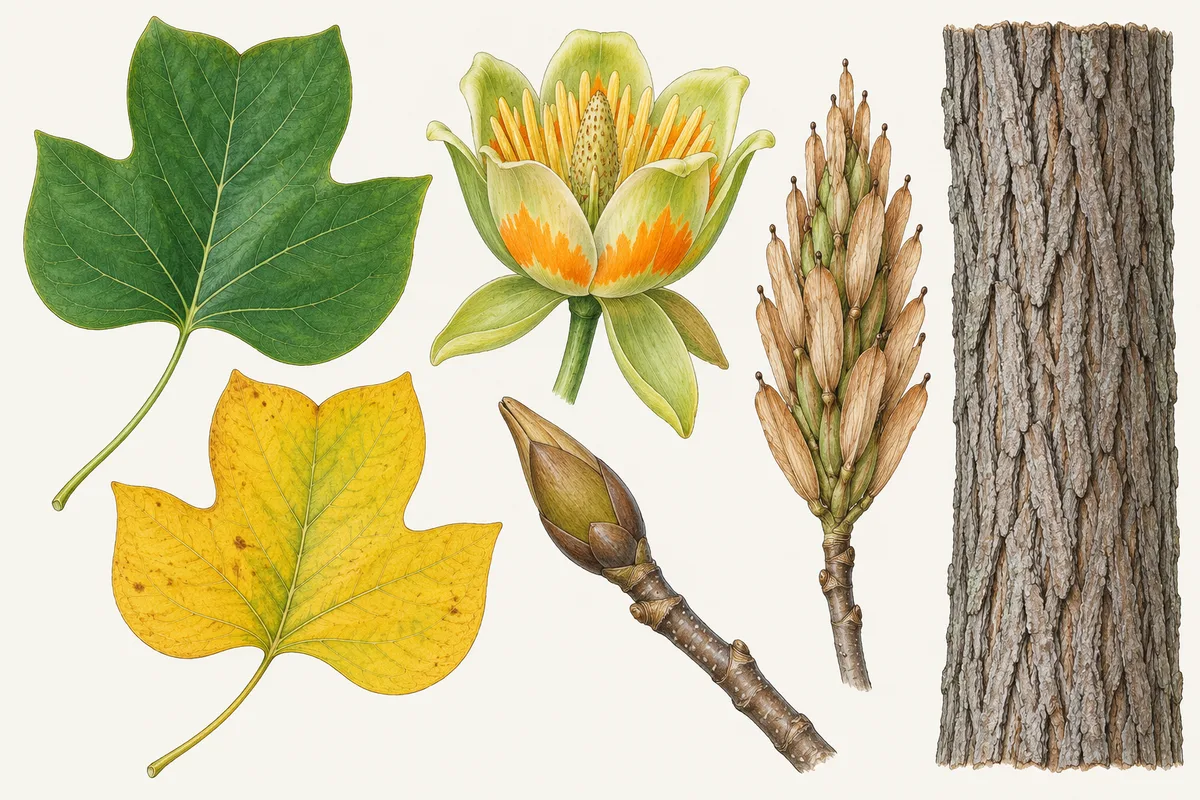
For tulip tree identification, look first at the leaf: four lobes with a broad, flat or notched tip, as if the end were cut off, 3 to 8 inches long. In late spring the tree carries upright, tulip-shaped flowers about 2 inches tall, yellow-green with an orange band. In winter, look for flattened buds shaped like a duck's bill and upright cones of winged seeds.
- The flat-topped, four-lobed leaf is unique among North American trees; tulip poplar is in the magnolia family, not a poplar.
- Winter buds about 1/2 inch long are flattened like a duck's bill, and a ring-shaped scar circles the twig at every node.
- Older bark has flat-topped ridges and pale furrows in a diamond pattern.
Field marks at a glance
- Scientific name
- Liriodendron tulipifera
- Family
- Magnoliaceae (magnolia family)
- Type
- Broadleaf, deciduous
- Leaves
- Alternate, simple, smooth-edged, four lobes with a broad, flat or notched tip, 3 to 8 inches (8 to 20 cm) long, glossy green above and paler below, on a stalk 2 to 4 inches long.
- Flowers
- Upright, tulip-shaped, about 2 inches tall, six yellow-green petals each with an orange band at the base; April to June depending on location, high in the crown after the leaves.
- Fruit
- An upright, cone-shaped cluster of winged seeds (samaras) about 2 to 3 inches long; brown by October, it breaks apart over winter and leaves a bare central spike.
- Buds and twigs
- Reddish-brown, flattened buds about 1/2 inch long shaped like a duck's bill; a stipule scar rings the twig at each node; broken twigs smell sweet and spicy.
- Bark
- Smooth gray-green with shallow white fissures when young; older bark gray-brown with flat-topped ridges and pale furrows in a diamond pattern.
- Fall color
- Golden yellow. In hot, dry summers some leaves turn yellow early and drop.
- Size
- Typically 100 to 150 ft (30 to 45 m) tall in forests with a trunk 2 to 5 ft across; planted trees 70 to 90 ft. Old-growth trees on the best sites approach 200 ft.
- Range
- Southern New England west through southern Ontario and Michigan, south to Louisiana and north-central Florida; most abundant in the Ohio River valley and the Appalachians.
The tulip tree is the tall, straight-trunked tree of eastern forests that most people know as tulip poplar or yellow-poplar. It is not a poplar at all but a member of the magnolia family, and it is one of the easiest trees in North America to identify once you know its leaf. The leaf alone settles it in summer; the bud, the seed cone and the bark settle it in winter.
How to identify a tulip tree by its leaf
The leaf is the giveaway. The Morton Arboretum describes alternate, simple leaves 3 to 8 inches long with a four-lobed, flat-tipped shape, glossy green above and pale below. Picture a maple leaf whose top lobe was cut off with scissors: two lobes at the base, two near the top, and a broad, straight or slightly notched edge where a point should be. No other common North American tree has that squared-off tip.
The NC State Extension Plant Toolbox adds that the margin is smooth, with no teeth, and that the leaf hangs on a long stalk, 2 to 4 inches.
Check the arrangement too. Tulip tree leaves are alternate, one per node. Maples, the trees most often mistaken for it from a distance, have opposite leaves.
In fall the leaves turn golden yellow. Our guide to trees with yellow leaves in fall compares it with the other yellow trees of eastern woods.
Tree Identifier can name a tulip tree from one photo of a leaf, a flower, a seed cone or the bark. The app does not show a confidence score or alternative species, so use the flat leaf tip to confirm the result yourself.
Flowers, seed cones and buds: the tulip tree through the year
Flowers (late spring). The flowers give the tree its name: upright and tulip-shaped, about 2 inches tall, yellow-green with an orange band at the base of each petal (Morton). The USDA Forest Service's Silvics of North America gives flowers 1.5 to 2 inches wide with six petals, opening from April to June depending on location, each tree flowering for 2 to 6 weeks. They open after the leaves and high in the crown, so look for fallen petals on the ground.
Seed cones (fall and winter). The flowers become upright, cone-shaped clusters of winged seeds, about 2 inches long by Morton's measure (NC State gives 2 to 3 inches). They turn brown in October and stay on the branches through winter, shedding their samaras from mid-October to mid-March (USDA). By late winter many cones are reduced to a bare spike, which still stands upright on the twig.
Buds and twigs (winter). Morton describes distinct reddish-brown buds about 1/2 inch long that resemble a duck's bill: two flat scales pressed together like a beak. NC State notes stipule scars that ring the twig at each node and twigs with a sweet, spicy scent when broken. Duck-bill buds and ringed nodes together point to tulip tree; the magnolia page covers its closest relatives, which share the ringed nodes but not the flat bud.
The seed cones are dry and woody. Never eat any seed, nut or fruit on the strength of a web page or an app; check with a local expert.
Tulip tree bark and size
Bark changes with age. NC State describes young bark as smooth and light gray-green; Morton adds shallow white fissures. On older trees the bark turns grayish-brown with flat-topped ridges and white-colored furrows that interlace in a diamond pattern (NC State). Combined with a long, straight, branch-free trunk, that bark is often enough to name a big tulip tree from the forest floor.
Size is the other clue. The Forest Service gives 100 to 150 feet (30 to 45 m) and a trunk 2 to 5 feet across for typical mature trees, and up to about 200 feet for old-growth trees on the best sites. Planted trees in yards are smaller: Morton gives 70 to 90 feet tall and 35 to 50 feet wide. Young trees grow fast; the Forest Service records an 11-year-old natural seedling 50 feet tall.
Where tulip trees grow
According to the Forest Service, the native range runs from southern New England west through southern Ontario and Michigan, south to Louisiana and east to north-central Florida. It is most abundant in the Ohio River valley and on the slopes of the Appalachian Mountains, on moist, well-drained soils. Morton lists it as hardy in USDA zones 5 to 9, and it is planted as a shade tree well beyond its wild range. NC State lists it as the state tree of Kentucky, Tennessee and Indiana.
Tulip tree vs sassafras, maples and poplars
| Tree | Leaf | Arrangement | Fruit | Bark |
|---|---|---|---|---|
| Tulip tree | 4 lobes, flat or notched tip, smooth edge | Alternate | Upright cone of winged seeds | Diamond pattern of pale furrows |
| Sassafras | Unlobed, mitten and 3-lobed on one tree | Alternate | Blue-black drupe on a red stalk | Reddish-brown, deeply furrowed |
| Red maple | 3–5 pointed, toothed lobes | Opposite | Pair of winged seeds | Smooth gray, later plated |
| Eastern cottonwood | Unlobed, triangular, coarsely toothed | Alternate | Seeds with cotton-like hairs | Smooth greenish-gray, later deeply furrowed |
Sassafras facts come from NC State's sassafras page, red maple facts from NC State's red maple page, and cottonwood facts from NC State's eastern cottonwood page, which places poplars in the willow family. For the true poplars, aspens and cottonwoods, see the poplar page; the three leaf shapes of sassafras are covered on the sassafras page.
Tulip tree (Liriodendron tulipifera) is one of the 138 species in Tree Identifier's Collection, and the app's Tree Map can save where you found one so you can come back in May to see it in flower.
Look-alikes and how to tell them apart
Sassafras (Sassafras albidum)
Sassafras mixes three leaf shapes on one tree, unlobed, mitten-shaped and three-lobed, and every lobe ends in a rounded point, never a flat, squared-off tip. Its young twigs are green and smell spicy when scratched, and its bark is reddish-brown.
Red maple (Acer rubrum)
Red maple leaves have 3 to 5 pointed, coarsely toothed lobes and grow in opposite pairs. Tulip tree leaves are alternate, smooth-edged and squared off at the tip. Red maple fruit is a pair of winged seeds, not an upright cone.
Eastern cottonwood and other poplars (Populus)
Despite the name tulip poplar, eastern cottonwood has unlobed, triangular leaves with coarse, curved teeth, and its tiny seeds carry cotton-like hairs. A four-lobed, smooth-edged leaf with a flat tip is never a poplar.
What a photo can't settle
- Saplings and sprouts sometimes have leaves with extra lobes or a deeper notch, and the USDA Forest Service notes a Coastal Plain form with rounded lobes; check several leaves from the crown.
- The flowers bloom high in the crown after the leaves are out, so a photo from the ground may show only leaves; a fallen petal or seed cone is often the easier proof.
- Planted cultivars, including variegated and columnar forms, can change the shape and color of the crown; a photo app names the species, not the cultivar.
Questions people ask
Is a tulip poplar a poplar?
No. Tulip poplar, yellow-poplar and tulip tree are all names for Liriodendron tulipifera, a member of the magnolia family. True poplars, aspens and cottonwoods belong to the genus Populus in the willow family.
What does a tulip tree look like in winter?
Look for flattened, reddish-brown buds about 1/2 inch long shaped like a duck's bill, a ring-shaped scar around the twig at each node, and upright brown seed cones in the crown, some already broken down to a bare spike. The bark of older trees shows pale furrows in a diamond pattern.
When does a tulip tree bloom?
From April to June depending on location, says the USDA Forest Service, and NC State gives May to early June for North Carolina. The flowers open after the leaves, high in the crown, so many people never notice them. The Forest Service says trees first flower at about 15 to 20 years old.
Why is my tulip tree dripping sap?
It is usually honeydew, not sap. NC State Extension notes that large aphid infestations leave sticky honeydew on the leaves, which then grows a black sooty mold. The same page says the leaves often turn yellow and drop early in hot, dry weather.
Which states have the tulip tree as their state tree?
NC State Extension lists it as the state tree of Kentucky, Tennessee and Indiana. In all three it is usually called tulip poplar or yellow-poplar.
Sources
- Yellow-Poplar (Liriodendron tulipifera), Silvics of North America — USDA Forest Service
- Liriodendron tulipifera (tulip poplar) — North Carolina Extension Gardener Plant Toolbox, NC State University
- Tuliptree (Liriodendron tulipifera) — The Morton Arboretum
- Sassafras albidum (common sassafras) — North Carolina Extension Gardener Plant Toolbox, NC State University
- Acer rubrum (red maple) — North Carolina Extension Gardener Plant Toolbox, NC State University
- Populus deltoides (eastern cottonwood) — North Carolina Extension Gardener Plant Toolbox, NC State University
Keep reading
- Tree profileMagnolia tree identification: southern magnolia and its relatives
- Tree profilePoplars, cottonwoods and aspens (Populus): how to identify them
- Clue guideWhich trees have yellow leaves in fall? Sort them by leaf shape
- Tree profileSweetgum tree (Liquidambar styraciflua): how to identify it
- Clue guideWhich tree has yellow flowers? Region first, then the flower shape