Also in Deutsch
Tree profile
Sweetgum tree (Liquidambar styraciflua): how to identify it
A star-shaped leaf that smells of camphor when crushed, a spiny brown gumball underfoot, and leaves that sit one at a time on the twig: three checks that separate sweetgum from every maple.
In short
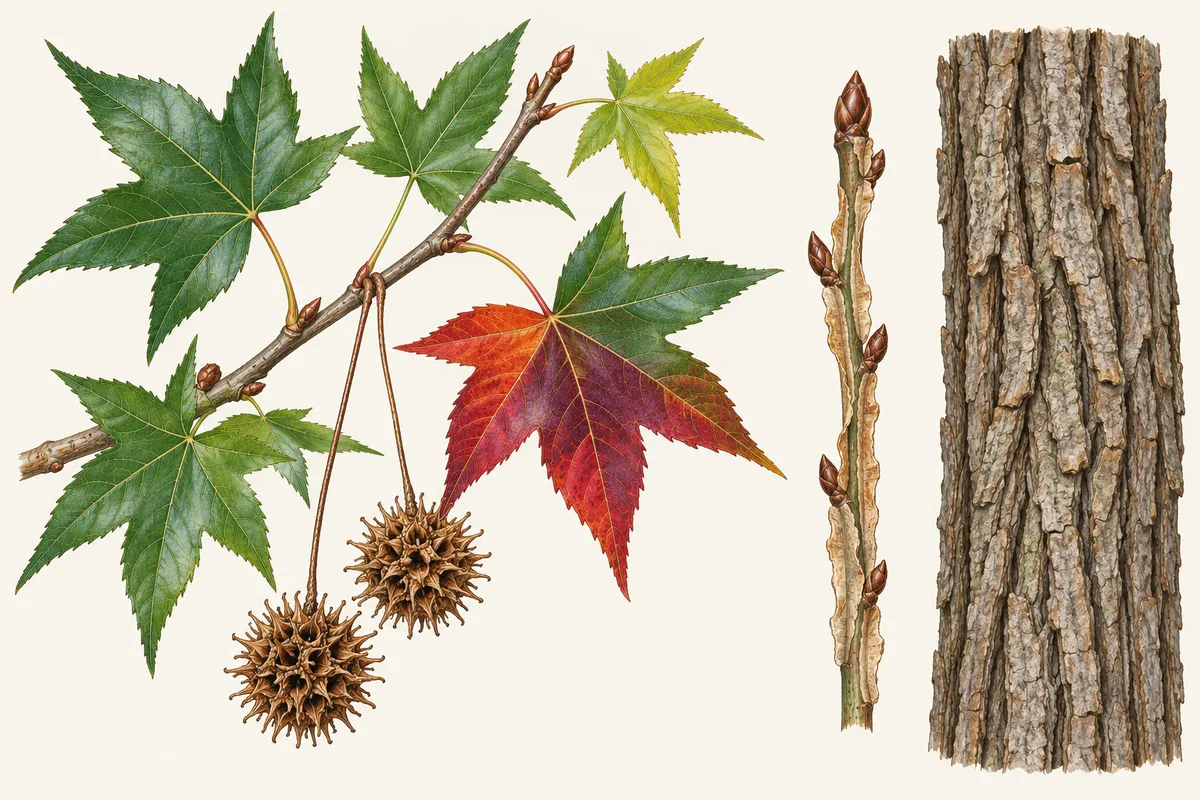
For sweetgum tree identification, check three things. The leaves are glossy, star-shaped, with 5 to 7 pointed, toothed lobes, 4 to 8 inches across, and they grow alternately, one per node, never in pairs like a maple's. The fruit is a hard, spiny brown ball 1 to 1.5 inches wide that hangs on through winter. Older twigs often carry corky wings.
- Alternate leaves rule out every maple: a star-shaped leaf that sits alone at its node is a sweetgum.
- Crush a leaf: the Morton Arboretum describes a camphor-like smell.
- Gumballs mature from September to November and fall through the winter, from about December to April.
Field marks at a glance
- Scientific name
- Liquidambar styraciflua
- Family
- Altingiaceae (sweetgum family)
- Type
- Broadleaf, deciduous
- Leaves
- Alternate, simple, star-shaped with 5 to 7 pointed lobes, finely toothed, glossy dark green, 4 to 8 inches (10 to 20 cm) long and wide, on long stalks. Camphor-like smell when crushed.
- Fruit
- A hard, woody, spiny ball 1 to 1.5 inches (2.5 to 3.8 cm) across, made of many small capsules; green in summer, brown by fall, often on the tree all winter.
- Flowers
- Small and greenish, March to early May depending on latitude; male flowers in upright clusters, female flowers in small round heads on the same tree.
- Twigs
- From the second year, many twigs grow 2 to 4 corky, wing-like ridges; some trees, especially in the north of the range, have branches covered in them.
- Bark
- Light gray with corky scales when young, then grayish-brown and deeply furrowed into narrow ridges.
- Fall color
- A mix of yellow, orange, red and purple on one tree, and the leaves hang on for a long time after turning.
- Size
- 60 to 100 ft (18 to 30 m) tall, trunk up to about 4 ft (1.2 m) across; pyramidal when young, rounded and wide-spreading with age.
- Range
- Connecticut south to central Florida and eastern Texas, west to Missouri, Arkansas and Oklahoma, north to southern Illinois; scattered in Mexico and Central America.
Sweetgum is one of the most planted and most common trees of the eastern United States, and the easiest to confuse with a maple. Its leaf has the same five-pointed outline, it turns the same reds and oranges in fall, and it often grows in the same yards. Three checks settle it in under a minute: how the leaves sit on the twig, what is lying on the ground, and what the twigs feel like.
How to identify a sweetgum in three checks
1. Leaf arrangement. Follow a twig and see where the leaves attach. Sweetgum leaves grow alternately, one leaf at each node. Every maple has opposite leaves, two at the same node facing each other. That single test separates a sweetgum from a red, sugar, Norway or silver maple even when the leaf shapes look the same.
2. The star-shaped leaf. The NC State Extension Plant Toolbox describes glossy, deep green leaves with 5 to 7 deeply separated, pointed, star-shaped lobes and toothed edges, on long stalks. The Morton Arboretum gives 4 to 8 inches long and wide and notes a camphor-like smell when the leaf is crushed. Crush one: no maple smells like that.
3. The gumball. Look under the tree. Sweetgum fruit is a hard, woody ball covered in sharp, beak-like points. The USDA Forest Service gives 1 to 1.5 inches (2.5 to 3.8 cm) across, made of many small two-celled capsules, each releasing one or two small winged seeds. The heads are glossy green in summer and turn yellow, then brown, from September to November; empty heads often stay on the tree all winter. NC State gives a wider range, 1 to 3 inches, and says most balls fall between about December and April.
Bonus check: corky twigs. NC State notes that from the second year many twigs grow two to four corky, wing-like ridges, and that in the north of the range some trees have branches covered in them. Corky wings plus a gumball is close to proof in winter, when there are no leaves to look at.
If you can't reach the leaves, Tree Identifier can name a sweetgum from one photo of a fallen leaf, a gumball or the bark. The app shows the common and scientific names but no confidence score and no list of look-alikes, so confirm the alternate leaves yourself.
Sweetgum leaves, flowers and fall color through the year
- Spring: small greenish flowers open from March to early May, depending on latitude (USDA). Male flowers stand in upright clusters; female flowers form small round heads that become the gumballs. Neither is showy.
- Summer: the leaves are glossy and star-shaped; the young gumballs hang green on long stalks.
- Fall: NC State describes fall color at its best as a mix of yellows, oranges, purples and reds, often all on one tree, and says the leaves stay on for a long time after turning. That mix of colors on a single crown is a good long-distance clue; our guide to trees with red leaves in fall compares sweetgum with red maple, black gum and the other red trees.
- Winter: brown gumballs hanging in the bare crown, corky twigs and grayish-brown, deeply furrowed bark with narrow ridges (Morton).
Sweetgum vs maple and sycamore
| Feature | Sweetgum | Red maple | American sycamore |
|---|---|---|---|
| Leaf arrangement | Alternate | Opposite | Alternate |
| Leaf outline | Star, 5–7 sharp lobes, finely toothed | 3–5 triangular lobes, coarsely toothed | 3–5 lobes, usually wider than long |
| Fruit | Spiny woody ball, 1–1.5 in | Pair of winged seeds, about 3/4 in | Fuzzy ball, 0.5–1 in, on a 3–6 in stalk |
| Bark | Gray-brown, deeply furrowed | Smooth light gray, later plate-like scales | Peels to white or cream on upper trunk |
Red maple figures come from NC State's red maple page (opposite leaves, 3 to 5 triangular lobes, paired samaras about 3/4 inch long); sycamore figures from NC State's American sycamore page. For the full maple genus, including sugar and Norway maple, see the maple identification page.
If all you have is the ball, the tree with spiky balls guide separates sweetgum from buckeye, horse chestnut, chestnut, sycamore and Osage orange.
Where sweetgum grows and how big it gets
The USDA Forest Service's Silvics of North America gives the native range as Connecticut south through the East to central Florida and eastern Texas, west to Missouri, Arkansas and Oklahoma, and north to southern Illinois, with scattered populations in Mexico and Central America. It is shade-intolerant, grows on river bottoms and old fields, and often sprouts from its roots, so young sweetgums tend to come up in groups.
NC State gives a mature height of 60 to 100 feet (18 to 30 m) and a spread of 40 to 50 feet, with trunks 4 feet or more across. Young trees are narrow and cone-shaped; old trees develop rounded, wide-spreading crowns. The Morton Arboretum lists sweetgum as hardy in USDA zones 5 to 9, which is why it is planted as a street and yard tree well north of its wild range.
Planted sweetgums and cultivars
Most sweetgums in suburbs were planted, and several cultivars change what you see:
- 'Rotundiloba': listed by NC State as producing no gumballs, so the fruit test fails on this one; rely on the alternate, star-shaped leaves.
- 'Slender Silhouette': a columnar form, about 60 feet tall and only 6 to 8 feet wide (Morton).
- 'Moraine': upright and oval, with red fall color, selected for cold hardiness (Morton).
A tree with no balls may also just be young: the Forest Service says sweetgum starts producing seed at 20 to 30 years. The gumballs are woody seed heads; never eat any seed, nut or fruit on the strength of a web page or an app, and check with a local expert.
Sweetgum (Liquidambar styraciflua) is one of the 138 species in Tree Identifier's Collection, the field-guide catalog that fills in as you identify trees. If you want to compare it with the other star of fall color in the same woods, the black gum page covers the tree that is often named alongside it despite looking nothing alike.
Look-alikes and how to tell them apart
Red maple (Acer rubrum)
Red maple leaves sit in opposite pairs and have 3 to 5 triangular lobes with coarse, irregular teeth, while sweetgum leaves sit one per node and have 5 to 7 neat star points. Red maple fruit is a pair of winged seeds about 3/4 inch long, never a spiny ball.
American sycamore (Platanus occidentalis)
Sycamore leaves are alternate too, but usually wider than long, with 3 to 5 shallow lobes, and the stalk base hides the bud. Its seed ball is fuzzy, 0.5 to 1 inch, on a stalk 3 to 6 inches long, and the upper bark peels to creamy white.
What a photo can't settle
- Sweetgum cultivars differ in shape, fall color and fruiting, and a photo of one leaf can name the species but not the cultivar of a planted tree.
- Young sweetgums under 20 to 30 years old may carry no balls at all, so the absence of gumballs does not rule sweetgum out.
- The camphor smell and the alternate leaf arrangement do not show in a single close-up leaf photo; check them on the tree.
Questions people ask
Is a sweetgum a maple?
No. Sweetgum belongs to its own family, Altingiaceae, not to the maple genus Acer. Its leaves look like maple leaves, but they grow alternately, one per node, where maple leaves grow in opposite pairs, and its fruit is a spiny ball instead of a pair of winged seeds.
When do sweetgum balls fall?
The balls ripen from green to brown between September and November, according to the USDA Forest Service, and many stay on the tree into winter. NC State Extension says most of them come down from about December to April, which is when they litter lawns and patios.
Is there a sweetgum without balls?
Yes. NC State Extension lists the cultivar 'Rotundiloba' as producing no gumballs. It is sold for yards where the fruit would be a nuisance. A sweetgum with no balls on it may also simply be too young: the Forest Service says trees start bearing seed at about 20 to 30 years.
Why does my sweetgum have corky ridges on its branches?
Corky wings are normal for sweetgum. NC State Extension says that after their second year the twigs may grow two to four corky, wing-like ridges, and that some trees, especially in the north of the range, have branches covered in them. They are not a disease.
How tall does a sweetgum tree get?
NC State Extension gives 60 to 100 feet with a trunk 4 feet or more across; the Morton Arboretum gives 60 to 75 feet for planted trees in the Chicago region. Narrow cultivars stay slimmer: Morton lists 'Slender Silhouette' at about 60 feet tall and only 6 to 8 feet wide.
Sources
- Sweetgum (Liquidambar styraciflua), Silvics of North America — USDA Forest Service
- Liquidambar styraciflua (American sweetgum) — North Carolina Extension Gardener Plant Toolbox, NC State University
- Sweet-gum (Liquidambar styraciflua) — The Morton Arboretum
- Acer rubrum (red maple) — North Carolina Extension Gardener Plant Toolbox, NC State University
- Platanus occidentalis (American sycamore) — North Carolina Extension Gardener Plant Toolbox, NC State University
Keep reading
- Clue guideWhich tree has spiky balls? Six candidates and how to tell them
- Tree profileMaple trees (Acer): how to identify them
- Tree profileSycamore tree: the British maple and the American plane tree
- Clue guideWhich trees have red leaves in fall? Sort them by leaf shape
- Tree profileBlack gum tree (Nyssa sylvatica): black tupelo, sour gum, pepperidge