Tree profile
Black gum tree (Nyssa sylvatica): black tupelo, sour gum, pepperidge
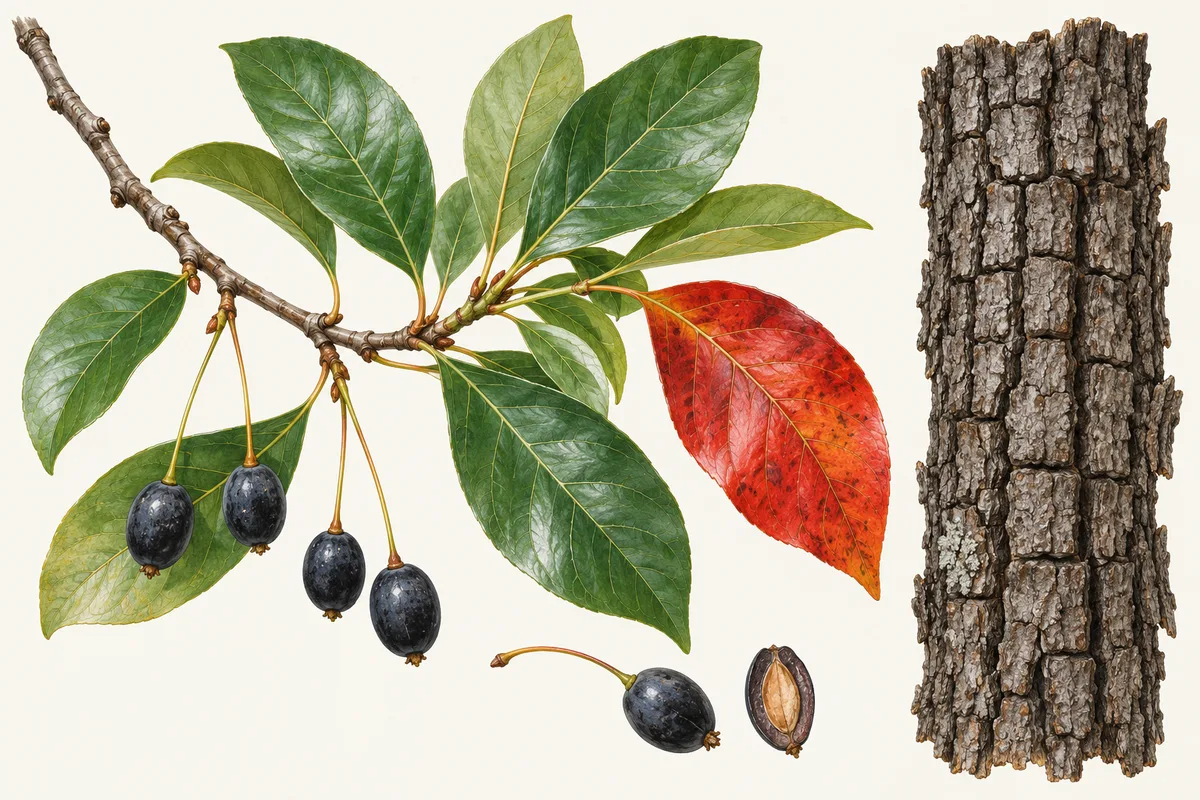
A plain oval leaf, a scarlet crown before almost anything else turns, bark broken into blocks like alligator skin and branches held out flat: the black gum is subtle in summer and unmistakable in fall.
In short
A black gum tree, also called black tupelo or sour gum, has glossy, leathery, oval leaves 3 to 6 inches long with smooth edges, which turn bright scarlet early in fall. Older bark breaks into thick, square blocks like alligator skin, branches grow out at near right angles, and female trees carry blue-black fruits about 1/2 inch long in September and October.
- Black gum is not related to sweetgum: its leaves are plain ovals, not stars, and its fruit is a small blue-black drupe, not a spiny ball.
- Fall color is consistently scarlet in early to mid fall, as the fruit ripens in late September.
- Only female trees fruit, so a black gum without fruit can still be a black gum.
Field marks at a glance
- Scientific name
- Nyssa sylvatica
- Family
- Nyssaceae (tupelo family)
- Type
- Broadleaf, deciduous
- Leaves
- Alternate, simple, elliptic to obovate, 3 to 6 inches (8 to 15 cm) long, glossy, leathery, dark green above; edges smooth, or with a few coarse teeth on sprouts and young trees. Leaf stalk 1/2 to 1 inch, often reddish.
- Fall color
- Bright scarlet, early to mid fall; yellow, orange and purple also occur.
- Fruit
- Oblong, blue-black drupe about 1/2 inch (13 mm) long, on stalks up to 1.5 inches; ripens September to October, only on female trees.
- Flowers
- Small, greenish-white, about 1/8 inch, in small clusters on long stalks as the leaves open, April to June; male and female flowers mostly on separate trees.
- Bark
- Gray to nearly black, broken by deep furrows into thick, square or rectangular blocks like alligator skin.
- Branching
- Slender limbs held at near right angles to a straight trunk; young trees pyramidal with horizontal branches.
- Twigs
- Gray to brown; cut one lengthwise and the pith is chambered, divided by thin cross-walls.
- Size
- Usually 40 to 70 ft (12 to 21 m) in the wild, 20 to 30 ft in cultivation; up to 120 ft and 4 ft across on the best sites.
- Range
- Southwestern Maine and extreme southern Ontario south to southern Florida and eastern Texas, west to central Michigan, Illinois, central Missouri and eastern Oklahoma; local in Mexico.
Black gum is the tree that turns scarlet before the rest of the woods, then goes back to being easy to overlook. Its leaves are plain glossy ovals, its flowers are tiny and green, and its fruit hides among the leaves. But it has three features almost no other eastern tree combines: alligator-skin bark, branches held out at right angles, and an early, uniform red in fall. The names are confusing too. Black gum, black tupelo, sour gum and pepperidge are one species, Nyssa sylvatica, and none of them is related to sweetgum.
How to identify a black gum tree
Work through these in order; three matches make a confident identification.
1. Leaves: glossy, leathery ovals. The NC State Extension Plant Toolbox describes alternate, simple leaves, elliptic to obovate with blunt points, 3 to 6 inches long and 1/2 to 3 inches wide, glossy, leathery and dark green above. The edges are smooth, except on sprouts and young trees, which may show a few coarse teeth. The leaf stalk is short, 1/2 to 1 inch, and often reddish.
2. Bark: alligator skin. On mature trees the bark breaks into thick, blocky ridges. The Morton Arboretum compares it to alligator skin; NC State describes deep furrows cutting it into rectangular or square ridges, gray to brown or nearly black. This is the best clue in winter.
3. Branching: right angles. NC State notes slender limbs growing at roughly 90 degrees to the trunk. Young trees are pyramidal, with horizontal branches on a straight central trunk (Morton). From a distance a young black gum looks neatly layered.
4. Fall color: early scarlet. Morton calls the fall color consistently scarlet, in early to mid fall. NC State lists yellow, orange, red and purple, but on most trees red dominates. Our guide to trees with red leaves in fall sets black gum beside red maple, sweetgum, sourwood and the red oaks.
5. Twig pith. Slice a twig lengthwise with a knife: NC State describes a chambered pith, divided into small compartments by thin cross-walls.
When the crown is out of reach, Tree Identifier can name a black gum from one photo of the bark, a leaf or the whole tree. It shows the common and scientific names without a confidence score or a list of look-alikes, so check the bark and branching against the list above.
Fruit and flowers: male and female trees
Black gum is mostly dioecious, with male and female flowers on separate trees; the USDA Forest Service's Silvics of North America calls it polygamo-dioecious, because some trees also carry a few perfect flowers. The flowers are small and greenish-white, opening from April to June on long stalks as the leaves emerge; male flowers form dense heads and female flowers sparse clusters (Morton).
Only female trees bear fruit. The Forest Service describes an oblong drupe about 1/2 inch (13 mm) long, blue-black, with a faintly ribbed stone, ripening in September and October and dropping from September through November. NC State lists thrushes and other songbirds, wild turkeys, black bears, foxes, raccoons and opossums among the animals that eat it, and calls it "one of the most important food sources for fall song bird migration".
Never eat a berry, nut, seed or fruit on the strength of a web page or an app; check with a local expert. Dark fruits on trees are the subject of our guide to trees with black berries.
Black gum vs sweetgum, persimmon and sourwood
| Tree | Leaf | Fruit | Bark | Season clue |
|---|---|---|---|---|
| Black gum | Glossy oval, smooth edge, 3–6 in | Blue-black drupe, 1/2 in, female trees | Thick square blocks | Scarlet in early to mid fall |
| Sweetgum | Star-shaped, 5–7 toothed lobes | Spiny woody ball, 1–1.5 in | Gray-brown, furrowed, narrow ridges | Gumballs hang on all winter |
| American persimmon | Oval, smooth or finely toothed, 2–6 in | Pale orange fruit, 1–1.5 in, female trees | Square blocks like a checkerboard | Fruit on bare twigs into December |
| Sourwood | Narrow, finely toothed, 3–6 in, sour taste | Strings of silver-gray capsules | Furrowed, blocky with age | White flower sprays in June–July |
Persimmon and sourwood figures come from NC State's American persimmon and sourwood pages. Persimmon is the look-alike that fools people in winter, because both trees have blocky bark; persimmon's bark is described by NC State as a checkerboard of square blocks, and its buds are nearly black with two scales. See the persimmon page for the full comparison, and the sweetgum page for the star-leaved tree that shares black gum's name.
Where black gum grows, and the other tupelos
The Forest Service gives a wide range: southwestern Maine to New York, extreme southern Ontario, central Michigan, Illinois and central Missouri, south to eastern Oklahoma, eastern Texas and southern Florida, with local populations in central and southern Mexico. It grows on dry uplands as well as stream bottoms; in North Carolina it reaches 3,000 feet (910 m) in elevation. The Morton Arboretum lists it as hardy in USDA zones 4 to 9 and tolerant of wet sites, clay, dry sites and road salt.
Two related trees share the name tupelo:
- Swamp tupelo (Nyssa sylvatica var. biflora) is a variety of black gum on the heavy, wet soils of bottomlands. The Forest Service notes that on the Coastal Plain the two intergrade and are hard to separate.
- Water tupelo (Nyssa aquatica) is a separate species of southeastern swamps that flood most of the year. NC State's water tupelo page describes a swollen, buttressed base, leaves 4 to 8 inches long and dark purple fruit up to 1 inch long on stalks 3 to 4 inches long.
Size, age and planted cultivars
NC State gives a mature height of 40 to 70 feet in the wild and 20 to 30 feet in cultivation, with trunks usually 1 to 2 feet across. The Forest Service reports trees up to 120 feet tall and 48 inches in diameter on the best sites. Small stumps sprout readily, and some trees send up many root suckers around the base.
Planted black gums are often named cultivars. NC State lists Afterburner ('David Odom'), an upright pyramid about 35 feet tall, and the Morton Arboretum notes its strong red fall color and lists 'Wildfire', whose new leaves come out bright red. NC State adds 'Miss Scarlet', a female selection with abundant blue fruit. A cultivar can change the crown shape and the shade of red, but not the oval leaf or the blocky bark.
Black gum (Nyssa sylvatica) is one of the 138 species in Tree Identifier's Collection, and saving an identification to the app's Tree Map lets you come back to the same tree in late September to see it turn.
Look-alikes and how to tell them apart
American persimmon (Diospyros virginiana)
Persimmon also has oval, smooth-edged leaves and blocky bark, but NC State describes it as a checkerboard of square blocks; its buds are nearly black with two scales, and female trees bear orange fruit 1 to 1.5 inches across, far larger than a black gum's blue-black drupe.
Sourwood (Oxydendrum arboreum)
Sourwood leaves are finely toothed, narrower and sour-tasting, and it flowers in midsummer in drooping white sprays 4 to 8 inches long that become strings of silver-gray capsules. Black gum leaves are smooth-edged and its fruit is a blue-black drupe.
Water tupelo (Nyssa aquatica)
Water tupelo grows in southeastern swamps that flood most of the year, with a swollen, buttressed base. Its leaves are larger, 4 to 8 inches, and its dark purple fruit, up to 1 inch long, hangs on stalks 3 to 4 inches long.
What a photo can't settle
- In summer, a black gum leaf is a plain, smooth-edged oval that many trees share; a single leaf photo is weaker evidence than the bark, the branching or the fall color.
- Black gum and swamp tupelo (Nyssa sylvatica var. biflora) intergrade on the Coastal Plain, and the USDA Forest Service says they are hard to tell apart there; a photo app gives the species, not the variety.
- Male trees never fruit, so the fruit test only works on female trees.
Questions people ask
Is black gum the same as tupelo?
Yes. Black gum, black tupelo, sour gum, pepperidge and tupelo are all common names for Nyssa sylvatica, according to the USDA Forest Service and the Morton Arboretum. Other tupelos exist, though: water tupelo grows in southeastern swamps, and swamp tupelo is a variety of black gum adapted to wet bottomlands.
Is black gum related to sweetgum?
No. They share the word gum and both turn red in fall, but black gum belongs to the tupelo family and sweetgum to its own family, Altingiaceae. Sweetgum has star-shaped leaves and spiny gumballs; black gum has plain oval leaves and small blue-black fruit.
Why doesn't my black gum tree have any fruit?
It may be a male tree. Black gum is mostly dioecious: NC State Extension and the Morton Arboretum both say only female trees bear fruit, and NC State adds that they need a male tree nearby for pollination. Some cultivars are sold as female, such as 'Miss Scarlet', listed by NC State with abundant blue fruit.
When does black gum turn red?
Early. The Morton Arboretum describes the fall color as consistently scarlet, in early to mid fall, with the fruit ripening in late September as the leaves change.
How big does a black gum tree get?
NC State Extension gives 40 to 70 feet in the wild and 20 to 30 feet in cultivation; the Morton Arboretum gives 30 to 50 feet for planted trees. On the best sites the USDA Forest Service reports trees up to 120 feet tall and 48 inches in diameter.
Sources
- Black Tupelo (Nyssa sylvatica), Silvics of North America — USDA Forest Service
- Nyssa sylvatica (blackgum) — North Carolina Extension Gardener Plant Toolbox, NC State University
- Tupelo (Nyssa sylvatica) — The Morton Arboretum
- Diospyros virginiana (American persimmon) — North Carolina Extension Gardener Plant Toolbox, NC State University
- Oxydendrum arboreum (sourwood) — North Carolina Extension Gardener Plant Toolbox, NC State University
- Nyssa aquatica (water tupelo) — North Carolina Extension Gardener Plant Toolbox, NC State University
Keep reading
- Clue guideWhich trees have red leaves in fall? Sort them by leaf shape
- Tree profileSweetgum tree (Liquidambar styraciflua): how to identify it
- Tree profilePersimmon tree (Diospyros): how to identify it
- Clue guideWhich tree has black berries? Sort it by leaf and cluster
- Tree profileDogwood tree identification: flowering dogwood and its look-alikes