Tree profile
Persimmon tree (Diospyros): how to identify it
Bark broken into small, dark, square blocks is the mark you can check in any season. Smooth-edged oval leaves and round orange fruit wearing a leafy cap confirm it.
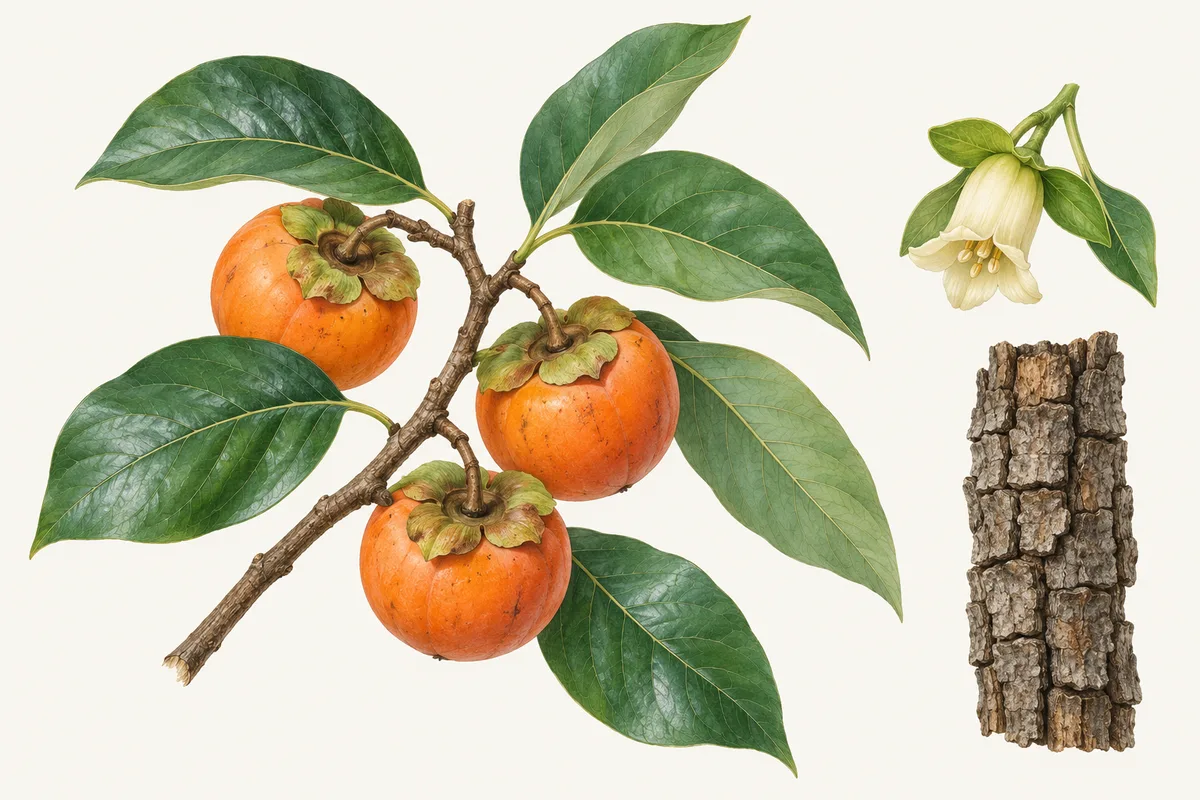
In short
Persimmon tree identification starts with the bark: on a mature common persimmon it is dark and broken into thick, square blocks that Virginia Tech compares to charcoal briquettes. Then check the leaves, alternate, oval, smooth-edged and 2.5 to 6 inches long, and the fruit, a round orange berry 3/4 to 2 inches across with a leafy cap, ripening from September to November.
- Square, blocky, dark bark on a medium-sized tree with smooth-edged oval leaves is the classic common persimmon.
- The fruit always wears a cap of leafy calyx lobes; black gum's small blue fruit and sassafras's blue fruit on red stalks do not.
- A yard tree with 3 to 4 inch orange fruit is usually an Asian persimmon (Diospyros kaki), a planted species from East Asia.
Field marks at a glance
- Scientific name
- Diospyros virginiana and Diospyros kaki
- Family
- Ebenaceae (ebony family)
- Type
- Broadleaf, deciduous
- Bark
- Young bark gray-brown with orange in the cracks; mature bark dark brown to black, broken into thick, square, scaly blocks like charcoal briquettes or a checkerboard.
- Leaves
- Alternate, simple, oblong to oval, smooth-edged, 2.5 to 5 inches long (Virginia Tech; NC State gives 2 to 6 inches). Shiny green above, paler or whitish below.
- Fruit
- A round, plum-like berry 3/4 to 2 inches across, green, then yellow, orange or dark red when ripe, often with a waxy bloom and a cap of leafy calyx lobes. Ripens September to November; often hangs on after leaf fall.
- Flowers
- Small, white to greenish-yellow, urn-shaped, in late spring (May to June). Male flowers in threes; female flowers single. Male and female flowers usually grow on separate trees.
- Twigs and buds
- Slender, light brown to gray, with no true end bud. Buds small, triangular, dark red to black, pressed against the twig, with 2 scales.
- Fall color
- Yellow, orange or bright red to reddish purple (NC State).
- Size
- Usually 30 to 60 ft (9 to 18 m); 70 to 80 ft on the best sites; a 15 to 20 ft shrubby tree on dry old fields.
- Range
- Common persimmon: native from Connecticut and Long Island south to Florida, west to Iowa, Kansas, Oklahoma and Texas, but not in the main Appalachian range. Asian persimmon: from East Asia, planted in yards.
Persimmons are the trees with the checkerboard bark. Common persimmon, also called American persimmon (Diospyros virginiana), grows wild across the eastern and central United States, in old fields, fence rows and woods; Asian persimmon (Diospyros kaki) is the larger-fruited species planted in yards. Both belong to the ebony family. Never eat a berry, nut, seed or pod on the strength of a web page or an app; check with a local expert. This page is about naming the tree.
How to identify a persimmon tree in any season
Work through four checks in this order. Each one is visible in a different season, so at least two are always available.
1. The bark (all year). On a mature common persimmon the bark is dark brown to black and broken into thick, square, scaly plates. The Virginia Tech common persimmon fact sheet says they are reminiscent of charcoal briquettes; NC State's American persimmon profile calls it a checkerboard of square blocks, sometimes known as alligator bark. Young bark is gray-brown with orange showing in the fissures, which is a good clue on saplings.
2. The leaves (spring to fall). Alternate, simple, oblong to oval and smooth-edged, 2.5 to 5 inches long according to Virginia Tech (2 to 6 inches in NC State's description), shiny green above and paler or whitish beneath. They look plain, which is why the bark and the fruit do most of the work.
3. The fruit (late summer into winter). A round, plum-like berry 3/4 to 2 inches across that turns from green to yellow, orange or dark red. The fruit sits on a cap of leafy calyx lobes, the same cap you see on a store-bought persimmon. The USDA Forest Service's Silvics of North America says it ripens from September to November and falls from September to late winter, so fruit often hangs on bare branches after leaf drop. Smaller orange fruit in clusters belongs to other trees; see trees with orange berries.
4. The twigs and buds (winter). Twigs are slender, light brown to gray, with no true end bud. The buds are small, triangular, dark red to black, pressed flat against the twig and covered by just two scales.
When bark, oval smooth-edged leaves and a capped orange fruit all agree, you have a persimmon. Tree Identifier can name the tree from one photo of a leafy branch, the fruit or the trunk. It shows no confidence score and no look-alike list, so run the checks above before accepting the name.
Common (American) persimmon: where it grows and how big
The USDA Forest Service maps common persimmon from southern Connecticut and Long Island south to Florida, and west through Pennsylvania, Ohio, Indiana, Illinois and Iowa to Kansas, Oklahoma and Texas. It does not grow in the main Appalachian range. It takes almost any site, from very dry, sandy woodland to river bottoms and rocky hillsides, and grows best in the bottomlands of the Mississippi River Valley.
- Size: usually 30 to 60 feet (9 to 18 m) at maturity, 70 to 80 feet (21 to 24 m) on the best sites, and only 15 to 20 feet (4.6 to 6.1 m) and shrubby on dry old fields.
- Form: a round-topped crown of crooked branches; trees in forest stands can grow a tall, slender trunk.
- Flowers: small, white to greenish-yellow and urn-shaped, appearing from about May to June in the Carolinas. Male flowers come in threes, female flowers singly.
- Fall color: NC State lists yellow, orange and bright red to reddish purple.
- Wood: heavy, hard and very close-grained; the Forest Service lists turnery, shoe lasts, shuttles and golf club heads among its traditional uses.
Male and female persimmon trees
Common persimmon is dioecious: the Forest Service describes male and female flowers on separate trees. Only female trees bear fruit, so a persimmon with the right bark and leaves but never any fruit is often a male tree. You can tell them apart in late spring. Male flowers are tubular, about 1/3 to 1/2 inch long and grouped in twos or threes; female flowers are single, about 3/4 inch long, with four or five greenish-yellow lobes. NC State adds that some trees carry perfect flowers, with both parts, so the rule has exceptions.
Asian persimmon in yards and orchards
The persimmon in a backyard with big orange fruit is usually the Asian or Japanese persimmon (Diospyros kaki). NC State's Asian persimmon profile describes a tree from eastern Asia, 20 to 30 feet tall, hardy in USDA zones 7a to 10b, with glossy leaves 3 to 6 inches long and orange fruit 3 to 4 inches across that can hang into winter. Its bark is brownish-gray and also breaks into rectangular or square plates, so bark does not separate the two species. Fruit size and the setting do: wild trees in fields and woods are almost always the native species.
Asian persimmon (Diospyros kaki) is one of the species in the app's Collection, the 138-species catalog that fills in as you identify.
Persimmon look-alikes: black gum, sassafras and sourwood
Virginia Tech lists three native trees that share persimmon's woods and its plain leaves. The quickest separating marks:
| Tree | Leaves | Fruit | Bark | Quick test |
|---|---|---|---|---|
| Common persimmon | Oval, smooth-edged, 2.5–5 in | Orange berry 3/4–2 in with a leafy cap | Square, dark blocks | The capped fruit |
| Black gum | 3–5 in, smooth or with a few coarse teeth near the tip | Dark purplish-blue, about 1/2 in | Shallow furrows, blocky when old | Chambered pith in a split twig |
| Sassafras | Oval, mitten and three-lobed on one tree | Dark blue drupe in a red cup on a red stalk | Red-brown, furrowed | Spicy smell of a broken twig |
| Sourwood | 4–7 in, very finely toothed | Dry five-part capsules | Deep furrows, rectangular plates | Drooping white flower sprays in midsummer |
Black gum and sourwood figures come from Virginia Tech's blackgum and sourwood fact sheets. For more on the trees in this table, see the black gum and sassafras pages, and the bark identification guide for other blocky and platy barks. If you are sorting a yard full of fruit trees, the fruit tree identification guide covers the common ones.
Tree Identifier's Tree Map keeps each identification you save with its location, which helps if you want to check a fruitless tree again next spring when it flowers. You can also ask the follow-up chat under a result how to tell a male persimmon from a female one.
Look-alikes and how to tell them apart
Black gum or tupelo (Nyssa sylvatica)
Old black gum bark also turns blocky, but its leaves are often widest near the tip with a few coarse teeth there, its fruit is a 1/2-inch dark purplish-blue berry with no leafy cap, and a split twig shows a pith divided into chambers.
Sassafras (Sassafras albidum)
Sassafras mixes oval, mitten-shaped and three-lobed leaves on one tree and its green twigs smell spicy-sweet when broken. Its fruit is a small dark blue drupe held upright in a red cup, not an orange berry.
Sourwood (Oxydendrum arboreum)
Sourwood bark can break into plates too, but its leaves are 4 to 7 inches long with very finely toothed edges, and it carries drooping sprays of small white flowers in midsummer, then dry five-part capsules instead of fleshy fruit.
Asian persimmon (Diospyros kaki)
Same genus and same leafy cap, but the planted Asian tree is usually smaller (20 to 30 ft) with glossier leaves up to 6 inches, and its orange fruit is larger, 3 to 4 inches across, often flattened or oval.
What a photo can't settle
- Bark alone can mislead: old black gum and sourwood also break into blocks, so check a leaf, a twig or the fruit before you settle on persimmon.
- A photo cannot show whether a fruitless persimmon is a male tree or a female that has not yet fruited; watch the flowers in late spring.
- Planted Asian persimmons include many varieties and the two species can look alike in leaf; fruit size is the most reliable check, and a single leaf photo may not separate them.
Questions people ask
What does persimmon tree bark look like?
On a mature common persimmon the bark is dark brown to nearly black and broken by deep cracks into thick, square, scaly blocks. Virginia Tech compares them to charcoal briquettes and NC State to a checkerboard, sometimes called alligator bark. Young trees have gray-brown bark with orange showing in the cracks.
What does a young persimmon tree look like?
A young persimmon has smooth or lightly cracked gray-brown bark with orange in the fissures, slender light brown twigs with no end bud, small dark red to black triangular buds, and the same smooth-edged, oval, shiny leaves as an old tree. The blocky bark comes with age.
Why does my persimmon tree have no fruit?
Often because it is a male tree. The USDA Forest Service describes common persimmon as dioecious, with male and female flowers on separate trees, so only female trees carry fruit. NC State notes that some trees have perfect flowers, and Asian persimmons in yards are often grafted fruiting varieties.
How do I tell American persimmon from Asian persimmon?
By fruit size and setting. American persimmon fruit is 3/4 to 2 inches across and the tree grows wild in woods and old fields of the eastern and central US. Asian persimmon fruit is 3 to 4 inches across, and the tree is a planted yard or orchard tree, usually 20 to 30 feet tall.
Sources
- Common persimmon fact sheet — Virginia Tech Dendrology
- Common Persimmon (Diospyros virginiana), Silvics of North America — USDA Forest Service
- Diospyros virginiana (American Persimmon) — NC State Extension Gardener Plant Toolbox
- Diospyros kaki (Asian Persimmon) — NC State Extension Gardener Plant Toolbox
- Blackgum fact sheet — Virginia Tech Dendrology
- Sourwood fact sheet — Virginia Tech Dendrology
Keep reading
- Field guideTree bark identification: seven bark types and the trees that have them
- Field guideFruit tree identification by leaf, bark and blossom
- Tree profileSassafras (Sassafras albidum): how to identify it
- Tree profileBlack gum tree (Nyssa sylvatica): black tupelo, sour gum, pepperidge
- Clue guideWhich trees have red leaves in fall? Sort them by leaf shape