Tree profile
Sassafras (Sassafras albidum): how to identify it
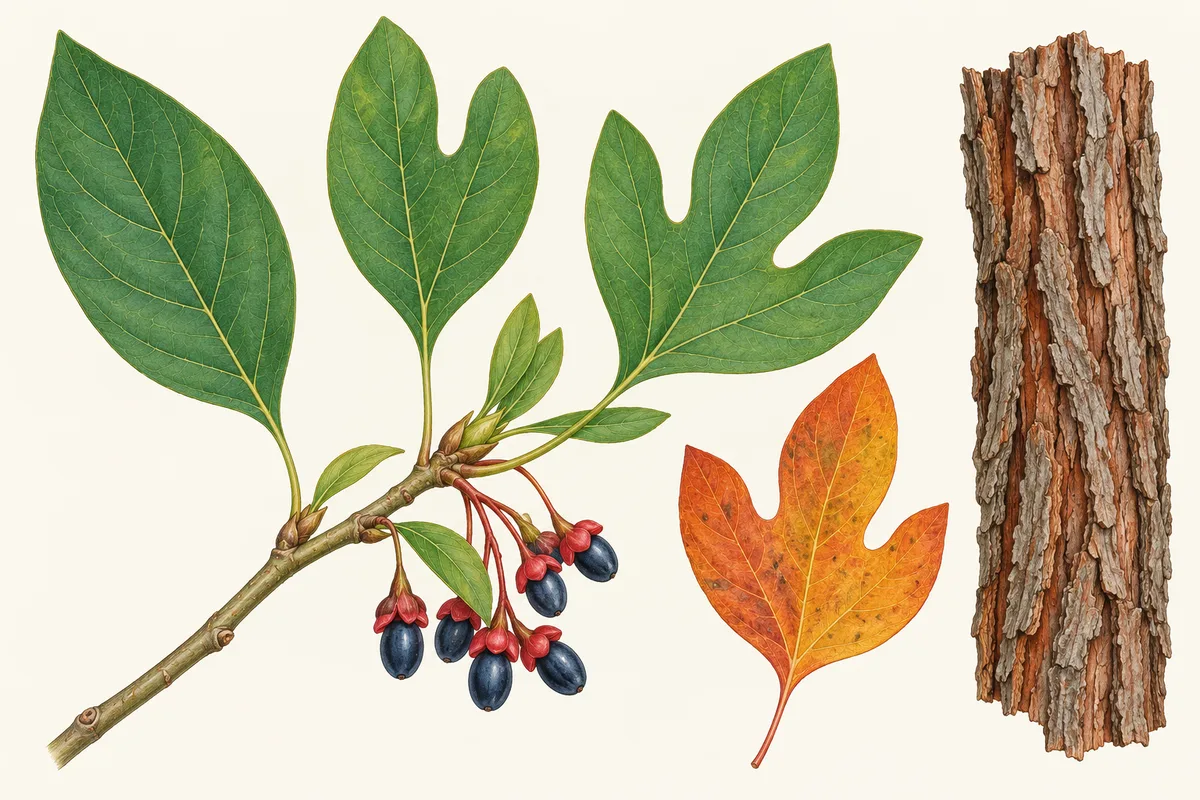
Oval, mitten-shaped and three-lobed leaves on the same branch, all smooth-edged and fragrant. Snap a green twig and it smells spicy-sweet.
In short
Sassafras tree identification starts with the leaves: smooth-edged, 3 to 6 inches long, and in three shapes on the same tree, unlobed, two-lobed like a mitten and three-lobed like a trident. Crush a leaf or snap a green twig for a spicy-sweet smell. Female trees carry dark blue fruit held upright in red cups on red stalks in late summer.
- Three leaf shapes on one branch with smooth edges: sassafras. Three shapes with toothed edges and milky sap: mulberry.
- In winter, look for slender green twigs that smell spicy-sweet when broken, and suckers forming a thicket.
- Older bark is red-brown with deep furrows and corky ridges; a cut shows cinnamon-brown inner bark.
Field marks at a glance
- Scientific name
- Sassafras albidum
- Family
- Lauraceae (laurel family)
- Type
- Broadleaf, deciduous
- Leaves
- Alternate, simple, smooth-edged, 3 to 6 inches long; unlobed (oval), two-lobed (mitten) or three-lobed (trident), often all three on one branch. Fragrant when crushed.
- Twigs
- Slender and green, sometimes hairy, with a spicy-sweet smell when broken. On young plants side twigs leave the stem at a steady angle of about 60 degrees.
- Buds
- Green, about 1/4 inch long, on slender green twigs; a scratched bud or twig smells spicy-sweet.
- Flowers
- Yellow-green, about 1/3 inch across, without petals, in 2-inch clusters as or before the leaves open, March to May. Male and female flowers on separate trees.
- Fruit
- On female trees only: a dark blue drupe about 1/3 to 1/2 inch long, held upright in a red cup on a red stalk, ripening in August and September.
- Bark
- Young bark green to brown; older bark red-brown, deeply furrowed with corky ridges; cinnamon-brown inner bark with a spicy smell when cut.
- Fall color
- Yellow, orange, red and burgundy, often several colors on one tree.
- Form and size
- Usually 30 to 60 ft, a shrub in the north of its range; irregular, often twisted trunk and flat-topped crown. Suckers from the roots form thickets.
- Range
- Eastern North America: southwestern Maine to central Michigan and extreme southern Ontario, south to central Florida and eastern Texas, west to Iowa, Missouri and eastern Oklahoma.
Sassafras (Sassafras albidum) is the tree with three leaf shapes. It belongs to the laurel family, grows wild across eastern North America and often stands in a thicket of its own root suckers along fence rows and old fields. Its leaves, its green twigs and its bark all carry a spicy, sweet smell that settles the identification even in winter. Never eat a berry, nut, seed or pod on the strength of a web page or an app; check with a local expert.
How to identify a sassafras tree: leaves first
1. Three shapes on one branch. The Virginia Tech sassafras fact sheet describes alternate, simple, smooth-edged leaves 3 to 6 inches long that are unlobed, two-lobed (mitten-shaped) or three-lobed (trident-shaped), with all three forms often on the same branch. The USDA Forest Service's Silvics of North America calls them "three distinctive leaf shapes". Look at several leaves before deciding: a branch with only oval leaves is common, especially in the upper crown.
2. Smooth edges. Run a finger along the margin. Sassafras leaves have no teeth. This is the single feature that separates it from the mulberries, which share the three shapes but always have toothed edges.
3. The smell. Crush a leaf: Virginia Tech calls it fragrant, and NC State's sassafras profile says all parts of the tree are aromatic. Snap a young twig for a stronger, spicy-sweet scent.
4. Green twigs. Sassafras twigs are slender and bright green, sometimes hairy, with green buds about 1/4 inch long. On young plants Virginia Tech notes that the side twigs leave the stem at a steady angle of about 60 degrees.
A photo that shows two or three leaf shapes on one twig gives Tree Identifier a good chance to name sassafras. Sassafras (Sassafras albidum) is one of the species in the app's Collection, the 138-species catalog that fills in as you identify. The app shows no confidence score, so check the smooth edges and the smell yourself.
Flowers, fruit and fall color
Flowers. In early to mid-spring, as or just before the leaves open, sassafras carries 2-inch clusters of small yellow-green flowers. NC State describes them as about 1/3 inch across with six sepals and no petals, from March to May; male and female flowers grow on separate trees, and female trees bloom more heavily. Our guide to trees with yellow flowers lists sassafras with the other early bloomers of the East.
Fruit. Only female trees fruit. The fruit is a dark blue, shiny drupe about 1/3 to 1/2 inch long, held upright in a red cup at the end of a red stalk about an inch long. The Forest Service gives August and September for ripening.
Fall color. Sassafras turns yellow, orange, red and burgundy, often several colors on one tree (NC State). It is one of the trees in our guide to trees with red leaves in fall.
Bark, size, thickets and range
- Bark: brown with cinnamon-brown inner bark, becoming coarsely ridged and furrowed (Virginia Tech); NC State describes reddish-brown bark with deep furrows and corky ridges. Cut bark has a spicy smell.
- Size: NC State gives 30 to 60 feet tall and 25 to 40 feet wide; the Forest Service says sassafras is little more than a shrub in the north of its range and short and shrubby on poor sites, while the best trees grow tall with a narrow, flat-topped crown.
- Thickets: sassafras reproduces readily from root sprouts, and the Forest Service says dense thickets often form from root sprouts rather than seed. A grove of small sassafras along a field edge is often one connected plant.
- Range: southwestern Maine west through New York, extreme southern Ontario and central Michigan; southwest through Illinois, southeastern Iowa, Missouri, southeastern Kansas and eastern Oklahoma to eastern Texas; east to central Florida (Forest Service).
- Habitat: a pioneer of abandoned fields, fence rows and dry ridges, especially after fire, and found on nearly all soils in its range.
Sassafras vs mulberry and other look-alikes
| Feature | Sassafras | Mulberry |
|---|---|---|
| Leaf shapes | Oval, mitten, three-lobed | Unlobed, mitten, lobed |
| Leaf edge | Smooth | Toothed |
| Sap from a broken leaf stalk | Not milky | Milky |
| Twig | Green, spicy-sweet smell | Slender, zigzag |
| Fruit | Dark blue drupe in a red cup on a red stalk | Blackberry-like cluster |
Virginia Tech's red mulberry fact sheet describes toothed leaves that range from unlobed to deeply lobed. Our mulberry page covers the milky sap test and red vs white mulberry, and the heart-shaped leaves guide puts sassafras next to redbud, linden and catalpa.
When a sassafras shows only oval leaves, Virginia Tech lists sourwood, black gum and common persimmon as look-alikes. The smell of a twig and the absence of teeth narrow it quickly; persimmon's blocky bark and black gum's chambered pith rule those two out.
On safety and uses. The Forest Service notes that oil of sassafras was extracted from root bark for the perfume industry and that tea was brewed from root bark. NC State Extension lists the bark as poisonous with low severity, names safrole as the toxic principle and says it has been shown to be a weak carcinogen in experimental animals. This page names the tree; it gives no advice on using it.
If you want to find a sassafras again when it turns red in October, Tree Identifier's Tree Map keeps each identification you save with its location.
Look-alikes and how to tell them apart
Red and white mulberry (Morus rubra, M. alba)
Mulberries also carry unlobed, mitten and three-lobed leaves on one tree, but every mulberry leaf is toothed, a snapped leaf stalk bleeds milky sap, and the fruit is a blackberry-like cluster. Sassafras leaves are smooth-edged and its twigs are green and spicy-smelling.
Common persimmon (Diospyros virginiana)
On a sassafras with only oval leaves, persimmon is the confusion. Persimmon leaves are shinier and never lobed, its twigs are brown and odorless, its bark breaks into square dark blocks, and its fruit is an orange berry with a leafy cap.
Black gum (Nyssa sylvatica)
Black gum leaves are oval like sassafras's unlobed leaves but never mitten-shaped; split a black gum twig to see a pith divided into chambers, and its fruit is a dark blue berry without the red cup.
What a photo can't settle
- A tree with only oval leaves in a photo could be sassafras, persimmon or black gum; photograph several leaves, ideally a mitten-shaped one, or check the twig smell.
- Leaf edges in a photo can hide small teeth; zoom in or check by hand before deciding between sassafras and mulberry.
- Only female trees carry the blue fruit on red stalks, so a fruitless sassafras in late summer is normal and says nothing about the identification.
Questions people ask
What do sassafras leaves look like?
They are smooth-edged, 3 to 6 inches long and come in three shapes: unlobed and oval, two-lobed like a mitten, and three-lobed like a trident. Virginia Tech notes all three can grow on one branch. They are bright green above, paler beneath, and fragrant when crushed.
What does a sassafras tree smell like?
Spicy-sweet. Virginia Tech describes that aroma from broken twigs and a spicy smell from cut bark, and NC State says all parts are aromatic. Crush a leaf or scratch a green twig to check; the smell is the quickest confirmation in winter, when there are no leaves.
Is sassafras toxic?
NC State Extension lists sassafras as poisonous with low severity, names safrole as the toxic principle and the bark as the poisonous part, and notes that safrole has been shown to be a weak carcinogen in experimental animals. This page gives no advice on using any part of the tree.
How do I identify sassafras in winter?
Look for slender, bright green twigs with green buds about 1/4 inch long; scratch one and it smells spicy-sweet. On young trees the side twigs leave the stem at a regular angle of about 60 degrees. Older trees have red-brown, deeply furrowed bark, and the tree often stands in a thicket of root suckers.
Sources
- Sassafras fact sheet — Virginia Tech Dendrology
- Sassafras (Sassafras albidum), Silvics of North America — USDA Forest Service
- Sassafras albidum (Common Sassafras) — NC State Extension Gardener Plant Toolbox
- Red mulberry fact sheet — Virginia Tech Dendrology