Clue guide
Which tree has orange berries? Check the leaf, the thorns and where you are
Orange berries on a tree come from a short list, and three checks sort it: whether the leaves are feather-like, silvery or plain, whether there are thorns, and where you are.
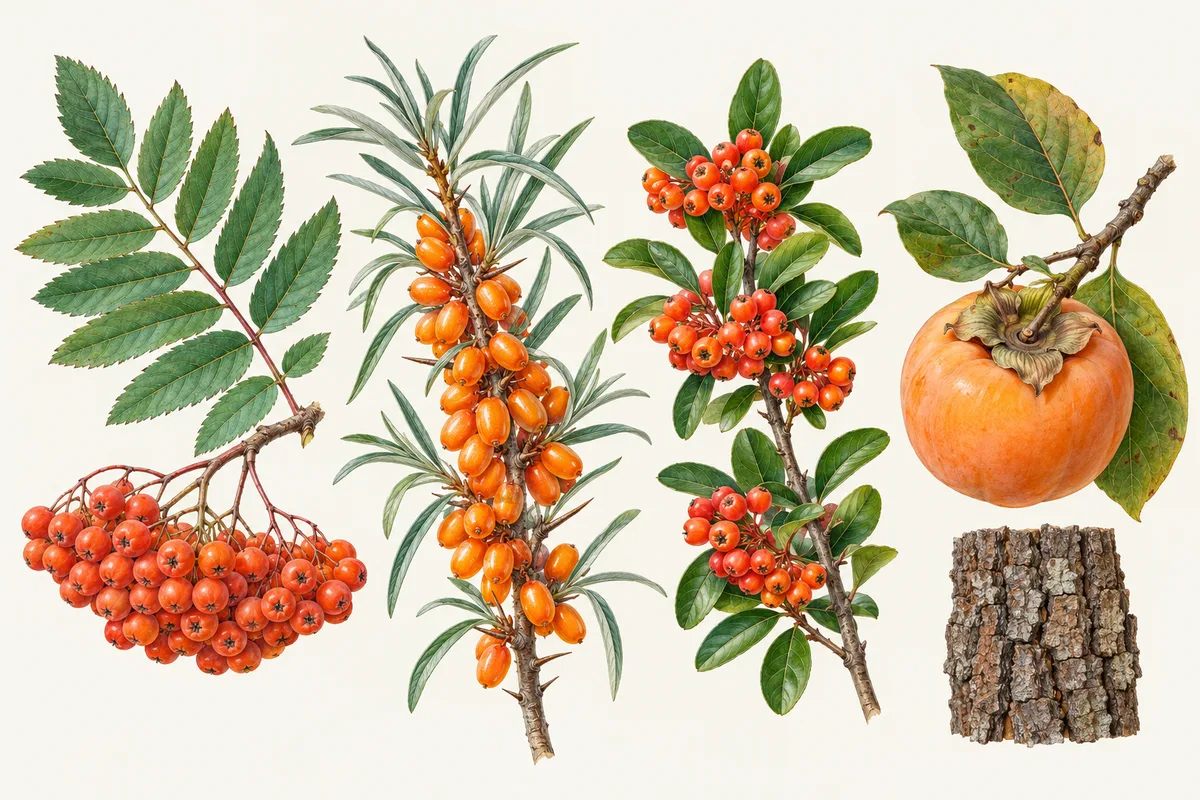
In short
A tree with orange berries is most often a mountain-ash or rowan (feather-like leaves, flat clusters of orange-red berries from late summer), a firethorn (thorny evergreen, orange-red fruit through winter) or, on silvery-leaved thorny shrubs, sea buckthorn or buffaloberry. In the Pacific Northwest, check Pacific madrone; in the East, orange fruit 1 to 1.5 inches across is a persimmon.
- Feather-like leaves with toothed leaflets and big clusters of orange-red berries mean mountain-ash or rowan, the commonest answer in Minnesota, Wisconsin, Michigan, Canada, the UK and Ireland.
- Narrow silvery leaves and thorns mean sea buckthorn (UK, Ireland, planted in Canada) or silver buffaloberry (Prairie Provinces and the Great Plains).
- Orange 'berries' in yellow husks on a vine climbing a tree are oriental bittersweet, which NC State lists as invasive, not fruit of the tree itself.
A tree with orange berries comes from a short list, and the leaf decides most cases before you even look closely at the fruit. Never eat a berry, nut, seed or pod on the strength of a web page or an app; check with a local expert. This page only helps you put a name on the plant.
Orange-berried trees by leaf and region
| Tree | Leaf | Orange fruit | When | Where |
|---|---|---|---|---|
| Rowan and mountain-ash (Sorbus) | Feather-like, 5–8 pairs of toothed leaflets plus one at the tip | Scarlet to orange-red, in dense clusters | Late summer to autumn | Northern US, Canada, UK, Ireland; planted widely |
| Sea buckthorn (Hippophae rhamnoides) | Narrow, willow-like, silvery | Small, bright orange, on female plants | Autumn | Native to Britain and Ireland; Eurasia |
| Firethorn (Pyracantha coccinea) | Evergreen, shiny, 1–2.5 in; sharp spur thorns | Orange-red, about 1/4 in | Fall, often all winter | Planted; from southern Europe to Iran |
| Silver buffaloberry (Shepherdia argentea) | Silvery gray both sides, 1–2 in, opposite; thorny | Mostly reddish-orange, about 1/4 in | Late summer, can last to spring | Prairie Provinces south to the Great Plains |
| Pacific madrone (Arbutus menziesii) | Evergreen, leathery | Bright red or reddish-orange, 8–12 mm | Mid-September to mid-November | British Columbia to California |
| Common persimmon (Diospyros virginiana) | Oval, 2–6 in, smooth edge | Pale orange, 1–1.5 in, waxy | September–December | New England to Florida, west to Texas and Kansas |
| Oriental bittersweet (Celastrus orbiculatus), a vine | Climbing vine through trees | Yellow husks splitting to show scarlet fruit | August–January | Invasive in much of the East |
Data come from the Woodland Trust (rowan), the RHS (sea buckthorn), USDA NRCS (buffaloberry), the USDA Forest Service (Pacific madrone) and NC State Extension (firethorn, persimmon, bittersweet), read on 21 October 2026.
Feather-like leaves: rowan and mountain-ash
If the leaves are divided into a row of toothed leaflets and the berries hang in heavy, flat clusters, you are looking at a rowan or a mountain-ash. The Woodland Trust describes alternate leaves of 5 to 8 pairs of long, oval, toothed leaflets plus one at the tip, creamy-white five-petalled flowers in dense clusters, and scarlet berries that ripen in autumn. Many people describe those clusters as orange or orange-red rather than scarlet, which is why so many "orange berries" searches from Minnesota, Wisconsin, Michigan, Maine, Alberta, Nova Scotia, the UK and Ireland end here. The bark is smooth and silvery gray, and the buds purple and hairy.
The Woodland Trust names ash and elder as the look-alikes: rowan's leaflets are serrated and more or less pointed at the tip, unlike either. European rowan is planted across North America next to the native American and showy mountain-ashes. The rowan page separates them, and trees with red berries covers the American mountain-ash in its red phase.
Silvery leaves and thorns: sea buckthorn and buffaloberry
A thorny shrub or small tree with narrow silvery leaves and orange berries packed along the stems is one of two plants in the oleaster family, and geography tells them apart.
Sea buckthorn is the answer in Britain and Ireland. The RHS describes a large deciduous shrub or small tree to about 6 m with narrow, willow-like, silvery leaves, thorny shoots and small, bright orange berries on female plants only. The RHS lists it as native to Great Britain and Ireland, and also as an invasive non-native species in Northern Ireland, where planting it in the wild is an offence.
Silver buffaloberry is the North American counterpart of the prairies. The USDA NRCS plant guide describes a thorny, thicket-forming native shrub to small tree, 3 to 20 feet tall, with opposite branching and leaves silvery gray on both sides, about 1 to 2 inches long. The fruit is about 1/4 inch long, mostly reddish-orange, ripening by late summer and sometimes hanging on dried until the next spring. It grows mainly in the prairies and parklands of the Prairie Provinces and south to California, Arizona, New Mexico and Oklahoma, most commonly in the northern Great Plains. If you are in Alberta, Saskatchewan, Montana or the Dakotas, start here.
Thorny evergreen against a wall: firethorn
An evergreen shrub with orange-red fruit, often trained flat against a house wall or fence, is a firethorn. NC State describes an upright, stiff plant 6 to 18 feet tall with sharp spur thorns, shiny dark green leaves 1 to 2.5 inches long, white flowers in clusters in spring, and showy orange-red fruits about 1/4 inch across that ripen in fall and often last through winter. Firethorn is native to southern Europe east to Iran. It is grown as a shrub more often than a tree, but old or trained plants reach tree height, which is why it appears in "small tree with orange berries" searches in the UK.
Pacific Northwest: Pacific madrone
On the West Coast from British Columbia to California, an evergreen tree with smooth, reddish-orange bark and clusters of orange-red berries is Pacific madrone. The USDA Forest Service silvics account describes ripe berries as bright red or reddish-orange, 8 to 12 mm across, ripening from mid-September to mid-November, often with yellowish-orange or yellowish-green berries in the same cluster. The bark is the giveaway: it peels away to a smooth reddish-orange layer, as covered on the peeling bark page. The native range runs from the east coast of Vancouver Island south to San Diego County.
Big orange fruit on a blocky-barked tree: persimmon
If the "berry" is the size of a plum, 1 to 1.5 inches across, pale orange with a waxy coating, the tree is a common persimmon. NC State gives fruit from September through December on female trees only, oval leaves 2 to 6 inches long, and thick, dark gray bark broken into square blocks, often called alligator bark. Persimmon is native from New England to Florida and west to Texas and Kansas. The persimmon page covers it through the year, including the planted Asian persimmon.
Not the tree at all: bittersweet
Clusters of orange and scarlet fruit spilling out of a tree in fall and winter may belong to a vine. NC State describes oriental bittersweet as a woody, twining vine reaching 30 to 60 feet, with capsules that turn yellow and split open to show scarlet, berry-like fruit from August to January. It is listed as invasive by the NC Invasive Plant Council and other agencies, is a Class C noxious weed in North Carolina, and hybridizes with the native American bittersweet. Follow the stem with the fruit: if it twines around the trunk rather than growing from it, the tree is something else.
Using a photo
A photo that shows one berry cluster together with a leaf, and the twig if there are thorns, gives the best lead. Tree Identifier names a plant from one photo, and European rowan and Japanese persimmon are among the species in its Collection. It shows no confidence score or list of alternatives, so check the result against the leaf and region columns in the table. The follow-up chat under each result can answer questions such as how sea buckthorn differs from buffaloberry. Its Toxicology notes are AI-written and are not a safety verdict: for anything about eating fruit, ask a local expert.
What a photo can't settle
- Mountain-ash and rowan species, and the many firethorn and sea buckthorn cultivars, often look alike in a photo of the berries alone; leaves and twigs narrow it further.
- Orange fruit on a tree may belong to a vine growing through it. Follow the stem before you name the tree.
- No page or app can tell you a berry is safe to eat. Treat any identification as a name to check with a local expert.
Questions people ask
What tree has orange berries in fall?
Across the northern US, Canada, the UK and Ireland, usually a mountain-ash or rowan, whose berry clusters ripen from late summer into autumn. Firethorn's orange-red fruit ripens in fall and often lasts all winter. Pacific madrone's berries ripen from mid-September to mid-November, and common persimmon fruit shows from September to December.
What tree has orange berries and thorns?
Firethorn, an evergreen shrub often trained flat against walls, with sharp spur thorns and orange-red fruit about 1/4 inch across. On a thicket of silvery-leaved shrubs, sea buckthorn (UK and Ireland) or silver buffaloberry (Prairie Provinces and the Great Plains).
What tree has orange berries in Washington state?
Pacific madrone is the native one. The USDA Forest Service describes ripe berries as bright red or reddish-orange, 8 to 12 mm across, often with yellowish-orange ones in the same cluster, on a tree with smooth, reddish-orange bark. Planted mountain-ash and firethorn are the other usual answers in towns.
Are orange berries on trees edible?
No page or app can tell you. Some are reported harmful: USDA NRCS, for example, says buffaloberry fruit contains saponin, which can irritate the digestive system. Never eat a berry, nut, seed or pod on the strength of a web page or an app; check with a local expert.
Why does my sea buckthorn or persimmon have no fruit?
Both have separate male and female plants. The RHS says sea buckthorn berries form only on female plants and need a male nearby, and NC State says common persimmon needs both sexes for fruit. A fruitless plant is often a male.
Sources
- Rowan (Sorbus aucuparia) — Woodland Trust
- Hippophae rhamnoides (sea buckthorn) — Royal Horticultural Society
- Pyracantha coccinea (firethorn) — North Carolina Extension Gardener Plant Toolbox, NC State University
- Silver Buffaloberry, Shepherdia argentea (Plant Guide) — USDA Natural Resources Conservation Service
- Pacific Madrone (Silvics of North America) — USDA Forest Service
- Diospyros virginiana (common persimmon) — North Carolina Extension Gardener Plant Toolbox, NC State University
- Celastrus orbiculatus (oriental bittersweet) — North Carolina Extension Gardener Plant Toolbox, NC State University
Keep reading
- Clue guideWhich tree has red berries? Sort it by leaf and season
- Tree profileRowan tree (mountain ash): how to identify it
- Tree profilePersimmon tree (Diospyros): how to identify it
- Clue guideWhich tree has peeling bark? Sort it by the color underneath
- Field guideTree seed identification: from acorn, pod or samara to the tree