Clue guide
Which tree has black berries? Sort it by leaf and cluster
Check how the berries hang (long strings, flat heads, single fruits or tight clusters on the twig), then whether the leaves are opposite or alternate. Most black-berried trees come down to one name.
In short
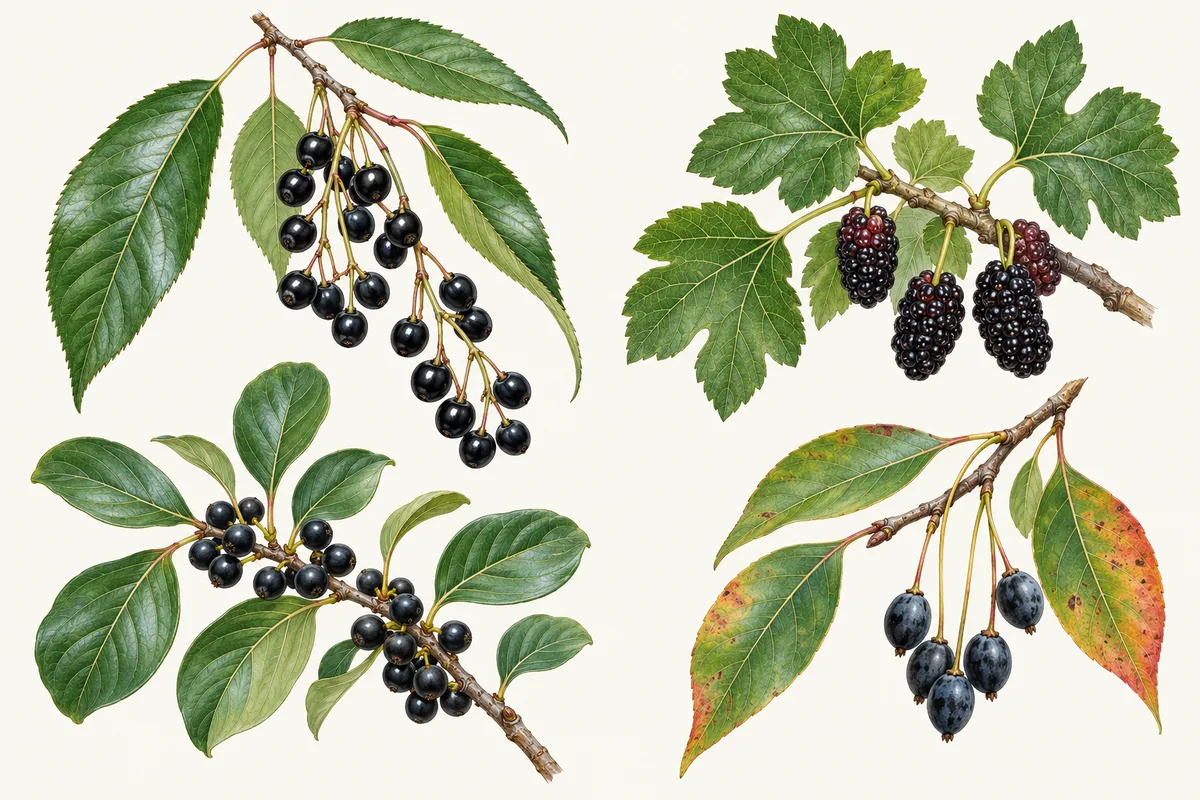
A tree with black berries is most often a black cherry (drooping strings of 3/8-inch purple-black cherries in late summer), a black tupelo (one to three blue-black fruits on long stalks), a mulberry (blackberry-like clusters) or an elderberry (flat heads of tiny berries above opposite, compound leaves). Black berries on thorn-tipped twigs mean common buckthorn, an invasive tree in the Midwest and Canada.
- How the berries hang sorts the list fastest: long drooping strings (black cherry, chokecherry), flat-topped heads (elderberry), few on long stalks (black tupelo), blackberry-shaped (mulberry), tight clusters along the twig (buckthorn, privet).
- Opposite leaves narrow a black-berried tree to elderberry or privet; common buckthorn is nearly opposite, with a thorn at the twig tip.
- Several of these fruits are reported toxic to people or pets by NC State Extension; no page or app can tell you a berry is safe to eat.
A tree with black berries is easiest to name from the way the fruit hangs and the arrangement of the leaves. Never eat a berry, nut, seed or pod on the strength of a web page or an app; check with a local expert. Several fruits below are reported toxic to people or pets by NC State Extension, and this guide is only for putting a name on the tree.
Black-berried trees at a glance
| Tree | How the berries hang | Size and color | When | Leaves | Our page |
|---|---|---|---|---|---|
| Black cherry (Prunus serotina) | Drooping strings, 3–6 in long | About 3/8 in, purple-black | Late summer | Alternate, finely toothed with incurved teeth | Cherry |
| Chokecherry (Prunus virginiana) | Drooping strings | Red, ripening black | Summer | Alternate, toothed, long-pointed tip | This page |
| Black tupelo (Nyssa sylvatica) | One to a few, on stalks up to 1.5 in | 3/8–1/2 in, bluish black | Late summer to fall | Alternate, smooth-edged, blunt tip | Black gum |
| Mulberry (Morus) | Blackberry-shaped clusters | 1/2–1 1/4 in long, red to purple-black | Early to mid summer | Alternate, toothed, several shapes | Mulberry |
| Elderberry (Sambucus) | Large flat or drooping heads | About 1/4 in, purple-black | August–September | Opposite, compound, 5–11 leaflets | Elder |
| Common buckthorn (Rhamnus cathartica) | Tight clusters along the twig | 1/4–1/2 in, glossy black | Fall | Nearly opposite, toothed, curving veins; thorn at twig tip | This page |
| Chinese privet (Ligustrum sinense) | Clusters at branch ends | Under 1 in, black | Summer into winter | Opposite, small, smooth-edged | This page |
| Blackthorn (Prunus spinosa), UK | Single fruits along spiny twigs | Blue-black sloes | Autumn | Small, toothed; spiny side shoots | Hawthorn vs blackthorn |
Figures come from the NC State Extension Gardener Plant Toolbox, except elder and blackthorn in Britain (Woodland Trust and our blackthorn page).
Drooping strings of black cherries: black cherry and chokecherry
If the black fruits hang in long, drooping strings like small bunches of grapes, the tree is almost certainly a wild cherry.
Black cherry is the big one, a forest and fencerow tree of 60 to 80 feet. The NC State profile describes fragrant white flowers in drooping clusters 3 to 6 inches long in late April and May, followed by purple-black cherries about 3/8 inch across that ripen in late summer. The leaves are 3 to 6 inches long, narrow, with fine incurved teeth. Young bark is shiny with lenticels; old bark breaks into a dark, scaly, flaky pattern. NC State rates the fruit, leaves and seeds as toxic, says ingestion is likely to cause death in livestock and pets, and advises people not to eat the fruit. The cherry page separates black cherry from planted and other wild cherries.
Chokecherry is the northern and western answer, a likely answer for searches from Minnesota, Ontario and Alberta. NC State describes it as a large shrub or small tree of 20 to 30 feet that forms dense thickets by spreading underground, with thin, smooth, dark brown to gray bark. Its fruit is red at first and turns black when ripe. The leaves are toothed and taper to a long, slender tip, and crushed leaves have a strong, bitter smell. NC State lists the stems, leaves and seeds as containing cyanide, particularly when wilting.
Few berries on long stalks: black tupelo
A tree with glossy, smooth-edged leaves and only one to three blue-black fruits per long stalk is a black tupelo, also called black gum. The NC State profile gives fruit 3/8 to 1/2 inch long on stalks up to 1 1/2 inches, ripening from late summer through fall, on female trees only. The leaves are 3 to 6 inches long with blunt tips and turn brilliant yellow, orange, red or purple in fall. Old bark breaks into hard, square blocks. It grows from southern Ontario through the central and eastern United States. The black gum page covers the tree in detail.
Berries like blackberries: mulberry
If the black fruit looks like a stretched blackberry, the tree is a mulberry. Female trees bear cylindrical clusters about 1/2 to 1 1/4 inches long that ripen red, then dark purple or black, in early to mid summer. Snap a leaf stalk: mulberries bleed milky sap. The leaves are toothed and come in several shapes on the same tree. Native red mulberry and introduced white mulberry both ripen dark purple to black, so the mulberry page uses the leaf surface to tell them apart.
Flat heads and opposite leaves: elderberry
Huge, flat-topped or drooping heads of tiny dark berries above opposite, compound leaves mean an elderberry. In North America, the NC State profile of American elderberry describes a multi-stemmed shrub or small tree of 5 to 12 feet with 5 to 11 toothed leaflets, creamy-white flower clusters 4 to 10 inches across in June, and purplish-black fruit about 1/4 inch across from August to September. NC State notes that unripe fruits are much more toxic than fully ripe ones.
In Britain and Ireland, elder is widespread in woodland, scrub, wasteland and hedgerows. The Woodland Trust describes a tree up to about 15 m with grey-brown, corky bark, leaves of 5 to 7 toothed leaflets that smell unpleasant when bruised, flowers from late May and small purple-black berries from late summer into autumn. It states that uncooked berries are poisonous. See the elder page for the tree in full.
Tight clusters on the twigs: buckthorn and privet
Common buckthorn is the answer to "black berries and thorns" in the Upper Midwest, the Great Lakes and Canada. The NC State profile describes a small tree up to about 30 feet with toothed, elliptical leaves set opposite or nearly so, with veins that arch toward the tip, and a straight thorn at the end of the twig between two curved buds. Scrape the bark and the inner bark is orange. Only female trees fruit: glossy black fruits 1/4 to 1/2 inch across that mature in fall, rated mildly toxic to people and mammals. Its leaves persist into late fall. The Minnesota Department of Agriculture lists common and glossy buckthorn as restricted noxious weeds, which may not be imported, sold or transported in the state except by permit.
Chinese privet is the Southern version: an evergreen or semi-evergreen shrub or small tree of 6 to 15 feet with opposite, smooth-edged leaves about 1 to 3 inches long. According to NC State, it carries creamy white, strong-smelling flowers in late spring and clusters of black fruit that birds eat and spread; the fruit and leaves have low-severity poison characteristics. NC State calls it an invasive species in North Carolina.
UK and Ireland: elder, blackthorn and buckthorn
Three black or near-black fruits dominate British hedgerows. Elder carries flat heads of tiny purple-black berries above opposite, feather-like leaves. Blackthorn carries single blue-black sloes along dark, spiny twigs; its white flowers open on bare branches in March and April, which the hawthorn vs blackthorn page uses to separate it from hawthorn. Common buckthorn, also called purging buckthorn, is native to Europe, Africa and northern Asia according to NC State and keeps the same thorn at the twig tip.
If the berries are red rather than black, see the tree with red berries guide; if they are still green, the tree with green balls guide.
When a photo helps
A photo that shows a cluster of berries with two or three leaves still attached gives the best lead. Tree Identifier names a tree from one photo, and black tupelo and white mulberry are in the app's Collection. The app does not show a confidence score or a list of look-alikes, so check the result against how the berries hang and how the leaves are arranged. Tree Identifier's Toxicology notes are AI-written and are not a safety verdict: for anything about eating fruit, ask a local expert or call poison control.
What a photo can't settle
- Black cherry and chokecherry fruit look alike in a photo; the size of the tree, the bark and the leaf teeth settle it.
- Unripe fruit of many trees passes through red or purple before black, so the color on the day of your photo may not match a description.
- No page or app can say a black berry is safe to eat. Treat any identification as a name to check, not a permission.
Questions people ask
What tree has berries that look like blackberries?
A mulberry. Female mulberry trees bear cylindrical clusters of tiny fruits, about 1/2 to 1 1/4 inches long, that look like elongated blackberries and ripen red to dark purple or black. Confirm with the leaves: toothed, often in several shapes on one tree, with milky sap when a leaf stalk is snapped.
What tree has black berries and thorns?
In the Midwest, the Great Lakes and Canada, usually common buckthorn: a straight thorn at the twig tip between two buds, nearly opposite toothed leaves with curving veins, and glossy black fruits in fall. In Britain, a blackthorn with blue-black sloes on spiny twigs. Minnesota lists common buckthorn as a restricted noxious weed.
What tree has small black berries in winter?
Privet often keeps clusters of black fruit into winter on evergreen or semi-evergreen branches with small opposite leaves. Common buckthorn fruit also hangs on after its leaves, which stay green late into fall. Both are spread by birds that eat the fruit.
Are black berries on trees poisonous?
Some are. NC State Extension reports that black cherry fruit, leaves and seeds contain cyanogenic glycosides and advises people not to eat the fruit; it lists common buckthorn and privet fruit as mildly toxic and unripe elderberries as much more toxic than ripe ones. Never eat a berry on the strength of a web page or an app.
What is the difference between black cherry and chokecherry?
Black cherry is a tall forest tree, 60 to 80 feet, with dark, scaly bark on old trunks and leaves with fine, incurved teeth. Chokecherry is a large shrub or small tree of 20 to 30 feet that forms thickets, with smooth dark bark; its fruit turns red before ripening black.
Sources
- Prunus serotina (black cherry) — North Carolina Extension Gardener Plant Toolbox, NC State University
- Prunus virginiana (common chokecherry) — North Carolina Extension Gardener Plant Toolbox, NC State University
- Nyssa sylvatica (blackgum) — North Carolina Extension Gardener Plant Toolbox, NC State University
- Sambucus canadensis (American elderberry) — North Carolina Extension Gardener Plant Toolbox, NC State University
- Elder (Sambucus nigra) — Woodland Trust
- Rhamnus cathartica (common buckthorn) — North Carolina Extension Gardener Plant Toolbox, NC State University
- Minnesota Noxious Weed List — Minnesota Department of Agriculture
- Ligustrum sinense (Chinese privet) — North Carolina Extension Gardener Plant Toolbox, NC State University
Keep reading
- Clue guideWhich tree has red berries? Sort it by leaf and season
- Tree profileMulberry (Morus): how to identify it
- Tree profileBlack gum tree (Nyssa sylvatica): black tupelo, sour gum, pepperidge
- Tree profileElder tree (Sambucus nigra): how to identify it
- Clue guideWhich tree has green balls? Sort it by the size of the ball