Clue guide
Which tree has green balls? Sort it by the size of the ball
Measure the ball against something in your pocket, squeeze it, and check whether it hangs from the leaves, the twigs or a conifer branch. Those three checks narrow green balls to one or two trees.
In short
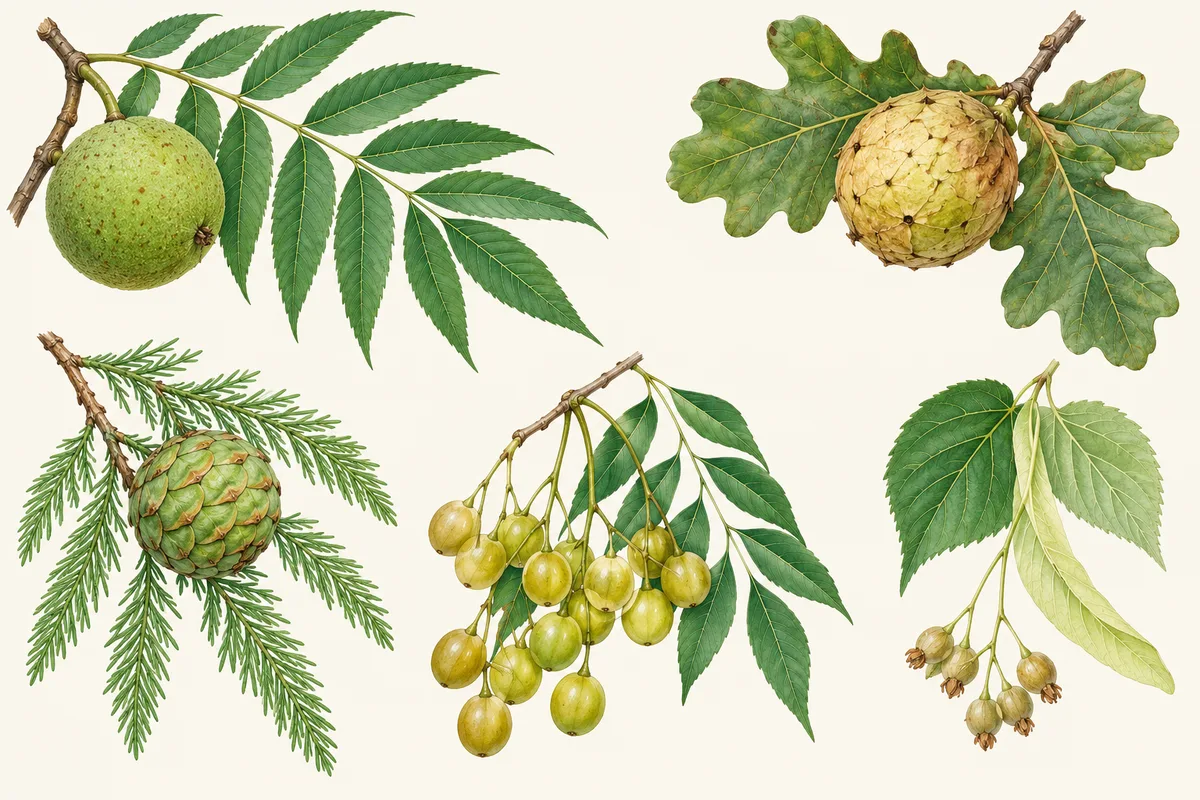
A tree with green balls is most often an Osage orange if the balls are wrinkled and 3 to 6 inches across, a black walnut if they are smooth, 1 to 3 inches and stain your hands, or a red or black oak if a 1 to 2 inch light, spongy ball is stuck to a leaf (an oak apple gall). Smaller balls point to bald cypress, chinaberry, cherry laurel, camphor or linden.
- Size sorts green balls fastest: softball (Osage orange), golf ball to tennis ball (walnut, pecan, oak apple gall), marble (bald cypress cone, chinaberry, cherry laurel), pea (linden, camphor).
- A ball attached to a leaf rather than a stalk is an insect gall, not a fruit.
- Spiky or fuzzy green balls in summer are young sweetgum, sycamore or horse chestnut fruit; the spiky balls guide covers them.
Green balls on a tree are usually unripe fruit, a nut still in its husk, a young cone, or a gall made by an insect. The quickest way to sort them is the size of the ball, then whether it hangs on a stalk, sits on a leaf or grows on a conifer. Never eat a fruit, nut or seed on the strength of a web page or an app; check with a local expert. This guide is for naming the tree, not for deciding what is safe.
Green balls by size: the quick table
| Ball size | Tree | Feel and attachment | When you see it | The check that settles it | Our page |
|---|---|---|---|---|---|
| 3–6 in, wrinkled | Osage orange (Maclura pomifera) | Heavy, brain-like skin, milky juice | Falls September–October | Thorns on the twigs, untoothed glossy leaves | Osage orange |
| 1–3 in, smooth | Black walnut (Juglans nigra) | Fleshy yellow-green husk that does not split | Nuts develop by October | Leaves 12–24 in with 15–23 leaflets | Walnut |
| 1–3 in, smooth | Pecan (Carya illinoinensis) | Oval green husk that splits into four | Summer to fall | 9–17 leaflets; husk splits | Hickory |
| 0.5–2 in, light | Oak apple gall (on red, black or scarlet oak) | Attached to a leaf or bud, spongy or hollow | While the wasp develops | Oak leaves around it; cut it open | This page |
| 3/4–1 in | Bald cypress (Taxodium distichum) cone | Round, purplish green, on a feathery conifer | Mature in October | Flat soft needles in two rows | This page |
| 0.4–0.5 in | Chinaberry (Melia azedarach) | Yellow-green, wrinkled, in hanging clusters | Through fall and winter | Fern-like, twice-divided leaves | This page |
| Under 1 in | Carolina cherry laurel (Prunus caroliniana) | Green, ripening glossy black | September–October | Evergreen leaves smell of cherry when crushed | This page |
| About 1/2 in | Camphor tree (Cinnamomum camphora) | Clusters ripening shiny black | Ripe fruit is black | Crushed leaf smells of camphor | This page |
| Pea-size | Linden or basswood (Tilia) | Hard, downy nutlets hanging under a leafy wing | July–August | Heart-shaped, lopsided leaves | Linden |
Figures come from NC State Extension's Plant Toolbox, except oak apple galls (Ohio State University Extension) and camphor tree (University of Florida IFAS).
Big green balls: Osage orange
A green ball the size of a softball or a grapefruit, deeply wrinkled and heavy, is an Osage orange, also called hedge apple. Only female trees bear it, from September to October, and its bitter milky juice can irritate skin. The tree has sharp thorns beside each leaf and orange-brown bark, and it was planted as hedgerows across the Midwest and South. The Osage orange profile covers the tree in full, including male trees that never fruit.
Golf-ball to tennis-ball size: walnuts, pecans and oak galls
Black walnut. A smooth green ball 1 to 3 inches across, hanging singly or in pairs from a tree with very long compound leaves, is almost always a black walnut. The NC State profile describes a fleshy yellow-green husk that does not split, around a brown to black nut 1 to 3 inches across, with nuts developing by October. The husk heavily stains skin and clothing, a quick confirmation after you pick one up. The leaves are 12 to 24 inches long with 15 to 23 finely toothed leaflets, and they emerge late and drop early. NC State also notes that the tree's juglone inhibits some plants under its dripline, such as tomatoes and azaleas. The walnut page separates black walnut, butternut and English walnut.
Pecan and hickories. A green ball with a seam that splits open when ripe is a hickory or pecan. The NC State pecan profile gives a green husk that dries brown and splits into four sections when ripe in fall, around an oval nut 1 to 3 inches long, on leaves with 9 to 17 leaflets. Walnut husks stay closed; hickory and pecan husks open. See the hickory page for the other species.
Oak apple galls. If the green ball is stuck to an oak leaf or bud rather than hanging from a stalk, it is not a fruit at all. Ohio State University Extension describes two common types on oaks in the red oak group, both 1/2 to 2 inches across and green while the gall wasp inside develops:
- the spongy oak apple gall, light green and smooth, with spongy, juicy tissue like apple flesh, made by Amphibolips confluenta on scarlet, red and black oaks;
- the large empty oak apple gall, light green with purplish-red bumps, hollow inside with white fibers radiating from the center, on scarlet and red oaks.
Both turn light brown and dry once the new wasp emerges, and many end up on the ground under the tree.
Marble-size balls: bald cypress, chinaberry and cherry laurel
Bald cypress. A round green ball on a conifer with soft, feathery needles, by a pond, river or swamp, is a bald cypress cone. The NC State profile gives female cones 3/4 to 1 inch across, purplish green maturing to brown in October, with thick, irregular scales, on a tree whose flat needles, 1/4 to 3/4 inch long, lie in two flat rows. Bald cypress drops its needles in fall, and trees growing in or near water raise knobby "knees" from their roots. It grows wild from Delaware to Florida and west to Texas. This is the usual answer to "cypress tree with green balls".
Chinaberry. A tree with lacy, fern-like leaves and clusters of round, yellow-green balls is a chinaberry. The NC State profile describes twice-divided leaves 12 to 24 inches long with toothed, pointed leaflets, fragrant lilac flowers in spring, and wrinkled, sticky fruit 0.4 to 0.5 inch across with a hard, marble-like seed. The fruit turns yellow and hangs on the bare tree through fall, winter and into spring. Chinaberry is native from India through China to Australia; NC State reports it as an invasive species in North Carolina, and says the NC Invasive Plant Council and many southern states list it. NC State rates it as having medium-severity poison characteristics, with the fruit, leaves, bark and seeds among the toxic parts.
Carolina cherry laurel. An evergreen with glossy leaves and small green fruit that later turns black is often a Carolina cherry laurel, common in Southeastern yards and woods edges. The NC State profile describes fruits under 1 inch that are green and mature to lustrous dark black from September to October, on a tree up to 35 feet with smooth-edged leaves 2 to 3 inches long. Crush a leaf: it smells of maraschino cherry. NC State lists the leaves, seeds, stems and green fruit as cyanogenic.
Pea-size balls: linden and camphor tree
Linden or basswood. Small, hard, downy balls about the size of a pea, hanging in clusters beneath a long, pale leafy wing, are linden fruit. The NC State basswood profile explains that each nutlet hangs from a stalk attached to a bract that acts as a wing in the wind, with fruit from July to August in North Carolina. The leaves are heart-shaped and lopsided at the base. In Britain the same genus is called lime; the linden page covers American basswood and the European limes.
Camphor tree. In Florida, an evergreen with shiny leaves and clusters of small fruit ripening black is often a camphor tree. UF/IFAS Gardening Solutions says crushing a leaf or peeling a twig releases a camphor odor, and that birds eat the shiny black berries and spread the seeds. The University of Florida's assessment lists camphor tree as invasive in North and Central Florida and as a caution species in South Florida. UF also warns not to confuse it with native red bay, which smells similar.
Spiky or fuzzy green balls, and UK readers
If the green ball is covered in points or soft fuzz, it is the summer stage of a tree on the spiky balls guide: sweetgum (beaked points, star-shaped leaves), American sycamore or London plane (fuzzy, on a long stalk), horse chestnut or buckeye (leathery, prickly husk), or chestnut (needle-sharp bur). Those balls turn brown in fall.
In Britain and Ireland, four common trees carry green balls: a horse chestnut with its prickly conkers, a London plane with its hanging fuzzy balls, a lime with its pea-size nutlets under a wing, and a walnut in its green husk. If the ball is black instead of green, try the tree with black berries guide.
When a photo helps
Green balls are often high in the crown. A photo that shows one ball and the leaves around it, or a fallen ball next to a fallen leaf, gives the best lead. Tree Identifier names a tree from one photo, and black walnut, bald cypress, American sycamore and sweetgum are in the app's Collection. The app does not show a confidence score or a list of look-alikes, so check the result against the size table above. Tree Identifier's follow-up chat can answer questions such as whether a gall harms an oak; for anything about eating fruit or nuts, ask a local expert.
What a photo can't settle
- Unripe fruit of many trees is green, so a photo of a green ball alone can fit several species; include the leaves and the twig in the same picture.
- Galls vary by wasp species and host; an app can tell you it is an oak, but rarely which gall wasp made the ball.
- Planted trees break range rules: Osage orange, chinaberry and camphor all grow well outside their native ranges.
Questions people ask
What tree has big green balls that fall in autumn?
If the balls are 3 to 6 inches across with a wrinkled, brain-like skin, it is an Osage orange, also called hedge apple. If they are smooth, 1 to 3 inches and stain your hands brown, it is a black walnut. Both drop their fruit from September to October.
What are the green balls on my oak tree?
Usually oak apple galls. Ohio State University Extension describes light green balls up to 2 inches across made by gall wasps on red, black and scarlet oaks; a wasp larva develops in a seed-like core at the center, and the gall turns light brown and papery once the wasp leaves.
What tree has small green balls that turn black?
In the South, often a Carolina cherry laurel, an evergreen whose fruits NC State describes as green maturing to lustrous black in September and October, or a camphor tree, whose clusters ripen shiny black. Crush a leaf: cherry laurel smells of maraschino cherry, camphor of camphor.
What tree has fern-like leaves and green balls?
A chinaberry. Its leaves are twice divided into many toothed leaflets, 12 to 24 inches long overall, and its round fruit, about half an inch across, turns yellow and hangs on the bare tree through winter. NC State reports it as an invasive species in North Carolina.
Are green balls from trees poisonous?
Some are. NC State Extension rates chinaberry as having medium-severity poison characteristics, with the fruit listed among the toxic parts, and lists cherry laurel seeds and green fruit as cyanogenic. Never eat a fruit, nut or seed on the strength of a web page or an app; check with a local expert.
Sources
- Juglans nigra (black walnut) — North Carolina Extension Gardener Plant Toolbox, NC State University
- Carya illinoinensis (pecan) — North Carolina Extension Gardener Plant Toolbox, NC State University
- Oak Apple Wasp Galls — Buckeye Yard and Garden onLine, Ohio State University Extension
- Taxodium distichum (bald cypress) — North Carolina Extension Gardener Plant Toolbox, NC State University
- Tilia americana (American basswood) — North Carolina Extension Gardener Plant Toolbox, NC State University
- Melia azedarach (chinaberry) — North Carolina Extension Gardener Plant Toolbox, NC State University
- Prunus caroliniana (Carolina cherry laurel) — North Carolina Extension Gardener Plant Toolbox, NC State University
- Camphor Tree — UF/IFAS Gardening Solutions, University of Florida
Keep reading
- Tree profileOsage orange (Maclura pomifera): how to identify the hedge apple tree
- Clue guideWhich tree has spiky balls? Six candidates and how to tell them
- Tree profileWalnut trees (Juglans): how to identify them
- Clue guideWhich tree has black berries? Sort it by leaf and cluster
- Field guideTree seed identification: from acorn, pod or samara to the tree