Tree profile
Osage orange (Maclura pomifera): how to identify the hedge apple tree
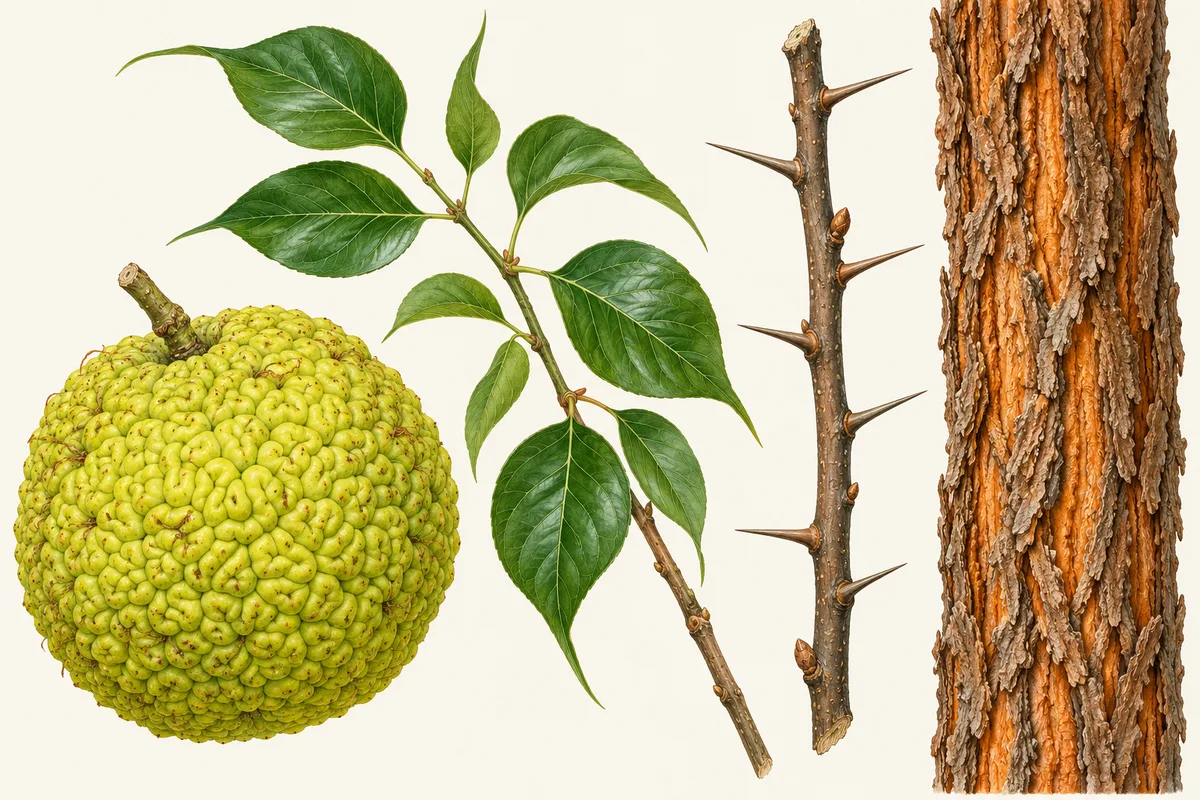
A wrinkled green ball the size of a softball under a thorny, low-crowned tree is the giveaway. When the fruit is missing, the thorns, the milky sap and the bright orange wood still name it.
In short
An Osage orange tree is a thorny, low-branched tree 20 to 60 feet tall whose female trees drop yellow-green, brain-like "hedge apples" 3 to 6 inches across in September and October. Check three things: straight thorns about half an inch long beside the leaf buds, glossy untoothed leaves that bleed milky sap when snapped, and orange-brown bark over bright orange wood.
- Only female trees bear hedge apples; a male Osage orange shows the same thorns, sap and orange bark but never fruits.
- Untoothed, glossy leaves plus milky sap separate it from mulberry, whose leaves are toothed.
- Its native range is small (the Red River country of Oklahoma, Texas and Arkansas), but it was planted as hedges in all 48 conterminous states.
Field marks at a glance
- Scientific name
- Maclura pomifera
- Family
- Moraceae (mulberry family)
- Type
- Broadleaf, deciduous
- Fruit
- On female trees only: a yellow-green, wrinkled, brain-like ball 3 to 6 inches (7.5 to 15 cm) across, often over 2 pounds (1 kg). Ripens and falls September to October. Bruised fruit oozes a sticky, bitter, milky juice.
- Leaves
- Alternate, simple, egg-shaped to lance-shaped, about 3 to 6 inches long, untoothed, shiny dark green above and paler below. Yellow in fall.
- Thorns
- Stout, straight thorns about 1/2 to 1 inch long in the leaf axils of sunlit shoots; shaded, slow-growing twigs can be thornless.
- Sap
- Milky from broken leaf stalks, twigs and fruit; it can irritate skin.
- Bark
- Orange-brown to gray-brown, deeply furrowed into rounded, interlacing ridges that can peel in long strips. Exposed roots and cut wood are bright orange.
- Flowers
- Tiny and green, in round clusters about 1 inch across, May to June. Male and female flowers grow on separate trees.
- Size and form
- Usually 20 to 40 feet, sometimes 60 to 70 feet; a short, often crooked trunk and a low, wide, spreading crown.
- Range
- Native to the Red River drainage of Oklahoma, Texas and Arkansas and parts of central Texas; planted as hedges in all 48 conterminous states and southeastern Canada.
The Osage orange is the tree behind the "hedge apples" that turn up on fall sidewalks across the Midwest and South: heavy, lime-green, wrinkled balls with nothing else quite like them. It is also one of the easiest trees to name once you know its thorns, sap and orange wood, which matters, because half the trees never fruit. Never eat a fruit, nut or seed on the strength of a web page or an app; check with a local expert.
The fastest checks for an Osage orange tree
- The fruit. A yellow-green ball 3 to 6 inches (7.5 to 15 cm) across with a deeply wrinkled, brain-like skin. The USDA Forest Service says it often weighs over 2 pounds (1 kg) and ripens from September through October. Bruise it and it oozes a bitter milky juice that blackens as it dries. No other North American tree drops anything like it.
- The thorns. Shoots growing in full sun carry sharp, stout, straight thorns 1/2 to 1 inch (1.3 to 2.5 cm) long, one beside each leaf. Twigs in deep shade can lack them.
- The sap. Snap a leaf stalk or a green twig. Osage orange bleeds white, milky sap, like its relatives the mulberries.
- The leaves. Alternate, simple and egg-shaped with a long point, 3 to 6 inches long, glossy dark green above and paler below, with no teeth. The Missouri Department of Conservation notes that they are widest below the middle, with hairs along the veins underneath.
- The bark and wood. Orange-brown bark in rounded, interwoven ridges that may peel in long strips. Where roots are exposed or a branch has been cut, the wood is bright golden orange.
Two of those five are enough in practice: thorns plus milky sap, or the fruit alone.
Male and female trees
Osage orange is dioecious. Male and female flowers grow on separate trees, both tiny and green in round clusters about an inch across, appearing from May to June after the leaves. Only female trees grow hedge apples. The Forest Service notes that a female with no male nearby can still set fruit, but without seed.
That means a large share of Osage oranges never fruit, and those are usually the ones people struggle to name. A fruitless tree with thorns, milky sap, untoothed glossy leaves and orange bark is a male Osage orange. Nurseries also sell male, largely thornless cultivars; NC State Extension lists 'Park', 'White Shield' and 'Wichita', and the Morton Arboretum describes 'White Shield' as fruitless with few to no thorns. Iowa State adds that no cultivar has been found that is completely thornless.
Where Osage orange grows and why it is everywhere
The native range is small: the Red River drainage of Oklahoma, Texas and Arkansas, plus the Blackland Prairies, Post Oak Savannas and Chisos Mountains of Texas. Yet the Forest Service reports that it was planted as a hedge in all 48 conterminous states and in southeastern Canada.
The reason is fencing. Before barbed wire, prairie farmers planted Osage orange in rows and cut it back to make thorny living fences; the Forest Service says hedges around every quarter-section were common, and credits the hedges with leading directly to the invention of barbed wire. Many old hedgerows still stand along field edges in Kansas, Missouri, Iowa, Illinois and Ohio, which is why the tree so often appears in straight lines along fences rather than in forests. The Missouri Department of Conservation lists fencerows, pastures, woodland edges, thickets and stream valleys as its usual places, and says it was introduced throughout Missouri long ago, possibly by Native Americans.
The Morton Arboretum notes that it suckers freely and is considered invasive in some areas of the United States.
Wood, bows and dye
Osage orange wood is the reason for most of its names. The Missouri Department of Conservation calls it the premier bow wood of North America, and the French name bois d'arc ("bow wood", Americanized as bodark) records that use. The Forest Service rates the heartwood the most decay-resistant of all North American timbers and immune to termites, and reports that about 3 million posts were sold annually in Kansas in the early 1970s.
Iowa State University Extension describes the wood as golden yellow or bright orange when freshly cut, turning brown with exposure, and extremely hard, heavy and durable; a bright yellow dye can be extracted from it. For a firewood pile or an old fence post, that orange color is the quickest confirmation. See identifying trees for firewood for other woods by color and grain.
Hedge apples: myths and cautions
Hedge apples are widely placed in basements to keep spiders away. Iowa State tested the idea: chemicals extracted from the fruit did repel German cockroaches, mosquitoes and houseflies, and sliced fruit worked in small enclosed spaces, but the university found no evidence that whole fruit placed around a house affects pests and does not recommend it. The Missouri Department of Conservation also says the fruit is unlikely to repel spiders or insects indoors.
On safety, stick to what the sources state. The milky sap and fruit juice can irritate the skin (USDA Forest Service, Iowa State, Missouri Department of Conservation). Iowa State notes that the fruit was once suspected of poisoning livestock, that studies in several states were negative, but that a fruit can lodge in a cow's or other ruminant's esophagus and kill it. Most birds and animals find the fruit unpalatable; the Missouri Department of Conservation notes that squirrels tear it open for the seeds. And the thorns are a real hazard when pruning or mowing.
Telling it from look-alikes
The fruit has no real look-alike, but a fruitless tree does. Mulberry is the closest: same family, same milky sap, sometimes the same orange-tinged bark. But mulberry leaves are toothed and often lobed or mitten-shaped, and the twigs never carry thorns; see the mulberry page. Honey locust and black locust are the other thorny trees of fencerows, but both have compound leaves and bean-like pods, and neither has milky sap; the tree with thorns guide sorts them by thorn type.
People also mix up the fruit itself with other green balls in summer, such as young sweetgum and sycamore balls or black walnuts in their husks. The tree with green balls guide covers them by size and texture, and the tree with spiky balls guide handles the prickly ones.
When a photo helps
Tree Identifier names a tree from one photo of the fruit, a leaf, the bark or the whole tree, and a hedge apple on the ground beside a leaf makes an easy picture. Osage orange is not one of the 138 species in the app's Collection, so the result is saved in your History and Wild Discoveries. The app does not show a confidence score or a look-alike list, so check the result against the thorns and sap. Tree Identifier's follow-up chat can answer questions such as how hedgerow Osage orange was managed, and the Tree Map remembers where a fruiting female stands so you can find it again next fall.
Look-alikes and how to tell them apart
Red and white mulberry (Morus rubra, M. alba)
Mulberries also bleed milky sap, but their leaves are toothed and often lobed or mitten-shaped, the twigs have no thorns, and the fruit is a soft, blackberry-like cluster about an inch long, not a hard ball.
Honey locust (Gleditsia triacanthos)
Honey locust thorns grow on the trunk as well as the twigs, are up to 3 inches long and often branched; its leaves are feather-like and compound, its fruit a flat, twisted pod 10 to 18 inches long, and its sap is not milky.
Black locust (Robinia pseudoacacia)
Black locust carries a pair of short spines, 1/4 to 1/2 inch, at the base of each leaf instead of a single thorn, has compound leaves with 11 to 19 oval leaflets and flat pods, and lacks milky sap.
Sycamore and sweetgum (fruit only)
Their summer balls are green too, but a sycamore ball is under about an inch and fuzzy, and a sweetgum ball is covered in points; an Osage orange fruit is 3 inches or more, smooth-wrinkled and heavy.
What a photo can't settle
- A male tree or a female out of fruit has to be named from thorns, sap, leaves and bark; a photo of leaves alone can be mistaken for several smooth-leaved trees.
- Thornless cultivars and shade-grown twigs remove the thorn clue, and Iowa State notes that no cultivar is completely thornless.
- Osage orange is not in Tree Identifier's 138-species Collection, so a correct identification appears in History and Wild Discoveries rather than filling a Collection slot.
Questions people ask
Why does my Osage orange tree have no fruit?
It is probably a male tree. Osage orange is dioecious: male and female flowers grow on separate trees, and only females produce hedge apples. Nurseries sell thornless, fruitless male cultivars such as 'White Shield', 'Wichita' and 'Park' for that reason.
Do hedge apples keep spiders and insects out of the house?
Probably not. Iowa State University found that chemicals extracted from the fruit repelled some insects in small, closed spaces, but says there is no evidence that whole fruit placed around a house affects pests, and does not recommend hedge apples for pest control. The Missouri Department of Conservation reaches the same conclusion.
Are hedge apples poisonous?
Sources do not call the fruit poisonous, but none call it food either. The milky juice can irritate skin, and Iowa State notes that a whole fruit can lodge in the throat of cattle and other ruminants and kill them. Never eat a fruit on the strength of a web page or an app.
Is Osage orange the same as a hedge apple tree or bois d'arc?
Yes. Hedge apple, hedge, bois d'arc, bodark and bowwood are all names for Maclura pomifera. Bois d'arc is French for bow wood, from the Osage people's use of its branches for bows.
Is Osage orange related to oranges?
No. Despite the name, it belongs to the mulberry family, Moraceae, not the citrus family. The fruit is a multiple fruit made of many one-seeded parts fused into a ball, closer in structure to a mulberry than to an orange.
Sources
- Osage-Orange (Maclura pomifera), Silvics of North America — USDA Forest Service
- Maclura pomifera (Osage-orange) — North Carolina Extension Gardener Plant Toolbox, NC State University
- Osage Orange — Missouri Department of Conservation, Field Guide
- All About Hedge Apples — Iowa State University Extension and Outreach, Yard and Garden
- Osage-orange — The Morton Arboretum
Keep reading
- Clue guideWhich tree has green balls? Sort it by the size of the ball
- Clue guideWhich tree has spiky balls? Six candidates and how to tell them
- Tree profileMulberry (Morus): how to identify it
- Clue guideWhich tree has thorns? Look at where they grow
- Field guideTree seed identification: from acorn, pod or samara to the tree