Tree profile
Elder tree (Sambucus nigra): how to identify it
A small, scruffy hedgerow tree with corky bark, opposite leaves that smell when bruised, flat plates of cream flowers from late May and hanging bunches of purple-black berries.
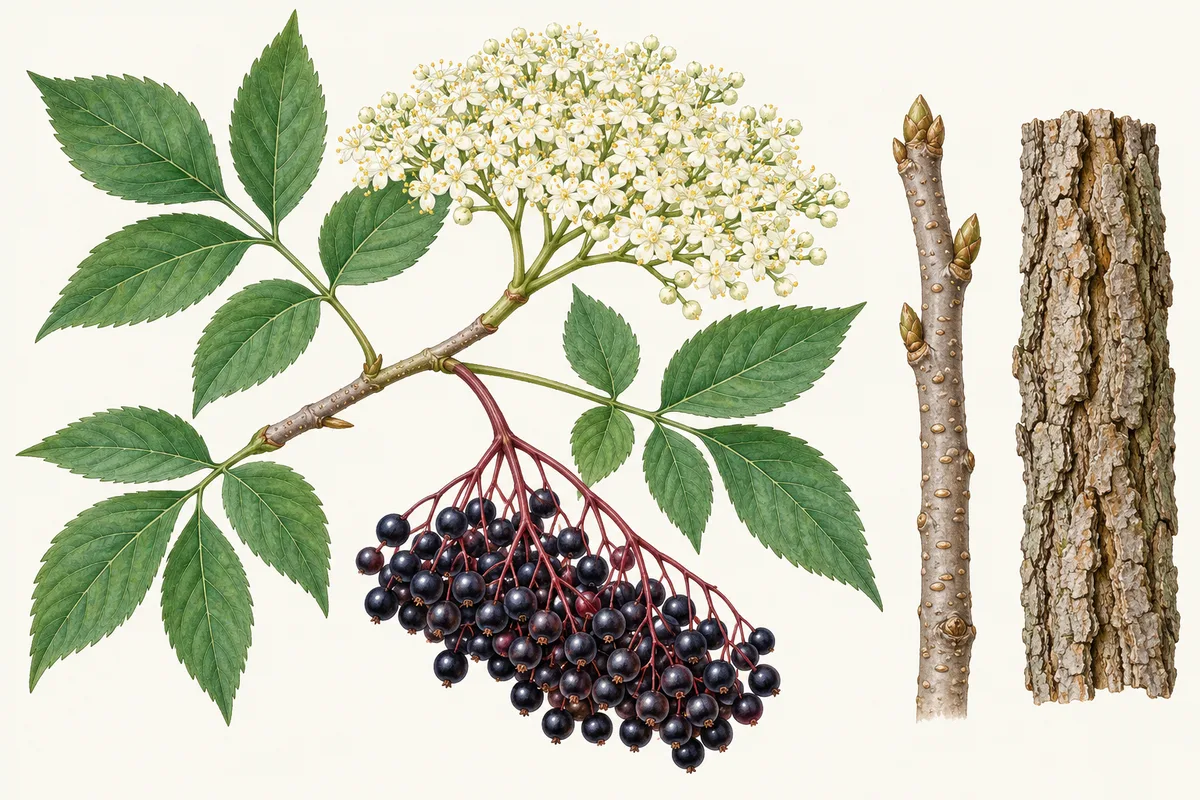
In short
Elder tree identification starts with the leaf: opposite pairs of feather-like leaves, each with about 5 to 7 oval, toothed leaflets that smell unpleasant when crushed. From late May, creamy five-petalled flowers open in flat plates 10 to 30 cm across, followed by purple-black berries in late summer. Snap a twig: elder has a soft white pith inside and grey-brown, corky bark outside.
- Opposite, feather-like leaves on a small tree with corky bark and a white-pithed twig point to elder; ash shares the opposite leaves but has black buds.
- Elderflower and elderberry are the flower and fruit of the same plant, Sambucus nigra, in Britain and Europe.
- The Woodland Trust says uncooked berries and other parts of Sambucus plants are poisonous: never eat a berry because a web page or an app named the tree.
Field marks at a glance
- Scientific name
- Sambucus nigra
- Family
- Viburnaceae (formerly Adoxaceae; the elder or moschatel family)
- Type
- Broadleaf, deciduous
- Leaves
- Opposite, pinnate (feather-like), with 5 to 7 oval, toothed leaflets per leaf in the Woodland Trust's description; NC State gives 3 to 9 leaflets on a leaf up to about 25 cm (10 in). They smell unpleasant when crushed.
- Flowers
- Tiny, creamy-white, five-petalled and strongly scented, in large flat-topped plates 10 to 30 cm across; generally from late May into summer.
- Berries
- Small, glossy, purple-black, about 9 mm (3/8 in) across in NC State's description, in heavy drooping bunches; ripen from late summer into autumn.
- Bark
- Grey-brown, corky and furrowed, on a short trunk with relatively few branches.
- Twigs and buds
- Green, foul-smelling twigs that are hollow or filled with soft white pith; ragged-looking buds, often with leaves showing through the bud scales.
- Size and lifespan
- Usually a large shrub or small tree; the Woodland Trust gives mature trees around 15 m and a lifespan of about 60 years. Spreads by suckers into thickets.
- Where
- Widespread across the UK in woodland, scrub, wasteland and hedgerows, often near rabbit warrens and badger setts where animals spread the seed.
- Names
- Elder, black elder, European elder, elderberry; old names include bour-tree or boretree. In North America the native plant is American elderberry (Sambucus canadensis).
Elder is the untidy small tree of British hedgerows, waste ground and woodland edges: a short, leaning trunk with corky bark, a few long arching branches, flat plates of cream flowers in early summer and drooping bunches of purple-black berries by autumn. It is easy to name once you know three checks: the leaf arrangement, the flowers or berries, and the twig.
Never eat a berry, nut, seed or pod on the strength of a web page or an app; check with a local expert. The Woodland Trust states that uncooked elder berries and other parts of Sambucus plants are poisonous.
How to identify an elder tree in four checks
1. Opposite, feather-like leaves. Elder leaves are pinnate: a central stalk carries pairs of oval, toothed leaflets with one at the tip. The Woodland Trust describes 5 to 7 leaflets per leaf, and the leaves sit in opposite pairs on the twig. NC State's black elder profile allows 3 to 9 leaflets on leaves up to about 25 cm (10 in) long. Crush a leaflet: both sources note an unpleasant smell.
2. Flat plates of cream flowers. From late May, elder carries flat-topped heads 10 to 30 cm across, made of hundreds of tiny, creamy, five-petalled flowers with a strong scent. Hawthorn and rowan also flower white in late spring, but rowan's leaves alternate along the twig and hawthorn's are lobed, so the opposite, feather-like leaves under the flower plates still point to elder.
3. Purple-black berries. Each flower becomes a small, glossy, purple-black berry, about 9 mm (3/8 in) across in NC State's description, ripening from late summer into autumn in heavy bunches that weigh the branches down. Birds and small mammals, dormice and bank voles among them, eat them, according to the Woodland Trust.
4. Corky bark and a white-pithed twig. The trunk is short, with grey-brown, corky, furrowed bark. Snap a young twig: it is green, smells unpleasant, and is hollow or packed with soft, white, spongy pith. Trees for Life notes that instrument makers removed this pithy core to make whistles and pipes.
Tree Identifier can name elder from one photo of the leaves, the flower plates, the berries or the bark. The app shows no confidence score and no look-alike list, so check the opposite leaf pairs yourself before you accept the name.
Elder through the year
- Winter: bare, with opposite pairs of ragged-looking buds, often with leaves already showing through the scales; green, hollow or pithy twigs; corky bark. The Woodland Trust lists the smelly, pithy twigs as the winter giveaway.
- Spring: the young leaves push out of those loose buds in opposite pairs; the Woodland Trust's Nature's Calendar survey asks the public to record elder budburst.
- Late May to July: the cream flower plates. In a hedge they stand out from a distance as flat white discs held above the leaves.
- Late summer and autumn: drooping bunches of purple-black berries, often stripped by birds. A Woodland Trust caption notes leaves turning red in autumn, though many simply yellow or drop.
Elder grows fast and throws up suckers, so it often forms a thicket rather than a single tree. NC State describes it reaching 2.5 to 6 m (8 to 20 ft) in gardens; the Woodland Trust gives around 15 m for mature trees in Britain and a lifespan of about 60 years.
Where you find elder in Britain and Ireland
The Woodland Trust describes elder as widespread across the UK, in woodland, scrub, wasteland and hedgerows, and often near rabbit warrens or badger setts, where the animals spread the seed in their droppings. In the Scottish Highlands it is less common: Trees for Life says it is confined there to pockets of deeper, richer soils, and its Gaelic names, ruis and droman, are rare in place names.
Elder is also a garden plant. The Woodland Trust notes many cultivated varieties with different coloured foliage and flowers, and NC State lists forms such as 'Black Lace', with dark, finely divided leaves, and cream-edged variegated forms. A dark-leaved or cream-edged elder in a border is usually one of these; its flower plates and opposite leaves are the same as the wild tree's.
In North America, the native plant is American elderberry (Sambucus canadensis). NC State's American elderberry profile describes a multi-stemmed shrub 1.5 to 3.5 m (5 to 12 ft) tall with 5 to 11 sharply toothed leaflets, usually 7, a white pith, creamy flowers in June and purple-black fruit in August and September. The checks on this page work for both.
Elder look-alikes: ash, rowan, walnut and two name traps
Ash is the look-alike that catches careful people, because both have opposite, pinnate leaves. The Woodland Trust ash profile gives 3 to 6 opposite pairs of leaflets plus one at the tip, black velvety buds, flattened smooth twigs and winged keys in late summer. Elder has no black buds, its twigs are green and pithy, and it carries flowers or berries instead of keys. Our ash page covers the other ashes.
Rowan has feather-like leaves too, but they alternate along the twig, and its berries ripen bright red in August. The rowan page has the details. Walnut is the Woodland Trust's named look-alike: its leaves are alternate, elder's opposite.
Two trees share only the name. Box elder (Acer negundo) is a maple with compound leaves of 3 to 7 leaflets and paired winged seeds; see the box elder page. Alder is a riverside tree with simple, racquet-shaped leaves and small woody cones that, the Woodland Trust's alder profile notes, stay on the tree all year.
If you find a good flowering elder and want to note it, Tree Identifier's Tree Map keeps each identification you save with its location, and the follow-up chat under a result can answer questions about the tree's parts and seasons. For the other small trees of British hedgerows, see the guide to tree identification in the UK.
Look-alikes and how to tell them apart
Ash (Fraxinus excelsior)
Ash also has opposite, pinnate leaves, so check the buds and bark: ash has black, velvety buds and smooth grey twigs, grows to 35 m, and carries winged keys rather than berries. Elder twigs are green with white pith and the bark is corky.
Rowan (Sorbus aucuparia)
Rowan's pinnate leaves sit alternately along the twig, one per node, with 5 to 8 pairs of finely toothed leaflets, and its berries ripen bright red in August. Elder's leaves are in opposite pairs and its berries are purple-black.
Walnut (Juglans regia)
The Woodland Trust names walnut as the look-alike: walnut leaves are alternate, elder's are opposite. Walnut also lacks elder's flat cream flower plates and bunches of purple-black berries.
Box elder (Acer negundo)
Despite the name, box elder is a maple: opposite leaves of only 3 to 7 leaflets, often lobed, and paired winged seeds in drooping clusters instead of flat flower plates and berries.
Alder (Alnus glutinosa)
Only the name is similar. Alder has simple, racquet-shaped leaves 3 to 9 cm long with no leaflets, and small woody cone-like catkins that stay on the tree all year.
What a photo can't settle
- A photo of leaves alone can mix up elder, ash and young rowan; the leaf arrangement on the twig (opposite or alternate) is easier to check in person than in a picture.
- Garden cultivars with purple, golden or finely cut leaves look very different from wild elder; flowers and berries settle it more reliably than foliage.
- No app or web page can tell you whether berries are safe to eat; identification here is for naming the tree only.
Questions people ask
Is an elder tree the same as an elderberry?
Yes. In Britain and Europe, elder, elderberry and elderflower all refer to Sambucus nigra: elderflower is the flower, elderberry the fruit. North Americans usually say elderberry for their native shrub, American elderberry (Sambucus canadensis), which NC State describes with 5 to 11 leaflets, usually 7, and fragrant creamy flowers in June.
Are elder berries poisonous?
The Woodland Trust says the uncooked berries and other parts of plants in the genus Sambucus are poisonous, and Trees for Life calls the leaves and uncooked berries slightly toxic. NC State lists cyanide-inducing glycosides. Never eat any berry on the strength of a web page or an app; check with a local expert.
How do I identify an elder tree in winter?
Look at the twigs. The Woodland Trust describes them as green and unpleasant-smelling, hollow or filled with white spongy pith, with ragged buds that often show leaves through the scales. Add the opposite bud pairs and the grey-brown, corky bark and few other UK trees fit.
What is the difference between elder and alder?
They are unrelated trees with similar names. Elder has opposite, feather-like leaves, flat cream flower plates and purple-black berries. Alder, a riverside tree in the birch family, has simple, racquet-shaped leaves, catkins from February to April and small woody cones that stay on the tree all year.
Why does my elder have purple or cut leaves?
It is probably a garden cultivar. The Woodland Trust notes many cultivated varieties with different coloured foliage and flowers, and NC State lists forms such as 'Black Lace', with dark, deeply divided leaves, and variegated forms with cream edges. The flowers, berries and opposite leaves still identify the plant as elder.
Sources
- Elder (Sambucus nigra) — Woodland Trust
- Elder tree facts and information — Trees for Life
- Sambucus nigra (Black Elder, European Elderberry) — NC State Extension Gardener Plant Toolbox
- Sambucus canadensis (American Elderberry) — NC State Extension Gardener Plant Toolbox
- Ash (Fraxinus excelsior) — Woodland Trust
- Alder (Alnus glutinosa) — Woodland Trust
Keep reading
- Field guideTree identification in the UK: British trees by leaf, bark and picture
- Tree profileRowan tree (mountain ash): how to identify it
- Tree profileAsh trees (Fraxinus): how to identify them
- Tree profileBoxelder (Acer negundo): how to identify it
- Clue guideWhich tree has white flowers? Start with the month