Also in Deutsch
Tree profile
Sumac trees: how to identify staghorn, smooth and poison sumac
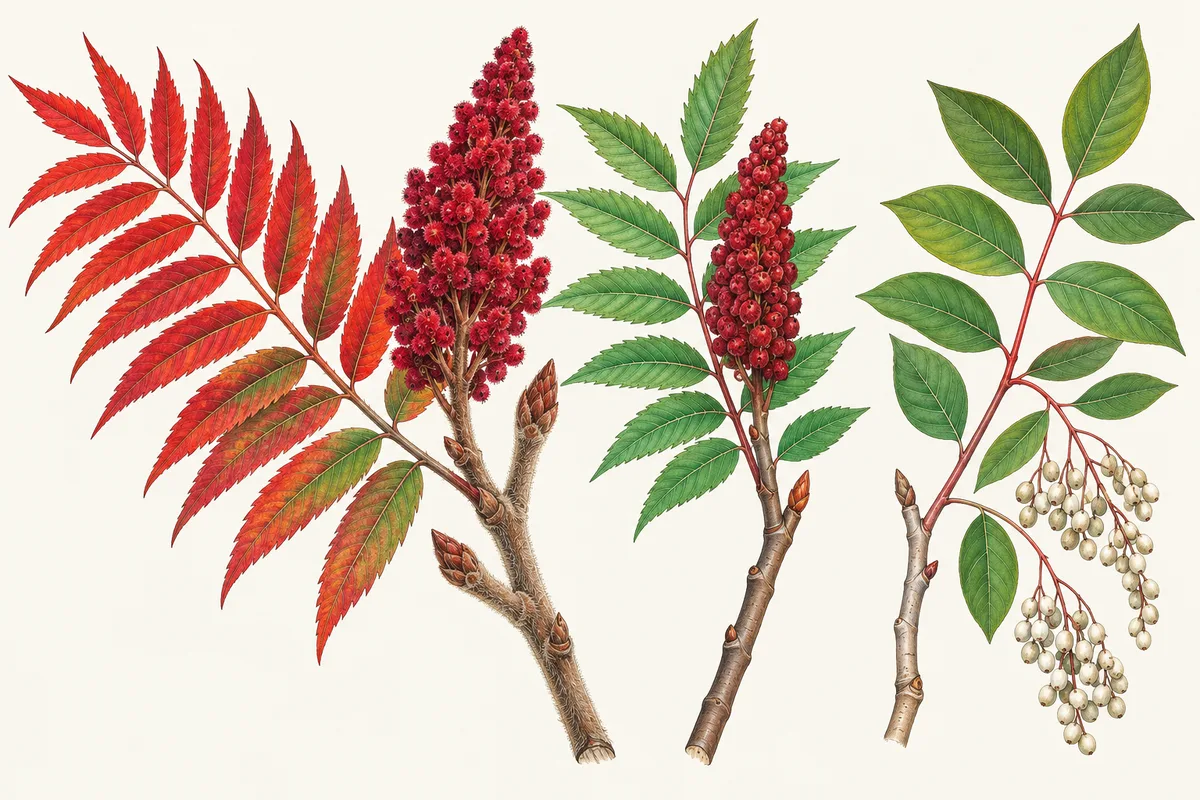
Red, upright fruit clusters mean a true sumac. Hanging white berries on a shrub in a swamp mean poison sumac, which you should never touch.
In short
Sumac tree identification starts with the fruit: staghorn, smooth and shining sumac carry upright, cone-shaped clusters of fuzzy red berries at the branch tips. Staghorn sumac has velvety twigs, smooth sumac hairless twigs, shining sumac a winged leaf stalk. Poison sumac has loose, hanging clusters of whitish berries, smooth-edged leaflets and grows in wet ground; never touch it.
- Red, upright fruit clusters at the branch tips point to the common sumacs; hanging white or yellowish berries point to poison sumac.
- Poison sumac contains urushiol, the oil in poison ivy; NC State Extension reports that all parts cause skin rashes and that smoke from burning it is dangerous to breathe.
- Tree of heaven has similar long leaves but smooth leaflets with one or two gland-tipped teeth at the base and twisted, winged seeds.
Field marks at a glance
- Scientific name
- Rhus (and poison sumac, Toxicodendron vernix)
- Family
- Anacardiaceae (cashew family)
- Type
- Broadleaf, deciduous
- Leaves
- Alternate, pinnately compound, up to 2 ft long in staghorn sumac, with 7 to 31 lance-shaped leaflets depending on the species.
- Fruit
- Common sumacs: small, round, fuzzy red drupes about 1/8 inch, packed in dense, upright clusters at the branch tips that persist into winter.
- Staghorn sumac
- Twigs stout and densely fuzzy, like deer antlers in velvet; leaf stalk fuzzy; 11 to 31 toothed leaflets; shrub or small tree to 25 ft.
- Smooth sumac
- Twigs hairless, often with a bluish bloom; 11 to 31 toothed leaflets; fruit clusters droop when mature; usually 9 to 15 ft.
- Shining sumac
- Leaflets with smooth edges and a winged leaf stalk between them; 7 to 15 leaflets; sticky dark red fruit.
- Poison sumac
- 7 to 13 smooth-edged leaflets on a reddish stalk; whitish berries in hanging clusters from the leaf axils; wet ground. Toxic to touch.
- Form
- Shrubs or small trees that spread by root suckers into thickets, with a wide, open crown.
- Fall color
- Bright scarlet, orange and yellow in the common sumacs; poison sumac also turns orange-red.
Sumacs are shrubs and small trees with long, feather-like leaves and, in late summer, cone-shaped clusters of fuzzy red fruit held upright at the branch tips. Three of them, staghorn, smooth and shining sumac, are common along roadsides, field edges and railway banks across eastern North America. A fourth plant called sumac, poison sumac, grows in swamps and causes a severe skin rash. Here is how to tell them apart, starting with the safety check.
First check: red upright clusters or white hanging berries
1. Look at the fruit. The common sumacs bear small, round, fuzzy red drupes about 1/8 inch across, packed into dense, upright clusters at the ends of the branches that stay on into winter (Virginia Tech, staghorn sumac). Poison sumac bears small round fruit, shiny green at first and then whitish, 1/4 to 1/3 inch across, in loose clusters that hang from the leaf axils along the stem (Virginia Tech, poison sumac).
2. Look at the ground. NC State Extension describes poison sumac growing mainly in bogs, marshes, swamps and thickets along riverbanks, in acidic soil (Plant Toolbox). Staghorn and smooth sumac prefer well-drained ground and do poorly in wet soil.
3. Look at the leaflet edges. Staghorn and smooth sumac leaflets are toothed. Poison sumac leaflets have smooth (entire) edges, 7 to 13 per leaf, on a stalk that is often reddish.
If the fruit hangs, the leaflets are smooth and the plant stands in wet ground, treat it as poison sumac and do not touch it. NC State reports that all parts of poison sumac contain urushiol, the same toxin as poison ivy and poison oak, causing skin redness, itching, blistering and swelling, and that inhaling smoke from burning it can cause dangerous lung inflammation. Wash skin, clothing and tools with soap and water after any contact.
Staghorn sumac: velvet twigs
Staghorn sumac (Rhus typhina) is named for its twigs: stout, brown and very fuzzy, resembling a deer's antlers in velvet (Virginia Tech). Its leaves are the largest of the group, 16 to 24 inches long, with 11 to 31 lance-shaped, toothed leaflets 2 to 5 inches long on a fuzzy leaf stalk. The flowers are small and yellow-green, in upright clusters up to 8 inches long in midsummer, followed by the red fruit.
It grows as a shrub or small tree to about 25 feet, with a short, often crooked trunk and an open crown whose branches fork repeatedly. NC State Extension gives its native range from Quebec and Ontario to Minnesota, south to Georgia, Indiana and Iowa, on woodland edges, roadsides, railroad embankments and stream margins, and notes that it forms thickets by root suckers. Cutleaf garden forms such as 'Laciniata', with fern-like foliage, and golden 'Tiger Eyes' are widely planted (NC State, staghorn sumac).
Smooth sumac: hairless twigs with a bloom
Smooth sumac (Rhus glabra) looks like staghorn sumac without the fuzz. Its twigs are stout, hairless and often coated with a bluish, waxy bloom; its leaves are 12 to 18 inches long with 11 to 31 toothed leaflets, paler and finely hairy beneath (Virginia Tech, smooth sumac). The fruit clusters typically droop as they mature in fall.
It is smaller, up to 10 feet by Virginia Tech's description and 9 to 15 feet by NC State's, and far more widespread: NC State describes it as appearing in every state and parts of Canada, in disturbed areas, open woods, prairies, dry rocky hillsides and canyons. Like staghorn sumac it spreads by suckers into dense colonies, and both turn bright orange to red in fall, which is when most people notice them; our red fall leaves guide covers the trees that color at the same time.
Shining sumac: the winged leaf stalk
Shining or winged sumac (Rhus copallinum) is the one to check carefully, because its leaflets have smooth edges like poison sumac. The difference is on the leaf stalk: shining sumac's carries prominent wings of leaf tissue between the leaflets. Its leaves are shorter, up to 12 inches, with 7 to 15 shiny, dark green leaflets, and its fruit is dark red and covered with short, sticky red hairs, in upright clusters (Virginia Tech, shining sumac). It reaches about 25 feet.
Poison sumac in detail
Poison sumac (Toxicodendron vernix) is a native shrub or small tree of eastern Canada and the east-central and eastern United States, up to 15 feet by Virginia Tech's measure and 25 feet by NC State's. NC State's quick ID features are long, smooth-edged, alternate leaves with 7 to 13 leaflets; red stems or leaf stalks; black sap from the trunk; and wet or flooded ground. Virginia Tech adds stout, hairless, orange-brown twigs with large shield-shaped leaf scars, smooth gray-brown bark speckled with dark lenticels, and fruit in hanging clusters that stay on the plant.
NC State also notes that poison sumac resembles a young ash tree, but ash leaves grow in opposite pairs and ash fruits are winged samaras; the ash page shows the opposite leaf arrangement. In fall its leaves turn a brilliant orange-red, the season when people are most tempted to pick a branch. Don't.
Sumac vs tree of heaven
Tree of heaven (Ailanthus altissima) is the invasive tree most often mistaken for sumac, and Virginia Tech lists smooth and poison sumac among its look-alikes. Its leaves are longer, 1 to 3 feet with 11 to 41 leaflets, and each leaflet is smooth-edged except for one or two large glandular teeth near the base (Virginia Tech, tree-of-heaven). Broken twigs have a strong odor. Instead of red upright fruit it carries twisted, winged seeds 1 to 1 1/2 inches long in hanging clusters, and it grows into a real tree, up to 70 feet. Our tree of heaven page has the full leaflet-gland test, and our invasive trees guide lists tree of heaven with the other invasives.
When a sumac-like plant is out of reach or you don't want to touch it, a photo of the leaf and fruit cluster from a step away is enough for Tree Identifier to suggest a name, and the follow-up chat can answer questions about that species. Treat the result as a lead to check against the fruit, leaflet and habitat tests above.
Look-alikes and how to tell them apart
Tree of heaven (Ailanthus altissima)
Each tree of heaven leaflet is smooth-edged except for one or two large gland-tipped teeth near its base, and the tree bears hanging clusters of twisted, winged seeds, never red upright fruit. Crushed leaves smell strongly unpleasant.
Ashes (Fraxinus)
Ash leaves grow in opposite pairs on the twig; every sumac, poison sumac included, has alternate leaves. NC State Extension names this the way to tell poison sumac from a young ash.
Shining sumac vs poison sumac
Both have smooth-edged leaflets. Shining sumac has wings of leaf tissue along the leaf stalk between the leaflets and upright clusters of sticky red fruit; poison sumac has no wings and hanging clusters of whitish fruit.
What a photo can't settle
- Staghorn and smooth sumac are usually dioecious, so only female plants carry fruit clusters; a male or young plant must be named from twigs, leaflets and habitat.
- Cutleaf and golden garden forms such as 'Laciniata' and 'Tiger Eyes' change the leaf shape and color, so a photo of a planted sumac may not settle the species.
- Tree Identifier gives one name from one photo, with no confidence score and no look-alike list. If you suspect poison sumac, photograph it from a distance and do not handle it to get a better picture.
Questions people ask
How can you tell poison sumac from regular sumac?
Look at the fruit and the ground. Staghorn, smooth and shining sumac hold fuzzy red berries in upright clusters at the branch tips and grow on dry or disturbed ground. Poison sumac has whitish berries in loose, hanging clusters from the leaf axils, smooth-edged leaflets, and grows in swamps, bogs and wet thickets.
Is sumac poisonous to touch?
Poison sumac is: NC State Extension reports that all parts contain urushiol, the oil in poison ivy, which causes redness, itching, blistering and swelling. NC State describes staghorn sumac, a red-fruited Rhus, as not poisonous, but if you are not sure which sumac you have, do not touch it.
How do you tell staghorn sumac from smooth sumac?
Feel a twig. Staghorn sumac twigs are stout and densely fuzzy, like a deer's antler in velvet, and its leaf stalks are fuzzy too. Smooth sumac twigs are hairless, often with a bluish bloom. Staghorn sumac also grows taller, to about 25 feet, while smooth sumac usually stays under 15 feet.
How do you tell sumac from tree of heaven?
Check the leaflet edges and the fruit. Staghorn and smooth sumac leaflets are toothed all the way along; tree of heaven leaflets are smooth except for one or two glandular teeth at the base. Sumacs bear upright red fruit clusters; tree of heaven bears hanging clusters of twisted, winged seeds.
Can you eat sumac berries?
This page does not give edibility advice. Poison sumac is toxic, and a red-fruited sumac and poison sumac can grow in the same region. Never eat any berry from a plant you have identified from a photo or a web page.
Sources
- Staghorn sumac fact sheet — Virginia Tech Dendrology
- Smooth sumac fact sheet — Virginia Tech Dendrology
- Shining sumac fact sheet — Virginia Tech Dendrology
- Poison sumac fact sheet — Virginia Tech Dendrology
- Toxicodendron vernix (Poison Sumac, Swamp Sumac, Thunderwood) — NC State Extension, Plant Toolbox
- Rhus typhina (Staghorn Sumac) — NC State Extension, Plant Toolbox
- Rhus glabra (Smooth Sumac) — NC State Extension, Plant Toolbox
- Tree-of-heaven fact sheet — Virginia Tech Dendrology